

Imagine your business had a shopfront on the busiest street in the world. Better yet, imagine that shopfront only appeared to people who were actively looking for exactly what you sell, right at the moment they needed it. That’s Google Ads.
For a small business, it’s not about having the loudest voice; it’s about being in the right place, at the right time, with the right answer. This is how you connect with customers who are ready to pull out their wallets.
Why Google Ads Is Your Digital Storefront

In today's market, you simply have to be visible online. Traditional advertising—think flyers or local paper ads—is like casting a wide, hopeful net. You pay for exposure, but there's no guarantee you're reaching people who are actually interested.
Google Ads completely flips that model. Instead of you searching for customers, it lets customers who are already searching find you.
Think of it like this: Old-school advertising is like throwing a massive net into the ocean and hoping you catch something valuable. Google Ads is like being given a high-tech fish finder that pinpoints exactly where your ideal fish are, what bait they prefer, and the best time to cast your line.
This precision is what makes Google Ads such a potent tool for small businesses. You stop wasting money on people who aren't interested. Every dollar is spent targeting users who have literally raised their hands by typing a specific need into Google.
The Power of Intent-Driven Marketing
The secret ingredient here is intent. Someone driving past your billboard might not need your services. But someone searching for "emergency plumber Adelaide" has an immediate, pressing problem they need to solve. By placing your ad at the top of their search results, you meet them at their moment of need.
This powerful shift hasn't gone unnoticed by Australian businesses. The adoption of Google Ads among small and medium-sized enterprises (SMEs) has skyrocketed. As of 2024, an estimated 65% of Australian SMEs are running active pay-per-click (PPC) campaigns—a huge leap from just 26% in 2016. This shows just how effective the platform is at driving real, tangible results.
Key Advantages for Your Business
For a small business, Google Ads offers three game-changing benefits:
- Unmatched Reach: You get instant access to the millions of Australians who use Google every single day to find products and services.
- Pinpoint Targeting: You can zero in on customers based on their location, age, interests, and—most importantly—the exact keywords they're searching for.
- Measurable Results: Every click, call, and sale can be tracked. You know exactly what’s working and can calculate your Return On Ad Spend (ROAS) to justify every dollar.
Getting a handle on this platform is a direct path to growth. For a fantastic resource that dives deeper, check out this guide on PPC management specifically for small businesses. It’s packed with practical advice on turning those clicks into loyal customers.
2. Match Your Goals to the Right Campaign
Choosing the right Google Ads campaign is like picking the right tool from your toolbox. You wouldn't use a sledgehammer to hang a picture frame, right? In the same way, you shouldn't launch a Shopping campaign if your main goal is to get the phone ringing. Getting this one step right—aligning your campaign with your business goal from the get-go—is the single most important decision you'll make.
Think of each campaign type as a specialist, perfectly trained for a specific job. Before you even think about ads, ask yourself a simple question: "What do I actually want to achieve?" The answer will point you straight to the campaign that’s built to deliver.
Here's a quick guide to help you decide which campaign type is the best fit for your business.
Matching Your Business Goal to the Right Google Ads Campaign
| Business Goal | Recommended Campaign Type | Best For (Business Type) | Primary Metric |
|---|---|---|---|
| Generate leads & online enquiries | Search | Trades, professional services, B2B, clinics | Cost Per Lead (CPL) |
| Sell products online | Shopping | E-commerce stores, online retailers | Return on Ad Spend (ROAS) |
| Increase foot traffic to my shop | Local | Cafes, mechanics, retail stores, dentists | Store visits, direction requests |
| Reach the most customers possible | Performance Max | Businesses with clear conversion goals | Cost Per Acquisition (CPA) |
This table is a great starting point, but let’s dive a little deeper into what makes each campaign tick and who they’re really for.
H3: Get Found by Eager Customers with Search Campaigns
Search campaigns are the bread and butter of Google Ads. These are the classic text ads you see at the top of the search results when you type something into Google. They are incredibly powerful for one simple reason: they capture active demand.
You’re not interrupting someone’s day with an ad they didn’t ask for. You’re putting your business forward as the solution at the precise moment a potential customer is looking for it. It's a game-changer.
- Primary Goal: To generate leads, drive targeted website traffic, and make sales from people actively searching for what you offer.
- Best For: Service businesses like plumbers, lawyers, and consultants. It’s also a go-to for B2B companies—basically, any business where people start their journey by searching for a solution.
Take a conveyancer in Adelaide. They could run a Search campaign targeting phrases like "conveyancing services Adelaide." Their ad shows up right in front of someone with an immediate need, making it one of the most effective ways to land highly qualified leads.
H3: Showcase Your Products with Shopping Campaigns
If you run an e-commerce business, Shopping campaigns are non-negotiable. These are the eye-catching product listings with images, prices, and your brand name that pop up at the top of the search results. Think of them as your digital shop window, grabbing a customer's attention before they've even clicked.
Unlike Search ads, you don't target keywords directly. Instead, Google Ads uses your product data feed from platforms like Shopify or WooCommerce and automatically shows your products for relevant searches.
- Primary Goal: To drive online sales for physical products.
- Best For: Any online retailer, from a boutique selling handmade jewellery to a larger store with thousands of products.
Imagine you're a small Aussie business selling organic dog treats. A Shopping ad lets someone searching for "healthy dog treats" see a photo of your product and its price right away. It massively shortens the path from search to sale.
H3: Drive Foot Traffic with Local Campaigns
For any business that relies on customers walking through the door, Local campaigns are a must. They are designed for one purpose: to drive more in-store visits, phone calls, and requests for directions on Google Maps, Search, and even YouTube.
These campaigns work by showing your business location to people who are physically nearby and searching for what you do. It's the 21st-century version of having the best sign on the high street.
A Local campaign is the bridge between an online search and a real-world customer. It connects the digital world directly to your physical shopfront, making it dead simple for nearby customers to find and visit you.
- Primary Goal: To increase foot traffic to a physical location, whether it’s a shop, clinic, or restaurant.
- Best For: Cafes, dental clinics, mechanics, retail stores, and any other brick-and-mortar business serving a local community.
An electrician in Perth, for example, can use a Local campaign to show up at the top of Google Maps when someone in a nearby suburb searches for "electrician near me." This puts them in direct contact with a customer who needs their help, often urgently.
H3: Maximise Reach with Performance Max
Performance Max (or PMax) is Google's all-in-one, AI-driven campaign type. Think of it as putting Google’s algorithm in the driver’s seat. You feed it your creative assets—text, images, and videos—and tell it your goals, and it runs your ads across the entire Google network. That includes Search, Display, YouTube, Gmail, Discover, and Maps, all from one campaign.
This approach works best when you have very clear conversion goals (like online sales or form submissions) and enough data for the AI to learn what a good customer looks like. It’s powerful, but it requires a bit of trust in automation.
- Primary Goal: To find more converting customers across every single one of Google's channels.
- Best For: Businesses with specific conversion goals who want to cast the widest net possible and let Google's machine learning do the heavy lifting on targeting.
Setting a Smart Budget and Bidding Strategy
It's the million-dollar question for every small business owner dipping their toes into Google Ads: "How much should I actually spend?" It's tempting to pluck a number out of thin air, but your budget shouldn't be a guess. It needs to be a strategic decision tied directly to what you want to achieve.
Think of your ad budget like fuel for a car. You wouldn't throw a few dollars in the tank and expect to drive across the country. You'd figure out the distance and make sure you have enough to get there. Your Google Ads budget is no different—it needs enough fuel to reach your business goals, whether that's ringing phones or online sales.
How to Calculate a Starting Budget
The most common mistake I see is setting a tiny daily budget, like $5 or $10 a day. This starves the Google algorithm of the data it needs to learn what works. You end up with a trickle of clicks but no real results, which quickly leads to the conclusion that "Google Ads doesn't work."
A much smarter way is to work backwards from your goal.
- Step 1: Define Your Goal: What do you want to achieve this month? Let's say you're a plumber aiming for 10 new jobs.
- Step 2: Know Your Numbers: If you know your website converts about 10% of visitors into a lead (that's one lead for every 10 clicks), you'll need 100 clicks to get those 10 leads.
- Step 3: Factor in Click Costs: If the average Cost-Per-Click (CPC) for plumber-related keywords is around $4 AUD, your starting budget is simple maths: 100 clicks x $4 = $400 AUD per month.
This simple calculation gives you a realistic, goal-driven starting point. It turns your ad spend from a vague expense into an investment tied to a tangible business outcome.
Understanding Australian Ad Spend Benchmarks
Of course, costs swing wildly depending on your industry and how competitive it is. In Australia, the average CPC often sits between $2 to $4 AUD. But some industries are a different beast entirely. Legal services can see clicks costing over $10.61 AUD, while a niche e-commerce store might get away with clicks for as little as $1.82 AUD.
For most Aussie small businesses, a monthly budget between $1,000 and $3,000 AUD is a solid starting point. This gives you enough firepower to target valuable keywords and properly test your ads to see what resonates with customers.
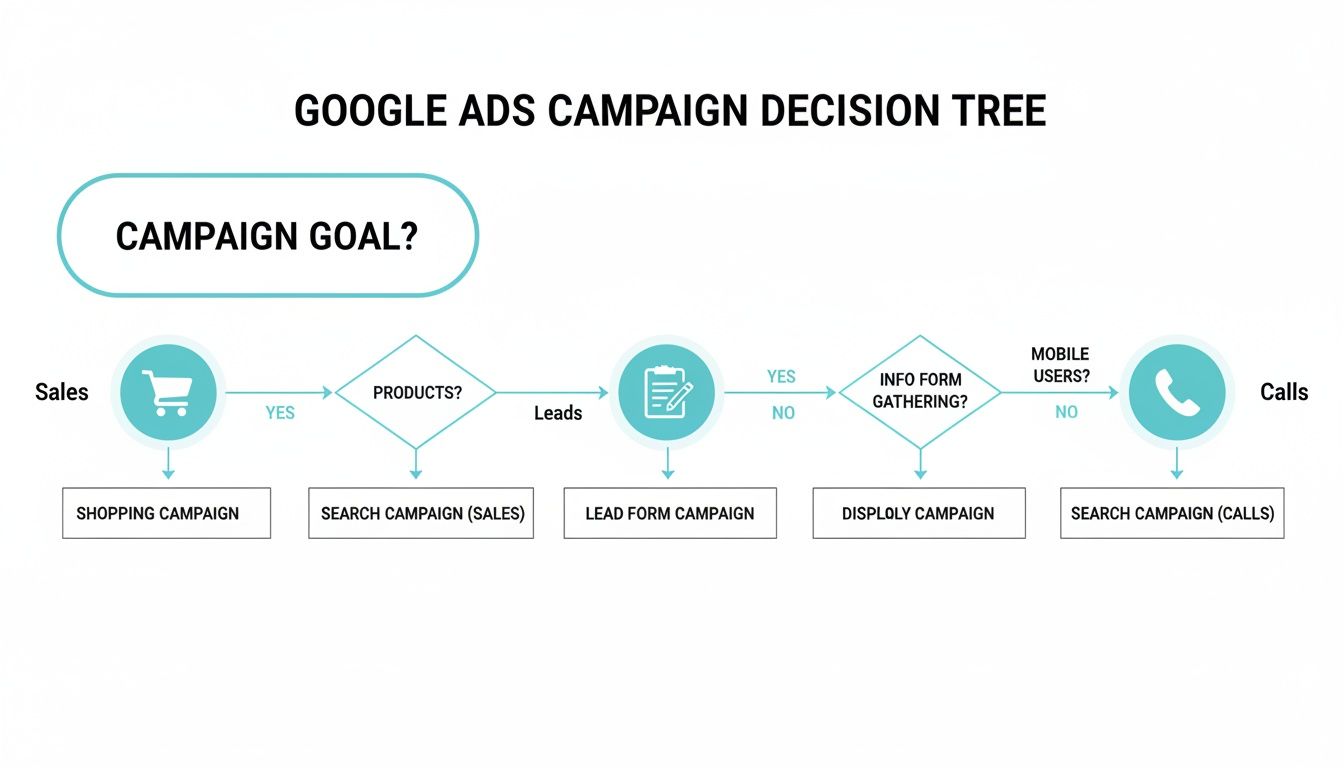
This decision tree is a great visual for mapping your primary goal—sales, leads, or calls—to the Google Ads campaign type that will get you there most effectively.
Let AI Do the Heavy Lifting with Automated Bidding
Once your budget is set, you need to decide how to bid in the ad auction. You could do it manually, but frankly, Google’s automated bidding strategies are a game-changer for busy business owners. They use AI to analyse thousands of signals in real-time—things like the user's device, location, and time of day—to set the perfect bid for every single auction.
Automated bidding is like having a team of data scientists working for you 24/7. Instead of you manually tweaking bids, Google’s AI is constantly working to get you the most bang for your buck.
A fantastic strategy for beginners is Maximize Conversions. You simply tell Google what a "conversion" is for your business—a submitted form, a phone call, a product purchase—and its algorithm will work to get you as many of them as possible within your daily budget.
This approach lets you focus on what you do best: running your business. For a deeper dive into controlling your spend, mastering your Google Ads budget is essential reading. By combining a goal-based budget with a smart bidding strategy, your ad spend stops being an expense and starts becoming a predictable, profit-driving machine.
Finding Your Customers with Keywords and Targeting
A great Google Ads campaign isn't just about throwing money at the wall and hoping something sticks. It’s about precision—getting your message in front of the right person at the exact moment they need you. This is where the real magic happens, powered by a smart mix of keywords and audience targeting.
Think of it like this: keywords are what people are thinking, while audience targeting is who they are. When you nail both, you connect your business with customers who aren't just browsing, but are ready to pull out their wallets.
The Art of Choosing the Right Keywords
Keywords are the absolute foundation of any Search campaign. They're the words and phrases people type into Google when they've got a problem to solve or a need to fill. Your job is to bid on the terms that scream, "I'm looking for a solution you provide!"
But let's be clear: not all keywords are created equal.
To make sense of it, let's use a coffee shop analogy to explain keyword match types. These are simply rules you give Google to control how closely a search needs to match your keyword.
Broad Match (
coffee): This is like someone walking into your cafe and just saying "coffee." Do they want beans? A machine? A flat white? Who knows. Broad match casts a massive net, but you’ll catch a lot of irrelevant clicks and waste your budget fast.Phrase Match (
"buy coffee beans"): This is much clearer. The person has a specific intent, like asking, "Where can I buy coffee beans?" You know what they're after, though their exact wording might vary slightly.Exact Match (
[large flat white]): This is a direct order. The customer knows precisely what they want. In the world of Google Ads, this gives you the most control, showing your ad only to people searching for that exact phrase.
For most small businesses, sticking with Phrase Match and Exact Match is the smartest way to start. It focuses your budget on people with clear buying intent, helping you get a better return right out of the gate.
How to Find High-Intent Keywords
Finding the right keywords isn’t a guessing game; it's about getting inside your customer’s head and using the right tools.
Start with "Seed" Keywords: First, just brainstorm the most obvious terms for what you do. If you're a builder, you’d start with things like "home renovations" or "kitchen builders."
Think Like Your Customer: What would they type in a panic? A customer doesn't just search for "plumber"; they search for "emergency hot water repair Sydney." These longer, more specific phrases—often called long-tail keywords—are absolute gold.
Use Google's Keyword Planner: This free tool inside your Google Ads account is your new best friend. Plug in your seed keywords, and it will spit out hundreds of related ideas, complete with search volume estimates and typical costs per click.
The real goal is to find keywords dripping with commercial intent. Phrases that include words like "buy," "quote," "for sale," "near me," or specific suburb names tell you the user is much further down the path to making a decision.
Going Beyond Keywords with Audience Targeting
While keywords capture what a user wants in the moment, audience targeting adds another layer of precision, letting you define who sees your ads. You can slice and dice your audience based on their demographics, interests, and online behaviour. This is a complete game-changer for stretching your google ads for small business budget.
Here are a few powerful ways to use it:
Demographic Targeting: Show ads based on age, gender, or household income. A financial advisor, for example, could target professionals aged 45-60 in a higher income bracket.
Affinity Audiences: Reach people based on their long-term passions. A local gym could target fitness enthusiasts or people who have shown an interest in marathon running.
In-Market Audiences: This one is incredibly powerful. It lets you target people who Google’s data shows are actively researching and about to buy a product or service just like yours.
Remarketing: This is a non-negotiable tactic. It allows you to show ads specifically to people who have already visited your website. It’s the perfect way to bring back those potential customers who got distracted and didn't convert the first time.
Imagine a local builder in Melbourne. With keywords, they can target "bathroom renovations Melbourne." But by adding audience targeting, they can show their ads only to homeowners in specific postcodes who have recently been browsing websites for tiles and bathroom fixtures. That’s the kind of laser-focus that turns a good campaign into a great one.
7. Crafting Ads and Landing Pages That Convert
Getting someone to click your ad is only half the battle. A truly successful Google Ads for small business campaign delivers a seamless one-two punch: first, a compelling ad that earns the click, and second, a persuasive landing page that seals the deal.
Think of your ad as the promise and your landing page as the proof. If there's a disconnect between them, you’ll lose that potential customer’s trust—and their business—in a heartbeat. The real goal is to create a smooth, connected journey from the moment they see your ad to the moment they convert.
Writing Ad Copy That Grabs Attention
Your text ad is a tiny billboard on a very crowded street. Every single character has to work hard to get noticed. Your copy needs to be sharp, relevant, and give someone an undeniable reason to choose you over the competition staring them in the face.
An effective ad isn't just about listing what you do; it’s about solving the searcher’s immediate problem. It must instantly answer their unspoken question: "Why on earth should I click on this one?"
Your ad copy must act as a bridge between the searcher’s problem and your solution. A great headline mirrors their search query, while the description proves you’re the best choice to solve their problem.
Let's make this tangible with a quick before-and-after for a local dental clinic.
Before (Weak Ad Copy):
- Headline: Adelaide Dental Clinic
- Description: We offer dental services. Book an appointment with our dentists today. We are open on Saturdays.
This is pretty generic, right? It states the facts but doesn't connect with a user's specific need or any kind of emotion.
After (Strong Ad Copy):
- Headline: Gentle Emergency Dentist Adelaide
- Description: Chipped tooth? Fast relief for dental pain. Same-day appointments available. 5-star rated. Book online now!
This version is so much more powerful. It targets a specific, urgent problem ("emergency"), uses reassuring language ("gentle," "fast relief"), builds trust ("5-star rated"), and has a crystal-clear call-to-action ("Book online now!").
Optimising Your Landing Page Experience
Okay, you've earned that precious click. The user arrives at your landing page. This is where the magic (the conversion) is supposed to happen, and its design is every bit as crucial as your ad copy. A confusing, slow, or irrelevant page will send potential customers clicking the 'back' button before you know it.
The number one rule here is message match. The main headline on your landing page must directly reflect the promise you made in your ad. If your ad shouted "50% Off First Dog Groom," your landing page headline needs to echo that offer, loud and clear.
Beyond that crucial first impression, a high-converting landing page needs a few key ingredients:
- A Single, Clear Call-to-Action (CTA): Don't make visitors think. Give them one primary goal—like "Get a Free Quote" or "Buy Now"—and make that button big, bold, and impossible to miss.
- Trust Signals: People do business with companies they trust. You can build instant credibility by including social proof like customer testimonials, reviews, industry awards, or money-back guarantees.
- Benefit-Driven Copy: Just like in your ad, focus on the benefits, not just the features. Instead of saying, "We use advanced equipment," try "Experience a pain-free check-up with our modern technology." See the difference?
- Mobile-First Design: The vast majority of Google searches now happen on mobile phones. Your landing page has to load quickly and be incredibly easy to use on a small screen, no questions asked.
By mastering both the ad and the landing page, you create a connected experience that guides users effortlessly from search to sale. This is how you make your Google Ads budget work much, much harder for your small business.
Measuring Success and Optimising for Profit
Getting clicks is easy. Getting clicks that actually make you money? That's the real game. For any small business using Google Ads, the entire point is to turn that ad spend into tangible profit. It's time to stop guessing and start measuring what truly drives your bottom line.
This is where conversion tracking comes in, and frankly, it's the most important tool you have. Think of it as your campaign's compass, showing you exactly which ads, keywords, and audiences are making the phone ring, filling up your contact forms, or selling your products. Without it, you're just flying blind and burning cash.
Setting up conversion tracking is simply about telling Google what a valuable action looks like for your business. It could be someone filling out a quote request, buying a product, or calling your office directly from an ad. Once you define these actions, you can finally see a clear line connecting an ad click to a profitable result.
From Clicks to Customers: The Metrics That Matter
With conversion tracking switched on, you can finally ignore the vanity metrics like raw clicks and impressions. Now you can focus on the numbers that actually dictate whether you're making or losing money. For any small business, it all boils down to two key figures: Cost Per Acquisition (CPA) and Return On Ad Spend (ROAS).
Cost Per Acquisition (CPA): This tells you, in plain dollars, what it costs to get one new lead or customer through your ads. Let's say you spent $500 and got 10 new leads—your CPA is $50. Knowing this number is crucial. Is paying $50 for a new customer sustainable for your business? If yes, great. If not, it's time to optimise.
Return On Ad Spend (ROAS): This is the ultimate report card for your advertising. It answers the most important question: "For every dollar I put in, how many am I getting back?" If you spend $1,000 and that generates $4,000 in sales, your ROAS is 4:1. You made four dollars for every one dollar spent.
ROAS tells you if your Google Ads account is a profit centre or an expense. A high ROAS means you've built a money-making machine. A low ROAS is a clear signal that something needs to change before you waste any more budget.
Your Simple Optimisation Routine
Optimisation isn't some complex, one-off project. It's a simple, ongoing habit of trimming the fat and feeding what works. By checking in regularly, you can make small, smart adjustments that add up to massive improvements over time.
Here’s a straightforward routine you can stick to:
Weekly Check-in (30 Minutes): Dive into your search terms report. Your goal is to find irrelevant search terms that are wasting your money and add them as negative keywords. At the same time, look for any ads or keywords with a high CPA or zero conversions and pause them. This is your weekly weeding.
Monthly Review (1 Hour): Zoom out and look at the bigger picture. Which campaigns, ad groups, and even specific ads are bringing in the best ROAS? The answer tells you where to put more money. Double down on your winners and consider cutting the losers to re-invest the budget where it will work harder for you.
This disciplined rhythm ensures you're constantly pushing your budget towards what's proven to work, maximising your profit and making sure every dollar you invest in Google Ads is pulling its weight.
A Few Common Questions Answered
How long until I see results from my Google Ads?
This is probably the number one question we get asked. While you can get clicks coming to your website almost instantly, real, profitable results don't happen overnight. Think of the first few months as an essential 'learning phase'.
You need to give the campaigns time to gather data on what's working and what isn't. I always tell clients to budget for at least two to three months before expecting to see a consistent, positive return. The first month is for discovery; the following months are all about using that data to refine and scale what’s bringing in the customers.
Can I just run Google Ads myself?
Absolutely, you can. Especially if you're just starting out with a smaller budget and have the time to really dig in and learn the ropes. The platform is open to everyone.
However, there's a pretty steep learning curve, and it’s very easy to burn through your budget with simple mistakes. It might be time to call in an expert if you find yourself in one of these situations:
- You can't find a spare 3-5 hours every week to properly manage and optimise your campaigns.
- Your monthly ad budget is creeping over the $2,000 mark.
- You're in a tough, competitive industry where your rivals are almost certainly using pros to get an edge.
What’s a good Return On Ad Spend (ROAS) for a small business?
There's no single magic number, as it all comes down to your business's profit margins. A solid benchmark that many businesses aim for is a 4:1 ratio—that’s generating $4 in revenue for every $1 you spend on ads.
But this can be misleading. A law firm with high-profit margins might be thrilled with a 3:1 return. On the other hand, an e-commerce store selling low-margin products might need to hit an 8:1 ratio or even higher just to make a decent profit. The first step is always knowing your own numbers—calculate your break-even point and set your sights on clearing it by a healthy margin.
Ready to turn those clicks into genuine, paying customers? Frank Digital Agency specialises in building and managing high-performance Google Ads campaigns that fuel real business growth. Let's work together to create a strategy that delivers results you can actually measure.
Start growing with Frank Digital Agency
Article created using Outrank