

Driving more traffic to your website isn't about finding a single magic trick. It's about a smart, consistent strategy: get the right people to your site, give them something valuable, and make it easy for them to stick around. The best results always come from blending long-term organic growth with short, sharp bursts from paid channels like Google Ads.
First, Let's See Where You Stand: Auditing Your Current Website Traffic
Before you dive into new tactics, you need to know your starting point. Launching a new traffic campaign without auditing your current performance is like driving with a blindfold on—you're moving, but you have no idea if it's in the right direction.
This isn't just about staring at charts. A proper audit tells you the story behind the numbers. It’s where you take raw data from a tool like Google Analytics and turn it into a clear action plan. The goal here is simple: find out what's working, what's broken, and where your biggest opportunities are hiding.
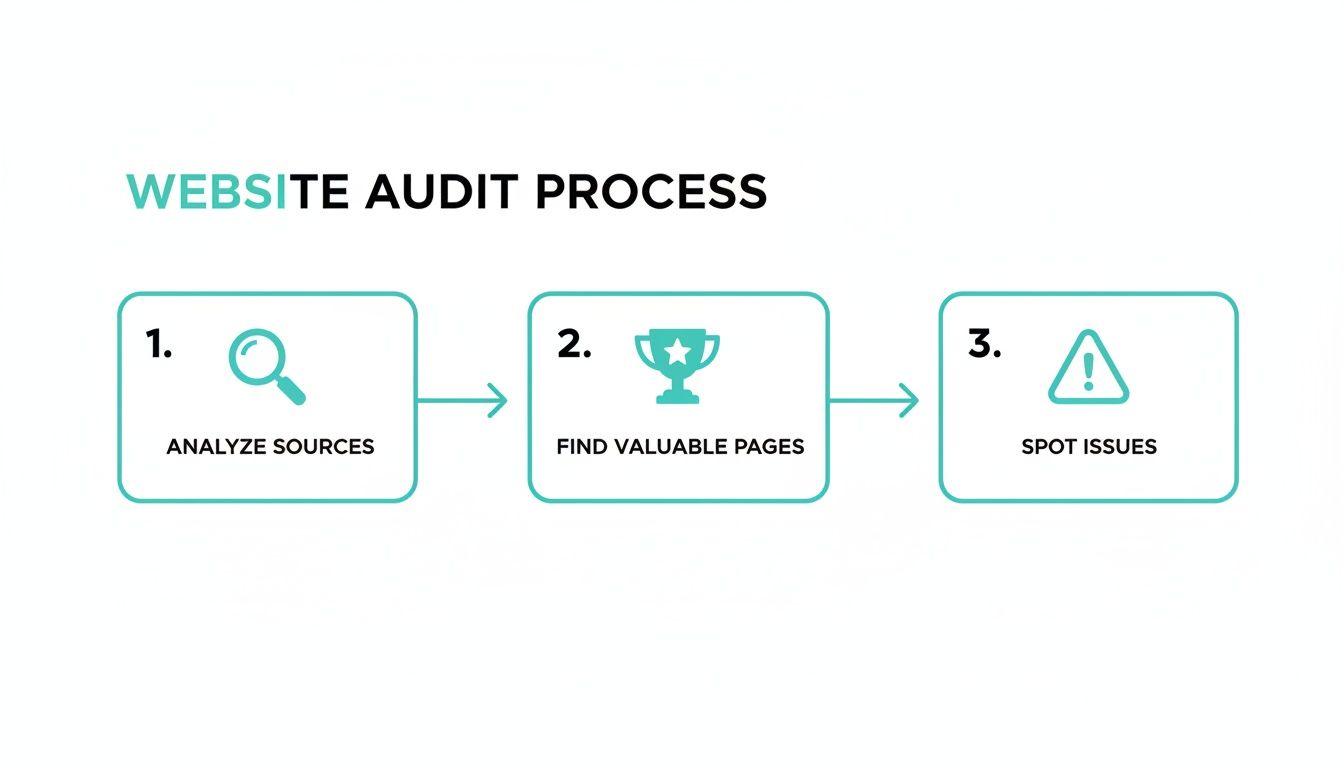
Where Are Your Visitors Actually Coming From?
The first thing to investigate is your traffic sources. How are people finding you in the first place? Google Analytics neatly categorises this, and each channel tells you something different about your audience.
- Organic Search: These are visitors who find you the old-fashioned way—by searching on Google. This is the lifeblood of sustainable, long-term traffic and a direct result of your SEO work.
- Paid Search: Anyone who clicks on one of your paid ads, like a Google Ad. This channel is fantastic for getting targeted eyeballs on your site, fast.
- Direct: People who type your URL straight into their browser. This usually points to strong brand recall and a loyal, returning audience.
- Referral: Traffic that comes from a link on another website. Think of these as digital word-of-mouth recommendations.
- Social: Visitors clicking through from platforms like Facebook, Instagram, or LinkedIn. This tells you how well your social media game is performing.
Getting a handle on this mix is vital. If, for instance, you're almost entirely reliant on paid search, it’s a sign you need to beef up your SEO to build a more stable foundation for the future.
Find Your Hero Pages (and Your Zeros)
Not every page on your website pulls its weight. Your next move is to dig into your analytics and find your content champions—the pages that draw in the most people, hold their attention, and maybe even turn them into customers. These are your traffic magnets.
At the same time, you need to spot the underperformers. A page that gets tons of traffic but has a sky-high bounce rate (meaning people leave after viewing just that one page) is a massive red flag. It’s getting people in the door but failing to convince them to stay.
By figuring out your best and worst pages, you're basically drawing a treasure map. You know where to dig deeper (on what works) and which areas need fixing before they cost you more customers.
Here in Australia, a massive 68% of all website traffic comes from organic search. For small and medium-sized businesses in Adelaide, this makes SEO an absolute non-negotiable if you want to grow without pouring all your budget into ads. This is exactly why a performance audit is your first step—it shows you precisely where your efforts will make the biggest difference.
To get a feel for what you should be tracking, here’s a breakdown of the core metrics you’ll find in Google Analytics and why they matter.
Key Website Traffic Metrics You Should Be Tracking
| Metric | What It Measures | Why It Matters for Traffic Growth |
|---|---|---|
| Users | The total number of unique visitors to your website. | A high-level view of your overall audience size. Steady growth here is the ultimate goal. |
| Sessions | The total number of visits to your site. One user can have multiple sessions. | Indicates how often people are returning. It's a great measure of engagement and brand loyalty. |
| Bounce Rate | The percentage of visitors who leave after viewing only one page. | A high bounce rate can signal irrelevant traffic, poor page design, or slow load times. |
| Pages per Session | The average number of pages a visitor views during a single session. | Higher numbers mean users are exploring your site, which is a strong sign of quality content and good navigation. |
| Average Session Duration | How long, on average, visitors spend on your website during a session. | Longer durations suggest your content is compelling and meeting user needs. |
| Traffic by Channel | A breakdown of where your traffic originates (e.g., Organic, Paid, Direct). | Helps you understand which marketing channels are most effective so you can double down on what works. |
Tracking these metrics isn't just about collecting data; it's about understanding the story your users are telling you with their clicks. This information is your guide to making smarter decisions about where to invest your time and money.
Laying the Groundwork with SEO and Content Marketing
While paid ads can give you a quick burst of traffic, think of search engine optimisation (SEO) and content marketing as the bedrock of your business. This isn't about short-term wins; it's about building a powerful digital asset that brings your ideal customers to you, day in and day out, for years to come.

At its heart, this combination is all about showing up on Google right when someone needs what you offer. When you get it right, you’re not interrupting them with an ad—you’re providing the solution they were actively looking for. That’s the magic of high-quality organic traffic.
Figuring Out What Your Customers Are Really Searching For
Everything starts with keyword research. Before you write a single word, you need to get inside your customers' heads and find the exact phrases they’re typing into Google. This isn't guesswork; it's a data-driven process of understanding what people actually want.
For instance, a plumber based in Adelaide shouldn’t just aim for the word "plumber." That’s far too broad. The real gold is in the high-intent phrases people use when they have a pressing problem:
- "emergency hot water repair Adelaide"
- "best plumber for blocked drains Brighton"
- "gas fitter Norwood cost"
These longer, more specific phrases are called long-tail keywords. They might get fewer searches, but the people using them are often much further along in their buying journey and ready to act. You can unearth these gems using free tools like Google Keyword Planner or more powerful platforms like Semrush.
The real secret to great keyword research is empathy. Seriously, put yourself in your customer's shoes. What specific problem are they trying to solve right now? The language they use is your roadmap.
Once you’ve got a solid list of keywords, you can start building them into the two core pillars of SEO.
Nailing the On-Page and Technical Details
SEO isn't one single thing; it's a mix of different practices that fall into two main camps. You need to get both right to signal to search engines that your website is the best answer out there.
On-Page SEO
This is all about optimising the bits of your website you can see and control directly—the content and structure of your individual pages.
- Title Tags: This is the clickable headline in the search results. Make sure your main keyword is in there.
- Meta Descriptions: Think of this as your 155-character ad. Write something compelling that makes people want to click.
- Content Quality: Don't just stuff keywords in. Create genuinely helpful, in-depth content that actually solves the user's problem.
Technical SEO
This is the behind-the-scenes work. It’s about making sure your site's infrastructure is set up in a way that search engines can easily crawl, understand, and index your content.
- Site Speed: A slow website is a conversion killer. Use Google's PageSpeed Insights to find and fix what's slowing you down.
- Mobile-Friendliness: Your site absolutely has to work flawlessly on a phone. No excuses.
- Site Architecture: Is your site easy to navigate? A logical structure helps both users and search engine bots find what they need.
For businesses that rely on local customers, understanding the importance of local SEO is non-negotiable. It’s the key to turning nearby searches into real-world business.
Powering Up Your Traffic with Content Marketing
With a solid SEO foundation, content marketing becomes your high-octane fuel. It’s the art of creating and sharing genuinely useful articles, guides, and resources that attract and hold the attention of your target audience. This is less about the hard sell and more about becoming the go-to authority in your industry.
The data doesn't lie: websites that regularly publish blog content see 55% more traffic on average. Fresh, helpful content tells Google your site is active and valuable.
With 97.1% internet penetration across Australia's 26.1 million users, and 48.9% of all web traffic coming from mobile, the opportunity is massive. If you're not consistently creating great, mobile-friendly content, you're leaving money on the table.
So, what does a smart content strategy look like for an Aussie business?
- Hyper-Local "How-To" Guides: A landscaper in Perth could create a guide on "How to Choose the Best Reticulation System for Perth's Dry Climate."
- Compelling Case Studies: A marketing agency in Melbourne could showcase "How We Doubled Website Traffic for a Fitzroy Cafe."
- Helpful Checklists: A conveyancer might publish "Your Ultimate Checklist for Buying Your First Home in South Australia."
Every piece of content is another chance to rank for a new keyword, another asset to share on social media, and another reason for someone to visit your site. It’s a long game, but one that pays off with steady, sustainable growth in organic traffic.
Need Traffic Now? Turn on the Taps with Google Ads
While SEO is your long-game, building a solid foundation for organic growth, sometimes you just need the phone to ring today. When you need to get in front of customers immediately, there's no faster or more direct tool than Google Ads. It puts your business right at the top of the search results, exactly when a potential customer is actively looking for a solution.
This isn’t about just chucking money at Google and crossing your fingers. A smart, strategic approach is non-negotiable if you want to see a real return on your investment. Think of it as a calculated way to buy highly relevant traffic—people who have already put their hand up and said, "I need what you're selling."
The real magic of Google Ads is connecting with customers at the precise moment they’re searching for your products or services.
Zero In on Your Ideal Local Customer
The raw power of Google Ads comes from its incredible precision. You don't have to shout your message to the entire country when your best customers are just down the road. For Australian service businesses, this level of control is a total game-changer.
Let's say you're a plumber in Adelaide. You can set up your campaign to show ads only to people within specific postcodes. Right away, you've stopped wasting your budget on clicks from someone in Sydney or Melbourne who you can't possibly help. This hyper-local focus means every dollar is spent targeting potential clients you can actually serve.
But you can get even more specific. Want to reach homeowners aged between 35 and 65? Easy. This ability to layer on demographics and target your perfect customer avatar is what separates a profitable campaign from a money pit.
It's like a digital letterbox drop, but infinitely smarter. Instead of hitting every house on the street, you're only slipping your flyer to the people most likely to need you, right when they're thinking about it.
Write Ad Copy That Begs to Be Clicked
Once your targeting is dialled in, your ad copy becomes your frontline salesperson. You've got just a couple of seconds to grab someone's attention and convince them to click. The trick is to speak directly to their problem and present your business as the obvious solution.
Steer clear of generic copy like "Adelaide Plumber – Call Us." It's boring and blends in. Instead, focus on what makes you the best choice.
- Showcase Your Unique Edge: "24/7 Emergency Plumber Adelaide. No Call-Out Fee."
- Solve Their Specific Problem: "Blocked Drain Expert? We Clear It Fast. Fixed Price Guarantee."
- Give a Clear Instruction: "Get a Free Quote Now" or "Book Your Service Online."
Your ad needs to be a tiny, problem-solving powerhouse. It identifies the issue, positions you as the perfect fix, and tells them exactly what to do next.
From Clicks to Customers: The Landing Page
Getting the click is only half the job. If your ad sends that hard-won visitor to a confusing homepage with a dozen different messages, you've just wasted your money. This is where a dedicated, high-converting landing page is absolutely critical.
A landing page is a standalone page built for one single purpose: to turn that visitor into a lead or a customer. It must mirror the promise made in your ad and make it ridiculously simple for the user to take the next step.
For our Adelaide plumber, a great landing page would feature:
- A Clear, Benefit-Driven Headline: "Fast & Reliable Hot Water Repairs in Adelaide."
- A Simple Contact Form: Just ask for the essentials—name, phone, suburb.
- Trust Signals: Show off customer testimonials, industry certifications, or service guarantees.
- A Prominent Call-to-Action: A big, brightly coloured button that says "Request a Free Quote."
This focused experience strips away all distractions and funnels the user directly towards your conversion goal.
Never Stop Refining: A/B Testing and Remarketing
A winning Google Ads campaign is never "set and forget." You have to keep tweaking and optimising to squeeze the most value out of every dollar.
A/B testing is your best friend here. It simply means running two slightly different versions of an ad or landing page to see which one performs better. You could test a different headline, a new offer, or a different button colour. By constantly testing and keeping the winner, you systematically improve your click-through rate and drive down your cost per lead.
And don't forget remarketing—it's one of the most powerful tactics available. This strategy lets you show targeted ads to people who have already visited your site but left without converting. It’s a gentle nudge that keeps your brand top of mind, giving them an easy way to come back when they're ready.
We’ve seen firsthand how these tactics deliver for Australian businesses. Well-optimised campaigns for local Adelaide services have generated up to a 200% ROI in new leads. By layering in A/B testing and continuous refinement, it's common to see 30-50% higher conversion rates than a basic, untargeted campaign. If you're curious about who's leading the pack, you can check out some of the top-performing websites in Australia.
Using Email and Social Media for Repeat Visits
Getting that first visit from SEO or a paid ad feels great, but the real magic for sustainable growth is convincing people to come back. Repeat traffic is a massive vote of confidence in your brand. To make that happen, your two best friends are email marketing and social media.
Think of it this way: someone finding you on Google is like a first date. Getting them to follow you on socials or, even better, subscribe to your email list is like getting their number. It’s your green light to keep the conversation going, build a real relationship, and invite them back.
Turn Visitors Into Subscribers
Your email list is pure gold. It's a direct line to your audience that you own, free from the whims of social media algorithms. The trick, of course, is getting people to sign up without being obnoxious about it.
The secret is a fair exchange of value. Nobody wants more "updates" cluttering their inbox. You've got to offer something genuinely useful.
- For Service Businesses: Think about a downloadable checklist, a direct link to book a free consult, or a handy guide like, "5 Mistakes to Avoid When Choosing a Plumber in Adelaide."
- For E-commerce Stores: The classic 10% off a first purchase still works wonders. You could also offer early access to a new collection or a free shipping code.
Once they're on your list, remember the goal is to nurture, not just sell. Send them your best stuff—exclusive tips, behind-the-scenes content, and valuable advice. A well-timed email pointing to a new blog post is one of the most effective ways to drive high-quality traffic back to your site from people who already know and trust you.
An email list isn't just a sales tool; it's a community-building engine. Every email you send is an opportunity to reinforce your brand's expertise and remind subscribers why they trusted you in the first place, encouraging them to click back to your site.
Make Social Media a Traffic Driver, Not a Time Sink
Let's be honest, social media can feel like you're shouting into the void. To make it worthwhile, you have to shift your focus from chasing vanity metrics like 'likes' to what actually moves the needle: driving qualified clicks back to your website.
Treat your social profiles as distribution channels for the fantastic content you’re already creating for your site. The key is to avoid just dumping a link. You need to create a bit of intrigue and give people a compelling reason to leave their feed and visit your page.
For instance, instead of just posting the title of your latest blog post, pull out a surprising statistic from it. Or maybe ask a provocative question that the article answers. This frames your content as something that offers immediate value, not just another link begging for a click. To get more out of every post and turn followers into website visitors, it's worth learning how to increase social media engagement.
Optimise Every Click for Mobile
Never forget where your audience is actually clicking from. There are 34.4 million mobile connections in Australia, which is a staggering 128% of the population. A massive chunk of your traffic from email and social media will land on your site via a smartphone.
This means any link you share absolutely must lead to a seamless mobile experience. A slow, clunky landing page will make your bounce rate skyrocket, completely wasting the click you worked so hard to get. You can check out more stats on top digital performers in Australia at Semrush.com to see just how mobile-dominant the market is.
Turning Clicks Into Customers with Website Optimisation
Getting people to your website is a huge win, but it’s only half the job. If they land on a page that’s slow, confusing, or just plain frustrating, they’ll be gone in seconds. All that hard work you put into SEO and ads? Wasted. This is where we shift our focus from just attracting visitors to making them want to stay. It’s a process called conversion rate optimisation (CRO).
It’s all about turning the traffic you’ve already earned into real business results. Let’s be honest, a beautiful website that doesn't convert is just an expensive digital brochure. A high-performing site, on the other hand, is your best salesperson—and it works 24/7.
Speed Up Your Site Because Every Second Counts
Website speed isn't some minor technical detail buried in a developer's checklist. It's a massive factor in both user experience and how Google sees your site. Google has been very clear: faster sites get preferential treatment in search results. Even more importantly, your visitors have absolutely zero patience for a slow-loading page.
The data doesn't lie. Studies consistently show that if a page takes longer than three seconds to load, more than half of your mobile visitors will simply give up and leave. For an e-commerce business, that delay could directly translate into thousands of dollars in lost sales.
To improve your website traffic and actually keep it, you need a fast site. Here are a few quick wins:
- Compress Your Images: Huge, unoptimised image files are the number one culprit behind slow websites. Use a tool to shrink their file size without making them look pixelated.
- Enable Browser Caching: This tells a repeat visitor's browser to "remember" parts of your site, like your logo and menu, so it doesn't have to reload everything from scratch on their next visit.
- Choose Quality Hosting: Cheap, shared hosting might seem like a good deal, but it can cripple your site's performance, especially when serving an Australian audience.
Create an Effortless User Experience
Okay, so your site loads in a flash. The next question is: can people easily find what they're looking for? This is the heart of user experience (UX). Great UX is almost invisible; it just feels natural and guides people where they need to go without them even having to think about it.
Take a hard look at your website's navigation. Is it simple and logical? Can someone visiting for the first time understand what you do and where to click within five seconds of landing on your homepage?
Good UX design isn't about flashy animations or trendy layouts. It’s about clarity and purpose. Every single element on the page should serve a function that helps the user achieve their goal—whether that's finding a phone number, reading a blog post, or making a purchase.
Simple menus, clear headlines, and obvious calls-to-action are the foundations of a website that converts visitors instead of confusing them.
Systematically Improve with A/B Testing
How do you know if changing your "Buy Now" button from blue to green will actually get more clicks? You test it. This is exactly what A/B testing is for. You create two versions of a webpage element (an 'A' version and a 'B' version) and show them to different segments of your audience to see which one performs better.
This data-driven approach takes all the guesswork out of improving your website. Instead of going with a gut feeling or what you think looks best, you use real user behaviour to make decisions. You can test almost anything:
- Headlines: Does "Affordable Plumbing Services" get more calls than "Expert Plumbers in Adelaide"?
- Calls-to-Action (CTAs): Does "Get Started" outperform "Request a Free Quote"?
- Button Colours: It sounds trivial, but a simple colour change can have a surprising impact on click-through rates.
- Page Layouts: Try different arrangements of testimonials, forms, and images to see what resonates most with your audience.
Start with small, simple tests on your most important pages, like your homepage or product pages. Over time, these small, incremental improvements add up to a significant lift in your overall conversion rate, making every single visitor you acquire that much more valuable.
To make this all work, auditing your site speed is a must. Considering Australians now average 6 hours and 5 minutes online daily, a fast experience is non-negotiable. An integrated approach—where your web design, ad copy, and email campaigns all work in sync—ensures the traffic you generate doesn’t just visit, but actually converts. You can learn more about how online behaviour is shaping digital strategy by exploring these insights on Australia's top websites.
Answering Your Top Questions About Driving More Traffic
When you're trying to get more eyes on your website, it's easy to get bogged down with questions. Let's cut through the noise. Here are some of the most common things we get asked by Australian business owners, with straight-up answers based on what we see work every day.
How Long Until I Actually See More Traffic?
This is the big one, and the honest answer is: it depends entirely on the path you take.
If you're after immediate results, a well-built Google Ads campaign can have your phone ringing in a matter of hours. You're essentially paying to jump to the front of the queue, getting in front of people who are actively searching for your services right now. It’s fast and effective.
On the other hand, SEO is a different game entirely. It’s about building a long-term asset that pays dividends for years. You’ll usually start to see the first signs of life—a nudge up in rankings, a bit more organic traffic—within 3 to 6 months. But the real, meaningful results that make a serious difference to your bottom line tend to materialise over 6 to 12 months as Google starts to trust your site and your content library grows.
Should I Start with SEO or Google Ads?
Why not both? The most powerful strategies we see don't treat this as an "either/or" question. Think of them as two sides of the same coin, working together.
- Google Ads gets you traffic today. It also gives you a goldmine of data on which keywords convert, which you can then feed directly into your SEO strategy to target proven winners.
- SEO is your long game. It builds a sustainable source of "free" organic traffic, meaning you're not always chained to your ad budget.
If you’re desperate for leads right now, by all means, fire up a Google Ads campaign. But don’t neglect SEO. Start laying that foundation from day one, even while your ads are running. You’ll thank yourself in a year’s time.
What's the Single Most Important Thing for Getting More Traffic?
If I had to boil it all down to one thing, it would be this: create genuinely useful, high-quality content that solves a real problem for your ideal customer. That’s the core of it all.
This isn’t just about blog posts. It’s about your service pages, your product descriptions, and even the text in your ads. When your content directly answers a searcher's question or addresses their pain point, you win. Google’s entire algorithm is designed to find and reward the most helpful answer.
Forget about chasing algorithms or looking for silver bullets. Just focus on being the best, most helpful resource in your niche. Quality content fuels every single channel—it makes your SEO work, your ads click, and your social posts worth sharing.
How Much Should I Actually Budget for This?
There’s no magic number here, as your budget will depend heavily on your industry, how competitive your market is, and your own growth ambitions.
For a Google Ads campaign in a competitive Aussie city like Adelaide, a starting point might be anywhere from $500 to over $2,000 per month. For a solid SEO and content strategy, costs can range from a few hundred dollars for some foundational work to several thousand for a comprehensive, agency-led plan.
The trick is to stop thinking of it as a cost and start seeing it as an investment. Track your return meticulously. Every dollar you spend should be working hard to bring profitable business through the door.
At Frank Digital Agency, we specialise in turning clicks into customers with performance-driven web design and strategic Google Ads management. If you're ready to see measurable growth in traffic and leads, let's talk. Learn how we can help your business at https://frankdigital.agency.