

At its core, a search engine marketing agency is your dedicated partner for paid advertising on platforms like Google. They take the reins on everything—from pinpointing the right keywords and crafting compelling ads to tracking every dollar spent—all to turn clicks into actual customers and deliver a healthy return on your investment.
Why Partnering with an SEM Agency is Key to Growth
Think of your business as a fantastic shop, but it's tucked away on a quiet side street. Your products are top-notch, your service is impeccable, but not enough people can find you. An SEM agency is the expert who moves your shop to the busiest intersection in town and puts up a giant, flashing sign that attracts only your ideal customers.
That's the real value they bring. SEM agencies are specialists who connect businesses—especially small and medium-sized ones here in Australia—with high-intent customers at the exact moment they’re searching for what you offer.
The Expert Angler Analogy
Trying to get new customers can feel like a fishing trip. You could just grab any old rod, cast a line, and hope for the best. You might get a few nibbles, but you'll probably spend a lot of time and money for very little reward. That's what marketing without a clear strategy often feels like.
Now, imagine hiring an expert fishing guide instead. That's what a good SEM agency is. They bring everything you need to make the trip a success:
- The Right Boat (Strategy): They map out a solid plan based on your business goals, your market, and your budget.
- The Best Fishing Spot (Keywords): They do the research to find exactly where your ideal customers are "swimming" online.
- The Perfect Bait (Ad Copy): They write ads that don't just get seen—they get clicked by the people most likely to buy.
When you work with an expert, you stop casting your net randomly and start fishing with real precision. It’s what turns SEM from a hopeful expense into a predictable, measurable investment designed to drive real growth.
An SEM agency’s main job is to remove the guesswork. They rely on data to make sure your marketing budget is spent effectively, targeting people who are actively looking to buy, not just browse.
The demand for this kind of expertise is huge. The Digital Advertising Agencies industry in Australia has swelled to a $3.7 billion market, with SEM leading the charge as the biggest revenue stream. This market has seen a 7.4% annual increase over the last five years, largely because businesses know they need to be visible on Google, which commands a staggering 93.95% of the Australian search market.
For any business—from a local tradie needing more phone calls to an e-commerce store chasing sales—partnering with a performance-driven agency is the smartest way to tap into this massive market. You can explore more insights on the digital advertising industry from IBISWorld.
What Search Engine Marketing Agencies Actually Do
It’s easy to think of a search engine marketing agency as just "the people who run our ads," but that barely scratches the surface. A truly skilled agency is more like a high-performance racing team, where every single component is meticulously fine-tuned to win. They don’t just buy website traffic; they build a strategic system designed to turn clicks into profitable customers.
This system is built on three core pillars that all work together to drive real, measurable results. Once you understand these, you'll see what a genuine performance-focused agency delivers day in and day out.
The goal is to connect businesses with the right customers at the exact moment they're looking for a solution, turning search engines into a powerful engine for growth.
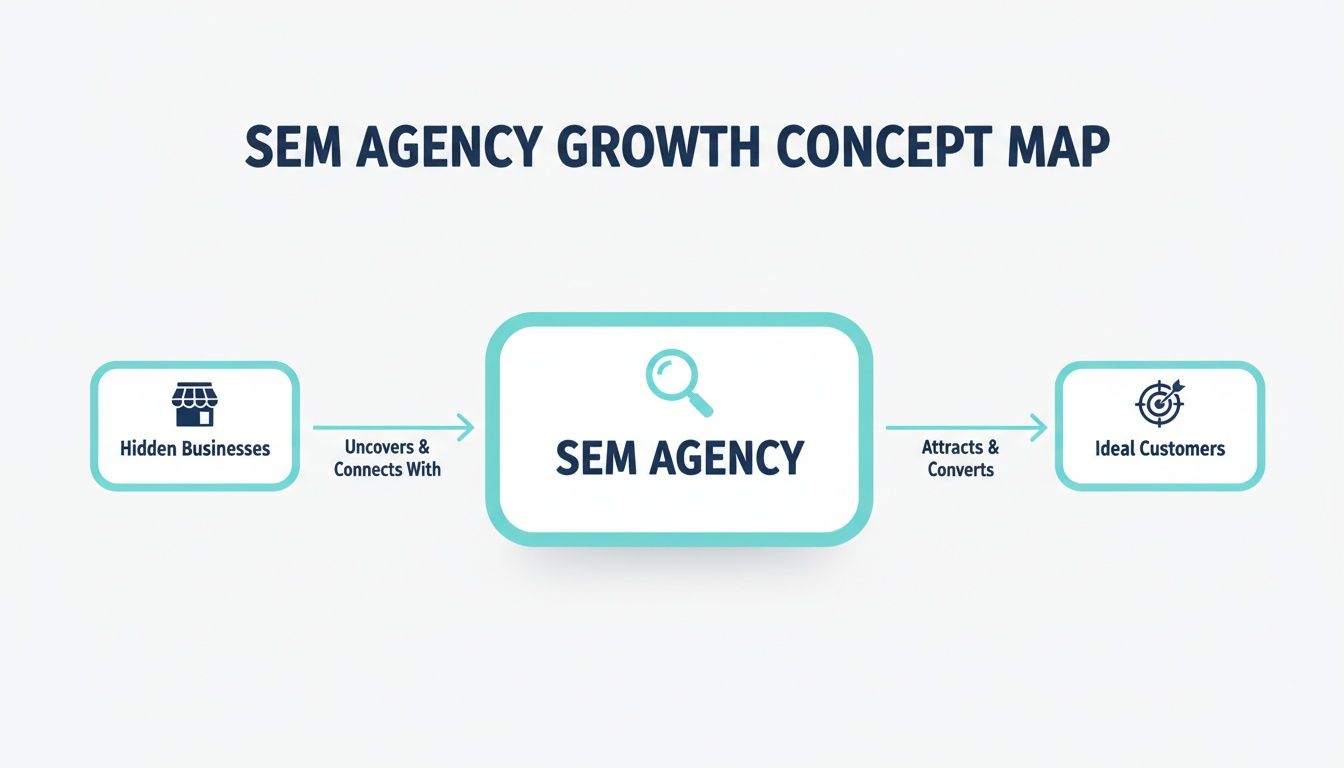
Ultimately, an SEM agency's job is to take a business from relative obscurity and place it directly in the path of motivated buyers. This requires a sharp blend of technical skill, creative thinking, and strategic foresight.
To break it down further, let's look at the key services a top-tier SEM agency provides and how they directly impact your bottom line.
Key SEM Agency Services and Their Business Impact
| Core Service | What It Involves | Primary Business Outcome |
|---|---|---|
| Strategic Ads Management | Deep keyword research, compelling ad copywriting, and smart bidding strategies to capture high-intent searchers. | Increased Lead Quality & ROAS: Attracts customers who are ready to buy, maximising your return on ad spend. |
| Landing Page Optimisation | Designing and refining landing pages that are fast, clear, and focused on guiding visitors to a single, specific action. | Higher Conversion Rates: Turns more of your ad clicks into actual leads, enquiries, or sales. |
| A/B Testing & Refinement | Continuously testing different versions of ads, headlines, buttons, and page layouts to find what works best. | Incremental Growth & Efficiency: Small, data-backed improvements compound over time, lowering acquisition costs. |
Each of these services is a critical piece of the puzzle, designed to not only attract visitors but to convert them efficiently.
H3: Strategic Google Ads Management
Think of your Google Ads manager as the expert driver of your racing team. They have an intimate knowledge of the track—in this case, the search engine results page—and know exactly when to accelerate, when to hold back, and how to navigate past competitors.
Their work involves far more than just picking a few keywords and setting a daily budget. It's a continuous cycle of analysis and action.
- Deep Keyword Research: This is about finding the exact search terms your ideal customers use when they’re ready to buy, not just when they're browsing. For example, they’ll target "emergency plumber Adelaide" instead of a vague term like "plumbing tips."
- Compelling Ad Copywriting: It's about crafting ads that speak directly to the user's problem and offer a clear, immediate solution. The goal is to earn that click over the three or four other competitors on the same page.
- Smart Bidding Strategies: They use data to determine the most effective way to bid on keywords, making sure your ad spend is channelled where it will generate the highest return.
The objective isn't just to get clicks; it's to get the right clicks. An expert Google Ads manager focuses on attracting high-intent users who are most likely to convert into a lead or sale, maximising your return on ad spend (ROAS).
H3: Conversion-Focused Landing Page Optimisation
If the Ads Manager is the driver, then the landing page optimiser is the pit crew. Their job is to ensure that once a visitor clicks your ad, they land on a page that is perfectly tuned for one thing: conversion.
Sending valuable ad traffic to your generic homepage is a recipe for wasted money. It’s like a race car driver pulling into a chaotic pit stop—it kills all momentum and you lose the race. This is where an agency like Frank Digital creates a seamless, persuasive experience, refining landing pages to guide visitors toward a specific action, whether that's making a call, filling out a form, or completing a purchase.
H3: Relentless A/B Testing and Refinement
The final pillar is A/B testing, which is like having a dedicated data analyst on the team. This process involves creating two versions of an ad or landing page (Version A and Version B) and running them at the same time to see which one performs better.
It’s a process of relentless, data-driven improvement. For instance, an agency might test:
- A headline that says "Book Your Free Consultation" against one that says "Get a No-Obligation Quote."
- A green "Submit" button against a blue one.
- A contact form with three fields against one with five.
These might seem like tiny details, but they can lead to huge improvements in conversion rates over time. This dedication to constant testing is what separates an average agency from a great one. It ensures your campaigns are always evolving and becoming more efficient.
While paid ads are a huge part of the picture, a top-tier SEM agency also understands the value of organic visibility. For a deeper dive, this comprehensive guide to improving search engine rankings is a great resource.
This holistic approach is becoming more critical than ever. Australian businesses are projected to invest $1.5 billion in SEO services—a 12% increase that shows just how much value there is in search visibility. When every dollar spent can potentially yield over $22 in returns, partnering with a skilled agency is a powerful growth strategy.
How to Vet and Choose the Right SEM Partner
Picking a partner from the sea of search engine marketing agencies is one of the biggest marketing calls you'll ever make. Get it right, and you'll have a genuine extension of your team, driving predictable growth and a solid return on your investment. Get it wrong, and you can watch your budget vanish with very little to show for it.
Think of it less like finding a supplier and more like hiring a strategic partner. You need a team that has the technical chops, of course, but just as importantly, they need to get your business goals, your industry, and what makes your customers tick. The best agencies tie their success directly to yours.
To find that perfect fit, you have to push past the polished sales pitches and get a real look at their processes, their actual track record, and how they communicate. That means having a solid vetting process and knowing exactly what questions to ask.
Analyse Their Track Record and Case Studies
Any agency worth its salt will have case studies ready to go. But don't just take their glossy brochures at face value. Your job is to hunt for concrete proof that they’ve solved problems like the ones you're facing right now.
When you’re sifting through their portfolio, look for wins with businesses of a similar size or in a related industry. An agency that's brilliant at scaling a national e-commerce brand might not have the right playbook for a local Adelaide plumber who just needs qualified phone calls.
More importantly, look at the story behind the case study. A good one won't just show flashy numbers; it will clearly break down:
- The Initial Challenge: What specific problem was the client wrestling with before the agency stepped in?
- The Strategy: What specific moves did the agency make to tackle that problem?
- The Results: Which measurable KPIs actually improved, and by how much? Keep an eye out for real-business metrics like Cost Per Acquisition (CPA), Conversion Rate, and Return On Ad Spend (ROAS).
Demand Transparency in Reporting and Communication
A true partner doesn't hide behind smoke and mirrors. One of the biggest red flags is an agency that’s cagey about its methods or sends over reports bloated with confusing jargon and vanity metrics like clicks and impressions.
You have a right to know exactly where your money is going and what results it’s actually producing. Before you sign anything, get crystal clear on what to expect for reporting and communication.
A trustworthy agency delivers clear, customised reports that link directly to your business goals. They should be able to explain every single metric and how it impacts your bottom line, not hide behind complexity.
Ask potential agencies about their communication rhythm. Will you have a dedicated account manager? How often will you meet to go over performance and plan the next steps? A proactive, open style of communication is a huge sign of a healthy partnership.
Ask the Right Questions During the Interview
The quality of your answers is determined by the quality of your questions. Steer clear of generic queries that just invite a pre-packaged sales pitch. Instead, ask probing questions that make them show you their strategic thinking.
For instance, instead of asking, “What results can you get me?” try flipping the script.
Powerful Question Example:
“Can you walk me through a campaign you ran for a client similar to my business? Tell me about the initial challenge, the strategy you built, and the specific KPIs you managed to improve in the first 90 days.”
This single question forces them to open up their playbook, showing you their problem-solving process, their feel for your industry, and whether they focus on metrics that actually matter.
Here are a few more potent questions to have in your back pocket:
- Who, specifically, will be working on my account, and what’s their level of experience?
- What’s your approach to keyword research and ad copy testing for a business like ours?
- Can you describe your process for landing page optimisation and improving conversion rates?
- How do you measure success beyond just clicks and impressions?
- What’s the plan if the initial campaign performance isn’t hitting the targets we set?
Assess Their Team and Cultural Fit
At the end of the day, you’ll be working closely with these people. The most incredible technical skills in the world won’t mean much if the team is a nightmare to work with. As you talk with them, get a feel for whether their communication style and company values mesh with your own.
Here at Frank Digital, for example, we’re all about clear, straightforward communication and a relentless focus on measurable ROI. We’re in it for the long haul, which means being transparent, responsive, and genuinely invested in our clients' success.
Look for an agency that’s curious about your business and asks you thoughtful questions. It’s a sure sign they want to be a real partner, not just another name on their client list. Choosing the right SEM agency is a major investment in your future growth—so take your time and get it right.
Understanding SEM Pricing and Measuring True ROI
As you start looking into search engine marketing agencies, two big questions always surface: "How much will this cost me?" and "What do I actually get for my money?" The answers aren't just about the figure on an invoice. It's about understanding the real value being delivered and knowing how to measure the return on your investment.
The first step is a simple but powerful mindset shift. Stop thinking of an SEM agency as just another expense and start seeing it as an engine for profit. To do that, you need to get a handle on how agencies structure their fees and, crucially, how to track the outcomes that genuinely impact your bottom line.
Demystifying SEM Agency Pricing Models
Agency pricing isn't a one-size-fits-all deal. Most fee structures are built to suit different business models, campaign sizes, and goals. Getting to know the pros and cons of each helps you find a partner whose financial incentives are pointing in the same direction as your own growth plans.
You’ll typically come across three common models:
- Percentage of Ad Spend: This is pretty straightforward. The agency takes a percentage of your monthly ad budget, often around 10-20%. It’s easy to understand and scales with your spending, but the potential downside is that it could encourage an agency to simply spend more, rather than focus on efficiency.
- Flat-Rate Retainer: You pay a fixed fee each month for a clearly defined scope of work. This model is brilliant for budgeting predictability and works well for businesses needing consistent, ongoing campaign management. Just make sure the deliverables are crystal clear so you know exactly what you’re paying for.
- Performance-Based Fees: Here, the agency’s fee is directly tied to results—think number of leads generated or sales closed. While this model perfectly aligns your goals with the agency's, it often includes a higher base retainer to offset the agency’s risk.
At Frank Digital, we champion transparent pricing that links directly to the results we generate. This ensures our partners always have a clear picture of the value they’re receiving.
The right pricing model really depends on your budget, your goals, and how hands-on you want to be. The most important thing is transparency. A good agency will walk you through their fee structure and explain exactly how it connects to the work they'll be doing for you.
Moving Beyond Vanity Metrics to Measure True ROI
Clicks and impressions might look great on a report, but they don't pay the bills. The real measure of success—the true ROI—comes from tracking Key Performance Indicators (KPIs) that directly affect your revenue. A performance-focused agency will always steer the conversation away from surface-level data and towards the metrics that measure actual profitability.
This laser focus is non-negotiable in the Australian market. With Google holding an ironclad 93.95% share of the search engine market, working with sharp search engine marketing agencies is essential for any business serious about online growth. Bing sits at a distant 4.48%, making it clear that SMBs need to master Google Ads to reach the nation’s 26.1 million internet users. You can dig deeper into these figures with these Australian search engine usage statistics.
The KPIs That Actually Matter
To properly hold your agency accountable and truly understand your campaign’s success, you need to speak the language of ROI. These three KPIs are the bedrock of any profitable SEM strategy.
- Cost Per Acquisition (CPA): This is your bottom-line cost to get a new customer. You calculate it by dividing your total ad spend by the number of new customers you won. A falling CPA is a great sign that your campaigns are getting more efficient.
- Conversion Rate: This metric shows the percentage of people who clicked your ad and then took the action you wanted, like filling out a form or buying a product. A higher conversion rate means your ads and landing pages are working together effectively to turn clicks into customers.
- Return On Ad Spend (ROAS): This is the big one. ROAS tells you how much revenue you’re generating for every single dollar you spend on ads. For instance, a ROAS of 5:1 means you made $5 in revenue for every $1 you invested.
By focusing on these core KPIs, you can have meaningful, productive conversations with your agency. It empowers you to judge their performance based on tangible business results, ensuring your investment isn't just a cost but a powerful driver for sustainable growth.
Winning SEM Strategies for Different Industries
A cookie-cutter SEM strategy is a sure-fire way to burn through your ad budget with nothing to show for it. Think about it: an e-commerce brand selling jewellery has completely different goals and customer behaviours than a local Adelaide plumber who needs the phone to ring for a burst pipe. This is where the real value of an experienced search engine marketing agency shines through.
A true SEM partner knows that a great strategy isn't about pulling a generic template off the shelf. It’s about getting under the skin of an industry—understanding the unique problems customers have, the exact words they use to search for solutions, and what it really takes to earn their trust and their business.
Without this tailored approach, you’re just throwing money at the wall. By matching the strategy to your specific industry, an agency makes sure every dollar is put to work where it will have the biggest impact, driving real growth for your business.
What works for an online store will fall flat for a local tradie, and a strategy for a law firm won't move the needle for a dental clinic. Let's explore how a smart SEM approach adapts to the unique demands of different sectors here in Adelaide.
SEM Strategy Focus by Industry
| Industry | Primary Goal | Key SEM Tactic | Crucial KPI |
|---|---|---|---|
| E-commerce | Drive direct online sales | Google Shopping & Performance Max | Return On Ad Spend (ROAS) |
| Trades & Home Services | Generate urgent, qualified leads (phone calls) | Hyper-local geo-targeting & "Click-to-Call" ads | Cost Per Acquisition (CPA) |
| Professional Services | Nurture leads & build authority | Content-led ads (e.g., guides) & Remarketing | Qualified Consultations Booked |
| Health & Medical Clinics | Secure patient appointments | Location-based ads & keyword targeting for specific services | Cost Per Booked Appointment |
As you can see, the objective dictates the entire strategy. A good agency starts with your business goal and works backwards, selecting the right tools and tactics to get you there efficiently.
SEM for E-commerce Brands
For any online store, the name of the game is direct product sales. The customer journey is often highly visual and can be quite impulsive, making platforms that put your products front and centre absolutely essential.
This is exactly why Google Shopping ads are the undisputed king for e-commerce. These are the image-based listings you see right at the top of the search results, complete with a picture, price, and your store name. They’re brilliant because they catch buyers with high intent right when they’re ready to pull out their wallets.
But a truly sophisticated e-commerce strategy goes beyond just the first sale. It's about getting the most value out of every customer. Key tactics here include:
- Dynamic Remarketing: Ever feel like an ad for a product you just looked at is following you around the internet? That’s dynamic remarketing. It shows ads for the exact items a user viewed, nudging them back to complete the purchase.
- Performance Max Campaigns: This is where you let Google’s AI do the heavy lifting. A single campaign can find new customers across all of Google's channels, from YouTube and the Display Network to Gmail.
- Feed Optimisation: This is the behind-the-scenes work of constantly refining your product data feed. Getting the titles, images, and pricing just right makes your ads more compelling and improves their overall performance.
The core metric for any e-commerce business is Return On Ad Spend (ROAS). A skilled agency will be obsessed with this number, constantly tweaking campaigns to make sure every dollar you spend on ads brings back multiple dollars in revenue.
SEM for Trades and Home Services
When you’re a plumber, electrician, or builder in Adelaide, the game changes completely. You’re not trying to get someone to click ‘add to cart’. You need a qualified lead—and fast. Usually, that means an urgent phone call or a form submission for a quote. Success is measured by the phone ringing.
Your customer is almost always local and needs help now, which means your strategy has to be laser-focused on geography and speed. Running a broad, nationwide campaign would be a total waste of money.
The entire focus shifts to capturing local intent. The core strategies for tradies always include:
- Geo-Targeted Search Ads: Campaigns are locked down to specific Adelaide suburbs or a tight service radius. This ensures your ads are only shown to people in the areas you actually service.
- "Click-to-Call" Ad Extensions: This is a must-have. It adds a call button directly to your ad on mobile, letting potential customers ring you with a single tap, without even needing to visit your website.
- Google Business Profile Optimisation: A well-managed profile helps you show up in the local map pack—prime real estate for service businesses. This is often powered by a steady stream of positive reviews and accurate business info.
For a trades business, the most important metric is Cost Per Acquisition (CPA)—specifically, what it costs to generate a qualified phone call or lead. A great agency works tirelessly to drive this number down.
SEM for Professional Services
For professionals like lawyers, accountants, and financial advisors, the sales cycle is much longer and built entirely on trust. No one hires a conveyancer after seeing one ad. They need to feel confident in your expertise and credibility first.
SEM in this space is less about the hard sell and more about nurturing leads and establishing your authority. The strategy has to guide potential clients through a more considered decision-making process, building a relationship along the way.
Winning strategies for professional services often lean on:
- Targeted Content Offers: Instead of "Buy Now," the call to action is often to download a valuable resource like a free guide, checklist, or webinar. This captures their contact details so you can nurture the lead over time.
- Search Ads Focused on Expertise: Ad copy needs to build instant trust. This means highlighting credentials, years of experience, specific areas of practice, and any awards or recognitions.
- Remarketing with Testimonials: Once someone has visited your site, you can show them ads featuring glowing client testimonials or five-star reviews. It’s a powerful way to reinforce your credibility and stay top of mind.
Here, a key KPI is often the number of qualified consultations booked. The goal is to fill the pipeline with prospects who are already educated on what you do and trust your expertise. It’s a perfect example of how an agency like Frank Digital adapts its thinking, ensuring the SEM strategy perfectly aligns with your industry’s unique path to purchase.
Your Questions About SEM Agencies Answered
Jumping into paid search for the first time? It's natural to have a lot of questions. Before you team up with one of the many search engine marketing agencies out there, it’s a good idea to get the basics down pat. Here, we'll tackle the most common questions we hear from businesses, giving you straight answers so you can move forward with confidence.
Getting your head around these key points will help you set realistic expectations and have a much better conversation with any agency you're considering.
How Long Does It Take to See Results From SEM?
This is the big one, isn't it? The good news is, unlike organic SEO which is a long game, a well-managed SEM campaign can start making an impact almost instantly. Once a campaign goes live, paid ads can start funnelling traffic to your website within a matter of hours.
But let's be clear: there's a world of difference between getting traffic and achieving real, profitable results. The first month is all about getting the ball rolling, gathering crucial data, and generating some initial leads. The real magic happens over the first 90 days. In that time, your agency uses real-world data to test, tweak, and tune your campaigns, and you should start to see big improvements in key metrics like your Cost Per Acquisition (CPA).
What Is the Difference Between SEO and SEM?
It’s easy to get these two mixed up. The simplest way to think about it is that Search Engine Marketing (SEM) is the overall strategy for getting seen on search engines. Inside that strategy, you have two main tactics:
Search Engine Optimisation (SEO): This is your organic, long-term play. It's all about earning traffic by improving your website's content, technical setup, and online reputation so search engines naturally want to rank you highly. Think of it as building a valuable asset over time.
Pay-Per-Click (PPC) Advertising: This is the paid approach, where you buy traffic through platforms like Google Ads. It gets you immediate visibility, right at the top of the search results.
A smart SEM agency uses both. SEO builds lasting authority and trust, while PPC delivers targeted leads right now. They’re two sides of the same coin and work best when they support each other.
How Much Should I Budget for Google Ads?
Unfortunately, there's no single magic number for a Google Ads budget. It really comes down to your industry, your location, and what you’re trying to achieve. A law firm in central Sydney, for instance, is going to need a much bigger budget to compete than a local plumber in a smaller town.
A good agency won't just guess a figure. They’ll dive into detailed keyword research to figure out what clicks actually cost in your market. From there, they'll work backwards from your goals—like how many new customers you want each month—to build a recommended starting budget.
The key is to shift your mindset: ad spend isn't just a cost, it's an investment. A successful campaign should always bring in more money than it costs, with the revenue from new customers easily covering what you spent to find them.
Do I Still Need SEM If My Business Is Built on Referrals?
A strong referral network is fantastic, but it's not a predictable or scalable way to grow. Word-of-mouth is reactive; SEM is proactive. It takes the great reputation you've already built and puts your business in front of thousands of potential customers who are looking for exactly what you offer, right now.
With SEM, you're in the driver's seat. You can target specific services, suburbs, or the exact type of customer you want more of. Plus, a solid online presence actually strengthens your referrals. When someone is told about your business, the very next thing they do is Google your name. Seeing a professional website and great reviews will seal the deal.
At Frank Digital Agency, our bread and butter is creating data-driven SEM strategies that answer these questions and deliver real, measurable results. If you're ready to turn clicks into customers and find a more predictable way to grow, let's have a chat about your goals.