

Defining a "good" click-through rate (CTR) is a bit like asking "how long is a piece of string?". It really depends on the context. For Google Search ads in Australia, a solid benchmark to aim for is around 6.11%. But that's just an average. The reality is, what’s considered "good" is a moving target that shifts dramatically based on your industry, the channel you're using, and what you’re trying to achieve.
What Is Click-Through Rate and Why It Matters
Let's use a simple analogy. Picture your business putting up a massive, eye-catching billboard on the busiest highway in town. Every car that drives past is an impression. Now, if you could count exactly how many of those drivers saw your sign and immediately took the next exit to find your shop, that's your click-through rate.
It’s one of the most honest and direct metrics in digital marketing. We calculate it with a straightforward formula:
(Total Clicks / Total Impressions) x 100 = Click-Through Rate (%)
A high CTR is a fantastic sign. It tells you that your message is hitting the mark—your ad copy, email subject line, or organic search listing resonated enough with your audience to make them stop, think, and act. This isn't just about feeling good; it has a real impact on your results.
The Core Importance of a Strong CTR
So, why do we obsess over this number? A healthy CTR is like a pulse check for your marketing campaigns. It tells you if things are working as they should for a few critical reasons:
- It Signals Relevance: A high CTR is a direct signal to platforms like Google that your ad is a great match for what people are searching for. The algorithm loves this, and it often rewards you with better ad placements and lower costs.
- It Drives Qualified Traffic: You can't get a conversion without a click. A better CTR means more people are landing on your website or product pages, giving you more shots at generating a lead or making a sale. These aren't just any visitors; they're people who were compelled by your message.
- It Lowers Advertising Costs: In the world of paid ads, a strong CTR boosts your Quality Score. A higher Quality Score is Google's way of saying "well done," and it can seriously reduce your cost-per-click (CPC). Your budget suddenly starts working a lot harder.
To give you a better feel for how CTR plays out in the real world, here's a handy table summarising the benchmarks you can expect across different channels.
Quick Guide to Average CTR Benchmarks
This table offers a snapshot of typical 'good' CTRs across key marketing channels. It's a great starting point for setting your own goals.
| Marketing Channel | Average 'Good' CTR | Primary Goal |
|---|---|---|
| Google Search Ads | 6.11% | Capture immediate, high-intent demand |
| Display Ads | 0.5% – 1.5% | Build brand awareness and retarget audiences |
| Social Media Ads | 1% – 2% | Drive engagement and top-of-funnel traffic |
| Organic Search (SERP) | 3% – 5% (Top 3 spots) | Earn long-term, trusted traffic |
| Email Marketing | 15% – 25% | Nurture leads and drive repeat business |
As you can see, the numbers vary wildly. It's all about matching the channel to the user's mindset and your campaign's objective.
The chart below paints a clearer picture of how different ad formats perform.
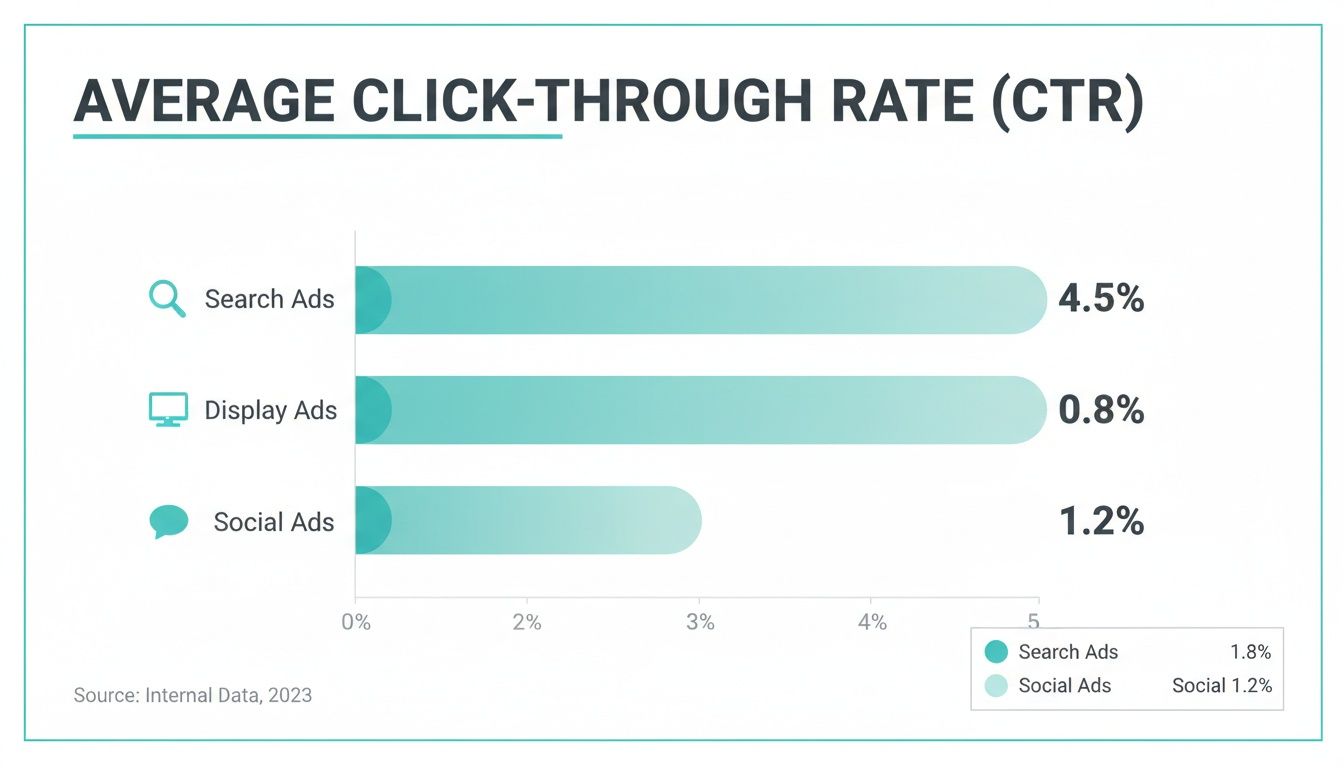
It’s no surprise that search ads come out on top. When someone is actively searching for a solution, they are far more likely to click than someone passively scrolling through social media.
Recent Australian data shows just how much these figures can fluctuate by industry. The average Google Ads search CTR hit 6.11%, but some sectors saw incredible growth. For example, Sports and Recreation CTRs jumped by 17.65% year-over-year, while Beauty and Personal Care saw a 15.08% increase. For a deeper dive, check out the Australian industry benchmarks from Traffic Radius to see how your field compares.
Knowing these numbers is the first step. It helps you set realistic goals and gives you a baseline to start optimising from.
CTR Benchmarks for Google Search Ads
When it comes to digital advertising, Google Search is where the action is. Unlike other channels where people are just passively scrolling, on Google, they’re actively hunting for a solution. They have a problem and they want it solved now. This high level of user intent is precisely why search ads almost always pull the highest click-through rates.
It’s the difference between someone idly window shopping and someone marching into your store asking, "Where are the size 10 boots?" The second person is primed to buy, and a sharp, well-placed ad is your chance to be the first answer they see. But figuring out what a "good" CTR looks like in this competitive space isn't as simple as picking one magic number.
Unpacking Industry Averages
Performance swings wildly from one industry to another, all thanks to differences in competition, cost, and just how badly a customer needs what you’re selling. For Australian businesses, a solid starting point is to aim for a search ad CTR of at least 2%. Think of this as a healthy baseline—if you’re hitting this, it’s a good sign your ad is relevant enough to get noticed.
But the real story is in the details. The legal services industry, for instance, often sees a lower CTR simply because the competition is absolutely ferocious. With the highest average cost-per-click (CPC) at around $8.67, every single click is a hard-won victory. In this kind of environment, your ad’s relevance and authority are everything.
At the other end of the scale, you’ve got industries like real estate and home services, where the average CPC is a much friendlier $1.40. This usually means it's a bit easier to get a high CTR with punchy, benefit-driven ad copy. Given that a massive 96% of advertisers put their money into search ads, understanding these benchmarks is crucial. You can dig deeper with this in-depth analysis of Australian PPC stats.
A 'good' CTR for a conveyancer in Adelaide will look very different from a 'good' CTR for an online clothing store. Context is everything. One fights for a few, high-value clicks, while the other aims for volume.
Why Do Benchmarks Differ So Much?
So, what causes these huge gaps in what’s considered a good CTR? A few key factors are at play, and getting your head around them will help you set realistic goals and know which levers to pull to improve your own campaigns.
- Competition Level: In crowded markets like finance or law, you’ve got dozens of businesses all bidding on the same keywords. This saturation means you have to work much harder to stand out and earn that click.
- Cost-Per-Click (CPC): High CPCs often go hand-in-hand with industries where a single conversion is worth a lot of money. Advertisers are willing to pay top dollar, which ramps up the competition and makes a high CTR tougher to achieve.
- Urgency and Intent: Someone searching for an "emergency plumber" has a much more immediate need than someone casually browsing for "living room design ideas." That raw urgency makes them far more likely to click the first relevant ad they see.
Improving Your Search Ad CTR
Just knowing the benchmarks isn’t enough—the goal is to use that insight to boost your own performance. A higher CTR doesn't just mean more traffic; it also improves your Quality Score, which is Google’s way of rewarding you with better ad positions and lower costs. Here are three key areas to focus on.
1. Master Your Ad Copy
Your headline and description are your digital shopfront. They need to grab attention and speak directly to the searcher's problem.
- Be Specific: Instead of a generic "Plumbing Services," try something like "24/7 Emergency Plumber in Adelaide."
- Include a Call to Action (CTA): Tell people what to do next. Use action-packed phrases like "Get a Free Quote," "Shop Now," or "Book Your Consult."
- Highlight Your Unique Selling Proposition (USP): What makes you the best choice? Is it being "Family-Owned"? Offering a "5-Year Warranty"? Or promising "Same-Day Service"? Flaunt it.
2. Leverage Ad Extensions
Think of ad extensions as free real estate. They’re extra snippets of info that make your ad bigger, more useful, and more likely to get clicked. They cost nothing to add and can have a massive impact on your CTR.
- Sitelink Extensions: Add direct links to important pages like 'Our Services' or 'Contact Us'.
- Call Extensions: Let mobile users call you with a single tap, right from the ad.
- Location Extensions: Show your business address, making it dead simple for local customers to find you.
3. Refine Your Keyword Targeting
The final piece of the puzzle is making sure your ad shows up for the right searches. A mismatch between your keywords and your ad is one of the biggest killers of a good CTR. You want to build tight, highly relevant ad groups where your keywords, ad copy, and landing page are all perfectly aligned. This kind of precision signals to both users and Google that you are the most relevant answer to their query.
What to Expect from Display and Social Media CTR
If search ads are like a customer walking into a hardware store asking for a specific drill bit, display and social media ads are more like a billboard they drive past on their way to the movies. In the first scenario, the intent to buy is high and immediate. In the second, they're not actively looking for what you're selling—you have to grab their attention while they're doing something else entirely.
This is the fundamental difference when we talk about display and social media ads. People are on these platforms to catch up with friends, read the news, or watch videos. Your ad is an interruption. Because of that, the whole concept of a "good" click-through rate shifts dramatically. Expecting the same numbers as a high-intent search campaign will only lead to frustration.
Why a Low CTR Isn't a Red Flag Here
On display and social channels, it’s completely normal for CTRs to be much lower, often dipping below 1%. This isn't a sign your campaign is failing; it’s a reflection of what these platforms are built for. Clicks aren't always the main goal.
Instead, the objectives are often broader:
- Building Brand Awareness: Just getting your brand name, logo, and vibe in front of the right eyeballs.
- Nurturing an Audience: Staying on the radar of potential customers who aren't quite ready to commit.
- Powerful Remarketing: Gently reminding people who’ve visited your site about that product they looked at or that service they considered.
Think of it like tending a garden. You're not expecting every single seed to sprout into a sale overnight. You're cultivating familiarity and building trust over time, so when that person eventually needs what you offer, your name is the first one that pops into their head.
Display and Social CTR Benchmarks
So, what numbers should you actually be aiming for? As a general rule of thumb, display ads often sit around 0.5% – 1.5%, while social media ads can see a slightly higher 1% – 2%. But we can get more specific with Australian data.
Across all industries down under, a good click-through rate for display ads averages out to 0.46%. Some sectors naturally perform a little better; E-commerce and Consumer Services, for example, both average around 0.51%, and the Automotive industry pulls ahead at 0.60%. If you're beating that 0.46% mark, it’s a solid sign that your audience targeting and creative are hitting the mark. You can dive deeper into the numbers with the full display advertising benchmarks from Thomas Marsden.
For these channels, a click is a bonus, not the sole objective. The real value often lies in the impression itself—the subtle act of keeping your brand visible and relevant in the daily digital lives of your ideal customers.
Keys to Success on Visual-First Platforms
Unlike the text-driven world of search, display and social media are all about the visuals. Your success depends entirely on your ability to stop someone mid-scroll. It really boils down to a few key things.
- Compelling Creative: Your visuals are the hero of the story. High-quality images, snappy videos, and clean graphics aren't optional—they're essential. For an e-commerce brand, this is your professional product photography. For a tradie, it might be a slick time-lapse video of a recent job.
- Laser-Focused Targeting: These platforms give you incredible power to segment your audience. You can target people based on their interests, life events, online behaviour, and previous interactions with your business. The more granular you get, the more your ad will resonate.
- Clear, Punchy Messaging: You’ve got a split second to get your point across. The message has to be immediate and easy to digest. A strong headline, minimal text, and an obvious call-to-action are your best friends.
Ultimately, a good CTR on these platforms is proof that your creative worked. It tells you that you managed to successfully interrupt someone's feed in a way they found interesting, turning a passive scroller into an engaged prospect, even if it was just for a moment.
What About Organic Search and Email CTRs?
So far, we've talked about paid ads, but what about the channels you own? Your organic search presence and email marketing campaigns are where click-through rates really show you how well you’re connecting with your audience. A strong CTR here isn't just a vanity metric; it’s a sign of trust, relevance, and a message that’s hitting all the right notes.
When it comes to organic search, the whole game is about winning on the search engine results page (SERP). Picture a busy high street, with every shop trying to pull customers in. Your ranking is your shop’s location—and being at the top is like having that prime corner spot everyone wants.
Why Ranking Is Everything in Organic Search
Your position on Google has a massive, almost brutal, impact on your click-through rate. The relationship is simple: the higher you rank, the more clicks you get. And it’s not a gentle slope; it’s a steep drop.
Data consistently shows that the #1 organic result on Google gets a CTR of around 28-30%. Think about that—it’s a huge slice of the pie. Drop to the second spot, and that rate often gets cut in half. By the time you’re at the bottom of the first page, you’re lucky to get a CTR above 3%.
This highlights a critical truth in SEO: if you're not in the top three results, you're practically invisible to most people. Nailing those top spots is the single most powerful way to drive up your organic CTR.
Why? It’s human nature. We’ve been trained to trust that Google’s algorithm will put the most relevant, authoritative answer right at the top. This behaviour makes the fight for those top positions incredibly fierce but absolutely vital for bringing meaningful traffic to your site.
How to Craft a Click-Worthy SERP Presence
While ranking is king, you still have to convince someone to click on your link instead of the one above or below it. This is where your title tag and meta description become your digital billboard on the SERP.
Write Compelling Title Tags: Your title needs to be a hook. Sure, include your target keyword, but make it stand out. Adding numbers ("10 Ways to…"), brackets, or asking an intriguing question ("How to Fix [Common Problem]?") often works wonders compared to a bland, generic title.
Create Benefit-Driven Meta Descriptions: Think of your meta description as a 160-character sales pitch. Don't just list what the page is about; sell the benefit. You need to answer the searcher's unspoken question: "What's in it for me if I click this?"
A well-crafted title and meta description can genuinely lift your CTR, even if you’re not in that coveted number one spot. It’s your opportunity to steal a click from a higher-ranking competitor simply by having a more appealing offer.
Decoding Your Email Marketing CTR
Switching gears to email marketing, CTR measures something entirely different. Here, it’s all about the engagement of your subscribers. Your open rate tells you if the subject line worked, but the click-through rate reveals if your content was actually valuable enough to make them take the next step.
So, what’s a good click-through rate for an email campaign? It definitely varies between industries, but a healthy benchmark to aim for is generally between 2-5%. Some sectors, like hobbies or government-related content, can see much higher rates because the audience is already highly invested in the topic.
A strong email CTR is usually a sign that a few things are working together perfectly:
- You have a quality list: You're emailing people who genuinely want to hear from you, not a list you bought or scraped.
- Your content is valuable: The message offers something useful—a great discount, insightful information, or exclusive access to something cool.
- Your Call-to-Action (CTA) is crystal clear: You’ve made it ridiculously easy for the reader to know what to do next, with a button or link that’s impossible to miss.
Ultimately, a healthy email CTR is proof that your message is resonating. It shows you’re successfully guiding your most loyal followers back to your website to learn more, buy something, or simply engage with your brand.
What Really Moves the Needle on Your Click-Through Rate?
Knowing the benchmarks for a "good" click-through rate is one thing, but understanding the why behind the numbers is where the real magic happens. A high CTR isn't a fluke; it's the result of several key ingredients coming together just right.
Think of it like baking a cake. If your flour is stale or you forget the sugar, the end result will fall flat. The same goes for your digital campaigns. Every single element plays a part in convincing a real person to stop what they're doing and click.
The Power of Your Copy and Creative
Your ad copy, email subject line, or video thumbnail is your first handshake. It’s your one shot to grab someone's attention in a sea of digital noise. Is it compelling enough to make them pause and want to know more?
Vague, generic messaging is the fastest way to be ignored. What works is strong, benefit-driven language that speaks directly to a person's pain point or desire.
- Weak Copy: "Digital Marketing Services in Adelaide"
- Strong Copy: "Get More Leads This Month. We Help Adelaide Tradies Fill Their Calendars."
See the difference? The second example is specific, nails the target audience, and promises a tangible outcome. That kind of clarity is what earns the click. In email marketing, this is even more critical; mastering effective email subject lines is non-negotiable for getting opens and, ultimately, clicks.
Keyword and Ad Relevance
When it comes to search ads, relevance is king. There's no debating it. A high CTR is a direct signal to Google that your ad is an excellent answer to the user's search. Getting this alignment right is what separates a profitable campaign from a money pit.
Let's say someone searches for "emergency plumber Mawson Lakes." If your ad just talks about general plumbing services for the whole of Adelaide, the connection is pretty weak. But if your headline screams "24/7 Emergency Plumber in Mawson Lakes | Call Now," you've created a perfect match.
This principle is simple but incredibly powerful: the more closely your ad mirrors the searcher's intent, the higher your CTR will climb. Google actually rewards this, giving you a better Quality Score, which leads to better ad positions and lower costs.
Precision in Audience Targeting
You could craft the world's most persuasive ad, but if it's shown to the wrong people, it will tank. This is especially true for display and social media ads, where you're interrupting someone's day rather than answering their direct search.
Targeting is your secret weapon. It lets you focus your message on your ideal customer based on their interests, online behaviour, and demographics. A conveyancer, for instance, could target ads to people who have recently been browsing real estate websites or using mortgage calculators. This level of precision means your message is shown to an audience that is primed to find it relevant and, as a result, far more likely to click.
From Numbers to Action: How to Measure and Improve Your CTR
Knowing what a ‘good’ click-through rate looks like is one thing, but turning that knowledge into actual results is where the magic happens. Improving your CTR isn't a shot in the dark; it’s about a deliberate process of measuring what’s working, finding the weak spots, and making targeted improvements.
Think of this as your playbook for turning data into dollars. We'll walk you through how to find your numbers and what they mean, then dive into powerful tactics tailored to your specific type of business.

Where to Find Your Current CTR
Before you can start improving, you need to know where you stand. Your CTR data is waiting for you inside the analytics dashboards of the platforms you're already using. Don't let the charts and figures intimidate you—finding what you need is actually quite simple.
Here’s a quick guide on where to look:
- Google Ads: Head to your 'Campaigns,' 'Ad Groups,' or 'Keywords' tabs. Just add the 'CTR' column to your report view, and you’ll see your performance at every level. This is your command centre for paid search.
- Google Search Console: Check the 'Performance' report to find your average CTR for organic search. This tool is gold for understanding how your website shows up on Google before anyone even clicks.
- Email Marketing Software: Any decent platform, like Mailchimp or Campaign Monitor, puts your open and click rates front and centre on the main reporting dashboard for every campaign you send.
Once you’ve got these numbers, compare them against the industry benchmarks we covered earlier. This simple act will instantly highlight your biggest opportunities for a quick lift.
Powerful Tactics to Boost Your Clicks
At its core, improving your CTR comes down to two things: relevance and appeal. Your job is to make your ad, search result, or email the most compelling, must-click option on the screen. The best way to do this systematically is with A/B testing.
A/B testing is just a fancy term for running two slightly different versions of something—say, an ad with different headlines or an email with a new call-to-action—to see which one performs better. Over time, these small, data-backed tweaks add up to massive gains in your click-through rate.
A/B testing takes the guesswork and ego out of marketing. It lets your audience tell you exactly what they want, leading to campaigns that genuinely connect and deliver a far better return.
Visuals are also a huge piece of the puzzle, especially on social media where your first job is to stop the scroll. If you're using video, understanding how to craft the perfect first impression is crucial. For a deeper dive, check out these YouTube thumbnail best practices for higher CTR.
CTR Optimization Checklist by Business Type
What works for an online store selling shoes is completely different from what works for a local electrician. The secret is to play to your strengths and use tactics that make sense for your audience.
To help you get started, we've put together a practical checklist with targeted, actionable tips for three common business types. This will help you focus your energy where it’ll make the biggest difference, right away.
| Business Type | Top 3 CTR Quick Wins | Key Measurement Platform |
|---|---|---|
| Trades (e.g., Plumbers, Electricians) | 1. Use location-specific keywords in ad headlines (e.g., "Mawson Lakes Electrician"). 2. Enable call extensions so mobile users can phone you directly from the ad. 3. Add trust signals like "Licensed & Insured" or "24/7 Service" to your ad copy. | Google Ads |
| E-commerce (e.g., Online Shops) | 1. Run Google Shopping ads with high-quality product images and competitive pricing. 2. Include promotions like "Free Shipping" or "20% Off" directly in your ad copy. 3. Use sitelink extensions to direct users to specific product categories. | Google Ads & Analytics |
| Professional Services (e.g., Conveyancers) | 1. Write authoritative and trustworthy ad copy (e.g., "Adelaide's Property Law Experts"). 2. Create compelling, benefit-driven meta descriptions for organic search listings. 3. Test different calls-to-action like "Book a Free Consult" vs. "Download Our Guide." | Google Search Console |
By putting these industry-specific quick wins into practice, you can start seeing immediate improvements. Remember, optimisation is never "done"—it's an ongoing cycle of testing, learning, and refining your message to better connect with your customers.
Got Questions About CTR? Let's Unpack Them.
Even once you've got your head around the numbers, a few practical questions always pop up. Let's tackle some of the most common ones to help you see how click-through rate fits into the bigger picture of your business.
Is a High CTR Always a Good Thing?
Not always. It’s easy to get excited by a high CTR – and you should be! It means your headline or ad copy is doing its job and grabbing attention. But that’s only half the story.
If all those clicks are hitting your landing page and then bouncing right off without converting, you might have a problem. This usually signals a mismatch between what your ad promises and what your page delivers. A high CTR paired with a low conversion rate just means you’re paying for tyre-kickers. The real goal is a healthy CTR that also brings in quality leads and sales.
How Much Data Do I Need Before I Judge My CTR?
It’s tempting to jump the gun, but making big calls on a tiny dataset is a classic mistake. For any paid campaign, you need to let it run long enough to get a statistically significant number of impressions before you can trust the CTR.
A decent rule of thumb is to wait for at least a few hundred impressions, though a few thousand is even better. This helps ensure the rate you're seeing is a genuine performance trend, not just a random blip on the radar. Check in weekly, but base your big strategic decisions on at least a fortnight's worth of data.
A great CTR means you made a killer first impression. A great conversion rate means you delivered on that promise. You need both to truly win.
Does My Website Design Affect My Ad CTR?
Indirectly? Yes. Massively. While your website's design doesn't change the words in your ad, platforms like Google are constantly judging the user's entire journey. They use a metric called Quality Score to decide where your ad ranks and how much you pay. A huge piece of that score is "Landing Page Experience."
If your website is clunky, slow to load, or a nightmare to use on a phone, Google will slap you with a poor landing page score. This can lead to your ads being shown less often or buried at the bottom of the page, which absolutely crushes your potential CTR and often makes your clicks more expensive.
At Frank Digital Agency, we build conversion-focused websites and manage data-driven Google Ads campaigns that turn clicks into customers. Discover how we can help your Adelaide business grow.