

Ever wondered how some businesses seem to pop up on Google right when you need them? That isn't luck; it's a smart strategy called Search Engine Marketing, or SEM.
In a nutshell, SEM is all about making sure your business shows up on search engine results pages (like Google or Bing) when people are actively looking for the products or services you offer. It’s a powerful way to get in front of customers who are already in a buying mindset.
Getting to Grips with How SEM Works
Imagine your ideal customer is searching online for a solution you provide. SEM is the tool that puts your business front and centre at that exact moment. It’s not about shouting into the void; it's about being the answer when someone asks the question.

Think of it like this: SEM gives you two ways to capture attention. The first is like paying for a prime-time commercial that airs exactly when your target audience is watching. The second is like becoming such a trusted, well-known brand that people naturally seek you out. One gets you noticed immediately, while the other builds long-term loyalty.
The Two Pillars of a Strong SEM Strategy
To really understand what search engine marketing is, you need to know about its two core components. They work in tandem to give you maximum visibility, but they go about it in completely different ways.
Paid Advertising (PPC): This is the fast track. You pay to place ads at the very top of the search results for specific keywords. When someone searches for a term you've targeted, your ad appears. It's fantastic for generating immediate, highly-targeted traffic.
Search Engine Optimisation (SEO): This is the long game. SEO is the art and science of improving your website so it ranks higher in the unpaid (or organic) search results. It involves creating great content, making your site technically sound, and building its authority over time.
This powerful duo ensures you can capture customers at every stage of their journey. Paid ads grab the attention of those ready to buy right now. At the same time, strong SEO builds a reliable, cost-effective stream of traffic that keeps delivering for years to come, turning your website into a true business asset.
The real magic of SEM is its timing. It puts your solution in front of motivated customers who are already searching for it. You’re not creating a need; you’re fulfilling one.
This quick table breaks down how each part of SEM functions.
SEM at a Glance: Key Components and Goals
Here's a quick summary comparing the main elements of Search Engine Marketing to help you understand the key differences and objectives of each.
| Component | Primary Goal | Speed of Results | Cost Model |
|---|---|---|---|
| Paid Ads (PPC) | Generate immediate traffic and leads | Instant | Pay-per-click (PPC) |
| Organic Search (SEO) | Build long-term authority and trust | Gradual | Investment in time & effort |
| Shopping Ads | Drive direct e-commerce sales with visuals | Instant | Pay-per-click (PPC) |
| Remarketing | Re-engage past website visitors | Instant | Pay-per-impression (CPM) or PPC |
As you can see, a comprehensive SEM strategy doesn't make you choose between paid ads and organic growth. The most successful businesses blend the immediate wins of PPC with the lasting power of SEO to create an online presence that’s impossible to ignore.
The Two Pillars of a Powerful SEM Strategy
Think of a solid search engine marketing strategy as a structure built on two core pillars: Paid Search (often called PPC) and Search Engine Optimisation (SEO). They're two different ways to get in front of your customers, but they work best when used together.
It's not about choosing one over the other. One gives you immediate results and pinpoint control, while the other builds a rock-solid foundation for long-term, sustainable growth. Getting your head around how they both work is the key to understanding SEM.
Pillar 1: Paid Search – The Fast Lane to Visibility
Paid search is pretty much what it says on the tin: you pay to have your ads appear at the top of the search results. It’s the fastest, most direct way to get in front of people who are actively looking for the exact products or services you sell.
Platforms like Google Ads let you bid on specific search terms. Imagine you're a plumber in Adelaide. You could bid on a phrase like "emergency plumber Adelaide." When someone's pipe bursts and they frantically search for that term, your ad pops up first, offering a direct solution to their problem.
This method gives you an incredible amount of control. You can target people based on their location, what time of day they’re searching, and the device they're using. This ensures every dollar of your budget is working hard to reach the people most likely to become customers.
Paid search is like renting a prime billboard on the busiest digital highway. You get instant visibility to highly motivated buyers, but that visibility disappears the moment you stop paying for the ad space.
Pillar 2: Search Engine Optimisation – The Foundation for Lasting Growth
On the other side of the coin, you have SEO. This is the craft of earning your way into the organic (unpaid) search results. You can’t just throw money at Google to get the top organic spot; you have to earn it by proving your website is trustworthy, relevant, and genuinely helpful.
SEO is a long-term play. It’s about making your website the best possible resource for your customers, which in turn makes it attractive to search engines. This usually involves:
- Creating genuinely useful content: Writing blog posts, guides, and service pages that actually answer the questions your customers are asking.
- Getting the technical stuff right: Making sure your site is fast, mobile-friendly, secure, and easy for Google to understand.
- Building authority: Earning links from other respected websites, which act like votes of confidence in your expertise.
While SEO takes more time and effort to get going, the payoff is huge. A high organic ranking builds incredible trust and creates a steady stream of traffic that doesn't rely on a daily ad budget. Your website becomes a genuine business asset that works for you 24/7.
For any business here in Australia, that means focusing on Google. With an unbelievable 93.95% market share, Google isn't just a search engine; it's the search engine. Whether you’re a local tradie or a national e-commerce brand, you simply have to be visible on Google. For a deeper dive, you can review more Australian search trends.
Why a Great Strategy Needs Both SEO and PPC
Too many businesses see this as an "either/or" decision. That’s a mistake. The smartest SEM strategies don't pick a side; they blend the instant gratification of PPC with the enduring power of SEO.
Think about it. When you combine them, you can dominate the entire search results page, capturing clicks from both the paid ads at the top and the organic listings below. The data you get from your PPC campaigns—like which keywords lead to actual sales—can be gold for your SEO strategy, telling you exactly what content to create.
In the end, it’s about combining the sprinter's speed of PPC with the marathoner's endurance of SEO. This one-two punch creates a marketing engine that’s both powerful and resilient, helping you win customers today while setting you up for success for years to come.
SEM vs SEO: Unpacking the Key Differences
One of the most common questions I hear in digital marketing is, "Aren't SEM and SEO the same thing?" It's an easy mistake to make. While they're definitely related, they're two distinct pieces of the same puzzle.
Think of it like this: Search Engine Marketing (SEM) is your entire strategy for being seen on search engines. Search Engine Optimisation (SEO) is a crucial part of that strategy, specifically the part focused on earning unpaid, organic traffic. SEM is the big picture; SEO is a vital discipline within it.
This diagram helps visualise how SEM acts as the umbrella, covering both paid search and organic SEO efforts.
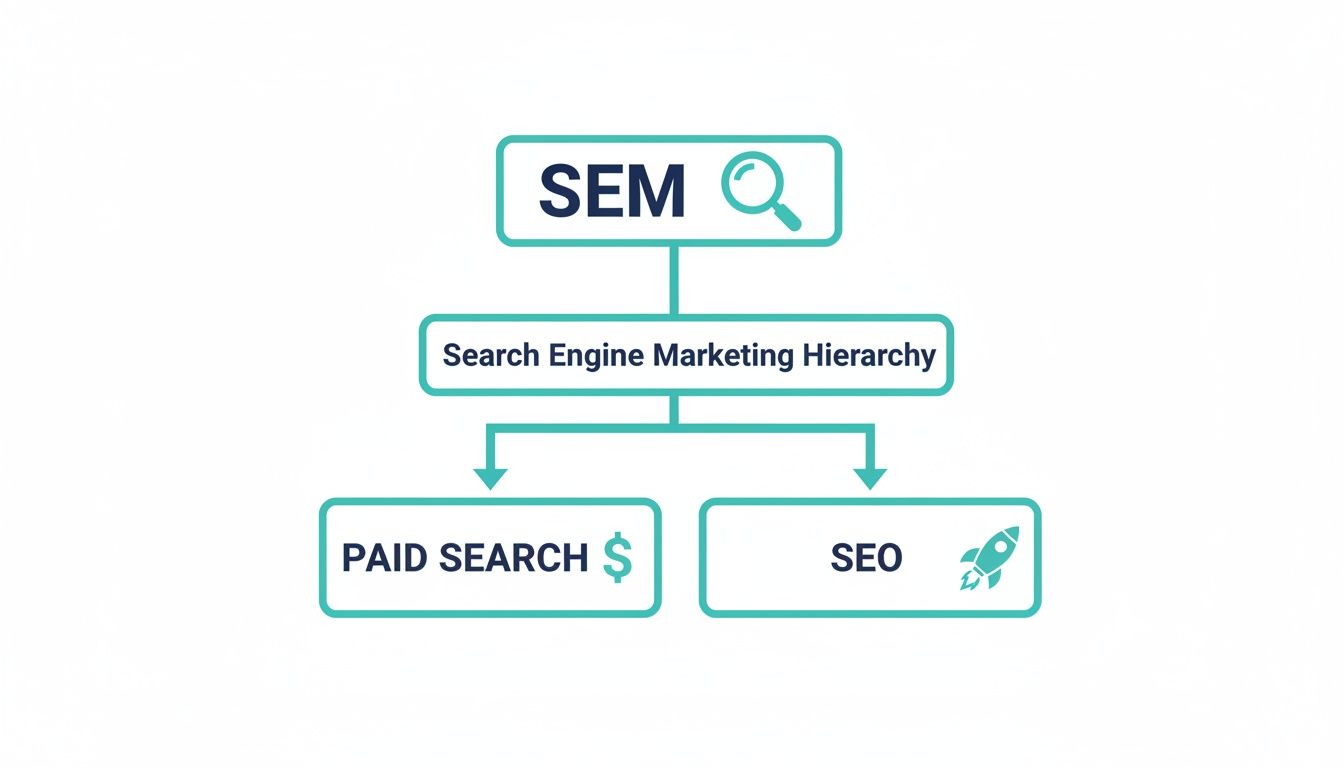
As you can see, a solid SEM plan doesn't choose between paid and organic—it uses both to maximise visibility.
The Real Estate Analogy
Let's break it down with a simple analogy from the world of real estate.
Paid search is like renting a massive, flashy billboard on the busiest motorway in town. You pay for that prime spot, and almost immediately, thousands of people see your brand. It’s high-impact and fast. But the moment you stop paying the rent, your billboard is gone, and so is that visibility.
SEO, on the other hand, is like building and owning the most respected, go-to shop on the high street. It takes time, hard work, and a genuine investment to build that reputation and become the place everyone trusts. Once you're established, though, customers come to you naturally, day after day, without you having to pay for every person who walks through the door.
A Direct Comparison: SEM vs SEO
To make the differences even clearer, here’s a side-by-side look at the key factors that set SEM and SEO apart. This can help you decide where to focus your resources, whether you're chasing immediate leads or building a long-term asset.
SEM vs SEO Direct Comparison
| Factor | Search Engine Marketing (SEM) | Search Engine Optimisation (SEO) |
|---|---|---|
| Primary Goal | Drive immediate, targeted traffic through paid placements. | Build long-term, organic visibility and authority. |
| Cost Model | Pay-per-click (PPC) – you pay every time someone clicks your ad. | No cost per click, but requires investment in time, expertise, and resources. |
| Speed to Results | Nearly instant. Traffic can start flowing within minutes of a campaign launch. | Slow and steady. It can take 3-6+ months to see significant results. |
| Result Longevity | Traffic stops the moment you turn off your ad spend. | Rankings can be durable and provide traffic long after the initial work is done. |
| Placement on SERP | Top or bottom of the page, clearly marked with an "Ad" label. | Below the paid ads in the main, "organic" section of the results. |
| User Trust | Varies. Some users are wary of ads, while others find them highly relevant. | Generally higher. Organic results are often perceived as more credible and trustworthy. |
| Control & Targeting | High. You have precise control over keywords, budget, audience, and ad copy. | Indirect. You influence rankings through best practices but don't directly control them. |
Ultimately, SEM gives you control and speed, while SEO delivers credibility and lasting value. One is a sprint, the other is a marathon, and the best strategies train for both.
Where You Appear on the Page
Another critical difference is simply where you show up on the search results page.
Paid SEM ads get the VIP treatment, appearing right at the top (and sometimes the bottom) of the page, always marked with a small "Ad" label. This is premium real estate reserved for advertisers.
Organic SEO results are what you see just below those ads. While they aren't at the absolute top, research consistently shows that many users skip the ads and trust these organic listings more. A smart SEM strategy ensures you have a presence in both sections, capturing clicks from every type of searcher.
If you're looking to get a firmer grasp on the organic side, particularly from an agency perspective, this guide on demystifying Search Engine Optimization (SEO) for marketing agencies is a great resource.
At the end of the day, SEM and SEO aren't rivals fighting for your budget. They're partners. When used together, they create a powerful synergy, letting you capture immediate interest with paid ads while you build a sustainable, authoritative online presence for the long haul.
How SEM Drives Real-World Business Growth
Alright, let's move past the theory and talk about what really matters: how does Search Engine Marketing actually make the phone ring or get people to click ‘add to cart’? The magic of a well-run SEM strategy is that it perfectly bridges the gap between someone's immediate need and your business's solution.
This isn't about aimlessly chasing clicks. It's about showing up for people who are actively looking for exactly what you sell, right when they're ready to make a decision. That specific connection is what fuels real, measurable business growth.

To see how this plays out, let's walk through two everyday scenarios where a smart SEM approach delivers tangible results for very different kinds of businesses.
A Local Service Provider Responding in an Emergency
Picture this: you're a plumber based in Adelaide. A homeowner frantically discovers a burst pipe flooding their kitchen. They don't have time to ask friends for recommendations; they need a professional now. What’s their first move? They grab their phone and search for "emergency plumber Adelaide."
This is precisely where a targeted Google Ads campaign becomes your best friend. By bidding on that exact keyword, your plumbing business can appear right at the top of the search results page. Your ad copy can shout about your 24/7 service and fast response times, offering an immediate fix for their very urgent problem.
In this situation, SEM isn't just marketing—it's an emergency response system. The customer gets exactly what they need, and your business lands a high-value lead in minutes. This highlights just how powerful it is to capture these high-intent searches, whether you're an electrician, a removalist, or a conveyancer.
This local focus is especially vital in Australia. Did you know that 46% of all Google searches in Australia have local intent? People are looking for something nearby. Even better, a whopping 28% of those local searches convert into a real action, like a phone call or a store visit. This makes SEM a non-negotiable for any Adelaide business targeting local customers. You can explore more of these key Australian marketing statistics in more detail.
An E-commerce Store Recapturing a Lost Sale
Now, let's switch gears to a national e-commerce store that sells running shoes. Their challenge isn't just getting people to their website, but turning browsers into buyers. This is where different parts of an SEM strategy start working together.
First up, they use Google Shopping ads. When someone searches for "women's trail running shoes," the store's products can show up right in the search results with pictures, prices, and star ratings. For a shopper, this visual-first format is incredibly effective and hard to ignore.
But what happens if the visitor checks out a specific pair of shoes and then gets distracted and leaves? This is where remarketing steps in.
Remarketing is the SEM tactic that gives your brand a second chance. It’s all about strategically re-engaging with past website visitors who showed interest but didn’t buy, gently reminding them of what they left behind.
Later that week, that same person might be reading a news article or scrolling through social media. Suddenly, they see an ad for the exact pair of running shoes they were looking at. This perfectly timed reminder is often the nudge they need to head back to the site and finish the purchase. It's a powerful way to lift conversion rates and get more value from your initial ad spend.
Tying It All Together for Growth
These examples really show the versatility of what search engine marketing is and how it adapts to different business goals:
- For Local Services: It’s a lead-generation machine, putting you in front of customers during their moments of urgent need.
- For E-commerce: It drives direct sales with eye-catching product ads and then works to recover lost revenue by re-engaging interested shoppers.
In both cases, SEM is far more than just a marketing expense; it's a direct line to revenue. It connects your business with motivated customers at the very moment they’re ready to act, turning simple search queries into profitable transactions that build a foundation for sustainable growth.
Measuring What Matters: Key SEM Performance Metrics
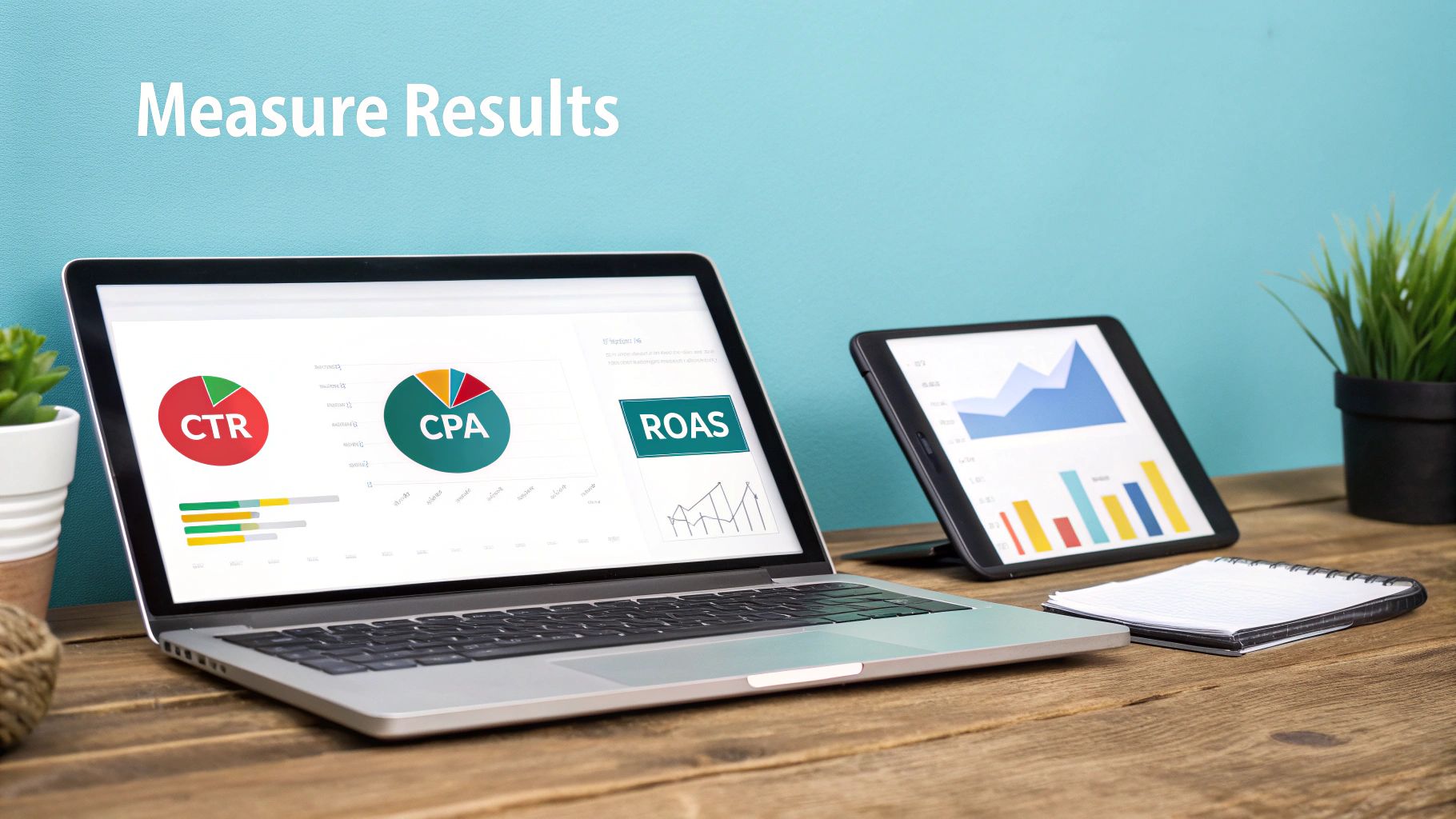
One of the best things about search engine marketing is that you never have to guess if it's working. The data tells you the whole story. But to turn that raw data into profitable decisions, you need to know which numbers to watch. Focusing on the right key performance indicators (KPIs) is what separates just spending money on ads from making strategic investments that actually grow your business.
And it's a significant investment. In Australia, search advertising revenue recently hit a staggering $1.896 billion in a single quarter, a 10% jump from the previous year. This shows just how crucial SEM has become for everyone from local tradies to national e-commerce stores who need a reliable stream of measurable leads and sales.
Core Engagement Metrics
Before you can even think about sales, you need to know if people are paying attention to your ads. That’s where engagement metrics come in. They tell you how well your ad copy, visuals, and targeting are connecting with your audience.
- Click-Through Rate (CTR): This is the percentage of people who see your ad and are compelled to click it. A strong CTR is a great sign that your ad is relevant and hitting the mark.
- Impressions: Put simply, this is how many times your ad has been displayed on a screen. It doesn't track engagement, but it does give you a sense of your ad's overall reach.
- Quality Score (Google Ads): This is Google's own report card on your ads and keywords. It scores you on relevance and quality, and a higher score can earn you lower ad prices and better placements.
Think of your CTR as the first handshake. It proves your message was interesting enough for someone to start a conversation, which is the first step towards making a sale.
Financial and Conversion Metrics
Getting clicks is one thing, but your business runs on sales and leads. Financial and conversion metrics are where the rubber meets the road, connecting your ad spend directly to your bottom line.
These are the numbers that truly matter to your business's health. They don't just tell you if you're getting clicks, but if those clicks are turning into profitable customers.
The most important financial KPIs to track are:
- Conversion Rate: This is the percentage of clicks that lead to a valuable action—like a filled-out contact form, a phone call, or a product purchase. It’s the ultimate test of your campaign's effectiveness.
- Cost Per Acquisition (CPA): Sometimes called Cost Per Conversion, this metric tells you exactly what it costs in ad spend to get one new customer or lead.
- Return on Ad Spend (ROAS): This is the holy grail. ROAS calculates how much revenue you generate for every single dollar you spend on ads, giving you a clear picture of profitability.
Getting a handle on these numbers is non-negotiable. A high CTR looks great on paper, but if your conversion rate is near zero, you’re just paying for website traffic that doesn't convert. Looking at the bigger picture, knowing how to measure marketing ROI helps you prove the overall value of your SEM efforts. By keeping a close eye on these KPIs, you can constantly tweak and improve your campaigns, making sure every dollar is working hard to grow your business.
Getting Started with Your SEM Strategy
So, you're convinced that SEM is the right move for your business. Fantastic. But what’s the next step?
You're at a crossroads, and there are essentially two ways forward. You can roll up your sleeves and manage it all yourself, or you can bring in a specialist agency that lives and breathes this stuff.
There’s no single "right" answer here. The best path for you really boils down to your own resources, how quickly you need results, and what you’re hoping to achieve.
The Do-It-Yourself (DIY) Approach
Going it alone puts you firmly in the driver's seat. You’ll get hands-on experience with powerful platforms like Google Ads, learning the ins and outs of everything from keyword research to writing compelling ad copy and managing your bids. It’s a fantastic way to get a really deep understanding of how your marketing budget is performing.
But let's be honest, this path has a steep learning curve. Getting a real handle on what search engine marketing is and how to do it well takes a serious time commitment—time you might rather spend on other parts of your business. It's also incredibly easy to make expensive mistakes when you're starting out, like bidding on irrelevant keywords or not tracking your conversions properly. Those early errors can burn through your budget with very little to show for it.
Partnering with an SEM Agency
The other option is to call in the experts. Working with a dedicated SEM agency, like our team here at Frank Digital Agency, gives you instant access to a team of pros who already know the landscape. An agency brings years of collective experience, battle-tested strategies, and sophisticated tools to the table right from day one.
Partnering with an agency is like hiring an entire high-performance marketing department. You get the benefit of specialised expertise without the overhead, allowing you to focus on what you do best—serving your customers.
A good team will help you sidestep the common traps, get results faster, and take care of the daily grind of monitoring and optimising your campaigns. This frees you up to concentrate on the bigger picture: growing your business.
Making the Right Choice for Your Business
To figure out which way to go, ask yourself a few honest questions:
- Time: Do you genuinely have several hours each week to learn, manage, and fine-tune campaigns?
- Expertise: Are you ready to get comfortable with data, analytics, and the technical side of ad platforms?
- Budget: DIY might seem cheaper upfront, but are you prepared for the inevitable wasted ad spend while you learn?
- Speed: Do you need to see a return quickly, or can you afford a more gradual process of trial and error?
If you have the time to invest and a genuine interest in digital marketing, the DIY route can be incredibly rewarding. But if your goal is to generate leads and sales as efficiently as possible with a clear return on your investment, partnering with an agency is almost always the smarter and faster way to turn searchers into customers.
Your Top SEM Questions, Answered
Even with all the pieces laid out, it's natural to have a few questions about how all this search engine marketing stuff works in the real world. Let's tackle some of the most common queries we hear from business owners.
These answers should give you the clarity you need to decide on your next move, whether that's dipping your toes into paid ads or doubling down on your website's SEO.
Is SEM Only for Big Companies with Huge Budgets?
Absolutely not. One of the best things about SEM, especially paid search, is that it's incredibly scalable. You can kick off a Google Ads campaign with a small daily budget—even just $10 to $20—to start testing the waters and see what works.
Unlike old-school advertising, you're in the driver's seat. You control every dollar and can ramp things up only when you start seeing a solid return. For a local Adelaide business, this means you can go toe-to-toe with bigger players in your neighbourhood without needing a massive war chest.
How Quickly Will I See Results from SEM?
This is the classic "it depends" scenario because the two sides of SEM work on different timelines.
- Paid Search (PPC): The impact here is almost instant. Once your ads are approved, they can show up at the top of Google within minutes. You can literally start getting website traffic the same day you launch a campaign.
- Search Engine Optimisation (SEO): This is the long game. You might notice small wins early on, but it typically takes a good 3 to 6 months (sometimes longer) to earn strong, stable rankings for the keywords that really matter.
A good way to think about it is this: PPC is like a tap you can turn on for an immediate flow of water. SEO is like digging a well that will provide a sustainable source for years to come.
Can I Do SEM Myself, or Should I Hire a Pro?
You can definitely give it a go yourself. Platforms like Google Ads are built for users to manage, but be warned—there's a steep learning curve. It's incredibly easy to burn through your budget on the wrong keywords or poorly written ads if you don't know the ropes.
Hiring an agency or a specialist brings instant expertise, professional tools, and battle-tested strategies to the table. This almost always gets you a better and faster return on your investment, freeing you up to do what you do best: run your business.
Ready to turn clicks into customers with a strategy that delivers real results? Frank Digital Agency is an Adelaide-based partner that designs high-converting websites and manages ROI-focused Google Ads campaigns to fuel your growth. Learn how we can help your business thrive.