

It's time for a hard truth: just having a website isn't good enough anymore. Far too many Adelaide businesses are sitting on a digital brochure that does little more than take up server space. A modern, performance-focused website needs to be your hardest-working salesperson—the one that never sleeps, tirelessly generating leads and sales 24/7.
Why Your Website Is Your Most Important Sales Tool

Let's ditch the old "build it and they will come" fantasy. For a local business, your website is your digital front door. It’s the very first impression a potential customer from Norwood or Glenelg has of your brand. In that split second, they decide whether to pick up the phone or click away to your competitor.
The crucial change needed is a shift in mindset. Stop thinking of your website as just another expense or an online listing. It's a core business asset, and it needs to be built from day one with clear, measurable goals in mind. This is what separates a business that's thriving online from one with a forgotten URL.
From Digital Brochure to Revenue Engine
A static website is completely passive. It just sits there waiting for people to stumble upon it, offering basic info like a printed flyer. A performance-driven website, on the other hand, is an active, dynamic tool for growth. It's specifically engineered to pull in the right kind of audience and then guide them towards taking a very specific action.
So what does this actually look like for an Adelaide business?
- A local plumber: Their site ranks high on Google for "emergency plumber Prospect," has massive "Call Now" buttons that are easy to tap on a mobile, and is packed with testimonials from happy clients in the area.
- A boutique on The Parade: It's a slick e-commerce site with gorgeous product photos, a checkout process that works flawlessly on a phone, and an option for local customers to click-and-collect.
- A conveyancer in the CBD: It’s a professional, reassuring site that answers common questions through a blog, capturing contact details by offering a free property guide download.
Your website should do more than just inform; it has to persuade. Every single element—from the main headline to the text on a button—must be crafted to move a visitor one step closer to becoming a paying customer.
Avoiding Common Website Pitfalls
I’ve seen countless local business websites fail. It's rarely because of ugly design; it's almost always due to a complete lack of strategy. They're built without a clear purpose, which leads to no traffic, confusing navigation, and zero leads. The goal is to sidestep these traps by putting conversions at the very centre of the plan. You can learn more about how professional web design helps convert leads and boost sales to see what strategic elements are at play.
Ultimately, a great website answers your customer's questions, solves their problems, and makes it incredibly simple for them to give you their money. It's a direct investment in a predictable, scalable revenue stream for your Adelaide business.
Laying the Strategic Foundation Before a Single Pixel is Placed
Jumping straight into design mockups without a solid strategy is like starting a road trip from Adelaide to Perth with no map, no fuel, and a vague sense of direction. You'll burn through resources and end up nowhere fast.
A high-performing website starts with a blueprint. It's a clear plan that defines its purpose and guides every single decision that follows. This foundational work is what separates a genuine business asset from just another pretty (and expensive) online brochure.
First things first, you need to get ruthless about your goals. "Get more customers" isn't a goal; it's a wish. A real goal is specific and measurable. For example, an Adelaide electrician might aim to increase qualified quote requests from the eastern suburbs by 20% within six months. Suddenly, that clarity starts to shape the entire project.
This strategic groundwork forces you to ask the hard questions that deliver real results. It makes sure every dollar you put into small business website design in Adelaide is a direct investment in a tangible outcome for your business.
Defining Your Ideal Adelaide Customer
You can’t build a website for everyone. When you try, you end up with a vanilla site that doesn't really connect with anyone at all. The key is to pinpoint your ideal local customer with almost uncomfortable precision.
Go deeper than basic demographics. What suburb do they live in? What local frustrations do they have that you solve better than anyone else? A conveyancer in the CBD isn't just targeting "homebuyers"; they're targeting first-home buyers in Prospect who feel totally overwhelmed by paperwork and just want clear, friendly guidance.
Ask yourself these kinds of questions to build a real customer profile:
- What are their biggest day-to-day frustrations? (e.g., "I can never get a tradie to actually call me back.")
- What are they typing into Google at 9 PM? (e.g., "best coffee near Glenelg beach.")
- What information do they absolutely need to see before they'll trust you enough to get in touch? (e.g., upfront pricing, photos of past work, reviews from other locals.)
When you understand this person inside and out, you can write copy and design an experience that speaks directly to them. It makes them feel seen and gives them the confidence to choose you.
Mapping the Customer Journey and Structuring Your Content
Once you know exactly who you're talking to, you can map out the path they’ll take through your website. This isn’t just about listing pages in a menu; it's about creating a logical flow that guides a visitor from initial curiosity all the way to taking action. This process is a non-negotiable part of building a website that truly works, and you can dive deeper into building a strategy before launching a website to see just how critical this planning phase is.
A visitor's journey almost always starts with a problem. They might find you through a blog post that answers a niche question, then click over to your services page to see how you can help, and finally land on your contact page to make an enquiry. Each step should feel completely natural and helpful. A huge piece of this strategic foundation is focusing on user experience optimization to ensure your site is a breeze to use.
A common mistake is building a website structure around what the business wants to say, not what the customer needs to know. Your site's navigation should be a mirror of your customer's thought process.
This thinking directly informs your sitemap and content plan. Every page needs a job to do. Your homepage has to grab them and communicate your value instantly. Your service pages must sell the benefits, not just list the features. And your 'About Us' page? That's your chance to build trust and a real human connection.
Ultimately, compelling copy is the fuel for your design. Without it, even the most stunning website will fail to convert. This is the framework that allows you to build with purpose.
How to Choose the Right Adelaide Web Design Partner
Picking the right team for your website is probably the single biggest decision you'll make in this whole process. It’s not just about finding someone who can build a pretty site; it's about finding a genuine partner who gets what it takes to grow a business in Adelaide and can turn your website into a real, money-making asset.
The Adelaide market has no shortage of designers, freelancers, and agencies, all with slick-looking portfolios. Your job is to cut through the noise. A great partner will spend more time asking about your business goals and your customers than they will about your favourite colours.
Going Beyond the Portfolio
A stunning portfolio is a starting point, but it barely tells half the story. A design that worked wonders for a cafe down in Glenelg could be completely wrong for a law firm in the CBD. You need to see evidence of a smart, repeatable process that gets results, not just a gallery of pretty pictures.
So, instead of just flicking through their past work, ask them to talk you through it. A true digital partner should be able to pull up a case study and explain the business problem they were hired to solve. They should connect the dots between their design choices and a tangible outcome, like a jump in online bookings or a phone that started ringing off the hook.
A top-tier Adelaide web design agency sells outcomes, not just websites. Their success is tied directly to your success, and their entire process should reflect that shared goal from the very first conversation.
This is the key difference between hiring a technician and bringing on a strategic partner. A technician builds what you ask them to. A partner will challenge your assumptions, ask the tough questions, and guide you towards what your business actually needs to grow.
Why a Local Adelaide Agency Matters
There’s a real advantage to working with a local agency that goes way beyond being in the same time zone. An Adelaide-based team just gets the local market. They understand the mindset of customers in the Barossa is different from those in the Adelaide Hills because they live and work here too.
This local knowledge makes a huge difference in your website's strategy.
- Market Nuance: They know the local competition and what it takes to stand out, whether you're based in Prospect or Unley.
- Authentic Connection: The words and visuals they use will feel genuine to an Adelaide audience, avoiding that generic, corporate-speak that falls flat.
- Face-to-Face Collaboration: Sometimes, nothing beats sitting down in the same room to hash out a strategy. It builds a much stronger, more trusting partnership.
More and more Adelaide businesses are catching on. We're seeing a big push from local micro-businesses and sole traders wanting mobile-friendly sites and clear navigation, and they’re specifically looking for local providers to do it. A great example is a local tourism client who, with the right local strategy, hit a 4.5 Google ranking for a super-competitive keyword—a massive win for a small business. You can see more on how this local focus pays off with these Adelaide case studies.
Key Questions to Ask Any Potential Partner
Before you sign on the dotted line, you need to do your homework. This isn’t about making things difficult; it’s about being a savvy business owner. The right questions can tell you everything you need to know about an agency’s approach.
Here's a handy checklist to help you evaluate potential web design partners. It's designed to help you look past the sales pitch and understand how they actually work and what you can expect.
Agency Selection Checklist: What to Ask Before You Hire
| Evaluation Criteria | Questions to Ask | What to Look For (Red Flags & Green Lights) |
|---|---|---|
| Strategic Approach | "What does your process look like before you start designing?" | Green Light: They talk about customer research, competitor analysis, goal setting, and content strategy. Red Flag: They want to jump straight into mockups without any discovery phase. |
| Measuring Success | "How do you measure the success of a website you've built?" | Green Light: They talk about business metrics: leads, conversion rates, sales, and ROI. Red Flag: They only mention vague things like traffic or how good it looks. |
| Communication | "Who will be my main point of contact, and how often will we hear from them?" | Green Light: A clear answer with a dedicated contact and a regular update schedule. Red Flag: Vague answers or the sense that you'll be passed around. |
| Relevant Experience | "Do you have experience with businesses like mine or with similar growth goals?" | Green Light: They can show examples of how they’ve solved similar business problems, even if not in your exact industry. Red Flag: They can only show work from completely unrelated fields. |
| Pricing & Scope | "What, specifically, is included in the price? What might cost extra later on?" | Green Light: A detailed, itemised proposal. They're upfront about costs for revisions or future additions. Red Flag: A single, unexplained lump-sum price with no detail. |
Taking the time to ask these questions will save you a world of headaches later. It ensures you're both aligned from day one.
Finding the right partner is a mission-critical step. For a deeper look at what separates the good from the great, check out our guide on how to choose the ideal web design company for your business. This initial investment in vetting your options will pay off tenfold when you find a team that’s as committed to your growth as you are.
Bringing Your Website to Life: From Blueprint to Launch
Alright, you’ve got your strategy locked in. Now for the exciting part: turning those plans and customer insights into a real, working website. This is where the magic happens, but it’s a disciplined process. Forget just picking pretty colours; a modern website build is a structured journey from a basic sketch to a powerful sales machine.
Our entire philosophy is built around ‘conversion-led’ design. What does that mean? It means every single thing on your site—from the layout of the homepage to the words on a button—has a job to do. That job is to gently guide your visitor toward taking the action you want, whether that’s making a call, filling out a form, or buying a product. It’s a practical mindset that ensures your investment in small business website design in Adelaide actually brings in leads and cash.
The whole thing usually kicks off with wireframes and what we call user experience (UX) planning. Think of a wireframe as the architectural blueprint for your site. It’s a simple, black-and-white map showing where everything goes—menus, buttons, forms—without the distraction of design elements. We focus purely on function and flow here, making sure the path for a user is dead simple and logical.
Why You Absolutely Must Start with Mobile-First Design
Let’s be blunt: your customer's first impression of your business will almost certainly be on their phone. This isn't a "trend" anymore; it's the default. That’s why a mobile-first design approach isn’t just a good idea, it's non-negotiable. It means we design the mobile version of your website first, and only then adapt that clean, focused layout for bigger screens like desktops.
Starting with the smallest screen forces you to be ruthless with what’s important. With limited real estate, you have to prioritise your core message and calls-to-action. The happy side effect is a cleaner, faster, and more effective experience across every single device.
The data backs this up, especially here in Australia. Website redesigns are gathering serious momentum, with 42% of local SMEs set to overhaul their sites between late 2025 and the end of 2026. A huge driver for this is the fact that over 65% of first-time customer interactions now happen on a mobile. Businesses that have already made the switch are seeing an average 23% improvement in page speed and a 17% jump in engagement—both of which directly help with Google rankings. You can dig into more of these stats about the rising website redesign activity in Australia.
Marrying Visuals with On-Page SEO Foundations
Once the UX blueprint is approved, the user interface (UI) design can begin. This is the part everyone thinks of—the colours, fonts, and images that bring your brand’s personality to the surface. A sharp, professional UI builds trust in an instant, while a cluttered or dated look will have people hitting the 'back' button before you can blink.
So, for an Adelaide tradie, what does a great UI look like in practice?
- A phone number you can’t miss right at the top of every single page.
- Big, clear service buttons for things like "Emergency Plumbing" or "Electrical Repairs."
- Genuine photos of the actual team on the job, not cheesy stock images.
This infographic breaks down the simple, high-level process for finding a design partner who can make this happen.
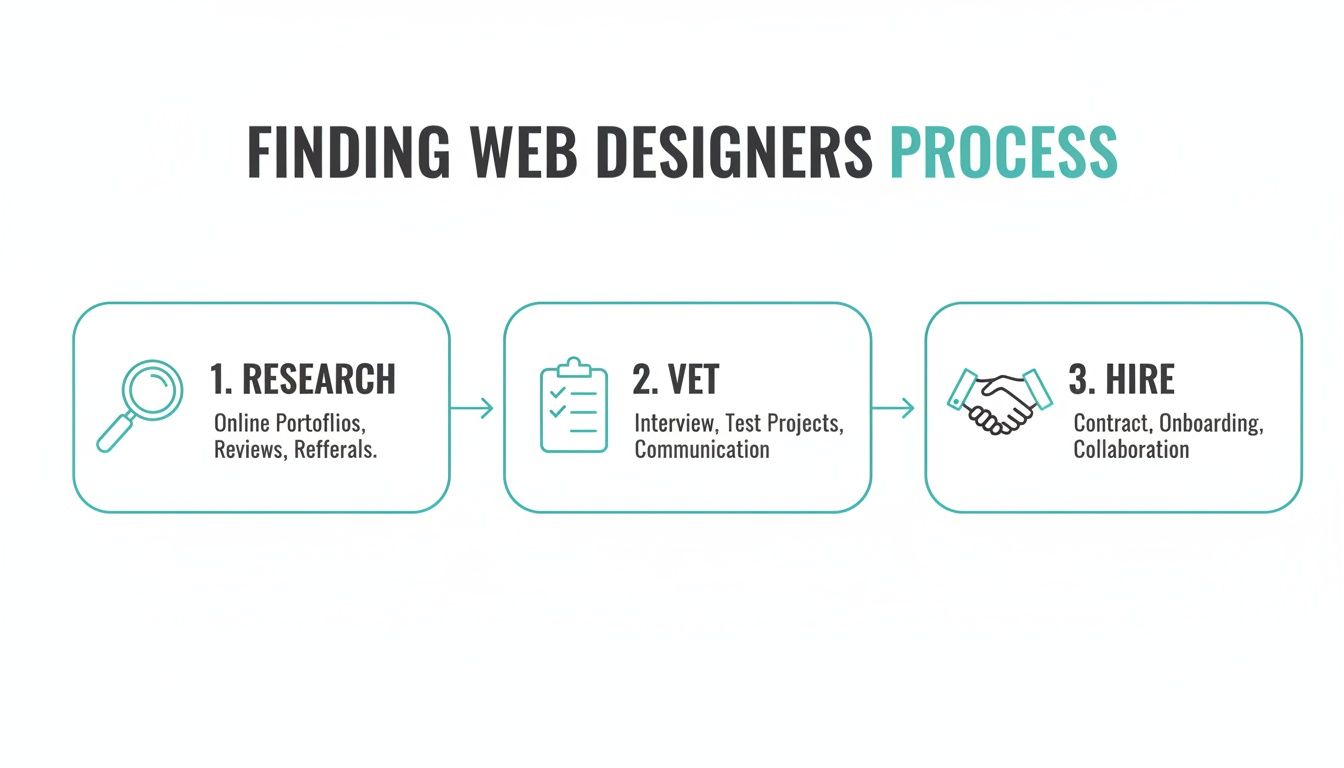
As you can see, a methodical approach—from research to vetting to hiring—is the secret to getting a great result.
While the designers are making things look good, the foundational on-page SEO needs to be built right into the structure. This is not some optional extra you tack on at the end. It means building the website's code and content in a way that Google can easily read, understand, and rank.
Your website's code is its first conversation with Google. If the conversation is confusing or slow, you'll never get the ranking you deserve, no matter how beautiful the design is.
Here are the non-negotiable on-page SEO elements that have to be baked in from day one:
- Logical Heading Structure: Using H1, H2, and H3 tags correctly to tell search engines what’s important on each page.
- SEO-Friendly URLs: Clean, descriptive URLs (like
yourbusiness.com.au/plumbing-services-adelaide) are far better than random, messy ones. - Image Optimisation: Every image must be compressed for speed and given descriptive 'alt text' so Google knows what the picture is about.
- Fast Page Speed: The site needs to be built to be lightweight and load in under three seconds. This is a massive ranking factor.
By weaving these technical pieces into the design and build from the very start, you’re creating a website that is primed for visibility the moment it goes live. It’s how you make sure your beautiful new site doesn’t just sit there looking pretty—it gets found.
Driving Traffic and Measuring Your Website's Success
Alright, your new website is live. It looks fantastic and you’re ready for business. But here’s the thing: launching a site without a plan to get eyeballs on it is like opening a beautiful new shop on a quiet backstreet with no signs. We need to build the pathways that lead customers right to your digital front door.
This is where the real work begins—and where you make your investment pay off. We’re shifting from the build phase to the growth phase, which boils down to two critical jobs: driving targeted, local traffic and proving your return on investment. If you aren't doing both, you're just guessing.
Honestly, many Australian businesses are dropping the ball here. A staggering 64% of SME owners don't fully grasp the importance of SEO, and only 36% are actually using it well. This isn't bad news; it's a massive opportunity for Adelaide businesses ready to get serious. By putting a solid, performance-driven strategy in place now, you can leapfrog the competition. You can read more about the current digital gap among Australian small businesses to see just how big that gap is.
Using Google Ads to Reach Active Buyers
Think of SEO as the long game—building organic authority over time. But if you want an immediate impact, Google Ads is your go-to. It lets you place your business directly in front of Adelaide customers at the exact moment they're searching for what you offer. This isn't about casting a wide, expensive net; it’s about surgical, strategic targeting.
A professionally managed campaign is a world away from a DIY effort. It’s laser-focused on ROI, using proven tactics to attract high-intent local customers.
- Hyper-Local Keyword Targeting: Instead of a broad term like "lawyer," we'd target specific phrases like "family lawyer Norwood" or "conveyancer Prospect SA." This captures people who are much closer to making a decision.
- Compelling Ad Copy: The ad itself needs to speak directly to a local's problem, offering a clear solution and a compelling reason to choose you over the other guys.
- Landing Page Optimisation: Clicks are sent to a dedicated page on your site that directly matches the ad's promise. This makes it incredibly simple for a visitor to take the next step.
This focused approach ensures your marketing budget is spent attracting qualified leads, not just random clicks. It’s the fastest way to get your new website generating real, tangible results.
Demystifying Google Analytics: Your Business Dashboard
If Google Ads is the engine driving traffic, then Google Analytics is the dashboard showing you how that engine is performing. Setting it up isn't optional; it's essential. It’s the only way to truly understand what people are doing once they land on your site.
Without this data, you're flying blind. You won’t know which pages are resonating, where you’re losing potential customers, or which of your marketing efforts are actually making you money.
Your website data tells a story about your customers. Learning to read it is how you turn your online presence from an expense into a predictable, measurable revenue stream.
Just a few of the key questions Google Analytics can answer for you:
- Where are my visitors coming from? (e.g., Google search, Facebook, direct traffic)
- What are my most popular pages? (Tells you what content your audience loves.)
- How are people finding me on Google? (Which search terms are bringing them to you?)
- Are mobile visitors converting as well as desktop visitors?
This information is pure gold. It allows you to make data-backed decisions to continually improve your site and your marketing, letting you double down on what works and fix what doesn't.
The final piece of this puzzle is connecting your marketing spend to actual business outcomes. We do this through conversion tracking. A 'conversion' is simply any valuable action someone takes on your site—filling out a contact form, making a phone call, or buying a product. To properly measure how your website generates leads and sales, exploring top conversion tracking tools is a must for understanding your ROI. By tracking these actions, you can calculate exactly how much revenue your website and your Google Ads are generating, proving the value of your entire digital investment.
Your Top Adelaide Website Design Questions, Answered
If you're thinking about investing in a new website for your business, you've probably got a lot of questions. That's a good thing. Getting clear, honest answers is the first step to making a smart decision. We've pulled together the most common questions we hear from Adelaide business owners to give you the practical insights you need.
How Much Does a Small Business Website Cost in Adelaide?
This is always the first question, and the only honest answer is: it depends. The cost for a small business website in Adelaide comes down to what you need it to do. It's a bit like buying a new work vehicle; a simple ute for running around town is going to have a very different price tag than a fully-fitted-out commercial van built for a specific trade.
For a basic, professional-looking 'brochure' site using a template, you might be looking at a starting point of around $3,000 to $5,000. This will get you online and looking sharp.
But if you're after a proper lead-generation machine—something designed from the ground up to attract and convert customers with custom design, strategic copywriting, and features like online bookings—then a realistic budget is somewhere in the $6,000 to $15,000+ range.
What pushes the price up? A few key things:
- Custom vs. Template Design: A unique design built just for your brand costs more than a pre-made template, but the difference in user experience and conversion rates is night and day.
- Number of Pages: Simply put, more pages mean more time spent on design, development, and content creation.
- Specific Features: Need e-commerce to sell products? A booking system for appointments? Or a custom quoting calculator? These specialist features add complexity and cost.
- Copywriting and Strategy: A website with professionally written, SEO-focused copy will always outperform one where the client supplies the text themselves. Good copy sells.
Think of your website as a business investment, not just a line-item expense. A cheap website that brings in zero leads isn't a bargain—it's a waste of money. A well-built site that consistently brings in new work can pay for itself many times over.
How Long Does It Take to Build a New Website?
Great work takes time. Building a professional, strategic website isn't an overnight job, and you should be wary of anyone who says it is. A realistic timeline for most small business websites, from our first chat to launch day, is typically between 6 and 12 weeks.
This timeframe allows for a proper, structured process that avoids rushed work and the costly mistakes that come with it. It’s broken down into a few key phases, each one building on the last.
- Strategy & Planning (1-2 weeks): This is where we dig deep with discovery meetings, look at what your competitors are doing, and map out the website's goals and structure.
- Design & Content (2-4 weeks): This phase is all about creating wireframes, visual mockups, and getting all the website copy written and approved.
- Development & Build (3-6 weeks): This is the heads-down, technical part where our developers turn the approved design into a fully functioning website.
- Testing & Launch (1 week): Before going live, we put the site through its paces with rigorous testing, make final tweaks, and then deploy it for the world to see.
Honestly, the biggest thing that can slow a project down is delayed feedback or content from the client. Quick responses and providing all the necessary info on time are the secret ingredients to keeping a project on track.
Is Ongoing Website Maintenance Really Necessary?
One hundred percent, yes. Launching your website is the starting line, not the finish line. Skipping a maintenance plan is like buying a brand new car and never taking it in for a service. It'll probably run fine for a bit, but sooner or later, something will break.
Think of website maintenance as essential insurance for your most important digital asset. It protects your investment and makes sure your site stays fast, secure, and working as it should. A good plan will always cover three critical areas:
- Security Updates: Regularly updating your website’s software (like WordPress and its plugins) is the single most important thing you can do to stop it from getting hacked.
- Performance Optimisation: Keeping everything up-to-date helps your site run quickly, which is vital for keeping visitors happy and for your rankings on Google.
- Regular Backups: If the worst happens, having recent, reliable backups means your website can be restored in a flash, minimising downtime and lost business.
Should I Use SEO or Google Ads for My New Website?
This isn't an "either/or" question. The smartest approach is to use both. SEO and Google Ads are two different tools that work together brilliantly, giving you short-term wins while you build long-term, sustainable growth.
Google Ads gets you traffic right now. For a brand-new website, this is huge. You can start sending targeted Adelaide customers to your site from the day it launches, generating leads and making sales while your long-term plan starts to build momentum.
Search Engine Optimisation (SEO) is the long game. It's the process of building your site's authority and relevance so it shows up in Google's search results organically (for free). This takes time and consistent effort, but the payoff is a powerful asset that brings in high-quality traffic without you having to pay for every single click.
Our advice? Use Google Ads to get the ball rolling and secure some quick wins. At the same time, invest in foundational SEO to build a powerful growth engine that will serve your business for years to come.
Ready to build a website that doesn't just look great, but actively grows your Adelaide business? At Frank Digital Agency, we specialise in performance-driven design and ROI-focused digital marketing. Let's have a chat about your goals. Contact us today to get started.