

So, you’re wondering what a new website is going to set you back. Let's cut to the chase.
For a professional small business website here in Australia, you're typically looking at an investment between $3,000 and $8,000. If you're planning to sell online, a good e-commerce store generally falls in the $8,000 to $25,000 range. These aren't just numbers plucked from thin air; they reflect the genuine strategy, design, and technical skill needed to build a website that actually does its job—bringing you more business.
Demystifying Your Website Investment
Figuring out website costs can feel a bit like a guessing game. I find it helps to think of it like building a house. You could pick a standard floor plan (that's your template-based site), add a few custom finishes, or bring in an architect for a completely bespoke design. The price for each is wildly different because the labour, materials, and complexity all change. A website is exactly the same.
A basic site is little more than a digital brochure, but a strategically built website is a 24/7 sales and marketing machine. The investment isn't just for a pretty design; it’s for the entire engine under the hood. We're talking about the user's journey from landing on your site to becoming a customer, plus all the technical groundwork that helps you show up when people search on Google.
Breaking Down the Price Brackets
To give you a clearer picture, let's look at what your budget gets you. The platform your site is built on also plays a huge role in the final cost, so it’s worth taking the time to choose between Framer and Webflow and see how they stack up financially.
Here’s a rough guide to what you can expect to pay for a website in Australia:
To make this even clearer, here's a quick summary of what different types of Australian businesses can expect to invest.
Typical Website Investment For Australian Businesses
| Website Type | Typical Price Range (AUD) | Best For |
|---|---|---|
| Brochure / Lead Gen | $3,000 – $8,000 | Tradespeople, local service providers, consultants, small professional firms. |
| Custom / Advanced | $8,000 – $15,000 | Businesses needing booking systems, client portals, or unique layouts. |
| E-commerce (Basic) | $8,000 – $15,000 | Retailers starting online with a small to medium product catalogue. |
| E-commerce (Advanced) | $15,000 – $25,000+ | Established online stores with large inventories & complex integrations. |
This table provides a starting point, but every project has its own unique requirements that will shape the final quote.
Basic Brochure Sites ($3,000 – $8,000): This is the sweet spot for getting a professional, credible online presence up and running. It’s perfect for Adelaide-based tradies, local service businesses, or consultants who need to look sharp and be found online. This budget typically covers a clean, mobile-friendly design across 5-10 pages, with all the foundational SEO in place to get you started.
E-commerce and Custom Sites ($8,000 – $25,000+): When your website needs to do more—like sell products, handle bookings, or manage a client portal—the complexity and investment naturally go up. This price range accounts for secure payment gateway setups, product database configuration, and a carefully designed user experience that makes it easy for customers to hit that "buy now" button.
A great website is an investment in your business's future. The initial cost is just one part of the equation; the real value lies in the leads, sales, and brand credibility it generates over its lifetime.
Remember, the initial build is just the beginning. It's crucial to also budget for the ongoing costs that keep your site secure, fast, and visible. Think of things like hosting, domain renewals, and regular maintenance—they're the essential check-ups that ensure your digital asset keeps performing for you long after launch day.
The 7 Key Factors That Shape Your Final Quote
So, why does one website cost $5,000 while another that looks pretty similar gets a $50,000 price tag? The real answer isn’t just about what you see on the screen. It’s buried in the complexity, strategy, and engineering happening behind the scenes.
Think of your final website design cost as a sum of its parts. Once you understand these individual components, you’re in a much better position to make a smart investment. Let's pull back the curtain on the seven biggest drivers that will influence your final quote.
1. The Number of Pages
This one seems obvious, but it’s a foundational driver of cost. A simple five-page website for an Adelaide tradie—think Home, About, Services, Gallery, and Contact—is a relatively straightforward job. It requires far less design and development time than a 50-page site for a professional services firm that needs separate pages for every service, team bios, and detailed case studies.
Every single page needs its own strategy, wireframe, design, and content. The more pages you add, the more time and expertise are invested, which naturally pushes up the cost. It’s like the difference between building a one-bedroom unit and a sprawling multi-level house; the materials might be similar, but the sheer scale dictates the budget.
2. Custom Design vs. Template Design
This is probably the most significant fork in the road for your budget. A template-based design uses a pre-built layout that gets customised with your branding, colours, and content. It’s a faster and more affordable way to get online, making it a solid choice for businesses on a tighter budget.
A custom design, on the other hand, is built from the ground up. We start with a completely blank canvas and craft an experience tailored specifically to your business goals, your customers, and your unique brand identity. This process is far more involved, demanding deep strategic thinking, user experience (UX) research, and one-of-a-kind visual design. The result is a unique digital asset that gives you a genuine competitive edge, and that bespoke approach requires a larger investment.
While a template gets you online quickly, a custom design is engineered specifically to guide your ideal customer toward conversion. It’s the difference between an off-the-rack suit and a tailored one—both work, but one fits your specific needs perfectly.
3. E-commerce Functionality
Thinking of selling products online? That's when the complexity—and the cost—really ramps up. Adding e-commerce isn’t as simple as dropping in a "buy now" button. It’s a whole ecosystem of critical features that have to work flawlessly together.
- Product Catalogue Setup: Adding and organising all your products, complete with variations like size and colour.
- Secure Payment Gateways: Integrating trusted, secure payment processors like Stripe or PayPal.
- Shopping Cart and Checkout: Designing an intuitive and frictionless journey from cart to confirmation.
- Inventory Management: Building systems to automatically track what’s in stock.
- Shipping and Tax Calculations: Configuring complex rules for different products and locations.
Each of these elements requires specialist development and rigorous testing to ensure your customers have a secure and smooth experience. That expertise is reflected in the final website design cost.
This concept map helps visualise how the cost brackets shift for different types of websites.
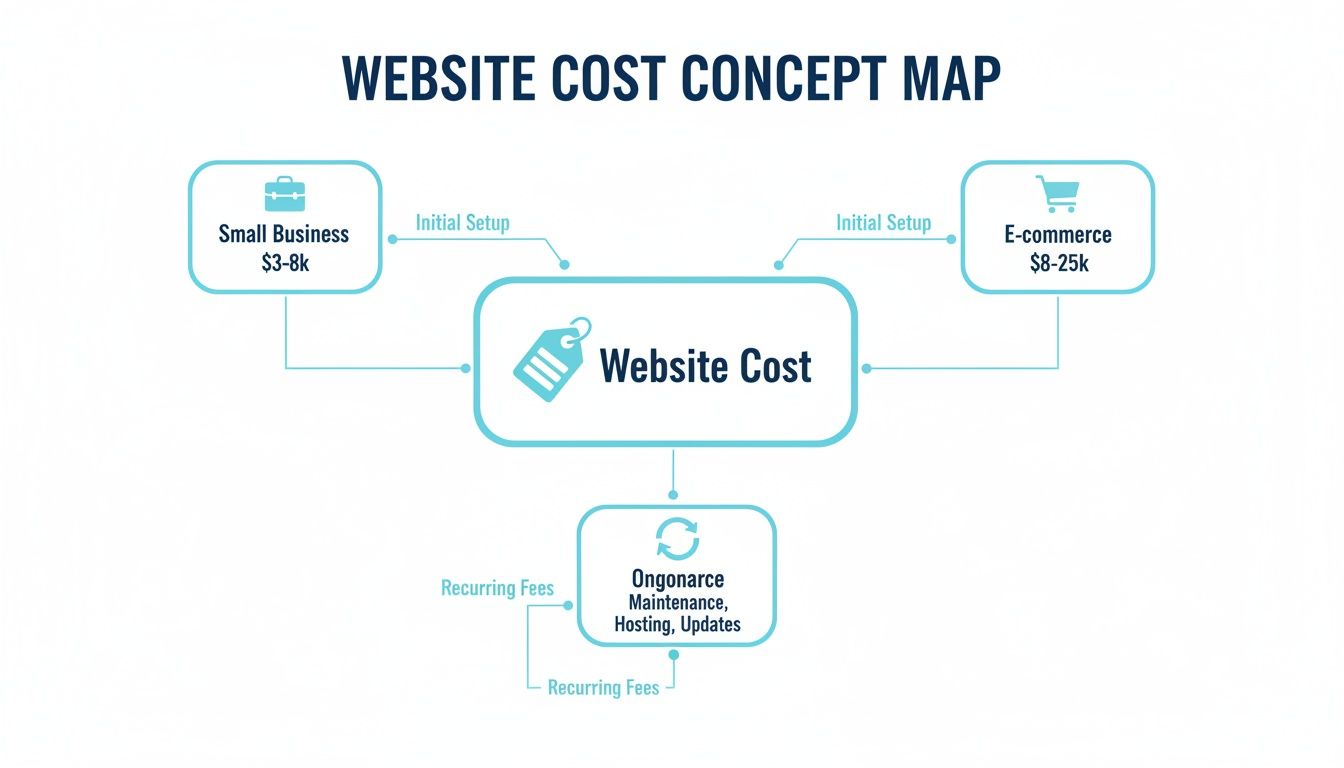
As you can see, the initial investment for an e-commerce site is higher, and it's vital to also budget for the ongoing costs that come with running an online store.
4. Content Management System (CMS)
A Content Management System is the engine under the hood of your website. It's the platform that lets you log in and update content without having to call a developer. While popular choices like WordPress are incredibly powerful and flexible, the cost to set them up properly can vary.
The job involves installing the platform, configuring all the necessary settings, and often customising the backend to make it dead simple for you and your team to manage. When you're looking at quotes, don't forget to factor in the ongoing needs of your chosen platform, such as managed WordPress hosting costs.
5. Custom Features and Integrations
This is where a budget can really stretch. Most websites share a set of common features, but what happens when you need something special? Maybe it’s an online booking system that syncs directly with your calendar, a secure client portal for sharing files, or an integration with your CRM software so new leads are captured automatically.
Every custom feature or third-party integration requires skilled development work to make it talk to your website seamlessly. A simple contact form is a world away from a multi-step quoting tool that pushes data directly into your sales team's pipeline.
6. Professional Content Creation
A website is just an empty shell without words and images that connect with your audience. While you can always supply your own, professional content creation is a separate service that can deliver huge value.
This might include:
- Copywriting: Crafting persuasive, SEO-friendly text that speaks directly to your ideal customer and nudges them towards taking action.
- Photography and Videography: High-quality, professional visuals that make your products, services, and team look their absolute best.
Investing in professional content isn’t just an expense; it ensures your message is clear, engaging, and actually optimised to turn visitors into customers.
7. Foundational Search Engine Optimisation (SEO)
What good is a brilliant website if no one can find it? Foundational SEO isn't an optional extra; it's a non-negotiable part of any professional website build. This isn't about a full-blown monthly SEO campaign, but it is about laying the essential groundwork for future success.
This includes critical tasks like keyword research, on-page optimisation (titles, meta descriptions), creating a logical site structure, and ensuring the site is technically sound so Google and other search engines can easily crawl and index your pages. It’s about building your site on solid rock, not sand.
Real-World Cost Scenarios for Adelaide Businesses
Let's ground all this talk of cost drivers in reality. To see how these factors come together, we'll walk through a few practical examples for local Adelaide businesses. This is where you can start to benchmark your own project, seeing the clear line between business goals, the features needed to achieve them, and what that looks like as an investment.
Scenario 1: The Local Tradie
Think of an Adelaide plumber. Their goal is simple and direct: get the phone ringing and fill the inbox with quote requests from people in their service area. The website doesn't need to win any abstract design awards; it needs to be a workhorse that builds trust fast and makes it dead simple for a potential customer to reach out.
- What it needs to do: Capture qualified leads, look professional and trustworthy, and show up when someone searches "plumber Adelaide."
- Must-have features: A clean, mobile-friendly design is non-negotiable. It also needs a clear "Request a Quote" form, click-to-call phone numbers, a gallery showing off their work, and real customer testimonials.
- Likely Investment: $3,500 – $7,000 AUD. This isn't just a brochure; it's a 24/7 lead generation machine.
Scenario 2: The Professional Services Firm
Now picture a conveyancing firm in the CBD. Their website has a bigger job to do. It’s not just about getting leads; it’s about establishing serious authority, communicating deep expertise, and even making the client onboarding process smoother. The look and feel must scream professionalism to attract the right kind of client.
- What it needs to do: Build brand credibility, educate visitors on their services, and connect with their CRM or document management software to improve efficiency.
- Must-have features: A completely custom, brand-aligned design. You'll need detailed service pages, team bio pages, maybe a secure client portal, and a well-maintained blog to prove their expertise.
- Likely Investment: $7,500 – $15,000 AUD. The jump in price here is down to the bespoke design work and the technical side of integrating with other business software.
Scenario 3: The Health and Wellness Clinic
Imagine a boutique physiotherapy clinic nestled in the Adelaide Hills. Their website has to be a digital reflection of the calm, professional experience clients get in person. The absolute priority is making it incredibly easy to book an appointment, all while beautifully showcasing their space and services.
- What it needs to do: Drive online bookings, cut down on admin time spent on the phone, and show off the clinic's environment and treatment options.
- Must-have features: An online booking system that syncs directly with the clinic’s calendar is essential. This is paired with elegant photo galleries, detailed service descriptions (often with pricing), and profiles of the practitioners.
- Likely Investment: $6,000 – $12,000 AUD. This budget allows for a stunning custom design that’s backed by the powerful booking functionality needed to run the business smoothly.
Your website is not an expense; it's a core business asset. The right investment aligns directly with your specific commercial goals, whether that’s generating leads, selling products, or streamlining your operations.
Scenario 4: The Local E-commerce Brand
Let's take a local Adelaide maker of artisan homewares who wants to start selling across Australia. This is by far the most complex project. It’s not just a website; it’s a full-blown online retail operation that needs to be secure, fast, and fine-tuned to convert visitors into customers, especially when you're spending money on Google Ads to bring them there.
In Australia, an e-commerce website is a more significant undertaking, with quality small-business builds typically falling between $8,000 and $25,000 AUD. For an Adelaide brand serious about growth, this range covers a high-performing storefront built to work hand-in-glove with paid ad campaigns.
As local experts point out, this investment breaks down into a few key areas: core development ($10,000–$25,000), plus specific add-ons like shipping automation ($300–$1,000), security certificates ($200–$600 per year), and foundational SEO ($800–$2,000) to get the right traffic from day one. You can find more detail on Australian e-commerce costs in this guide from Nirmal.com.au.
- What it needs to do: Generate online sales, manage stock, offer a rock-solid checkout experience, and deliver a high return on ad spend (ROAS) from Google Ads.
- Must-have features: A powerful e-commerce platform, secure payment gateway integrations, a product catalogue with fantastic photography, inventory management, and conversion rate optimisation (CRO) built-in.
- Likely Investment: $10,000 – $25,000+ AUD. This reflects the complexity of building a complete digital retail business designed for serious growth.
To make this even clearer, here’s a quick-glance table comparing these common Adelaide business scenarios.
Sample Website Project Costs in Adelaide
This table provides a snapshot of typical project scopes and their associated costs, helping you place your own business needs into context.
| Business Type | Key Features | Estimated Cost Range (AUD) |
|---|---|---|
| Local Tradie (e.g., Plumber) | Mobile-first, quote forms, click-to-call, photo gallery, testimonials, basic local SEO. | $3,500 – $7,000 |
| Professional Services (e.g., Conveyancer) | Custom brand design, detailed service pages, team bios, blog, potential CRM/client portal integration. | $7,500 – $15,000 |
| Health Clinic (e.g., Physio) | Integrated online booking system, practitioner profiles, service descriptions, photo/video galleries. | $6,000 – $12,000 |
| E-commerce Store (e.g., Homewares) | E-commerce platform, payment gateway, inventory management, secure checkout, product pages, CRO-focused design. | $10,000 – $25,000+ |
These figures should give you a solid starting point. Remember, the final cost always comes down to the specific goals and the unique functionality your business needs to succeed online.
Budgeting Beyond the Build for Ongoing Success
Launching your brand-new website is a huge moment, but it's the starting line, not the finish. A high-performing website is a living, breathing asset that needs ongoing care to protect your initial investment and keep bringing in customers. A massive part of understanding the total website design cost is planning for these essential recurring expenses.
Skipping this step is like buying a new car but never budgeting for petrol, insurance, or a service; eventually, it’s just going to stop working for you. A smart, proactive plan ensures your site remains a valuable business tool, not an outdated and vulnerable liability.
Essential Ongoing Website Costs
To keep your digital storefront open for business, secure, and running like a well-oiled machine, you need to account for a few key services. These aren't optional extras; they're the fundamental utilities that power your entire online presence.
Here’s a breakdown of the four main recurring costs you should have on your radar:
- Website Hosting: Think of this as the rent you pay for the digital real estate where your website's files live. Cheap hosting might look appealing, but it often leads to painfully slow load times, weak security, and shared server space that can drag your site down. Quality hosting ensures your site is fast and reliable, which is non-negotiable for both user experience and SEO.
- Domain Name Registration: This is your website's street address on the internet (like frankdigital.agency). It's a small but vital annual fee that keeps your unique address registered solely to you.
- SSL Certificate: An SSL certificate encrypts the data flowing between your users' browsers and your server, which is what puts that little padlock icon in the address bar. It’s absolutely essential for security, building user trust, and it's a confirmed Google ranking factor.
- Website Maintenance Plan: This is arguably the single most important ongoing investment you'll make. It’s your insurance policy against the digital world's constant threats and updates.
Why Professional Maintenance Is Non-Negotiable
A professional maintenance plan is more than just a "nice-to-have." It’s the active service that shields your website from security breaches, keeps it loading quickly, and ensures all its features continue to work as they should after inevitable software updates.
Think of a maintenance plan as preventative care for your most valuable marketing asset. It’s all about fixing problems before they happen and optimising performance so you can focus on running your business, not troubleshooting a broken website at 10 PM.
Without regular, professional maintenance, your site becomes an easy target for hackers. Plugins become outdated and can break key functions (like your contact form!), and performance can slow to a crawl over time, directly hurting your ability to convert visitors into leads or sales.
For larger businesses, the stakes are even higher. While an enterprise-level website design in Australia can start from AUD $25,000, with maintenance hitting $500-$2,000 per month, this investment is a drop in the ocean when website downtime can cost a business thousands per minute. You can find a detailed cost analysis for larger projects from Digital Nomads HQ.
Ultimately, budgeting for these ongoing costs is a core part of a successful digital strategy. It ensures the money you invest upfront in your website build continues to generate a positive return for years to come.
How a Great Website Gets More Out of Your Ad Budget
Throwing money at Google Ads while your website is slow, clunky, or confusing is like trying to fill a bucket with a massive hole in the bottom. You can keep pouring your budget in, but you'll never see the results you're after. A cheap website doesn't just look bad; it actively works against your ad spend, frustrating the very people who clicked your ad and causing them to leave.
This is a fast track to high bounce rates and zero conversions, essentially burning through your marketing budget. Your website and your ad campaigns aren't separate things—they’re two sides of the same coin, working together to win new customers.
The Direct Link Between Your Website and Ad Costs
Google’s main job is to give its users a good experience. When someone clicks on your ad, Google wants them to land on a page that’s relevant, loads quickly, and is genuinely helpful. This is where your Quality Score enters the picture. Think of it as Google's rating of your ads, keywords, and, crucially, your landing pages.
When you provide a great user experience, Google rewards you with a higher Quality Score. The payoff? Better ad placements and a lower cost-per-click (CPC). On the flip side, a poorly built website with slow load times and a confusing layout will drag your Quality Score down, forcing you to pay more for every single click just to stay visible.
Your landing page experience is a massive part of your Quality Score. Investing in a strategic website design isn't just a creative cost; it's a direct way to lower how much you pay to acquire each new customer.
Turning Those Expensive Clicks into Customers
So, how does a quality website actually boost your ad performance and give you a solid return on your investment? It all boils down to creating a smooth, conversion-focused path for the user.
Here’s how a well-designed site works hand-in-glove with your Google Ads:
- Message Match: The promise you make in your ad is the first thing they see on your landing page. If your ad shouts "Emergency Plumbing in Adelaide," your page's headline should say exactly that. It builds instant trust and tells the user they’re in the right place.
- Blazing-Fast Speed: Pages should load in the blink of an eye, especially on mobile. Research has shown that even a one-second delay in mobile load times can slash conversion rates by up to 20%. Speed is non-negotiable for keeping ad traffic engaged.
- Crystal-Clear Calls-to-Action (CTAs): The user should know precisely what you want them to do next, whether it’s "Get a Free Quote" or "Book Your Appointment Now." The path from visitor to lead should be obvious and effortless.
- Mobile-First Design: The vast majority of ad clicks happen on a smartphone. Your site absolutely has to work flawlessly on a small screen, or you’re just throwing money away.
This is what an integrated strategy looks like: a high-performance website supporting a smart, data-driven ad campaign. It’s the engine that turns clicks into profitable customers. A higher upfront website design cost often pays for itself many times over through more efficient ad spend and higher conversion rates, delivering a much better long-term return.
Getting a Quote That’s Actually Accurate
Walking into an agency and asking, "How much for a website?" is a bit like asking a builder, "How much for a house?". Without a blueprint, you’re only going to get a wild guess. To get a quote that’s nailed down and avoids nasty budget blowouts later, you need to hand over a solid brief.
Putting in a little thought upfront helps an agency see your vision clearly. The more detail you provide, the more precise the quote will be, and the more likely you are to get a site that actually does its job.
Here’s what you need to pull together to get a quote you can count on.
Start with Your Business Goals, Not a Website Wishlist
Before you even think about colours or fonts, you need to be crystal clear on what this website is meant to achieve. What commercial outcome are you chasing? This is the most critical part of your brief because it steers every single design and technical decision that follows.
- Need More Leads? If you're a local Adelaide trade or service business, your main goal is probably getting the phone to ring or filling up your contact form.
- Driving Online Sales? For an e-commerce store, it's all about boosting revenue, lifting the average order value, and making checkout seamless.
- Making Life Easier? Maybe you run a busy clinic and need to automate bookings, or you’re a professional services firm wanting a client portal to cut down on admin.
A great agency doesn't just build pretty websites; they build tools that make you money. When you lead with your goals, they can design a solution built from the ground up to deliver a tangible return on your investment.
Know Your Customers and Your Rivals
Next, turn your attention to the two most important groups of people outside your business: your customers and your competitors. This context is absolutely essential for building a site that not only attracts the right people but also convinces them you're the best choice.
Who are you talking to?
Get specific. Think about their age, where they live (is it all over Adelaide or just the eastern suburbs?), and what problem you solve for them. What do they need to see and read to feel confident enough to pick up the phone?
Who are you up against?
Jot down a list of 3-5 competitors. Look at both local rivals and any national players. Make notes on what you genuinely admire about their websites, but more importantly, identify where they fall short. This analysis often reveals a gap in the market you can strategically fill.
Map Out Your Pages and Features
Okay, now we can get into the nuts and bolts. This is where you list the functional parts of the website, which directly impacts the technical complexity and, therefore, the cost.
First, list the pages you know you'll need. Think Home, About Us, individual Service pages, a Blog, and a Contact page. From there, think about the special features needed to hit those business goals we talked about.
- Key Functions: Do you need a full e-commerce shop with payment gateways? A calendar for booking appointments? A slick portfolio gallery? Or maybe a password-protected area for clients?
- Software Connections: Does the website need to talk to other tools you rely on? This could be your Salesforce CRM, Mailchimp for email marketing, or Xero for accounting.
- The Actual Content: Have you got all the words and professional photos ready to go? Or will you need the agency to provide expert copywriting and photography to make sure the site looks and sounds professional?
Once you have this information gathered, you’re in a powerful position. You’re no longer asking a vague question; you’re presenting a strategic plan. This gives a good agency everything they need to provide an accurate quote for a website that will become a genuine growth engine for your business.
A Few Common Questions We Hear About Website Costs
Thinking about a new website always brings up a lot of questions. We get it. Here are some of the most common ones we hear from Adelaide and Australian business owners, with straight-talking answers to help you plan your investment.
"Why Can't I Just Use a Cheap Website Builder or a Freelancer?"
This is probably the most common question, and it's a fair one. On the surface, a DIY builder or a cheap freelancer looks like a great way to save a few thousand dollars. But it’s often a classic case of a false economy.
What you save upfront, you often pay for tenfold down the track. Think poor SEO that leaves you invisible on Google, generic designs that don’t build trust, and gaping security holes that put your business and your customers at risk.
The biggest thing these cheap options miss is local strategy. They don't understand the Adelaide market or what makes an Australian customer tick. A professional agency isn't just building a website; we're building a lead-generation machine, engineered from day one to turn visitors into customers.
A cheap website is often the most expensive mistake a business can make. It costs you lost leads, missed sales, and wasted ad spend every single day it’s live.
"How Long Will It Actually Take to Build My Website?"
The timeline is always a big question, and the honest answer is: it depends on what we're building.
For a standard small business website – say, 5-10 pages for a local tradesperson or a professional services firm – you’re typically looking at four to eight weeks. That covers everything from our initial strategy workshop right through to pressing the launch button. The final timing often comes down to the complexity of the design and how quickly you can provide feedback and content.
If your project is a bit more involved, the timeline naturally stretches out:
- Custom Websites: If you need unique features or specific software integrations, plan for around 6 to 10 weeks.
- E-commerce Stores: These are more complex beasts. We usually need 8 to 12 weeks to make sure every part of the shopping and checkout process is secure, seamless, and built to sell.
"What Kind of Support Do I Need After My Site Is Live?"
Getting your website live is the starting line, not the finish line. To make sure your investment keeps paying off, ongoing support is non-negotiable. It really falls into two camps.
First, you have website maintenance. This is the essential stuff: keeping your site secure, fast, and reliable. A proper maintenance plan includes regular software updates to plug security gaps, daily backups so you never lose your work, and performance monitoring to keep things loading quickly. Think of it as the regular servicing for your most important business asset.
Second, there’s growth-focused optimisation. This is where the real value is. It's about more than just "keeping the lights on." A good agency partner will dive into your analytics, see how users are actually behaving on your site, and find opportunities to make it better. This is how we continuously tweak and improve your site to get more leads and sales over time.
Ready to build a website that delivers a real return on investment? The team at Frank Digital Agency combines conversion-focused design with data-driven Google Ads management to turn your website into a powerful growth engine. Get in touch for an accurate, no-obligation quote today.