

So, what's the real cost for a professional website design in Australia? You’re generally looking at somewhere between $5,000 to $10,000 for a standard site, but that number can climb quickly once you start adding custom features. The key is to see it as a business investment, not just a line item on an expense sheet. The final price really comes down to your goals and how complex the job is.
How Much a Website Really Costs in Australia
Let's cut to the chase, because this is the question every business owner wants answered. Figuring out website costs in Australia is a bit like buying a car. You could get a dependable sedan that gets you from A to B (that’s your simple brochure website), or you might need a heavy-duty commercial van with custom shelving and equipment to do your job (that's your complex e-commerce store). The price tags are going to be worlds apart.
Your website is your hardest-working employee. It’s out there 24/7, finding you leads, closing sales, and building your reputation. When you start thinking of it as an investment in your growth, you're on the right track to making a smart decision.
Setting Realistic Budget Expectations
Before we get into the nitty-gritty, it helps to see what others are actually paying. Looking at current market rates gives you a much clearer picture. Right now, a standard 6-10 page site for a small Aussie business lands somewhere in the $5,000 to $10,000 range.
For a growing business in a city like Adelaide—think a local plumber or a law firm—a custom WordPress site with 10-15 pages will often come in between $9,997 and $14,997. These prices reflect Australia’s high cost of living and the fierce competition for skilled developers, who can charge anywhere from $75 to over $180 per hour. You can find more insights into the factors that drive up Australian website costs.
A thoughtfully designed website is a powerful asset. Research shows that 75% of consumers judge a company’s credibility based on its website design. Skimping here doesn't save you money; it costs you business down the line.
To set some clear expectations from the get-go, here’s a quick summary of what you can expect to invest based on the type of website you need.
Australian Website Design Costs at a Glance
This table breaks down the typical investment levels for different website projects in Australia, helping you match your needs to a realistic budget.
| Website Type | Typical Price Range (AUD) | Best For |
|---|---|---|
| Basic Brochure Site | $3,000 – $8,000 | Startups, local trades, or businesses needing a simple online presence. |
| Small Business Site | $8,000 – $15,000 | Growing businesses requiring lead generation and custom features. |
| E-commerce Store | $10,000 – $40,000+ | Businesses selling products online with payment gateways. |
| Custom Web App | $25,000 – $100,000+ | Companies needing unique functionality or complex integrations. |
As you can see, the range is wide, but it gives you a solid starting point for budgeting and understanding what's possible at each level.
What Kind of Website Do You Actually Need?
Let's get one thing straight: not all websites are created equal. A local café doesn't need the same setup as a national retail chain, and the price tag reflects that. The cost of your website comes down to what you need it to do. Is it a simple online brochure to build trust, or a powerful sales engine that processes orders while you sleep?
Figuring out your business goals is the first step to understanding any quote you receive. When you match your goals to the right type of website, you invest in features that actually make you money, rather than just paying for shiny objects you'll never use.
Let's break down the common types to see where you fit.
The Brochure & Lead Generation Site: Your Digital Handshake
Imagine you’re a fantastic local plumber in Adelaide. Your main goal isn't to sell pipes online; it's to get your phone ringing with quote requests. You need a sharp, professional website that quickly tells people who you are, what you do, and why you’re the best person for the job.
This is what a brochure or lead generation site does. Think of it as your best business card and a portfolio, all rolled into one. These sites are usually on the smaller side, focusing on the essentials: Home, About, Services, and a clear Contact page. The real investment here is in a clean design, words that sell, and making sure it looks and works perfectly on a mobile phone—where over half of all web traffic now comes from.
What you're really paying for:
- A simple, no-fuss layout that gets visitors to act.
- High-quality photos of your work to show you're the real deal.
- Clear calls-to-action like "Call for a Free Quote."
- A design that works flawlessly on any screen, from a phone to a desktop.
For a classic 4-8 page site like this, most Aussie small businesses can expect to see website design costs in the $3,000 to $8,000 range.
The Small Business Growth Engine: More Than Just a Pretty Face
Now, what if you're a growing law firm or a financial advisor? Your needs are a bit more involved. You still need leads, of course, but you might also want an online booking system, a blog to share your expertise, or a way to connect the site to your client management software (CRM).
This kind of website is a true growth engine. It doesn't just sit there looking good; it actively helps run your business and market your services. The design is usually more tailored to your brand to help you stand out and build authority. Behind the scenes, it's built on a solid Content Management System (CMS) like WordPress, so you or your team can easily update it without calling a developer.
A professional website isn't an expense; it's an asset that works for you 24/7. It builds trust, captures leads, and automates parts of your customer journey, freeing you up to focus on what you do best.
This extra smarts and custom work mean a bigger investment. For a custom build with a CMS and other essential features, costs typically climb into the $5,000 to $25,000 bracket. These projects involve more strategy, design work, and development time to nail every detail.
The E-commerce Machine: Your 24/7 Storefront
If you’re selling products online, your website is your business. Whether you're a boutique clothing brand or a nationwide supplier, an e-commerce platform is the most complex and feature-heavy site of them all, and its price reflects its job: to make you money directly.
An e-commerce site has to juggle a lot at once. We're talking product catalogues, inventory tracking, secure payment processing, and calculating shipping on the fly. The customer experience has to be absolutely seamless—a clunky checkout is a killer, leading to abandoned carts in nearly 70% of all online shopping sessions.
This is why the costs are much higher. You aren't just buying a design; you're investing in a secure, reliable, and high-performance sales machine. For a local Adelaide e-commerce brand with a custom design, prices might start in the $5,000 to $8,000 range. But for a full-blown e-commerce platform that can handle complex product management and shipping, you're realistically looking at $8,000 to $20,000 or more. For a deeper dive, check out these more detailed breakdowns of Australian web design pricing.
The Core Factors That Drive Your Website Quote
Getting a web design quote can feel a bit like looking under the bonnet of a car for the first time—it’s a collection of complex parts that all come together to create the final price. So, what exactly are you paying for? The number on that quote isn't just pulled out of thin air; it’s a careful calculation of the time, skill, and resources needed to build your most important digital asset.
Think of it like building a house. A simple blueprint for a single-storey home is worlds apart from a multi-level commercial building with custom engineering. In the same way, a basic website is far less intensive to build than a complex e-commerce platform humming with custom integrations. The big cost drivers really boil down to design, development, specific features, and the quality of the content that fills the pages.
Custom Design Versus Templates
One of the first big forks in the road that will heavily influence your website cost is the choice between a pre-made template and a fully custom design. A template is like buying a suit off the rack—it's fast, more affordable, and gets the job done. The catch is, it might not fit your brand perfectly and will inevitably look like many other websites out there.
A custom design, on the other hand, is a bespoke, tailored suit. It's built from the ground up to perfectly match your brand, speak to your audience, and achieve your unique business goals. While the upfront investment is higher, a custom site gives you a powerful competitive edge and is designed to grow with you.
This diagram gives you a quick snapshot of how website costs scale with complexity.
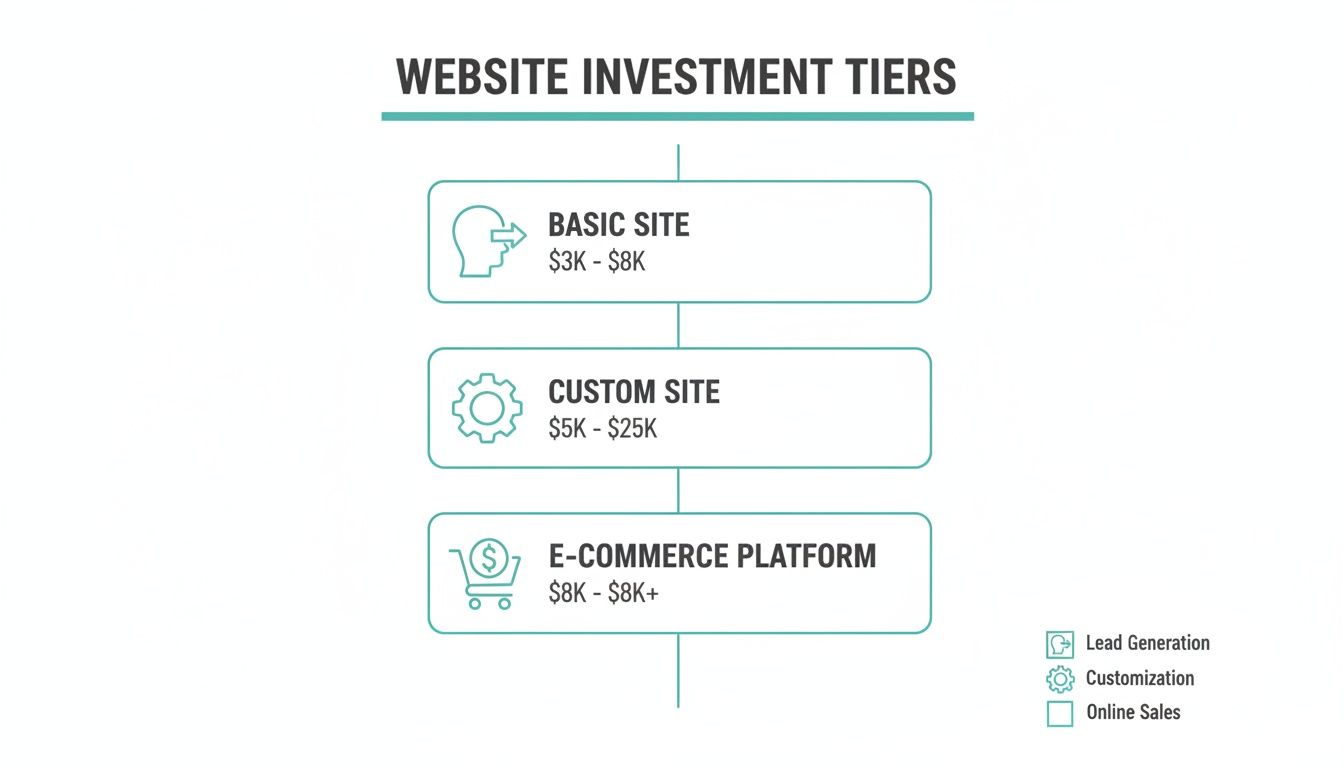
As you can see, the investment grows as the site's job moves from simple information delivery to managing complex online sales.
To make this choice clearer, let's break down the key differences between templates and custom builds.
Cost Driver Comparison Template vs Custom Design
| Feature | Template-Based Website | Custom-Built Website |
|---|---|---|
| Initial Cost | Lower upfront investment. Ideal for tight budgets or new businesses. | Higher upfront investment. Reflects the hours spent on strategy, design, and development. |
| Design & Branding | Limited customisation. You're working within a pre-defined structure. | Fully unique. The design is created from scratch to embody your brand identity. |
| Development Time | Faster. The foundation is already built, so launch is quicker. | Longer. Requires a full design and development cycle from start to finish. |
| Scalability | Can be restrictive. Adding complex features later may be difficult or impossible. | Highly scalable. Built with future growth in mind, allowing for easy feature additions. |
| Competitive Edge | Looks generic. Risks blending in with competitors using the same template. | Stands out. A unique user experience gives you a distinct advantage. |
Ultimately, a template is a great starting point for some, but a custom site is a long-term asset built for performance and growth.
Functionality And Custom Features
Beyond the look and feel, functionality is a massive cost driver. A simple "brochure" website with five pages and a basic contact form is fairly straightforward. But what happens when you need it to do more? Each new feature adds another layer of complexity, demanding more development time and specialised expertise.
Here are a few common features that will increase a project’s scope:
- E-commerce Functionality: This isn’t just a website; it’s an entire online store. It involves product pages, a shopping cart, secure payment gateways, inventory management, and shipping integrations.
- Booking and Scheduling Systems: A must-have for many service-based businesses, this allows clients to book appointments directly on your site and often syncs with tools like Google Calendar.
- Membership Portals: If you plan to offer exclusive content behind a login, you’ll need a system for user registration, recurring payments, and content protection.
- Custom Integrations: This is where you connect your site to other business tools, like a CRM or accounting software. It requires building custom API connections to get your different systems talking to each other.
To make sure these additions don't blow your budget, it's so important to have clear strategies to avoid scope creep, as it’s one of the quickest ways to inflate your final bill.
Content Creation And SEO Foundation
A beautiful website with weak content is like a stunning shop with empty shelves. High-quality, engaging content—persuasive copywriting, professional photos, and well-produced videos—is what actually turns visitors into customers. Some businesses supply their own, but many agencies offer professional content strategy and creation, which adds to the cost but dramatically improves the outcome.
In the same vein, Search Engine Optimisation (SEO) is the foundation that ensures your website actually gets found on Google. A basic SEO setup is non-negotiable and includes:
- Keyword research to figure out what your customers are actually searching for.
- On-page optimisation of titles, meta descriptions, and page content.
- Technical SEO to make sure your site is fast, mobile-friendly, and easy for Google to index.
A website without a solid SEO foundation is like a billboard in the desert. It might look great, but if no one can find it, it can't deliver a return on your investment.
Investing in SEO from day one is absolutely crucial for long-term growth. At the enterprise level, a site build can easily top $25,000, with significant costs coming from complex API integrations ($2,000-$10,000+) and database automation. This is largely driven by the high demand for local talent; senior Australian developers now command $120-$180+ per hour, especially after the tech sector saw a 27% hiring boom.
What About the Ongoing Costs of Running a Website?
Getting your new website live feels like crossing the finish line, but it’s really just the beginning of the race. It’s easy to focus on that big, upfront design and build cost, but many business owners get caught out by the recurring expenses needed to keep their site online, safe, and actually doing its job.
A great way to think about it is like buying a new car. You have the initial purchase price, sure, but you also have to budget for petrol, insurance, and regular services to keep it running well. Your website is exactly the same—it’s a business asset that needs ongoing care to perform at its peak and deliver a return.
These aren't just 'extra fees' to trip you up. They are essential for your site's health, security, and long-term success. Ignoring them can lead to your site getting hacked, running slow, or disappearing offline completely, all of which will cost you far more in the long run.
The Essential Running Costs
Let's break down the most common ongoing costs you'll need to work into your yearly budget. These are the absolute non-negotiables for any serious business website in Australia.
Domain Name: This is your unique address on the internet, like
yourbusiness.com.au. You rent this address, and you need to renew it every year. Expect this to cost anywhere from $20 to $100 per year, depending on the type of domain you have.Website Hosting: This is the physical space on a server where all your website's files live. Think of it as the rent you pay for your plot of land on the internet. Hosting costs can swing wildly depending on how much traffic you get and how fast you need your site to be.
For most small and medium businesses, a solid shared or managed hosting plan is more than enough. These typically range from $250 to $750 a year. If you're running a busy e-commerce store, you'll likely need a more powerful, dedicated server, which can easily run into the thousands annually.
Maintenance and Security Plans
Your car needs regular oil changes and tune-ups, and your website is no different. It needs consistent maintenance to run smoothly and stay secure from hackers. This is probably the most important ongoing investment you’ll make after the site goes live.
A proper website maintenance plan from a local agency will usually cover these critical tasks:
- Software & Plugin Updates: The platform your site is built on (like WordPress) and all its plugins are constantly being updated to fix security holes and add new features. Not doing these updates is the single biggest reason websites get hacked.
- Regular Backups: If the worst happens, having a recent backup of your site is your get-out-of-jail-free card. A good plan includes automated backups stored somewhere safe (not on the same server!), so you can get back online quickly.
- Security Monitoring: This means actively scanning for malware, blocking hacking attempts, and generally keeping your site's defences up to date against the latest cyber threats.
- Performance Checks: Making sure your site still loads quickly for visitors and works perfectly on all the different browsers and devices people use.
For a professional maintenance and security plan in Australia, you should budget between $600 and $5,000 per year. The final price tag depends on how complex your site is and what level of support you need. It might seem like a lot, but believe me, the cost of cleaning up a hacked site and trying to repair a damaged reputation is infinitely higher.
When you're setting aside funds for maintenance, don't forget to include your marketing and SEO tools. It's helpful to understand the pricing models for AI-powered SEO and content tools to get a complete picture of your total annual digital spend.
How to Choose a Web Design Partner You Can Trust

Picking a web design agency is one of the biggest calls you'll make for your business. This isn’t just hiring a vendor to build a thing; it’s about finding a genuine partner who’s as invested in your success as you are. A great partner knows your website is a tool for growth, not just a digital brochure.
They'll shift the conversation from cost to value, focusing on how their work will actually generate leads, boost sales, and deliver a return you can see. Making a smart choice here means looking past the price tag to vet their process, transparency, and track record with businesses like yours.
Writing a Brief That Gets You Accurate Quotes
To compare apples with apples, you need to make sure every agency is quoting on the same project. A vague request like, "I need a new website," will get you a confusing mess of quotes that are impossible to stack up against each other. A clear, detailed project brief is your best friend here.
Think of your brief as the blueprint for your website. The more detail you put in upfront, the better the proposals you'll get back. This clarity helps serious agencies give you a realistic handle on the website design costs involved.
Your brief should cover:
- Your Business Goals: What’s the point of this website? (e.g., "Generate 20 qualified plumbing leads per month" or "Increase online sales by 30%").
- Your Target Audience: Who are you trying to talk to? Paint a picture of your ideal customer.
- Key Features: List the non-negotiables. Think online booking, e-commerce functionality, or a project gallery.
- Your Budget Range: Don't be shy. Being upfront about your budget helps agencies propose a realistic solution you can actually afford.
- Project Timeline: When do you need this thing live?
Vetting Potential Partners With the Right Questions
Once you’ve got a few proposals in hand, it’s time to start the interviews. This is your chance to dig in and find out who’s the right strategic and cultural fit. You’re looking for a team that communicates well, has a solid process, and can back up their talk with real results.
Don’t be afraid to ask the hard questions. A confident, trustworthy agency will welcome them and give you straight answers.
A great web partner doesn't just build what you ask for; they ask the right questions to understand what your business truly needs to succeed. They act as a strategic advisor, not just a coder.
Here are some essential questions to have up your sleeve:
Process and Communication
- Can you walk me through your entire process, from discovery to launch and beyond?
- Who will be my main point of contact, and how often can I expect to hear from you?
- How do you handle feedback and revisions during the project?
Experience and Results
- Can you show me examples of websites you've built for other businesses in my industry?
- What specific results did you get for those clients? Did traffic increase? Did they get more leads?
- What's your approach to mobile-first design and SEO?
Technical and Support
- What platform do you recommend we build on, and why?
- What kind of training do you provide so my team can manage the site ourselves?
- What do your ongoing maintenance and security plans actually include?
Spotting the Red Flags
Knowing what to look for is only half the battle; you also need to know what to avoid. Some providers will promise the world and deliver a dud, leaving you with a costly website that doesn't do its job.
Be wary of any agency or freelancer that:
- Guarantees a #1 Google ranking. No one can promise this. It’s a massive red flag.
- Offers a ridiculously low price. A quote that’s way cheaper than the others usually means they’re using a cheap template, cutting corners, or will sting you with hidden fees later.
- Can't show you a portfolio. A reputable agency will be bursting to show off their previous work.
- Uses a lot of jargon without explaining it. A good partner makes complex ideas simple to understand.
Choosing the right partner is the most critical step in making sure your website investment pays off. Take your time, do your homework, and trust your gut. A true partner will feel like an extension of your own team.
Common Questions About Website Design Costs
When you start looking into getting a new website, the quotes can be all over the place. One agency might quote you $5,000, while another says $50,000 for what sounds like the same project. It’s confusing, to say the least.
Let’s clear things up by tackling the most common questions Australian business owners have about web design costs. This should help you make sense of the numbers and invest your money wisely.
Why Are Website Design Costs Higher in Australia?
It's a fair question. Why does it seem to cost more to build a website here than it does overseas? The answer really comes down to the local economy.
The price of website design in Australia is a direct reflection of our high cost of living, strong labour laws, and the fierce demand for skilled local tech talent. With experienced senior developers charging anywhere from $120 to $180+ per hour, you’re paying for top-tier expertise.
Sure, an overseas quote might look more attractive on paper, but a local Australian agency brings something to the table that can’t be outsourced: deep market knowledge. They understand what makes Aussie customers tick, ensuring your website's language, design, and user flow feel right for a local audience. Plus, you get the huge benefit of clear communication during your business hours and the protection of local consumer laws.
Choosing a local partner is an investment in quality and relevance. They get the nuances of the Australian market, which is crucial for building a site that doesn’t just look good, but actually connects with your target audience and gets results.
Ultimately, you’re paying for expertise that’s perfectly tuned to your market, and that’s a powerful advantage for long-term growth.
Can I Get a Professional Website for Under $3,000?
You’ll definitely see offers for websites under the $3,000 mark. Before you jump on one, it’s really important to understand what you're actually getting for that price.
These budget options are almost always built using pre-made templates. Think of it as an "off-the-rack" suit – it might fit okay, but it's not tailored to you. You'll face heavy restrictions on customisation, branding, and any meaningful Search Engine Optimisation (SEO).
For any business that relies on its website to bring in leads and sales, a cheap site often turns into a false economy. It might look passable at first, but it will almost certainly lack the strategic thinking needed to turn a casual visitor into a paying customer. A truly professional website is so much more than a pretty design; it’s a powerful sales tool built on:
- A solid strategy to understand your customers and what you want to achieve.
- A conversion-focused design that nudges visitors towards taking action.
- A rock-solid technical foundation for speed, security, and search engine visibility.
Getting these fundamentals right requires a bigger investment, but that’s what delivers a real, measurable return.
How Long Does It Take to Build a Website?
The timeline for a website build is tied directly to its complexity. It’s a bit like building a house – a simple one-storey home goes up much faster than a custom-designed, multi-level mansion.
As a general guide, you can expect:
- Standard Small Business Website: These projects usually take 4 to 8 weeks from the initial discovery and strategy phase right through to design, development, and launch.
- Complex E-commerce Store: A bigger beast altogether. A site with custom features, thousands of products, and multiple payment systems can easily take 10 to 16 weeks or more.
Remember, this is a partnership. The single best thing you can do to keep your project on track is to provide clear requirements and give feedback promptly at each stage.
What Is the ROI on a Professional Website?
The return on investment (ROI) from a professionally built website can be absolutely massive. A great site is your hardest-working employee – it’s out there 24/7, acting as your top salesperson, generating qualified leads, driving sales, and building your brand’s credibility.
Don't just take our word for it. A study by Stanford University found that a staggering 75% of users admit to judging a company’s credibility based purely on its website design.
Think about it this way: for a service-based business in Adelaide, landing just a couple of new high-value clients can often pay for the entire website investment within the first year. The trick is to measure success by tangible business outcomes, like leads generated and sales closed, not just by how nice the site looks. When you start focusing on performance, the ROI becomes crystal clear.
Ready to invest in a website that delivers a real return? The team at Frank Digital Agency builds high-performance, conversion-focused websites that turn your online presence into a powerful growth engine. https://frankdigital.agency