

Email marketing is one of the most reliable, cost-effective ways to connect directly with your customers, build a loyal following, and drive actual sales. It consistently delivers the highest return on investment of any digital marketing channel, which makes it an absolute must-have for any small business looking to grow sustainably.
Why Email Marketing Is Still a Powerhouse for Small Businesses
Let’s be real. As a small business owner, every dollar in your marketing budget has to count. This is exactly where email marketing proves its worth. It’s not just another channel to post on; it's your direct line to the people who matter most—your customers. The return you get here is something other platforms can only dream of.
If you're just getting started, it's worth getting your head around the basics. This simple guide on What is Email Marketing covers the core concepts well.
Think about it this way: with social media, you're at the mercy of ever-changing algorithms that decide who gets to see your posts. Your email list, on the other hand, is an asset you completely own and control. You're not just renting space on someone else's platform; you're building a genuine community of people who have actively said, "Yes, I want to hear from you." That's powerful.
The Unbeatable Return on Investment
The numbers behind a solid email strategy are pretty staggering. Let’s say you run a local plumbing business in Adelaide or a small e-commerce store. What if I told you that email marketing could bring you an average ROI of 3,800%? It sounds unbelievable, but it's true. For every single dollar you put in, you could see $38 back in revenue. That kind of return blows paid search and social media out of the water.
The Australian market really highlights this trend. Email ad spending is set to hit AU$370.67 million in 2024 and is on track to reach AU$421 million by 2029. It’s clear that smart businesses are investing here.
A strong email list isn’t just a marketing tool; it’s a reliable revenue engine. It lets you nurture potential customers, win back abandoned carts, and turn first-time buyers into loyal fans who keep coming back—all without a massive ad spend.
Building Lasting Customer Relationships
Beyond the sales figures, email is fantastic for building genuine, long-term relationships. It’s your chance to deliver real value straight to someone's inbox, which builds trust and loyalty over time.
This consistent, personal communication keeps your business top-of-mind. So, the next time a customer needs exactly what you offer, you’re the first person they think of.
Here’s how this plays out in the real world:
- A local café could send out a weekly newsletter featuring a "customer of the week" and a small discount on their favourite coffee.
- An e-commerce store might set up an automated email offering a 10% discount to anyone who hasn't made a purchase in 90 days.
- A tradie could send a seasonal home maintenance checklist to all past clients, positioning themselves as the expert and generating a few service calls in the process.
Each of these examples shows how email supports the entire customer journey, from their very first visit to their tenth purchase. Your local competitors are already using these tried-and-true methods to build loyalty and drive sales—it’s time to make it work for you, too.
Choosing Your Tools and Setting Clear Goals
Before you even think about hitting 'send' on that first email, you need to lay a solid foundation. This is the strategic groundwork that makes all the difference in email marketing. It really boils down to two things: picking the right platform and knowing exactly what you want to achieve.
Jumping in without a plan is like setting off on a road trip with no map. You'll burn a lot of fuel, but you probably won't get where you want to go. The tools you choose and the goals you set will shape your entire approach.
Selecting the Right Email Marketing Platform
The market is flooded with great email marketing platforms, but the "best" one is completely dependent on your business. A local plumber in Adelaide has very different needs to a national e-commerce store.
Let's look at a few of the most popular choices I see businesses using:
- Mailchimp is usually the first stop for small businesses, and for good reason. Its super user-friendly interface is perfect for beginners who just want to send out simple newsletters and promotions without getting bogged down in tech.
- Klaviyo is an absolute powerhouse for e-commerce. It plugs straight into platforms like Shopify and WooCommerce, letting you build incredibly targeted campaigns based on what your customers actually do—think abandoned cart reminders or product recommendations based on past purchases.
- ActiveCampaign is a fantastic choice for service-based businesses that need more than just email. It wraps email marketing, a solid CRM, and advanced automation into one package, making it ideal for nurturing leads through a longer sales funnel.
My advice? Don't just go with the most popular name. Think about your budget, how comfortable you are with technology, and where you see your business in a year or two. Most of these platforms have free plans, which are perfect for taking them for a test drive before you commit.
The right tool should make your life easier, not more complicated. It should feel like a natural part of your business, helping you connect with customers without the headache.
Defining Clear and Measurable Goals
Okay, so you've got a platform in mind. The next critical step is to get crystal clear on what you're trying to achieve. Vague goals like "get more sales" won't cut it. You need specific, measurable objectives to guide your strategy and tell you if what you're doing is actually working.
So, what does a good goal look like in the real world?
- For an e-commerce store: "Increase online sales from email by 15% in the next quarter."
- For a local tradie: "Generate 10 new quote requests per month through our email newsletter."
- For a beauty salon: "Book 20 appointments directly from our monthly promotions email."
See the difference? These goals are sharp, time-bound, and give you a clear benchmark for success. They turn your email marketing from a shot in the dark into a reliable growth engine. Setting these targets from the start helps you focus your efforts on what really matters.
This simple flow shows how investing a bit of time and resources into a structured email plan directly nurtures customer relationships and, in turn, fuels business growth.
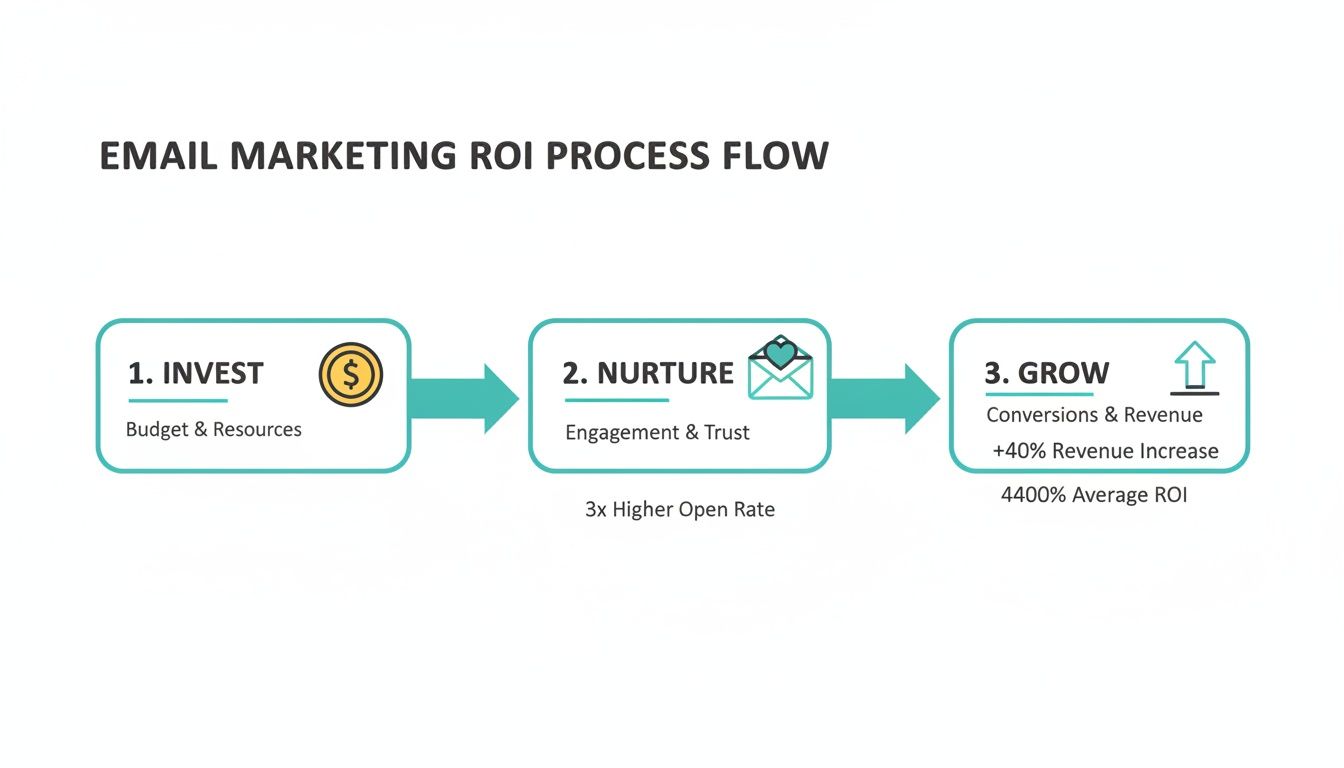
It’s a great reminder that a small initial investment in strategy and tools can pay off big time by building genuine customer loyalty.
Integrating Your Tools for a Seamless Data Flow
Your email platform shouldn't be an island. To really unlock its power, it needs to talk to your other business tools—especially your website and any CRM software you use.
When these systems are connected, customer data flows automatically. For instance, when someone fills out a contact form on your website, their details should instantly pop up on a specific list in your email platform, which can then trigger a welcome email series.
This integration is the secret to scaling your marketing without hiring more people. It means every new lead is captured and nurtured without you having to lift a finger, letting you focus on running your business while your marketing works in the background. If getting these technical connections sorted sounds like a nightmare, partnering with a dedicated email marketing agency can build you a powerful, integrated system from day one and make sure you get the most out of your investment.
How to Grow and Segment Your Email List
Your email list is easily one of the most valuable assets your small business will ever own. Why? Because unlike social media followers, you're in complete control. There's no algorithm deciding who sees your message. Growing this list with the right people is the foundation of a powerful marketing engine.
There’s a good reason everyone’s focused on building their subscriber base. In Australia, a huge 81% of small businesses rely on email marketing as their primary channel for attracting new customers and keeping the old ones coming back. With global email users set to hit 4.89 billion by 2027, it’s a channel you just can’t afford to sideline.
Turn Your Website into a Lead Generation Machine
Think of your website as prime real estate for capturing new subscribers. You’re already putting in the work to get traffic there, so the next step is making it incredibly easy and appealing for visitors to join your list. This isn’t about being pushy; it’s about offering real value at just the right moment.
Here are a few high-impact ways to do it:
- Homepage Sign-up Form: Place a clean, simple form in your website's footer or sidebar. It’s a passive but essential way to catch people who are already curious about your brand.
- Targeted Pop-ups: Done right, modern pop-ups are anything but annoying. You can trigger them to appear when someone is about to leave your site (this is called exit-intent) or after they’ve browsed a page for a bit. The key is to offer something compelling in return.
- Embedded Forms on Blog Posts: If you’re creating content, this is a no-brainer. Add a sign-up form directly within relevant articles. Someone reading a "DIY Gutter Cleaning" guide is the perfect person for a tradie’s home maintenance newsletter.
Optimising these forms is where the real wins are. Tiny tweaks to your call-to-action or form design can make a massive difference. Getting a handle on the basics of conversion rate optimisation in marketing will give you a serious edge in turning more of those website visitors into subscribers.
Create Irresistible Lead Magnets
What’s a lead magnet? It’s simply a free, valuable resource you offer someone in exchange for their email address. This tactic is so effective because it provides immediate value and solves a specific problem for your ideal customer. A generic "sign up for our newsletter" just can't compete with a tangible solution.
Your lead magnet should be a small win for your future customer. It should be so useful that they'd almost be willing to pay for it. This builds instant goodwill and trust.
To get you started, here are a few ideas tailored to different industries.
The table below gives some specific examples of lead magnets that work well for common small business types. Notice how each one offers a direct solution to a potential customer's problem.
| Industry Type | Lead Magnet Idea | Where to Place the Offer |
|---|---|---|
| E-commerce Store | 15% discount code for first-time buyers. | Exit-intent pop-up on product pages or at checkout. |
| Local Tradie (Plumber, Electrician) | A "Seasonal Home Maintenance Checklist" (PDF). | Pop-up on the homepage or embedded in blog posts. |
| Professional Services (Accountant, Consultant) | A free "Business Tax Deduction Cheatsheet". | On the services page or as a banner across the top of the site. |
| Health & Beauty (Salon, Clinic) | A guide on "5 Simple Stretches to Relieve Back Pain". | Within relevant blog articles or offered on the booking page. |
The right lead magnet doesn't just get you an email address; it attracts high-quality subscribers who are genuinely interested in what you have to say. It sets the stage for a profitable relationship from day one.
Why a Smart List Is Better Than a Big List
Once people start subscribing, the real magic begins with segmentation. This is just a fancy way of saying you’re dividing your email list into smaller, more focused groups based on specific criteria. Sending the same generic message to everyone is a surefire way to get low engagement and high unsubscribe rates.
Segmentation lets you send incredibly relevant, personalised content that actually connects with each subscriber. Think of it as having a one-on-one conversation instead of shouting into a crowded room.
You can slice and dice your list in all sorts of useful ways:
- Purchase History: Group customers who have bought certain products. A beauty salon could send a special offer on skincare only to clients who’ve previously had a facial.
- Geographic Location: This is gold for any business with a physical location. A restaurant in Adelaide could send an exclusive event invite to subscribers living in nearby postcodes.
- Website Behaviour: See who has visited specific pages or—even better—who abandoned their shopping cart. An e-commerce store can automatically send a gentle reminder to users who left items behind.
- Engagement Level: Create groups for your most active fans (your "VIPs") and for those who haven’t opened an email in months. This allows you to reward your loyalists and run targeted campaigns to win back the inactive ones.
By organising your list this way, you shift from random email blasts to genuinely strategic communication. This personalised approach is exactly how you build a loyal audience that doesn’t just read your emails but acts on them, driving real, measurable growth for your business.
Crafting Emails That People Actually Open and Read
You've got a growing list and the right tools in place. That's a huge win, but it's only half the battle. Now for the fun part: creating emails that your subscribers actually want to receive. This is where your brand's personality comes to life and where you start turning casual readers into loyal customers.
Let's be honest, the inbox is a battlefield. Your email is just one of dozens, all screaming for attention. To have any chance of standing out, you need to nail three things: the subject line, the email body, and the overall design.
Writing Magnetic Subject Lines
Your subject line is everything. Seriously. It's the gatekeeper to all the hard work you put into the email itself. If it doesn't get the click, nothing else matters.
Think of it as the headline on a newspaper. It has to be compelling enough to stop someone mid-scroll and pique their curiosity. Sending something vague like "July Newsletter" is like asking to be ignored. It's a one-way ticket to the trash folder.
Here are a few approaches I've seen work time and time again:
- Spark Curiosity: "Don't open this email." It feels wrong, but that's exactly why it works. It creates an itch people just have to scratch.
- Use Urgency: "Last chance for 20% off ends tonight." This taps into the fear of missing out (FOMO) and pushes people to act now, not later.
- Make it Personal: "Jessica, your home maintenance checklist is here." Using a subscriber's name or referencing something they've looked at feels personal and relevant.
- Highlight Value: "5 tips to make your indoor plants thrive." This is straight to the point—it tells them exactly what they'll get by opening.
Don't just guess what will work. A/B testing your subject lines is a game-changer. Send two different versions to small chunks of your list, see which one gets more opens, and then send the winner to everyone else. It's the fastest way to learn what your audience really responds to.
Designing Clean, Mobile-Friendly Layouts
Here's a stat that should grab your attention: over 50% of all emails are opened on a phone. If your email is a jumbled mess on a small screen, people won't waste time trying to decipher it. They'll just delete it.
Simplicity is your secret weapon in email design. You don’t need an all-singing, all-dancing layout to be effective. In fact, clean, simple designs almost always perform better because they keep the focus squarely on your message and call-to-action.
A great email design isn't just about looking good; it's about guiding the reader's eye naturally towards the one thing you want them to do. Think of it as creating a clear path, not a confusing maze.
Concentrate on these design fundamentals:
- Single-Column Layout: This is your safest bet. It stacks everything vertically, guaranteeing it will look good on any device without that dreaded horizontal scrolling.
- Readable Fonts: Stick to the classics like Arial, Helvetica, or Georgia. Make sure the font size is comfortable for reading on a phone—around 16px for body text is a good starting point.
- Compelling Imagery: Use high-quality photos that add to your message, but don't go overboard. Too many large images can make your email slow to load and even trigger spam filters.
- Clear Call-to-Action (CTA): Your CTA button should be impossible to miss. Use a bright, contrasting colour and action-focused text like "Shop Now," "Book Your Appointment," or "Download Your Guide."
And please, always send a test email to yourself. Open it on your phone. It’s a simple five-minute check that can save you from a world of embarrassment.
Automating Your Key Customer Touchpoints
Automation is the sanity-saver for busy business owners. It lets you send super-relevant, timely emails based on what your subscribers do, all without you having to manually press "send." These "set-it-and-forget-it" workflows are your 24/7 sales and relationship-building team.
Getting started doesn't have to be overwhelming. You can make a massive difference with just a couple of core automations.
Here are two that every small business should have:
- The Welcome Series: When someone new joins your list, don't just leave them hanging. A welcome series of 3-4 emails sent over a week or so is perfect. The first email should go out instantly, delivering whatever you promised them for signing up. The next few can tell your brand's story, highlight popular services, and maybe offer a little something to encourage their first purchase.
- The Abandoned Cart Reminder: If you run an e-commerce store, this is non-negotiable. Roughly 70% of online shopping carts are abandoned. An automated email sent a few hours after someone leaves items behind can claw back a huge chunk of that lost revenue. A friendly nudge, maybe with free shipping or a small discount, is often all it takes to get them over the line.
These automated emails ensure every subscriber gets a consistent, valuable experience, building trust and keeping your business front-of-mind when it matters most.
Measuring What Matters to Improve Your Results
Sending emails without tracking what happens next is a bit like throwing your marketing budget into the wind. You're putting in the effort, but you have no real idea if it's actually working. For your email marketing for small business to become a genuine growth engine, you need to focus on the key performance indicators (KPIs) that tell you the real story.
Too many business owners get hung up on open rates. While it’s nice to see a high number, it’s a vanity metric that can be seriously misleading. It doesn’t tell you if your message actually hit the mark and inspired someone to take action. It’s time to look beyond the open and dive into the numbers that truly matter.
Key Metrics Beyond the Open Rate
To get a clear picture of how your campaigns are really doing, you need to track a handful of core metrics. Think of them as a diagnostic tool. Together, they reveal the strengths and weaknesses in your strategy, showing you exactly where to focus your attention.
Let's break down the essentials:
Click-Through Rate (CTR): This is the percentage of people who actually clicked on a link in your email. A high open rate paired with a low CTR is a classic red flag. It usually means your subject line was compelling, but the content or offer inside just didn't connect. Our guide on what is a good click-through rate goes into more detail on what to aim for.
Conversion Rate: Now we're talking. This is the ultimate measure of success—the percentage of subscribers who completed your desired action after clicking. This could be making a purchase, booking a consultation, or downloading a guide. This KPI directly links your email efforts to actual business results.
List Growth Rate: This simply tracks how quickly your email list is expanding. A healthy growth rate is a great sign that your lead magnets and sign-up forms are working, consistently bringing in new, interested prospects.
Unsubscribe Rate: It can sting to see people opt out, but don't ignore this metric. It’s critical feedback. A sudden spike in unsubscribes might mean your content isn't what they signed up for, or maybe you're just emailing them a bit too often.
The Power of A/B Testing
So, how do you actually improve these numbers? The short answer: A/B testing.
This is a straightforward but incredibly powerful technique. You create two versions of a single email—let's call them A and B—and change just one thing. You could test different subject lines, calls-to-action (CTAs), hero images, or even the time of day you send it.
Send Version A to a small slice of your audience and Version B to another. Whichever version performs better (gets more clicks, opens, or conversions) is the one you send to everyone else.
A/B testing takes the guesswork out of email marketing. Instead of crossing your fingers and hoping for the best, you’re using real data from your own audience to make smarter decisions and systematically improve your results with every send.
Imagine a local Adelaide café running a weekend special. They could test two subject lines:
- Version A: "Our Weekend Coffee & Cake Special"
- Version B: "Treat Yourself This Weekend in Adelaide ☕"
By seeing which one gets more opens, they learn what kind of language gets their customers excited and can use that insight for every campaign that follows.
Gathering Direct Feedback to Refine Your Strategy
Analytics tell you what your subscribers are doing, but they don't always explain why. To get that deeper insight, sometimes the best thing you can do is just ask.
Sending a simple survey can give you a goldmine of information. Ask what content they find most valuable or how often they'd like to hear from you.
For better response rates, try using an embedded survey in email. This lets people respond with a single click right inside the message, which removes friction and dramatically boosts participation.
When you combine the hard data from your analytics with this kind of real, human feedback, you create a powerful improvement loop. Your email strategy stops being static; it starts to evolve, adapt, and become an increasingly effective tool for your business.
Your Pre-Launch Checklist and Legal Must-Knows
Before you hit 'send' on any campaign, it’s worth taking a moment to run through a final pre-flight check. I’ve seen this simple habit save countless businesses from embarrassing mistakes. It’s that final quality control step that ensures every email lands professionally, making your small business look polished and trustworthy from the get-go.
First, proofread everything twice. No, really. Then, grab a colleague and ask them to read it over. It’s incredible what a fresh pair of eyes can spot after you’ve stared at the same sentence ten times. Next, click every single link. A broken link is a dead end for a potential sale and a surefire way to frustrate a customer.
And don't forget to check how it looks on different devices. What looks perfect on your big desktop monitor might be a jumbled mess on a mobile screen. Most email marketing platforms, like Mailchimp or Campaign Monitor, have a built-in preview tool for exactly this reason. Use it. Every single time.
Navigating Australian Spam Laws
Beyond the technical checks, getting your head around the legal side of things is non-negotiable. Here in Australia, email marketing is governed by the Spam Act 2003. Trust me, ignorance isn’t an excuse the regulators will accept.
Failing to comply can lead to some seriously hefty penalties. The good news? The rules are actually quite straightforward and, frankly, they just encourage good marketing practices that build trust with your audience.
It all boils down to three golden rules you absolutely must follow:
- You must have consent. You need clear permission to email someone. This can be express consent (they physically ticked a box or filled out a form to join your list) or inferred consent (based on an existing business relationship, like a recent customer). Whatever you do, never, ever buy an email list. It’s illegal and a complete waste of money.
- You must identify yourself. Your email has to clearly state who you are and include your business contact details. This usually means putting your business name and ABN in the email footer. It’s a small detail that builds huge credibility.
- You must provide a simple way to unsubscribe. Every single promotional email needs a functional, easy-to-find unsubscribe link. When someone opts out, you have to honour that request promptly—the law says within five business days.
Following these rules isn’t just about dodging fines; it’s about respecting your subscribers. People who have willingly opted in are the ones who are far more likely to become loyal, paying customers. It’s the very foundation of effective email marketing.
By making this checklist and a quick legal review part of your routine, you’re not only protecting your business but also building a much healthier relationship with your subscribers. This little bit of diligence ensures your emails are effective, compliant, and actually welcome in your audience’s inboxes. And that, right there, is the ultimate goal.
Got Questions? We've Got Answers
Even the best-laid plans can hit a few snags, and when you're getting stuck into email marketing for your small business, questions are bound to pop up. Let's tackle some of the most common ones we hear from business owners.
How Often Should I Be Emailing My Customers?
There's no magic number here, but the golden rules are consistency and value. You don't want to show up so often you become annoying, but you also don't want to be so infrequent they forget who you are.
A weekly or fortnightly newsletter is a brilliant starting point for most businesses. From there, watch your engagement metrics like a hawk. If your unsubscribe rate starts creeping up, it might be a sign you're a little too present in their inbox.
- For e-commerce stores: A weekly email shouting about new arrivals or a special offer usually hits the sweet spot.
- For service-based businesses: A monthly roundup of handy tips or a company update is often enough to stay top-of-mind without overwhelming people.
Your audience will tell you what's working through their actions (or inaction!). Pay attention.
What’s the Difference Between a Campaign and an Automation?
This is a classic point of confusion, but it's actually pretty simple.
Think of a campaign as a one-off broadcast. It’s an email you build and send manually to a specific group at a specific time. Your Christmas sale announcement or the launch of a new service? That’s a campaign.
An automation, on the other hand, is a set-and-forget workhorse. It's a pre-written email (or a whole series of them) that gets sent automatically when someone takes a specific action. The perfect example is the 'welcome email' that lands in a new subscriber's inbox moments after they sign up. Automations are on the job 24/7, saving you a heap of time and making sure your communication is always relevant and timely.
Can I Just Use My Gmail or Outlook for Marketing Emails?
Look, it might seem like the easy path, but it's a shortcut you really shouldn't take. Using your personal or business inbox for bulk email marketing is a one-way ticket to the spam folder.
Professional email marketing platforms like Mailchimp or Klaviyo are designed for this. They have relationships with internet service providers that ensure your emails actually get delivered.
Using a proper email platform isn't just about looking professional; it's about being effective. You get access to vital analytics like who opened your email and what they clicked on, plus it handles all the unsubscribe admin for you. This is non-negotiable for staying on the right side of anti-spam laws and actually getting a return on your effort.
Ready to turn clicks into customers with a data-driven digital strategy? Frank Digital Agency builds fast, ROI-focused websites and manages high-performing Google Ads campaigns that deliver measurable results for Adelaide businesses. Get in touch today to start your growth journey.