

Pay-per-click advertising, or PPC, is a pretty simple concept at its core: you pay a small fee every time someone clicks on one of your ads. Instead of waiting for your website to climb the organic search rankings through SEO, you're essentially buying visits from highly targeted customers. It’s a way to get immediate visibility and have complete control over your ad spend.
How Pay Per Click Advertising Works
Picture this: your business is a shop on the world's busiest high street—a search engine like Google. Millions of potential customers walk past daily. With PPC, you can step out and grab the attention of the exact person looking for your products or services, right when they're ready to buy.
That’s the real power behind what is Pay Per Click advertising. You're not just throwing an ad out there and hoping it sticks. You’re strategically placing your message in front of people who are actively searching for the solutions you offer.
The Nuts and Bolts of PPC
To get a clearer picture of how this all works, let's break down the essential components of PPC advertising. This quick table summarises the key pieces of the puzzle.
PPC Advertising at a Glance
| Component | Simple Explanation |
|---|---|
| Keywords | The search terms or phrases people type into Google. You choose which ones trigger your ads. |
| Bids | The maximum amount you're willing to pay for a single click on your ad. |
| Ad Auction | A lightning-fast, automated auction that decides which ads are shown and in what order. |
| Ad Copy | The actual text of your advertisement that users see. |
| Landing Page | The specific webpage a user is sent to after clicking your ad. |
Think of the whole process as a super-fast auction that happens millions of times a day, every single time someone hits 'search'.
It all starts with keywords. These are the words and phrases you target, the very terms your ideal customer is typing into the search bar. Next comes your bid – how much you're willing to pay for that click. But it's not just about who pays the most.
The search engine runs a near-instant ad auction that weighs your bid against the quality and relevance of your ad. The winners get their ads displayed to the user.
The beauty of PPC is its directness. You only pay when a genuinely interested person takes the action to click, creating a direct path from their search query to your website.
This performance-based model is a game-changer, especially for small and local businesses. It levels the playing field and gives you a competitive way to generate leads and sales. Unlike old-school advertising, every cent is trackable, so you know exactly what your return on investment is.
How the PPC Ad Auction Actually Works
Ever wondered what happens in the split second between you hitting 'enter' on a search and the ads appearing at the top of the page? It’s not just about who’s willing to pay the most. Behind the scenes, a lightning-fast, silent auction is taking place, and it’s a lot more nuanced than you might think. This is the PPC ad auction.
This whole process is designed to give users the most relevant ads possible, not just the ones from companies with the deepest pockets. Google Ads and other platforms know that a good user experience is key. They reward advertisers who put in the effort to create high-quality, genuinely helpful campaigns. Getting your head around this is central to understanding how PPC really works.
The winner of this auction isn't decided by the highest bid alone, but by a metric called Ad Rank. The formula itself is simple, but it’s the key to unlocking PPC success.
Ad Rank = Maximum Bid x Quality Score
As you can see, a smaller bid can absolutely beat a bigger one if it's paired with a fantastic Quality Score. This means a small business with a smartly optimised campaign can snag a better ad position—and pay less for it—than a massive competitor taking a lazy, big-budget approach.
This diagram shows the simple journey a customer takes: they see your ad, they click it, and they land on your website.
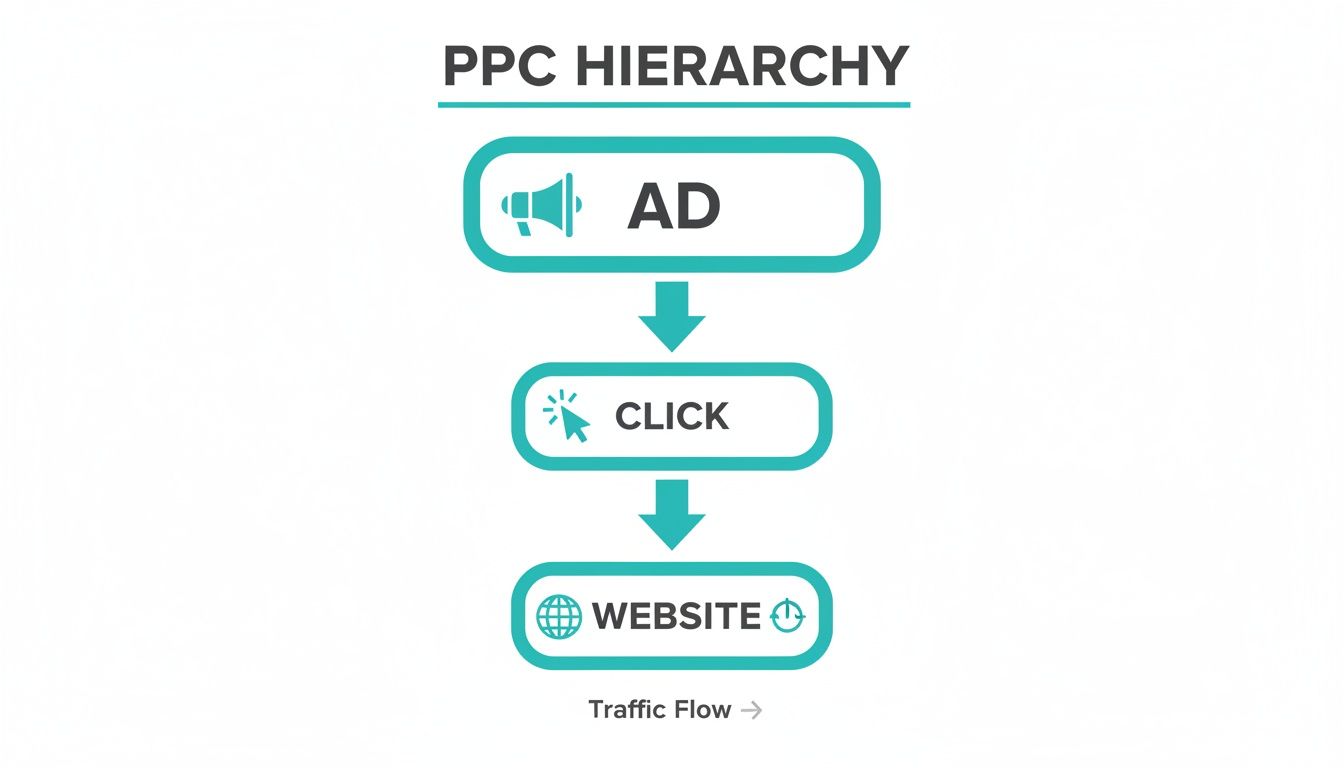
It’s a great reminder that the click isn't the end goal; where the user lands—your website—is just as crucial.
Understanding Your Quality Score
So, what is this Quality Score that holds so much power? Think of it as Google’s rating of your ad's overall quality and relevance, scored on a scale from 1 to 10. A high score is a massive thumbs-up from the platform, signalling that your ad is a great match for what people are looking for. The reward? Lower costs and better ad positions for you.
Your Quality Score isn't just one number; it’s a dynamic score based on three core components. If you want to make your advertising budget stretch further, focusing on these three pillars is the best place to start.
Expected Click-Through Rate (CTR): This is Google's prediction of how likely people are to click on your ad when it shows up. It’s not a wild guess—it’s based on your ad’s past performance and how it stacks up against competitors bidding on the same keywords.
Ad Relevance: This is all about how well your ad copy aligns with what the user is actually searching for. For instance, if someone types in "emergency plumber Adelaide," an ad headlined "24/7 Emergency Plumbers in Adelaide" is going to be far more relevant than a generic one that just says "Home Maintenance Services."
Landing Page Experience: Once someone clicks, what happens next? This factor looks at how good your landing page is. Does it load quickly? Is it easy to use on a mobile? Most importantly, does it deliver on the promise you made in your ad?
At the end of the day, a high Quality Score is your reward for creating a user-focused experience.
It’s Google's way of saying, "Your ad is helpful and relevant, so we'll give you a discount and a better spot on the page."
A well-structured campaign with compelling ads and a seamless landing page isn’t just good for your customers; it’s brilliant for your budget. By focusing on quality, you directly improve your Ad Rank, which allows you to compete with the big players without needing their massive bankroll. This is what makes PPC such a game-changer for businesses of all sizes.
Choosing Your Battlefield: Major PPC Platforms
So, you get how the ad auction works. Now, where do you actually run your campaigns? Choosing the right platform is a lot like picking the perfect spot for a shopfront—you have to go where your ideal customers hang out. For most businesses, that decision starts with a couple of heavyweights.
The world of pay-per-click is massive, but it's really dominated by two giants: Google Ads and Microsoft Advertising (which you might remember as Bing Ads). At first glance, they seem pretty similar. They’re both search engines, right? But dig a little deeper, and you'll find they have distinct audiences and strategic perks. Knowing these differences is what separates a good budget allocation from a great one.
Don't think of these platforms as rivals. It’s better to see them as complementary tools in your marketing kit. One might be your go-to for catching high-volume, general searches, while the other is brilliant for reaching a more niche, professional crowd at a lower cost.
Google Ads: The Undisputed Leader
When most people talk about PPC, they’re really talking about Google Ads. And for good reason. With over 90% of the global search market share, its reach is simply immense. It's the default choice because, let's face it, almost everyone uses Google to find… well, everything.
This colossal user base means you have an enormous pool of potential customers to tap into, no matter how specific your industry is. The flip side? All that popularity means the competition can be stiff, which often drives up the Cost Per Click (CPC) for sought-after keywords.
Microsoft Advertising: The Strategic Alternative
Microsoft Advertising powers searches across Bing, Yahoo, and even DuckDuckGo. While it has a smaller slice of the market, it's a significant one. The audience here often skews a bit older and more affluent, which can be a goldmine for businesses targeting professionals or the B2B sector.
For many advertisers, the biggest pull is the breathing room. Less competition often means lower bids are needed to win top spots, potentially leading to a much healthier Return On Ad Spend (ROAS). It’s a powerful secondary channel that smart marketers use to mop up valuable traffic their competitors are completely ignoring.
Choosing a platform isn't about picking a winner; it's about understanding where your specific customers are. Many successful strategies involve using both Google for its reach and Microsoft for its cost-effective, targeted audience.
The Different Types of PPC Ads
Once you've picked your platform, you need to choose the right type of ad for the job. Each format is built for a different purpose, whether that's capturing an immediate sale or just getting your name out there.
Matching the ad format to your business goal is the bedrock of any solid campaign. Let's break down the most common ones with some real-world examples.
Search Ads: These are the classic text ads you see at the top of the search results page. They are absolutely perfect for catching "high-intent" users—people who are actively looking for exactly what you offer.
- Example: A plumber in Adelaide uses Search Ads to target phrases like "emergency plumber Adelaide" or "blocked drain repair." Their ad pops up at the precise moment a homeowner is in a panic, driving immediate phone calls.
Shopping Ads: You know those product ads with pictures, prices, and shop names that appear in a carousel? Those are Shopping Ads. If you run an e-commerce store, these are non-negotiable.
- Example: An online boutique selling handcrafted leather goods runs Shopping Ads. When someone searches "men's leather wallet," their products show up visually at the top, making it easy for shoppers to compare styles and prices before clicking straight through to the product page.
Display Ads: These are the visual banner ads you see on websites all over the internet, from news sites to niche blogs. They are brilliant for building brand awareness and for remarketing (reminding previous visitors about your site).
- Example: A local financial consultant wants to become the go-to expert in Adelaide. They run Display Ads on finance blogs and news sites that their target clients read, keeping their firm top-of-mind even when those people aren't actively searching.
Video Ads: These ads run on platforms like YouTube, showing up before, during, or after the video you actually wanted to watch. They are incredibly powerful for telling a story and showing a product or service in action.
- Example: A fitness centre creates a punchy, 30-second Video Ad showing off their equipment and real members' success stories. They target it to people in their local area who have shown an interest in health and fitness, driving brand recognition and new sign-ups.
The Metrics That Matter for Measuring PPC Success
Launching a PPC campaign is exciting, but how do you actually know if it's paying off? Pouring money into ads without tracking performance is like driving blind. This is where metrics come in. Think of them as the dashboard for your advertising engine, telling you what’s working, what’s not, and how to steer your budget toward real business results.
Clicks are a good start, but they don't pay the bills. True success is measured by the return you get on your investment. To see the whole picture, you need to look past the surface-level numbers and focus on the key performance indicators (KPIs) that directly impact your bottom line. These are the metrics that turn raw data into smart decisions, helping you refine your campaigns and turn clicks into customers.
Cost Per Click (CPC)
Your Cost Per Click (CPC) is the most basic building block of PPC. It’s exactly what it says on the tin: the specific amount you pay each time someone clicks on your ad. While a lower CPC generally feels better, the real goal isn’t just to get the cheapest clicks possible. It's about finding a cost-effective way to attract the right kind of visitor—the one who’s actually likely to become a customer.
CPC can swing wildly depending on your industry, the keywords you're targeting, and your Quality Score. A competitive keyword in a high-stakes sector will naturally cost more than a niche, long-tail search term. Here in Australia, for example, the average CPC on Google Ads is around $5.26 AUD, but that figure changes dramatically by industry. An e-commerce business might pay between $1.82 and $3.40 per click, while hyper-competitive fields like finance can see CPCs skyrocket to $13.37 for top keywords.
Click-Through Rate (CTR)
Click-Through Rate (CTR) is your ad’s report card. It measures how often people who see your ad actually click on it. The calculation is simple: divide the number of clicks by the number of times it was shown (impressions), then express that as a percentage. A high CTR is a fantastic sign that your ad copy and targeting are hitting the mark with your audience.
A strong CTR doesn't just mean your ad is popular; it's also a major factor in your Quality Score. Google rewards ads that people want to click on with better ad positions and lower CPCs.
For instance, an ad that gets 100 clicks from 1,000 impressions has a CTR of 10%. There’s no single "good" CTR, as it depends heavily on the ad type and industry, but aiming to beat your industry’s average is always a solid goal. A consistently low CTR is often a red flag pointing to a disconnect between your keyword, ad copy, and what the user was actually searching for.
Conversion Rate
This is where the rubber really meets the road. Your Conversion Rate tells you what percentage of clicks resulted in a valuable action—making a sale, filling out a contact form, making a phone call, or signing up for a newsletter. This single metric reveals how effectively your landing page turns traffic into tangible business outcomes. A ton of clicks with a tiny conversion rate is a clear signal that something is broken after the click.
You can't manage what you don't measure. A proper Google Ads conversion tracking setup is non-negotiable if you want to understand which keywords and ads are actually driving leads and sales. Without it, you’re just guessing.
The Most Important Metrics in One Place
To help you connect the dots, here’s a quick breakdown of the essential PPC metrics and what they actually mean for your business goals.
Key PPC Metrics and Their Business Impact
| Metric | What It Measures | Why It Matters for Your Business |
|---|---|---|
| CPC (Cost Per Click) | The price you pay for a single click on your ad. | Helps you manage your budget and understand the cost of acquiring a potential customer. |
| CTR (Click-Through Rate) | The percentage of people who click your ad after seeing it. | Indicates how relevant and engaging your ad is to your target audience. Higher CTRs improve your Quality Score. |
| Conversion Rate | The percentage of clicks that lead to a desired action (e.g., sale, lead). | The ultimate measure of your landing page’s effectiveness. It shows how well you turn traffic into business. |
| ROAS (Return On Ad Spend) | The amount of revenue generated for every dollar spent on ads. | The bottom-line metric. It tells you directly if your advertising is a profitable investment. |
Each of these metrics tells a different part of the story. By monitoring them together, you get a complete picture of your campaign's health and profitability, allowing you to make smarter, data-driven decisions.
Return On Ad Spend (ROAS)
Finally, we get to the ultimate measure of success: Return On Ad Spend (ROAS). This metric calculates the total revenue you earn for every single dollar you put into advertising. The formula is simple but incredibly powerful: (Total Revenue from Ads / Total Ad Spend) x 100%.
Let's break it down:
- A ROAS of 100% means you broke even.
- A ROAS of 300% means you generated $3 in revenue for every $1 you spent.
While other metrics are like diagnostic tools for your campaign’s health, ROAS is the final score. It directly connects your advertising efforts to your bank account, giving you the definitive answer to the all-important question: "Is this working?"
Common PPC Mistakes That Drain Your Budget
It’s a story we’ve seen countless times: a business dives into PPC with big expectations, only to watch their budget vanish with nothing to show for it. The problem usually isn't the platform; it’s a few common, easily avoidable mistakes. Getting a handle on these pitfalls is the first step to building a PPC campaign that actually works.
Think of your budget as fuel in a car. These common errors are like tiny leaks in the fuel tank, slowly but surely draining your resources before you even get close to your destination. By patching these leaks, you make sure every dollar spent is actually pushing your business forward.
Ignoring the Power of Negative Keywords
One of the biggest money-wasters in PPC is overlooking negative keywords. These are simply terms you tell Google not to show your ads for. It sounds simple, but skipping this step guarantees you’ll pay for clicks from people who will never, ever buy from you.
Let’s say you’re a high-end interior designer in Adelaide bidding on "kitchen renovations." Without any negative keywords, your ad could pop up for searches like:
- "DIY kitchen renovations"
- "cheap kitchen renovation ideas"
- "kitchen renovation jobs"
None of these searchers are your ideal client. Every click is just money down the drain. By adding words like "DIY," "cheap," and "jobs" to your negative keyword list, you instantly filter out this irrelevant traffic and start spending your budget on people who are actually looking for your services.
Bidding on Overly Broad Keywords
It's tempting to go after massive, high-volume keywords like "shoes" or "marketing." The thinking is that more traffic equals more customers, right? Unfortunately, it rarely works that way. This approach is usually just a fast track to burning through your budget on clicks from window shoppers and people with zero buying intent.
A winning PPC strategy is built on precision, not just volume. Specific, long-tail keywords connect you with people who are much closer to making a purchase.
Instead of a broad term like "shoes," an online retailer would be far better off targeting "women's black leather ankle boots" or "men's waterproof running shoes size 11." These longer phrases might get fewer searches, but the conversion rate is dramatically higher because you're matching exactly what the user wants.
Neglecting the Landing Page Experience
You could write the most compelling ad in the world, but if it leads to a clunky, confusing, or irrelevant landing page, you’ve just paid for a lost customer. The user's journey doesn't stop at the click—that's where it really begins. Your landing page has to follow through on the promise your ad made.
This disconnect is a massive conversion killer. If your ad shouts about a "50% Off Sale on Adelaide Garden Supplies" but links to your generic homepage, visitors will get frustrated and leave. A dedicated, high-converting landing page needs to:
- Match the Ad Message: The headline should instantly confirm the user is in the right place.
- Load Quickly: Every second counts. A slow page is one of the top reasons people hit the back button.
- Have a Clear Call-to-Action (CTA): Don't make them think. Tell them exactly what to do next, like "Buy Now" or "Request a Quote."
- Be Mobile-Friendly: With so much traffic coming from smartphones, a flawless mobile experience is non-negotiable.
Steering clear of these common mistakes is crucial to truly understanding what is pay per click advertising and making it work. When you become deliberate with your keywords and create a smooth path from ad to conversion, PPC stops being a cost centre and starts becoming a powerful engine for growing your business.
So, What's Next? Putting Your PPC Knowledge into Action
We've covered a lot of ground together, from the nuts and bolts of the ad auction to the key metrics that truly matter. You've seen how platforms like Google and Microsoft Ads work, the common pitfalls to avoid, and just how powerful PPC can be for businesses aiming for real growth.
Now it's time to bridge the gap between knowing and doing. The good news? You don't have to get everything perfect on day one. The secret is to start with a solid, thoughtful plan that turns what you've learned into tangible results.
Your Pre-Launch Checklist
Before you dive in and start spending, take a moment to walk through these essential steps. Think of this as your pre-flight check, making sure all the critical pieces are in place for a campaign designed to win from the very first click.
Pinpoint Your Goal: What does a "win" actually look like for you? Is it the phone ringing off the hook, a surge in online sales, or a flood of new leads from your contact form? Getting crystal clear on this one thing will guide every other decision.
Set Your Budget: Decide on a monthly ad spend you can comfortably commit to. Keep in mind that the early days are all about learning and gathering data, not necessarily about immediate, massive profits.
Do Your Keyword Homework: Get inside the head of your ideal Adelaide customer. What phrases are they actually typing into Google? Zero in on keywords that show they're not just browsing—they're ready to take action.
Nail Your Landing Page: The page visitors land on after they click your ad is make-or-break. It needs to be fast, look great on a phone, and have one clear, compelling call-to-action that directly matches the promise you made in your ad.
Pay-per-click advertising offers one of the most direct lines to your ideal customers. But its success isn't automatic; it's built on a solid strategy and a commitment to ongoing improvement. Without a clear plan, it's just a fast way to spend money.
Getting these steps right is what separates a profitable campaign from a costly experiment. If you're excited to turn these ideas into a high-performing ad strategy but would rather have an expert in your corner, the team at Frank Digital Agency is ready to help. We build and manage ROI-focused campaigns that connect Adelaide businesses with customers who are ready to buy.
Frequently Asked Questions About PPC Advertising
Even after you get your head around the basics of pay-per-click, a few questions always pop up. That’s completely normal—this is a game where the details really do matter. To help you move forward with a bit more confidence, we’ve put together answers to the most common questions we hear from business owners ready to take the plunge.
These are the quick, no-nonsense answers you need to clear up any lingering doubts about budgets, timelines, and whether you should go it alone or bring in a pro.
How Much Should I Budget for Pay Per Click Advertising?
There’s no magic number here. The right budget is all about your industry, what you want to achieve, and how fierce the competition is in your neck of the woods. A local Adelaide plumber is going to have a very different starting budget than a national e-commerce store.
A few key things will shape what you need to spend:
- Industry Competition: Crowded fields like legal services or finance naturally have a higher average Cost Per Click (CPC). You’ll just need more budget to get seen.
- Target Keywords: The keywords you’re bidding on all come with different price tags. Broad, popular terms usually cost more than super-specific, long-tail phrases.
- Geographic Targeting: It goes without saying that a campaign targeting all of Australia will need a much bigger war chest than one focused just on the Adelaide metro area.
The smartest way to start is with a test budget you're comfortable with for the first one to three months. Think of this initial phase less about raking in profits and more about gathering priceless data. Once you see a positive Return On Ad Spend (ROAS), you can start scaling up with real confidence.
How Long Does It Take to See Results from PPC?
This is one of the best things about PPC: it’s fast. Unlike SEO, which is a long game that can take months to bear fruit, a PPC campaign can start sending people to your website within hours of launching. Your ads can be right at the top of the search results almost instantly.
But let’s be clear—there’s a big difference between seeing traffic and seeing meaningful results, like a steady flow of quality leads or sales. It’s important to have realistic expectations for the first couple of months while the campaign finds its feet, gathers data, and gets fine-tuned.
Here’s a rough timeline of what to expect:
- Month 1: Data Collection & Early Tweaks. The first few weeks are all about learning. We're figuring out which keywords, ads, and audiences are hitting the mark and starting to cut away what isn’t working.
- Months 2-3: Refining and Growing. By now, a well-managed campaign should be showing a clear upward trend. You’ll start to see a more consistent stream of conversions and a measurable ROI as we double down on the winning strategies.
A little patience at the start is what sets you up for long-term, sustainable success.
Can I Do PPC Myself or Should I Hire a Professional?
This is the million-dollar question for any business owner. While platforms like Google Ads are designed so anyone can use them, effectively managing a campaign is a full-time discipline. It takes a serious amount of time, deep expertise, and a commitment to constant learning to get it right.
It's surprisingly easy to set up a campaign, but it's just as easy to burn through a lot of money with common missteps like choosing the wrong keywords, writing ads that don't connect, or targeting the wrong audience. The whole advertising world is always changing, with new features and better strategies popping up all the time.
Hiring a specialist or an agency means you're bringing in someone whose entire job is to master this stuff. They live and breathe campaign optimisation, A/B testing, and staying on top of every platform update. For most busy business owners, that kind of partnership almost always delivers a far better return and frees you up to do what you do best—run your business.
Ready to turn clicks into customers without the steep learning curve? The team at Frank Digital Agency builds and manages ROI-focused PPC campaigns that connect Adelaide businesses with customers actively searching for their services. Start your journey to profitable advertising today.