

Marketing for tradies is all about one thing: building a reliable system that brings in a steady stream of quality jobs. It’s not about flashy gimmicks. It’s about moving past the hope of a random referral and putting your business in front of customers at the exact moment they’re searching for your skills.
Get this right, and your phone will keep ringing, even when things typically go quiet.
Why Most Tradie Marketing Misses The Mark
Let’s be real. Marketing often feels like a massive distraction from the actual work—the jobs that pay the bills. For years, the playbook for tradies across Australia has been brutally simple: do a quality job, and word will get around. And to be fair, that word-of-mouth system is gold. It often brings in fantastic, high-trust clients.
The problem? It's completely unpredictable. You can't turn up the dial when you need more work, and you have no control over when the next referral lands. This leaves your business exposed during quiet spells and creates a huge digital opportunity that most of your competitors are simply ignoring.
The Great Digital Divide In The Trades
The honest truth is that most tradies are leaving a tonne of money on the table. While everyone’s worried about profitability and keeping the workflow steady, very few are actually using the digital tools that can solve those exact problems.
This is the journey I see all the time, from relying on old-school methods to achieving genuine, scalable growth.
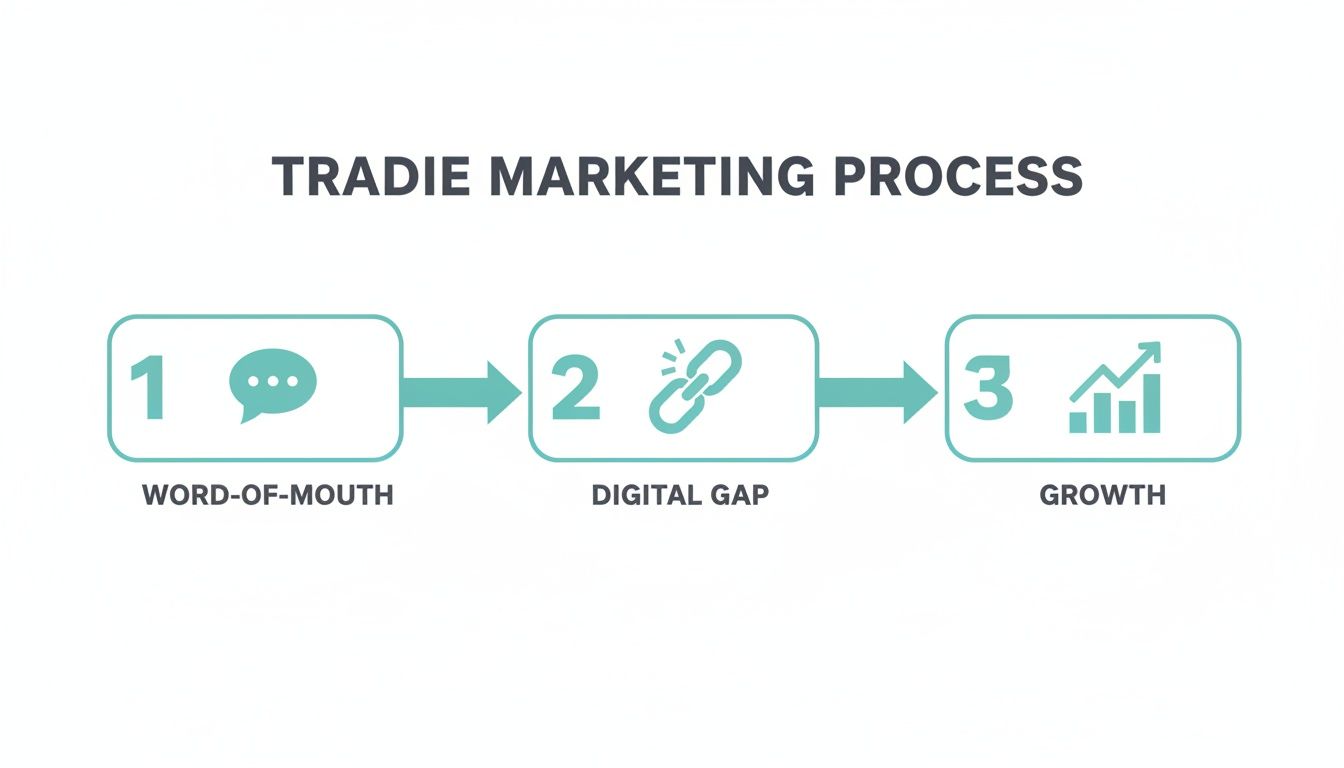
As you can see, bridging that digital gap is the crucial step. It’s what takes a business from just surviving to truly thriving.
The numbers back this up. A recent industry report painted a stark picture of just how big this gap really is.
Digital Marketing Adoption Among Australian Tradies
This table gives a quick snapshot of how tradies are currently using (or, more often, not using) key digital marketing channels.
| Marketing Channel | Adoption Rate (%) |
|---|---|
| Website | 76% |
| Word-of-Mouth (Primary) | 70% |
| Google Ads | 29% |
| Email Marketing | 24% |
| Search Engine Optimisation (SEO) | 17% |
| SMS Marketing | 13% |
Source: 2025 ServiceTitan Australian Tradies Market Report
What this tells us is that while most tradies have a website, very few are actively driving traffic to it with things like Google Ads or SEO. The heavy reliance on word-of-mouth (70%) shows just how much opportunity there is for anyone willing to step up their digital game.
The tradies who win the most work are not always the best on the tools—they're the best at getting found. A smart digital strategy is what separates a busy business from one that’s constantly chasing its next job.
Understanding The Common Pitfalls
So, why does this gap exist? I’ve seen it countless times. Many tradies have been burned by a slick-talking marketing agency that promised the world and delivered nothing. Others are just flat-out too busy on the tools to figure out what actually works.
To see what not to do, you only need to look at common mistakes and compare them with effective advertising strategies for roofing companies, a trade that faces very similar marketing challenges.
The usual stuff-ups I see include:
- The 'Digital Flyer' Website: It might look pretty, but it does absolutely nothing to turn a visitor into a phone call or a quote request.
- Ignoring Local SEO: Not showing up for "plumber near me" or "electrician in Parramatta" searches is a killer. This is how most of your customers are finding you today.
- Boosting Social Posts Randomly: Chucking $50 at a Facebook post without a clear strategy is just burning cash. It rarely leads to actual jobs.
- Flying Blind on Results: Pouring money into ads without knowing what’s making the phone ring is a recipe for disaster. You have to track what works.
By side-stepping these common missteps from the get-go, you'll put yourself miles ahead of the competition.
Your Website: From Digital Brochure to Lead-Generating Machine
Think of your website as your best salesperson, the one who never sleeps. It’s on the clock 24/7, ready to convince potential customers you're the right person for the job. But let's be honest, most tradie websites are little more than online business cards. They might look alright, but they don't actually do anything to bring in work.
We’re going to fix that. The whole point is to turn your website into a tool that actively converts visitors into paying customers. It should answer their questions, build their trust, and make it dead simple for them to book a job.
Start Where Your Customers Are: On Their Phones
Picture this: a pipe has just burst under the kitchen sink, or the power's gone out in the middle of dinner. Is your customer firing up their desktop computer? No chance. They're grabbing their phone, standing right in front of the problem, and desperately searching for a local tradie who can help right now.
This is why your website must be built for mobile first. It's not a suggestion; it's the foundation of your entire online strategy. If someone lands on your site and has to pinch and zoom just to read your phone number, they’re gone. They'll just hit the back button and call your competitor whose site actually works.
Tell Them Exactly What to Do Next
Every page on your website needs a purpose. You have to guide your visitors and tell them precisely what action you want them to take. We do this with a clear Call-to-Action (CTA). Your CTAs can't be shy; they need to be big, bold, and use direct, no-nonsense language.
Forget a weak "Contact Us" link buried in the footer. You want something that grabs their attention and solves their problem:
- Get a Free Quote Today
- Call Now for Emergency Service
- Book Your Job Online
- Request a Consultation
A pro tip is to have a CTA button permanently fixed in the top right corner of your header, so it's always visible. Then, repeat it further down the page. A visitor should never have to hunt for how to get in touch with you.
Build Rock-Solid Trust in Under 10 Seconds
When a potential customer lands on your site, they're really only asking one question: "Can I trust this business to do a good job and not rip me off?" You've got a precious few seconds to give them a resounding "YES!" with powerful trust signals.
This is what separates the professional outfits from the fly-by-nighters. Your website needs to be loaded with proof that you're the real deal.
Your online reputation is everything. A website without testimonials, photos of your work, and clear credentials is like a salesperson showing up with no references—it just feels off, and it makes it much harder to close the deal.
Here’s a quick checklist of the absolute must-haves:
- Real Customer Testimonials: Don't just make them up. Use genuine reviews from happy clients. Adding their first name and suburb makes them feel much more authentic.
- Galleries of Your Work: Show, don't just tell. High-quality "before and after" photos are incredibly powerful. This visual proof often works better than a whole page of text.
- Your Licences and Insurance: Pop the logos for any industry certifications, licenses, or insurance you hold right on your homepage. It instantly shows you're a legitimate, professional operation.
- A Big, Clickable Phone Number: Your phone number needs to be impossible to miss on every single page, preferably right at the top. On mobile, it must be "click-to-call" so they can ring you with a single tap.
Structure Your Pages to Answer Their Questions
A customer with a problem has questions. Your website's job is to answer them before they even have to ask. By structuring your pages logically, you can tackle their biggest concerns head-on, like costs, what the process involves, and how quickly you can get the job done.
Take a service page for "Hot Water System Repairs." It shouldn't just say you fix them. It should cover:
- Common signs that their system is on its last legs.
- The different types of systems you work on (gas, electric, solar).
- A quick rundown of your emergency call-out process.
- A clear CTA like "Call for an Urgent Quote."
When you anticipate and answer their questions like this, you're not just a contractor anymore. You become the helpful expert they need, building the confidence they need to pick up the phone and call you.
Winning Local Search with SEO and Google Business Profile
Let's be honest. When a pipe bursts or the power goes out, nobody is digging out the Yellow Pages anymore. They’re grabbing their phone and searching for a local tradie who can fix the problem now. This is your playbook for making sure you're the first name they see.
We'll kick things off with the most powerful free marketing tool you have: your Google Business Profile (GBP). This isn't just a pin on a map; it's your digital storefront, and getting it right is the difference between the phone ringing off the hook and hearing crickets.
Optimising Your Google Business Profile
Think of your GBP as the foundation of your local marketing. It costs you nothing but time, and the payoff is huge. This is how you land in that coveted "map pack" at the top of Google's search results—the prime real estate where 76% of local searchers end up visiting a business within 24 hours.
Your goal is to fill out every single field with detailed, accurate information. Don't just put "Plumber." That’s not nearly enough to stand out.
- Business Name: Use your registered business name, plain and simple. Don't be tempted to stuff it with keywords like "Best Plumber Sydney"—Google will penalise you for that.
- Categories: This is a big one. Choose your primary category (e.g., "Plumber"), but then go deep on all the secondary ones. Think "Hot Water Service," "Drain Cleaning Service," and "Gasfitter." This is how you show up for more specific, high-intent searches.
- Service Area: Get granular. List the actual suburbs and postcodes you cover. This tells Google exactly where to show your profile to potential customers who are ready to hire.
- Services: Don't just list a few things. Detail every single service you offer. If you’re a sparky, this means listing out "Switchboard Upgrades," "LED Downlight Installation," and "Emergency Fault Finding." The more detail, the better.
Your Google Business Profile is a living thing, not a set-and-forget task. Google rewards active businesses. Get into the habit of regularly uploading photos from recent jobs, responding to every single review, and using Google Posts to share updates or specials.
The Power of Photos and Reviews
Photos and reviews are the social proof that tips a potential customer over the edge. Put yourself in their shoes: would you call the tradie with zero reviews and one blurry photo of their van, or the one with a dozen 5-star reviews and a gallery of crisp, professional-looking work? It's a no-brainer.
Make it a habit to take before-and-after photos of every job. This is pure marketing gold. Upload them directly to your GBP to show people the quality of your workmanship.
Just as crucial is having a system for collecting reviews. The best time to ask is right after the job is done and the customer is thrilled with your work. A simple text message with a direct link to your GBP review page makes it dead simple for them. Trust me, positive reviews are one of the heaviest-hitting factors for ranking locally.
On-Page SEO That Actually Moves The Needle
Beyond your GBP, your website needs to pull its weight and reinforce your local authority. This is where on-page local SEO comes into play. It might sound a bit technical, but the core idea for a tradie is simple: create specific pages for the specific services you offer in the specific locations you serve.
A generic "Services" page just won't cut it. You need to build out dedicated pages for your most profitable work.
Here’s what that looks like in practice:
- A page for "Blocked Drain Plumber in Parramatta"
- Another one for "Hot Water Repairs in Blacktown"
- And a separate one for "Gas Fitting Services in Penrith"
Each page should be written to solve a customer's specific problem in that exact location. Mention local landmarks, talk about common issues you see in the area (like old terracotta pipes in established suburbs), and sprinkle in testimonials from happy clients in that suburb. This screams "local expert" to Google.
Nailing Your NAP Consistency
Finally, let's talk about one of the most fundamental (and often overlooked) parts of local SEO: NAP consistency. This stands for Name, Address, and Phone number. This info must be 100% identical everywhere it appears online.
That means checking it on your:
- Website’s header and footer
- Google Business Profile
- Facebook page
- Local business directories (like TrueLocal or Yellow Pages online)
Even a tiny difference, like "St" versus "Street" or an old mobile number floating around on a directory, can confuse Google and drag down your local rankings. Do a quick audit of your online footprint and make sure your NAP is consistent everywhere. It's a simple check that builds massive trust with search engines, cementing your status as a reliable local authority.
Driving Immediate Leads with Google Ads
While SEO is your long game for building authority, sometimes you just need the phone to ring this week. This is where Google Ads steps in. Think of it as the express lane to the top of the search results, putting your business front and centre the moment a potential customer in your suburb has a problem they need fixed right now.
Unlike other marketing efforts that need time to warm up, a well-structured Google Ads campaign can start generating calls and quote requests almost instantly. This is your guide to launching profitable ad campaigns without just burning through cash. It's all about getting the right message in front of the right people at precisely the right time.
Target Suburbs, Not Cities
I’ve seen this mistake cost tradies a fortune: targeting too broadly. Showing your ad for "plumber Sydney" is a guaranteed way to waste money on clicks from people miles outside your actual service area. The secret to profitable ads for tradies is all about hyper-local targeting.
Your goal is to focus every dollar of your ad spend on the specific suburbs where you actually want to work. You can set this up by targeting specific postcodes or by drawing a radius around your home base. This simple step ensures you're only reaching potential customers you can realistically serve, which immediately boosts your return on investment.
Choosing Keywords That Signal Real Intent
Not all keywords are created equal. You have to get inside the head of a customer who's ready to hire someone, not just looking for a DIY video on YouTube. The real value is in what we call "high-intent" keywords—phrases that include a service and often a location or a word that signals urgency.
Think about what someone in a panic would actually type into their phone.
- Weak Intent: "how to fix leaking tap"
- Strong Intent: "emergency plumber near me"
- Weak Intent: "hot water system cost"
- Strong Intent: "hot water repair Blacktown"
When you focus your budget on these high-intent keywords, you’re paying to get in front of people who are actively looking for a professional and are ready to pick up the phone.
Writing Ad Copy That Solves a Problem
Your ad is your 3-second pitch. It has to grab their attention and instantly tell them you're the solution to their problem. Don't just list what you do; speak directly to their pain point and offer a clear, compelling benefit.
A great ad for an emergency electrician could look something like this:
"Power Out in Parramatta? 24/7 Emergency Electrician. Fast Call-Outs & Upfront Pricing. Call Now for a Quick Fix!"
This ad is effective because it:
- Identifies the exact problem and location ("Power Out in Parramatta?").
- Offers the perfect solution ("24/7 Emergency Electrician").
- Eases common worries upfront ("Fast Call-Outs & Upfront Pricing").
- Gives a clear, direct instruction ("Call Now").
The single biggest mistake in Google Ads is sending traffic to your homepage. Your homepage gives a general overview, but your ad promised a very specific solution. Always, always send ad traffic to a dedicated landing page that perfectly matches the ad's promise.
The Critical Role of Landing Pages
So, if your ad promises "Emergency Hot Water Repairs," the person who clicks it had better land on a page that is 100% focused on emergency hot water repairs. This is what we call a landing page, and its job is to convert that click into a lead, with zero distractions.
A high-converting landing page needs to have:
- A headline that mirrors the ad they just clicked.
- A big, easy-to-tap phone number right at the top.
- A simple form to request a quote or callback.
- A few bullet points on why you’re the best choice for this specific job.
- A couple of glowing testimonials from happy customers.
This laser-focused approach dramatically increases the chance that a visitor will take action, simply because you've made it incredibly easy for them to solve their specific problem.
Tracking What Actually Works
Finally, you can't run a profitable campaign blind. You absolutely must set up conversion tracking. This is just a small piece of code that tells Google which of your keywords and ads are actually generating the phone calls and form submissions.
Without it, you’re just guessing. With it, you can see that the keyword "blocked drain plumber Penrith" brought in five paying jobs last month. This data is pure gold. It allows you to double down on what’s working and cut the campaigns that are just wasting money, ensuring your marketing budget delivers a clear, measurable return.
Nailing Your 5-Star Reviews and Reputation System
For any tradie, your reputation isn’t just a bonus—it’s the currency that buys trust and lands you the next job. Online reviews have become the new word-of-mouth. They’re that digital handshake that reassures a potential customer you’re the right person for the job.
Building a rock-solid online reputation doesn't happen by accident. It comes from a simple, repeatable system. This process delivers the social proof needed to convince new clients to pick you over the competition. It also gives your local SEO a serious kick, because Google absolutely loves seeing a business with a constant stream of fresh, positive feedback.
Making It Dead Simple to Leave a Review
The perfect time to ask for a review? Right after you’ve packed up your tools. The client is happy, the great job you did is fresh in their mind, and they're far more likely to take a minute to help you out. If you wait a week, the moment is gone, and your request just becomes another thing on their to-do list.
The trick is to make it ridiculously easy for them. Nobody has the time or patience to go searching for your review page. Your goal should be to get them there in a single click.
- SMS is your secret weapon. A quick, friendly text with a direct link to your Google review page is personal, immediate, and has a way higher open rate than an email that gets buried in their inbox.
- Keep it short and sweet. You’re a tradie, not a novelist. A simple, polite message is all you need.
Here’s a template you can tweak and use on the spot:
"Hey [Customer Name], it's [Your Name] from [Your Business]. Was great helping you out with the [Job Description] today. If you've got a spare 30 seconds, we'd be stoked if you could leave us a quick review on Google. It really helps us out! Here's the link: [Your Google Review Link]"
This approach is friendly, direct, and cuts out all the hassle. It respects their time while showing them just how much their feedback means to a local business like yours.
Focus on the Platforms That Actually Matter
Don't try to be everywhere at once. Spreading yourself too thin just dilutes your efforts and burns you out. For most tradies, the game is won or lost on one key platform, with a couple of others playing a supporting role.
Here’s where to put your energy:
- Google Business Profile: This one is non-negotiable. Your Google reviews are the first thing people see and have the biggest impact on your local search ranking. A high star rating here directly translates to more phone calls.
- Facebook: It’s often the second place potential customers look. They’ll check out your Facebook page for photos of recent work and see what others are saying. Reviews here add another powerful layer of trust.
- Industry-Specific Sites: Depending on your trade, platforms like Hipages or TrueLocal can be useful, but they should never be your main focus over Google.
Get Google sorted first. Once you have a steady flow of great reviews coming in there, then you can start thinking about pointing the odd customer to other sites.
How to Handle the Inevitable Bad Review
Look, no matter how good you are, you'll get a negative review one day. It happens. The most important thing is not to panic or fire back a defensive reply. How you respond is often more important than the review itself, because your public reply shows everyone else what you're made of.
When a bad review lands, follow these steps:
- Don't reply instantly. Take five. Walk away from the screen. Replying while you're fuming is a surefire way to make things worse.
- Acknowledge their frustration and apologise. Start by thanking them for their feedback and saying you're sorry their experience wasn't up to scratch, even if you think they're completely wrong.
- Take the conversation offline. Never get into a public slanging match. The goal is to show you’re a professional who solves problems. End your public reply by offering to make it right directly. Something like, "Please give me a call on [Your Number] so we can sort this out for you."
- Learn from it. Is there a grain of truth in the feedback? Maybe there's a small tweak you can make to your process to stop it from happening again. Use it as a free lesson to improve your business.
A calm, professional response can actually turn a negative into a huge positive. It shows potential customers that you stand by your work and are committed to making things right, which can be even more convincing than a perfect 5.0 rating.
Got Questions About Marketing? We've Got Answers
Even with the best playbook in hand, it's natural to have a few questions. Marketing can feel like a minefield, and it's tough to know where to put your hard-earned cash for the best results. Let's tackle some of the most common questions we hear from tradies on the tools, with straight-up, practical advice.

How Much Should a Tradie Really Budget for Marketing?
Look, there’s no one-size-fits-all answer here. But a solid rule of thumb for a running business is to earmark around 5-10% of your desired yearly revenue. If you're really looking to grow fast or you're just starting out, pushing that closer to 10-12% will give you the momentum you need to get noticed.
The real game-changer isn't the exact dollar amount, but how you think about it. You don't need to bet the farm from day one. Start smart with a channel you can measure, like Google Ads. Dipping your toes in with a budget of $500-$1,000 a month is a great way to test the waters. Once you see it bringing in profitable jobs, you can scale it up with confidence.
Your marketing budget shouldn't be seen as another expense on the P&L. It's an investment designed to multiply your revenue, with every dollar sent out to bring back more.
This shift in mindset is everything. When done right, marketing for tradies pays for itself many times over by keeping your job board packed with high-quality work.
My Word-of-Mouth Is Great, So Why Bother with Digital?
Word-of-mouth is gold. It brings in fantastic clients who already trust you before you've even quoted the job. The problem? You can't control it. It's totally unpredictable, and you can't just 'turn it on' when you have a quiet week coming up.
Digital marketing puts you in the driver's seat.
- You control the lead flow. Need more jobs? You can turn on the tap with ads. Booked solid for a month? You can dial it back. Simple.
- You find brand new customers. It gets your business in front of people who have never heard of you but are actively searching for the exact services you offer.
- You’re building a real asset. A strong website, top Google rankings, and a glowing online reputation become valuable business assets that work for you 24/7.
Think of digital marketing as the reliable engine that drives your business forward, while word-of-mouth is the free fuel that gives you a welcome boost along the way. You need both.
If I Can Only Do One Thing, What's the Most Important?
Easy. If you do nothing else, claim and completely fill out your Google Business Profile (GBP). It is, without a doubt, the single most powerful, high-impact marketing tool available to any local business, and it costs you nothing but time.
For most potential customers, your GBP is their very first impression of your business. A well-managed profile with your correct details, recent photos of your work, regular posts, and a steady stream of 5-star reviews will bring in calls and website clicks without you spending a single cent on ads. It's the bedrock of all your local marketing.
SEO Feels Slow. Is It Actually Worth the Effort?
It's true, SEO is a long game, not a quick fix. But the payoff is huge and incredibly valuable. Think about it this way: when you stop paying for ads, the leads dry up instantly. But a website ranking on the first page of Google can bring you a consistent stream of free, high-quality leads for years.
The good news is that for a local tradie, SEO isn't some dark art. It boils down to a few key, achievable actions:
- Nailing your Google Business Profile optimisation.
- Consistently getting reviews from your happy clients.
- Building out website pages for each of your key services and the suburbs you serve.
To really connect with your local market, a savvy tradie needs to use diverse marketing materials across both digital and traditional channels. The effort you put into SEO today is an investment in a sustainable, cost-effective future, making your business stronger and far less dependent on advertising to survive.
At Frank Digital Agency, we're experts in turning your online presence into your most reliable source of new work. We build websites that convert visitors into leads and run Google Ads campaigns that deliver a measurable return, helping tradies across Adelaide fill their schedules with profitable jobs. Ready to grow? We're ready to help.