

Ever wondered, "What's the price for web development?" It's a bit like asking how much a house costs. You wouldn't expect a one-bedroom unit to have the same price tag as a custom-built mansion, right? The same logic applies here. A simple, clean website might set you back a few thousand dollars, whereas a complex digital platform with all the bells and whistles can easily run into the tens of thousands.
The final figure really comes down to three big things: the design complexity, the custom features you need, and the overall scope of the project.
Understanding Web Development Price Beyond A Simple Number
So, how much should a new website for your Adelaide business really cost? It’s the million-dollar question, but the answer is never just a single number.
Think about it like building that house. A basic project home gets the job done—it puts a roof over your head. But an architect-designed home is crafted to fit a specific family's lifestyle, solving unique problems and adding long-term value. Both are houses, but they serve completely different purposes and, naturally, come with very different costs. Your website is no different. It's not just a line item on an expense sheet; it's a strategic investment in your business's future.
From Cost Centre to Profit Centre
The moment you stop seeing your website as an online brochure and start seeing it as your hardest-working employee, everything changes. This isn't just a pretty page; it's a 24/7 sales rep, a customer service agent, and a lead-generation machine all rolled into one.
When you frame it that way, the conversation shifts from price to value. A bigger upfront investment suddenly makes a lot more sense if it’s going to deliver a significantly better return.
A well-built website can directly help you:
- Generate Qualified Leads: It attracts people actively searching for what you offer and turns them into genuine prospects.
- Increase Direct Sales: For e-commerce stores, a smooth, intuitive checkout process is the difference between a sale and an abandoned cart.
- Automate Business Processes: Think of the hours saved by integrating a booking system or a client portal directly into your site.
- Build Brand Authority: A professional, fast, and genuinely helpful website builds trust before you’ve even spoken to a potential customer.
A great website is an asset that appreciates in value. It works tirelessly to grow your Adelaide business by attracting new customers and serving existing ones, making its initial price a foundation for future returns.
To give you a clearer picture, here’s a quick breakdown of how different factors influence the final cost.
At-A-Glance Website Price Factors
| Influencing Factor | Impact on a Simple Website | Impact on a Custom Website |
|---|---|---|
| Design & UX | Uses a pre-built template with minor brand customisation. Clean but not unique. | A fully custom design based on deep user research and brand strategy. |
| Functionality | Standard features like a contact form, image gallery, and blog. | Custom-coded features, API integrations, and complex user interactions. |
| Content | You provide all the text and images. The developer just populates the pages. | Involves professional copywriting, SEO, and photography/videography. |
| E-commerce | Basic setup with a simple payment gateway (e.g., Stripe, PayPal). | Advanced features like custom shipping rules, inventory management, and subscriptions. |
At the end of the day, understanding these moving parts is key. The more you add—whether it's a custom booking system, an online store, or integration with your CRM—the more time and expertise it requires from the developer.
The Core Factors Defining Your Budget
Ultimately, the web development price is a direct reflection of what it will take to achieve your business goals. Just like adding a pool or a gourmet kitchen raises the cost of a house, adding custom functionality increases the cost of a website.
The big three—scope, complexity, and custom integrations—are what form the foundation of any quote you'll receive. Getting your head around these will help you set a realistic budget that aligns with the results you’re chasing, ensuring your investment truly helps your Adelaide business grow.
The 7 Key Factors That Drive Your Website's Cost
When you get a quote for a new website, the number you see isn't just pulled out of thin air. The final price is a direct reflection of the time, skill, and resources needed to actually build what you’ve envisioned. Getting your head around the main cost drivers is the first step to having more productive conversations with developers and making a smart investment.
So, let's break down the seven biggest factors that determine where your money really goes.
This diagram shows how the core components—scope, complexity, and features—all build on each other to form your final web development price.
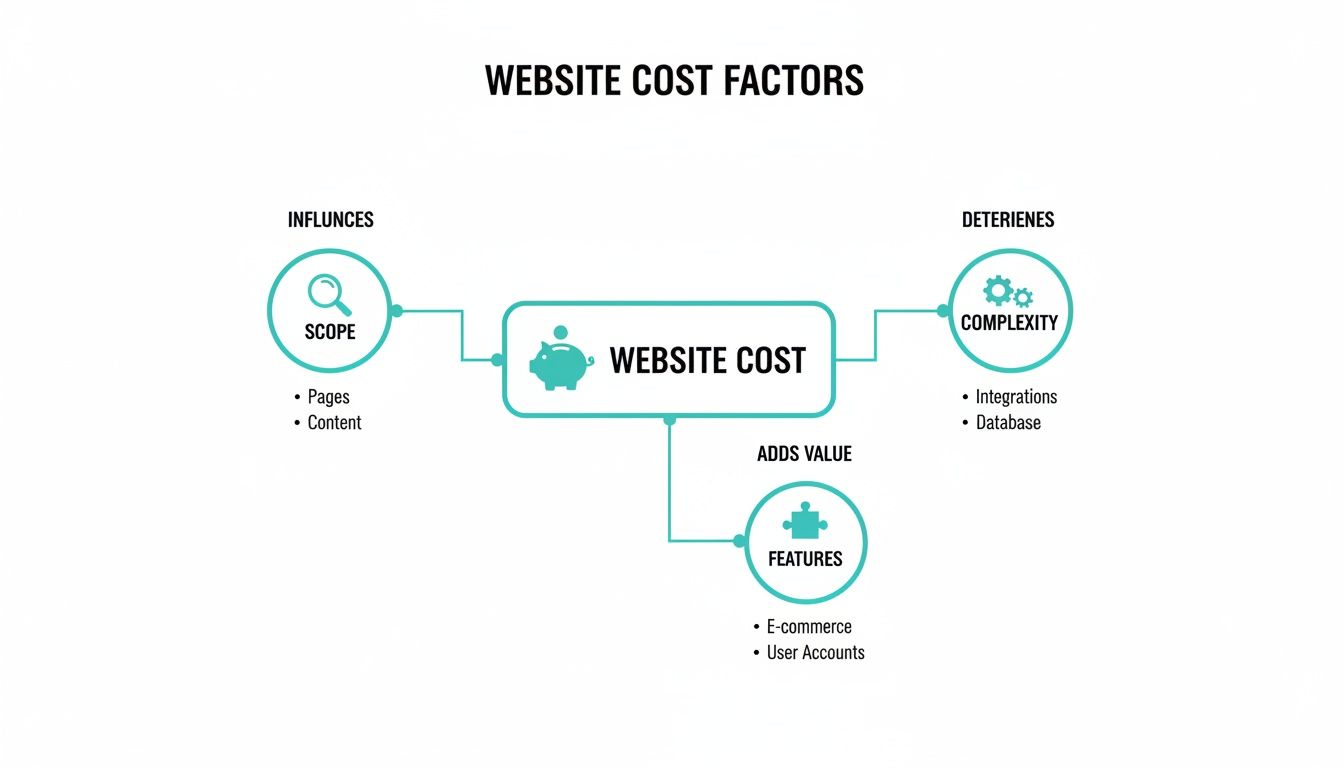
As you can see, it all starts with those three pillars. Let’s unpack what they mean for your project.
1. Project Scope and Size
The most obvious cost factor is simply how big the website is. Think of it like building a house—a one-bedroom granny flat is going to cost a lot less than a five-bedroom home.
A simple five-page "brochure" website for an Adelaide plumber (Home, About, Services, Gallery, Contact) is a relatively small job. On the other hand, a 50-page corporate portal with different service divisions and a massive resource library is a much bigger undertaking.
More pages mean more hours spent on design, development, putting the content in, and testing everything. It’s a direct and predictable sliding scale.
2. Design Complexity and User Experience
How your website looks and feels to a visitor is a huge part of the cost. There's a massive difference between using an off-the-shelf template and creating a completely bespoke user experience (UX) from scratch.
Template-Based Design: This is the most budget-friendly option. A developer takes a pre-made theme and adapts it with your logo, brand colours, and content. It's fast and works well for basic needs but won't give you a one-of-a-kind look.
Custom UX/UI Design: This is a much deeper process. It starts with understanding your brand, your ideal customer, and what you want to achieve. A designer will then craft wireframes and mockups to build a unique visual identity that’s engineered to get your visitors to take action. It costs more because it involves hours of strategy and creative work, but the return is often significantly higher.
A website's design isn't just about looking good—it's about making it easy for users to take action. According to industry studies, a well-designed user interface can raise your website’s conversion rate by up to 200%.
3. E-commerce Functionality
Planning to sell online? That’s where e-commerce functionality comes in, adding a whole new layer of complexity. The cost here really depends on how sophisticated you need your online shop to be.
A basic setup with a simple product catalogue and standard payment gateways like Stripe is fairly straightforward. The price starts to climb as you add more advanced features, like a custom checkout process, inventory management, customer subscription models, or personalised product recommendations. Each one of these adds development time and often requires specialist skills.
4. Custom Features and Integrations
This is where the price can really start to vary. Nearly all websites have standard features like a contact form or a blog. Custom features, however, are things built specifically to solve a unique business challenge you have.
For an Adelaide professional services firm, that might be a secure client portal for sharing documents. For a local tradie, it could be a smart booking system that syncs with their calendar and sends out automated SMS reminders. These integrations—connecting your site to other software like a CRM or accounting platform—require specialised API development work, which adds to the bottom line.
5. Content Creation and Asset Preparation
This is a critical question that directly affects the price: who's writing the words and providing the images?
If you supply all the text, photos, and videos ready to go, the developer’s job is just to load them into the finished design. But many businesses find they get better results by investing in professional copywriting to make sure the messaging is sharp, persuasive, and optimised for Google. Similarly, professional photography lifts a brand far above stock images, but it’s a separate cost to factor into your budget.
6. Foundational SEO
A stunning website is useless if no one can find it. Foundational Search Engine Optimisation (SEO) is about building your site in a way that search engines like Google can easily find and understand it right from the launch.
A basic package will usually cover the essentials, like title tags, meta descriptions, and creating an XML sitemap. For an Adelaide business, a more thorough local SEO setup would involve optimising your Google Business Profile, researching local keywords, and adding schema markup to help you show up in local search results. The more in-depth the SEO strategy, the higher the upfront cost, but the bigger the payoff in long-term organic traffic.
7. Accessibility Compliance
Making sure your website can be used by people with disabilities isn't just a "nice-to-have" anymore—it's a legal and ethical must-do. Following the Web Content Accessibility Guidelines (WCAG) involves specific design and coding techniques, like providing text alternatives for images and ensuring the site works with just a keyboard.
Building to these standards requires specialised knowledge and extra testing, which naturally adds to the project's cost. The upside? It opens your business up to a wider audience and helps future-proof your investment.
Realistic Website Costs For Adelaide Businesses
It’s one thing to see global estimates for web development, but those figures often don't reflect the reality on the ground here in Adelaide. So, let's talk about real numbers you can actually use to budget for your business. Think of your website as an investment, and understanding the local market is the first step to planning it properly.
To make sense of it all, I'll break down the typical project costs into clear brackets. This will give you a solid idea of what kind of website you can expect for your money and help you feel confident that the final quote aligns with what you’re trying to achieve.
Entry-Level Professional Websites ($5,000 – $10,000)
This is the sweet spot for many small businesses in Adelaide. We're talking about tradies, consultants, and local shops who need a sharp, professional online presence but aren't ready to remortgage the house for it. A website in this range is a huge leap from a basic DIY builder and gives you a fantastic foundation to grow on.
Here in Australia, this budget is a very accessible starting point for a quality 6-10 page site. It’s perfect for service providers looking to get the phone ringing with qualified leads. An agency might build you a conversion-focused WordPress site designed to turn visitors into paying customers—a must-have for any business chasing more bookings.
Here’s what you can generally expect in this price bracket:
- A Clean, Professional Design: Your site will likely be built on a premium theme but customised to perfectly match your brand's colours, logo, and vibe.
- Mobile-First Responsiveness: It’s a non-negotiable these days. Your site will look and function flawlessly on smartphones, tablets, and desktops.
- User-Friendly CMS: You’ll get a content management system like WordPress, which means you can easily update text, add blog posts, or swap out images without calling a developer.
- Foundational On-Page SEO: This covers the core optimisation needed to help Google find and understand your site, like setting up title tags, meta descriptions, and submitting a sitemap.
This investment gets you a credible, hard-working digital storefront that puts your brand on the map and starts attracting local customers.
Business Growth Websites ($10,000 – $25,000)
When you've outgrown a simple brochure website, you'll find yourself stepping into this price range. This is for established Adelaide businesses that are serious about lead generation and need custom functionality or a more sophisticated, bespoke design.
For instance, a local law firm needs a site that not only projects authority but also integrates with their practice management software. Or maybe a growing home builder wants to showcase their work with detailed project galleries and interactive floor plans.
This budget tier is where strategy truly drives development. It's less about just building pages and more about engineering a customer journey that guides visitors from discovery to conversion.
Projects in this category usually include everything from the entry-level package, plus:
- Custom Design and UX: A unique design crafted from the ground up, based on proper research into your target audience and business goals.
- Advanced Functionality: This is where you get things like custom quote calculators, client portals, or integrations with third-party CRMs and marketing tools.
- Professional Copywriting: Engaging, persuasive content written by a pro and optimised with specific keywords to pull in organic search traffic.
- Local SEO Strategy: A much more comprehensive plan to help you dominate the local search results for your services in Adelaide and the surrounding suburbs.
An investment at this level gives you a powerful marketing asset—a machine built to fuel business growth and deliver a measurable return. You can dig deeper into what impacts web page design rates in our other guides.
Custom and E-commerce Solutions ($25,000+)
For businesses with truly complex needs or those diving into e-commerce, the investment typically starts here and can scale up significantly. This bracket covers large corporate sites, custom-built web applications, and feature-rich online stores.
An Adelaide boutique wanting to launch an online shop needs much more than a pretty gallery of products. They’ll require a secure payment gateway, inventory management, shipping calculators, and customer account features. Each of these elements adds another layer of complexity and cost.
Likewise, a company needing a custom web app to solve a unique internal workflow will fall into this category. The final price is tied directly to the hours of specialised development work needed to bring that vision to life. This is where your website stops being a brochure and becomes an integral part of your entire business operation.
Choosing The Right Pricing Model For Your Project
Deciding how you'll pay for your website is just as crucial as the final price tag. The right payment structure isn't just about money; it sets the tone for your entire relationship with a developer or agency. It’s about creating a partnership where everyone's on the same page, working towards the same goal.
Think of it this way: the model you choose can either create a smooth, collaborative process or a series of frustrating roadblocks. Let's walk through the main options you'll come across so you can steer clear of any nasty financial surprises down the track.
The Certainty Of Fixed Price Projects
A fixed price model is exactly what it says on the tin. You map out a very specific, detailed scope for your project, and the developer gives you one single price to get it all done. No more, no less.
It’s like getting a quote from a builder to construct a new deck. You’ve already agreed on the exact size, the specific timber, and the type of finish, so they can confidently give you a firm, final price. This is easily the most popular choice for projects where the finish line is crystal clear from the start.
- Best For: Projects with a rock-solid, well-defined scope. A standard 10-page website for a local business, where all the features and pages are known upfront, is a perfect example.
- Key Advantage: You get total budget certainty. You know precisely what you’re spending from day one, which makes planning your finances a breeze.
- Potential Downside: It’s rigid. If you suddenly decide you want to add a new feature or pivot your strategy halfway through, you’ll have to stop, get a new quote, and sign off on a formal ‘change order’. This can slow things down.
The Flexibility Of Hourly Rates
Working on an hourly rate means you pay your developer for the actual time they put in—every hour is tracked and billed. This approach gives you maximum agility, which is fantastic for projects that are likely to shift and evolve as you go, or for when you just need ongoing, as-needed help.
Think of this like hiring a handyman for the day. You’ve got a list of jobs, but you might spot something new or change your mind about a task. You simply pay for the time they’re there, working on what you need.
Developer hourly rates in Australia can be all over the map depending on experience. The good news for us is that Adelaide's rates are often 15-30% lower than in places like Sydney. A senior developer here might charge between $120-$180 per hour, which directly impacts your total budget. It’s why so many Adelaide SMBs choose a local agency; research shows 65% of Australian firms stick with local talent to sidestep the headaches that can come with offshoring. You can find more detail in this breakdown of Australian web development costs.
The Partnership Of Monthly Retainers
With a retainer, you pay a consistent fee each month for an agreed-upon block of hours or a specific set of ongoing services. This isn't really for the initial website build; it's for everything that comes after. It’s perfect for businesses that view their website as a living, breathing part of their business—not just a one-off task to tick off a list.
A retainer transforms your developer from a one-time contractor into a long-term digital partner invested in your growth. It’s a proactive approach to website management.
This model is all about the long game: keeping your site secure, updating content, running SEO checks, and making continuous tweaks to improve performance.
- Best For: Ongoing website support, search engine optimisation (SEO), content updates, security monitoring, and conversion rate improvements.
- Key Advantage: It’s proactive. You have an expert consistently making sure your site stays fast, secure, and aligned with your business goals, long after it first goes live.
- Potential Downside: It can feel like a wasted expense if you don’t have a clear plan for using those dedicated hours each month.
Comparing Pricing Models For Your Web Project
Choosing the right model is all about matching the payment structure to your project's reality. To make it simpler, here’s a quick breakdown of the pros and cons of fixed price, hourly, and retainer models to help you find the best fit.
| Pricing Model | Best For | Key Advantage | Potential Downside |
|---|---|---|---|
| Fixed Price | Projects with a clearly defined scope and deliverables (e.g., a brochure website). | Budget Certainty: You know the total cost from the very beginning. | Inflexibility: Changes often require a new quote and contract amendment. |
| Hourly Rate | Evolving projects, complex builds, or ongoing ad-hoc tasks where the scope is unclear. | Maximum Flexibility: You can adapt and change direction as you go. | Budget Uncertainty: Costs can climb if the project scope expands significantly. |
| Monthly Retainer | Ongoing maintenance, marketing (SEO/CRO), and long-term website management. | Proactive Partnership: Your site is continuously improved and maintained. | Potential Underuse: You might pay for time you don't fully use in quiet months. |
Ultimately, there's no single "best" model—only the one that’s best for you. If you have a clear, unchanging vision, a fixed price offers peace of mind. If you’re building something new and expect to learn as you go, an hourly rate provides the freedom you need. And if you’re serious about long-term growth, a retainer builds a valuable partnership.
Budgeting For An E-commerce Website
An e-commerce website is a whole different beast compared to a standard business site. It’s not just a digital brochure; it’s your virtual storefront, your checkout counter, and your stockroom all rolled into one. For any Adelaide business serious about selling online, getting a grip on what drives the cost is the first step to building a site that actually makes you money.

Unlike a simple service-based site, your online store has a lot more moving parts. You're not just showing off what you do; you're managing products, taking payments securely, and giving customers a smooth, reliable shopping journey from the moment they land on your site to the moment their order arrives.
Core E-commerce Cost Drivers
A few key features separate e-commerce pricing from the rest. Each one adds another layer of complexity and, naturally, adds to the development time and overall cost.
- Platform Selection: This is a big one. Deciding between a platform like Shopify or a solution like WooCommerce for WordPress sets the stage for everything else. They have different upfront costs, ongoing fees, and customisation potential.
- Payment Gateway Integration: You absolutely have to get this right. Securely hooking up your store to processors like Stripe, PayPal, or Afterpay is non-negotiable and requires meticulous setup to ensure every transaction is bulletproof.
- Inventory Management: Your website needs to be smart. It has to track what’s in stock, handle different product versions (like size and colour), and sometimes even talk to your physical store’s point-of-sale system.
- Customer Accounts & Functionality: Think about features that build loyalty and boost sales. Things like customer logins, order tracking, and abandoned cart recovery emails are essential tools for a modern online store.
Think of your e-commerce website not as an expense, but as a direct investment in your sales engine. A well-designed checkout can slash cart abandonment rates, and a simple automated email can recover sales you thought were lost forever.
Realistic E-commerce Pricing in Australia
Let's be upfront: building a solid online store requires a bigger budget. In Australia, a smaller e-commerce site can range from AUD $8,000 to $20,000. For larger, more complex stores with heaps of custom features, you could be looking at $25,000 to $150,000+.
This is a critical investment for Adelaide businesses, especially when you consider that by 2026, a staggering 60% of online sales are projected to happen on mobile devices. A cheap, clunky site just won't cut it.
Our guide to e-commerce website development dives deeper into what it takes to build a high-performing store. To figure out the best way to pay for it all, it's worth exploring different pricing models to see what aligns with your budget and long-term goals.
Planning For Ongoing Website Costs After Launch
Getting your new website live is a massive achievement, but it’s really just the beginning. It's a common mistake to think the initial development price is the only bill you'll ever see. That's a bit like buying a new car and completely forgetting you'll need to pay for petrol, insurance, and regular servicing.
To keep your website—your most valuable digital asset—humming along and actually making you money, you need to budget for what comes after the launch. These aren't just tedious chores; they're vital investments to protect your site's performance, lock down its security, and grow its value over time.
The Non-Negotiable Running Costs
Let's start with the absolute basics. Every single website has a few recurring expenses that are essential just to stay online and functioning securely.
- Web Hosting: Think of this as the rent you pay for your website's plot of land on the internet. Good hosting is the difference between a zippy, reliable site and one that's constantly slow or offline. For a closer look, our guide on Australian web hosting comparisons breaks it all down.
- Domain Name Renewal: This is your website's street address (like your .com.au). It needs to be renewed every year. It’s a small fee, but if you forget it, you lose ownership of your name.
- Software Updates & Security: If your site is built on a platform like WordPress, the core software, theme, and plugins all need regular updates. These updates aren't just for new features; they patch security vulnerabilities that hackers love to exploit.
Choosing the right foundation is key. Learning how to choose a web hosting provider is crucial, as that decision has a direct ripple effect on your site's speed and security down the track.
Shifting From Maintenance To Growth
While the essentials keep the lights on, the smartest businesses see these ongoing expenses as an opportunity to grow, not just maintain. Instead of simply playing defence, you can invest in activities that actively improve your website's performance and generate a much stronger return. This is where a monthly retainer with a digital partner can be a game-changer.
A proactive approach flips website maintenance on its head. It stops being a cost centre and becomes a revenue driver, continuously refining your digital storefront to capture more leads and sales long after launch day.
Think about earmarking a budget for strategic services that build momentum on your initial investment:
- Conversion Rate Optimisation (CRO): This is the science of turning more of your website visitors into actual customers. It involves analysing how people use your site and making data-driven tweaks to guide them towards taking action.
- Ongoing SEO: Google's rulebook is always changing. Continuous Search Engine Optimisation helps your site adapt, hold onto its rankings, and keep a steady stream of organic traffic coming your way.
- Fresh Content: Regularly adding new blog posts, case studies, or service pages does two things. It gives your audience a reason to come back, and it tells Google that your site is a relevant, active authority in its industry.
By planning for these costs from day one, you ensure your website doesn't just sit there gathering dust. It evolves, it improves, and it continues to be a powerful engine for your Adelaide business.
Common Web Development Pricing Questions, Answered
Let's be honest, trying to make sense of web development quotes can feel like navigating a maze. As an Adelaide business owner, you just want straight answers so you can make a smart decision. Here, we'll tackle the most common questions we get, cutting through the jargon to give you the clarity you need.
Why Do Website Price Quotes Vary So Much?
You've probably noticed that quotes can be all over the place. That's because you're not just buying a "website"—you're investing in a business tool, and there are vastly different ways to build one. A low quote almost always means a cookie-cutter template with little to no real strategy behind it. It gets you online, but that's where the value ends.
A higher quote from a reputable agency, on the other hand, reflects a much deeper process. It's built on a foundation of strategic planning, custom user experience (UX) design, and a build that’s engineered to get you results. Think of it like this: you can buy a generic, flat-pack shed, or you can have an architect design and build a custom workshop perfectly suited to your trade. Always look at what's included in the quote, not just the final number.
The real value of a website isn’t its upfront cost, but its power to generate leads and sales. A bigger investment in a conversion-focused site almost always delivers a far greater return by turning more of your visitors into actual customers.
Can I Get A Professional Website For Under $5000?
You’ll definitely see offers in this price range, but they come with some serious compromises. Projects at this level are typically built on restrictive templates, include next to no search engine optimisation (SEO), and offer very little support once the site is live. It's a quick fix, not a long-term solution.
For a local Adelaide business that’s serious about growth, investing in a properly strategised website makes far more sense. A cheap site often leads to a frustrating and expensive redesign down the track, wiping out any savings and costing you countless missed opportunities. See it as a long-term asset, not a one-off expense.
How Do I Ensure My Website Delivers A Good ROI?
The key to getting a strong return on investment (ROI) is to stop thinking about a list of features and start focusing on business outcomes. A website with a positive ROI is one that actively helps you hit your goals, whether that’s booking more jobs, selling more products, or getting the phone to ring with qualified enquiries.
To achieve that, you need a digital partner who understands what actually moves the needle:
- Conversion-Focused Design: Every single element on the page should be there to guide a visitor toward taking action.
- Blazing-Fast Loading Speeds: A slow site is a conversion killer. In fact, 47% of users expect a page to load in two seconds or less.
- A Perfect Mobile Experience: Most of your traffic will come from smartphones, so a mobile-first approach isn't optional anymore.
- Solid Foundational SEO: Your site needs to be built from the ground up so that Google can easily find, understand, and rank it.
Your website should be one of your hardest-working business tools. Make sure it's built from day one to not only attract visitors but turn them into paying customers.
Ready to build a website that delivers real results? Frank Digital Agency combines conversion-led design with data-driven marketing to turn your digital presence into a growth engine. Get in touch today to discuss your project.