

Proper website development for ecommerce is about turning your online presence from a simple digital catalogue into a powerful, automated sales machine. It’s the process of building an online store that doesn't just show off your products, but is engineered from the ground up to turn visitors into customers and drive real business growth.
Why Strategic Ecommerce Development Is Your Growth Engine
Viewing your ecommerce website as just a digital business card is a huge missed opportunity. Think of it this way: what’s the difference between a flimsy pop-up market stall and a flagship retail store? The pop-up is basic. It gets the job done, but it doesn't create an experience or build a brand.
A strategically built ecommerce site is your digital flagship. Every corner is designed to guide customers, anticipate their questions, and make the buying journey completely frictionless. This isn't just about a pretty design; it's about building a revenue-generating asset that works for you 24/7.
From Cost Centre to Investment
Investing in professional ecommerce development isn't an expense—it's a direct investment in your most important growth engine. Every detail, from how fast a page loads to the number of clicks it takes to check out, is fine-tuned to boost conversions and maximise your return on investment (ROI). A well-built site is your best salesperson, working tirelessly to turn browsers into loyal customers.
In today's competitive market, this is non-negotiable. To really accelerate your growth, you need to be implementing proven tactics to increase ecommerce sales, and a solid technical foundation makes all of those tactics far more effective.
Tapping Into the Australian Market
For Australian businesses, the opportunity is massive. The local ecommerce market is on track to hit a staggering AUD 64.9 billion in revenue by 2025, with almost 10 million households now regularly shopping online.
Yet, there's a surprising gap in the market. Only 41% of Australian small to medium businesses even have a website, despite 75% of consumers saying they'd rather buy from a business that does. With development costs for a small business typically ranging from AUD 8,000 to $25,000, it’s a clear pathway to claiming a piece of this booming digital pie. Discover more insights about Australia's ecommerce market opportunities.
A high-performance ecommerce website does more than just process transactions. It builds brand trust, gathers valuable customer data, and creates a seamless experience that encourages repeat business, turning one-time buyers into lifelong advocates.
Ultimately, smart development ensures your online store isn’t just a platform, but a core part of your business strategy. It’s built for scale, security, and a standout user experience, creating a foundation that supports your long-term ambitions and delivers tangible financial results.
Choosing the Right Ecommerce Platform for Your Store
Picking an ecommerce platform is a bit like choosing the location and design for a physical shop. It’s the single most important decision you'll make at the start, as it dictates what you can do, how much work you'll have to put in, and how easily you can grow. The right choice in your website development for ecommerce journey makes running your business smooth, while the wrong one can become a source of constant frustration.
Let's use a real-world analogy. Are you renting a spot in a busy shopping centre, buying your own building to customise from the ground up, or setting up a central warehouse that can supply products to any storefront, anywhere? Each path comes with its own set of perks and trade-offs.
Hosted Platforms: Renting in a Prime Location
Hosted platforms, also known as Software-as-a-Service (SaaS), are where most businesses get their start. Think of services like Shopify or BigCommerce; they're the digital equivalent of leasing a retail space in a premium, high-traffic mall.
You get a fantastic, secure spot with all the essentials handled for you—security, maintenance, payment processing, you name it. It's an all-in-one deal designed to get you up and running fast. This lets you focus on what you do best: selling products, safe in the knowledge that the technical backbone is managed by experts.
The catch? Just like in a real shopping centre, you have to play by the landlord's rules. Customisation options are limited to what the platform allows, and you'll always have those monthly fees. It's a brilliant choice for businesses that value ease of use and reliability over absolute control.
Self-Hosted Platforms: Owning Your Building
Self-hosted platforms, with WooCommerce (built on WordPress) as the prime example, are like owning your commercial property. You have total freedom. You can design, build, and change every single part of your store without any creative limits.
This approach gives you unmatched control over your brand, features, and data. You can build whatever you can imagine without being locked into a subscription. But, as they say, with great power comes great responsibility. You're the owner, so you're on the hook for everything: security patches, server upkeep, performance tuning, and fixing anything that breaks.
This path is perfect for businesses with very specific needs, a deep desire for customisation, and either the technical skills in-house or the budget to hire a development partner to manage it all.
Headless Commerce: The Central Warehouse Model
Headless commerce is the most advanced and flexible option out there. For this analogy, imagine your ecommerce platform isn't a shop at all. Instead, it’s a powerful, central warehouse that manages all your products, inventory, and customer data.
From this "headless" backend, you can push your products out to any "head" (or frontend) you want. This could be a custom-built website, a mobile app, a smart mirror, an in-store kiosk, or even a voice-activated shopping assistant. It separates your sales engine from how customers see it, giving you ultimate adaptability.
This model offers maximum flexibility, letting businesses create truly unique customer experiences across multiple channels without being boxed in by a traditional template. It's the way forward for brands wanting to innovate and meet customers wherever they are.
This is the ideal setup for ambitious, scaling businesses that need to deliver a consistent brand experience across a growing number of digital touchpoints. It demands serious technical expertise and a bigger upfront investment, but it lays a future-proof foundation for true omnichannel retail.
To help you decide, here’s a breakdown of the three main options.
Comparing Your Ecommerce Platform Options
| Platform Type | Best For | Key Advantages | Key Considerations |
|---|---|---|---|
| Hosted (SaaS) | Startups, SMBs, and businesses prioritising speed and ease of use. | All-in-one solution, managed security and hosting, predictable monthly costs, fast to launch. | Limited customisation, transaction fees may apply, dependent on the platform's ecosystem. |
| Self-Hosted | Businesses with unique needs, developers, and those wanting full control. | Unlimited customisation, full data ownership, no monthly platform fees, huge plugin ecosystem. | Requires technical management, you're responsible for security and performance, costs can be variable. |
| Headless | Large or scaling enterprises, omnichannel brands, and innovators. | Ultimate flexibility, superior performance, future-proof, create unique experiences on any channel. | Higher complexity and cost, requires a skilled development team, longer initial setup time. |
Ultimately, the right platform is the one that aligns with your business goals, technical resources, and budget.
This diagram shows how a well-chosen ecommerce platform becomes the engine for your growth, directly connecting your operations to more customers and higher revenue.
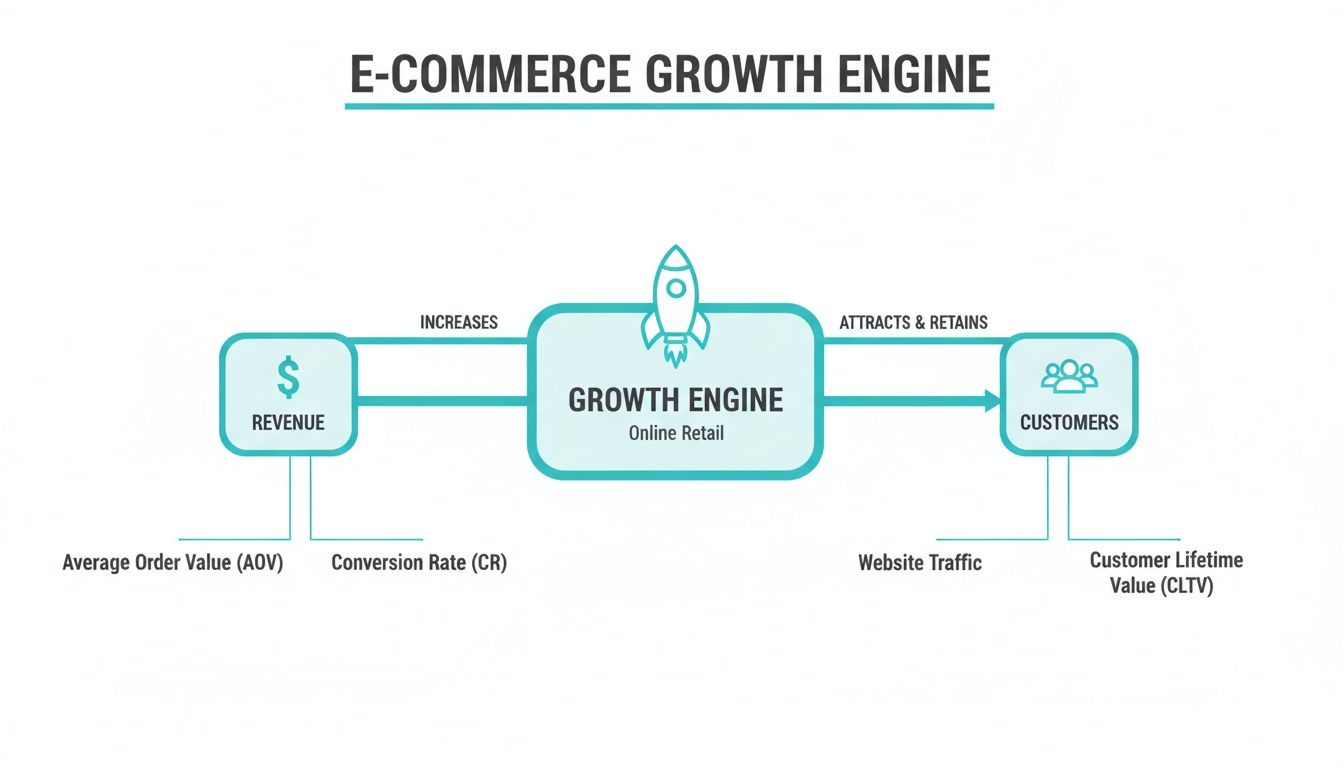
The key takeaway is that your platform isn't just a piece of software; it's the central hub that makes every customer acquisition and sales strategy possible.
Designing a Website That Converts Visitors into Customers
A pretty website is nice. A profitable one is essential.
In e-commerce, beautiful design alone doesn't pay the bills. Your site needs to be engineered from the ground up to turn a casual browser into a paying customer. This is the heart of conversion-led design—every single element, from the menu to the "buy now" button, has one job: to make a sale.
Think of it this way: great design is part psychology, part persuasion. It’s about building a digital storefront that makes it ridiculously easy for someone to find what they want, trust your brand, and feel confident clicking "complete purchase". When you get this right, your website becomes your best, most effective salesperson—and it works 24/7.
The hard truth is that a bad first impression online is incredibly expensive. In Australia's $69 billion e-commerce market, poor design is a direct revenue killer. Research shows that 38% of users will simply leave a site if it looks unappealing, and a massive 88% will never come back after a bad experience. For any business serious about growth, investing in a professional, conversion-focused design isn't just an option; it's non-negotiable. You can read the full research about Australian web design statistics to see just how much is at stake.
Building Trust Through Intuitive Navigation
Imagine walking into a massive department store where none of the aisles are labelled. You’d get frustrated and leave almost immediately. Your website's navigation is the digital version of those signs. It needs to be crystal clear, logical, and exactly where people expect it to be.
If customers can't find what they're looking for in a few seconds, they're not going to stick around. They’ll just go to a competitor. Your menu structure has to reflect how your customers actually think about your products.
Key elements of navigation that just works:
- A Clear Main Menu: Stick to simple, universal terms like 'Shop', 'About Us', and 'Contact'. Avoid overly clever or vague labels that just cause confusion.
- Logical Categories: Group your products into well-defined categories and subcategories that make perfect sense to someone who has never visited your site before.
- A Prominent Search Bar: A powerful, easy-to-spot search function is a must-have, especially if you have a large product catalogue. Make sure it returns relevant results, and fast.
Crafting High-Impact Product Pages
This is it—the moment of truth. Your product page is where the final buying decision happens. It's your digital sales pitch, and it has to be compelling, informative, and persuasive. You're not just listing features; you're helping the customer picture this product in their own life.
High-quality images are your most powerful tool here. Since customers can't physically touch the product, your photos have to do all the heavy lifting. Show it from multiple angles, show it in use, and include a zoom function so they can get a feel for the details.
A great product page does more than describe an item; it answers every potential question a customer might have before they even think to ask it. It removes doubt and builds the confidence needed to complete a purchase.
On top of great photos, your product pages absolutely must include:
- Clear and Concise Descriptions: Write engaging copy that focuses on the benefits for the customer, not just the technical specs.
- Visible Pricing and Shipping Information: Don't hide costs. Unexpected fees at checkout are the number one reason people abandon their carts. Be upfront from the start.
- Social Proof: Proudly display customer reviews, star ratings, and testimonials. People trust other people's opinions far more than they trust marketing copy.
- A Strong Call-to-Action (CTA): Your 'Add to Cart' button should be impossible to miss. Use a bold, contrasting colour and clear, action-oriented text.
Creating a Frictionless Checkout Process
The checkout is the final hurdle. A customer can love your brand and your product, but a clunky, confusing checkout will send them running. The goal here is pure, absolute simplicity. Every extra step, every unnecessary form field, is another chance for them to abandon the sale.
Think of it like the express lane at the supermarket. You want to get customers through as quickly and painlessly as possible. A long, multi-page checkout process that demands they create an account is a known conversion killer.
To nail your checkout, focus on these three things:
- Offering a Guest Checkout: Never force people to create an account. It's a massive roadblock for first-time buyers.
- Simplifying Forms: Only ask for the information you absolutely need. Use tools like address auto-fill to make it even faster.
- Providing Multiple Payment Options: Cater to everyone by offering trusted gateways like Stripe, PayPal, and buy-now-pay-later options like Afterpay.
By focusing on these conversion-led principles, you’re not just building an e-commerce website. You're creating a powerful asset designed to maximise your competitive advantage and deliver a real return on your investment. To learn more, take a look at our guide on how an ecommerce website can maximise your competitive advantage.
Optimizing Your Store for Mobile Shoppers
Let's be blunt: in today's world, your mobile website isn't an add-on or a "nice-to-have." It is your primary storefront. Thinking about website development for ecommerce with a mobile-first mindset isn't a clever strategy anymore; it's the baseline for staying in business.
Think of it this way. A big, sit-down restaurant is great, but a well-designed food truck is engineered for a completely different environment. It's built for speed, convenience, and delivering an amazing experience in a small, focused space. That's exactly what your mobile site needs to do.
Why Mobile Commerce Is King
The move to mobile isn't just a trend; it's a fundamental shift in how people buy things. The numbers for Australian businesses are hard to ignore. In a single year, smartphones were responsible for an eye-watering AUD 56.07 billion in revenue, making up 68% of all online purchases.
It gets even clearer when you look at traffic. Mobile devices brought in 77% of all ecommerce visitors, yet desktops only accounted for 30% of the actual orders. If your mobile experience is an afterthought, you're actively turning away the majority of your potential customers and revenue. You can dig deeper into the trends shaping Australian online shopping on ibisworld.com.
A clunky mobile website is the digital equivalent of a shop with a locked front door. Customers will arrive, get frustrated, and immediately go somewhere else—likely to a competitor who has invested in a better experience.
This isn't just theory; it’s the reality of modern commerce, and it demands a total rethink of how we build online stores.
What Real Mobile Optimisation Looks Like
True mobile optimisation is so much more than just a "responsive" design that squishes your desktop site onto a smaller screen. It means redesigning the entire customer journey for someone holding a phone, likely on the move, and navigating with their thumb.
It’s all about making every tap and scroll feel effortless and intuitive. You have to account for smaller screens and, often, less reliable mobile data connections. Every single element needs to earn its place and serve a clear purpose, without creating clutter.
Here’s what a high-converting mobile site absolutely must have:
- Thumb-Friendly Design: Buttons, links, and form fields need to be big enough to tap easily without zooming or hitting the wrong thing. Key calls-to-action, like ‘Add to Cart’, should be right where a thumb can comfortably reach them.
- Lightning-Fast Load Times: Mobile shoppers have zero patience. Every extra second your site takes to load drastically increases the chances they'll give up. That means optimising images and keeping your code clean is non-negotiable.
- Simplified Navigation and Forms: Forget complex, multi-level menus. A clean "hamburger" menu is your best friend. Checkout forms should be stripped back to the bare essentials—ask only for what you absolutely need to process the order.
- Click-to-Call and Map Integration: If you have a physical presence, make it dead simple for customers to call you or get directions with a single tap.
A genuinely optimised site respects the user's context. By building for mobile from the ground up, you're not just appealing to a segment of your audience; you're designing for the way most people shop now. For more practical advice, take a look at our guide on how to create a mobile-friendly site that works.
Connecting Essential Tools to Power Your Business
Think of your ecommerce website as the engine of your business. It's powerful, sure, but it can't run on its own. Integrations are the drivetrain, the fuel lines, and the electrical system—the critical connections that make everything work together seamlessly. No online store is an island; to really scale and automate your operations, your website development for ecommerce needs a solid plan for plugging in essential third-party tools.
These integrations are like hiring a specialist crew. While your website handles the core job of showing off products and taking orders, this crew works tirelessly behind the scenes. They manage the complex stuff, automating everything from payments to shipping, which frees you up to focus on growing your business instead of getting lost in manual admin.
Building Your Core Tech Stack
"Tech stack" might sound a bit intimidating, but it's really just the collection of software and tools that keeps your online business humming. A well-chosen stack takes repetitive work off your plate, gives you the data you need to make smart decisions, and lets you grow without your workload spiralling out of control.
Here are the non-negotiable tools you’ll need to get started:
- Payment Gateways: These are your digital cash registers. They securely process customer credit and debit card payments, and using trusted names like Stripe, PayPal, or Square is crucial for building confidence and making checkout a breeze.
- Inventory Management Systems: If you sell products both online and in a physical store (or on multiple marketplaces), an inventory system is a lifesaver. It automatically syncs your stock levels everywhere, preventing you from selling an item you don't actually have—a surefire way to frustrate a customer.
- Shipping and Logistics Providers: These integrations connect your store directly to courier services. They can automatically calculate shipping rates at checkout, print shipping labels with a click, and send tracking information straight to your customers.
A smart tech stack is an operational superpower. It transforms your ecommerce site from a simple online catalogue into a highly efficient, automated business engine that can handle growth without missing a beat.
Choosing the right partners here is a big deal. For example, your shipping provider can make or break the customer experience. It's worth checking out a best courier service comparison guide for ecommerce success to see how different options stack up for Australian businesses.
Tools for Marketing and Customer Engagement
Once the operational side is sorted, your tech stack needs tools to actually attract, convert, and keep customers coming back. This is how you turn casual website visitors into a loyal community and a reliable source of repeat business.
Marketing Automation Platforms
These tools are the heart of your growth strategy. They handle all sorts of automated tasks, like sending follow-up emails for abandoned carts, welcoming new subscribers with a special offer, and running targeted sales promotions. Platforms like Klaviyo or Mailchimp plug directly into your ecommerce site, using real customer data to send incredibly relevant messages.
This kind of automation is a game-changer for nurturing leads and driving repeat sales. For a closer look, our guide on email marketing for small business breaks down how to build these automated funnels from scratch.
Analytics and Customer Insights
You can't improve what you don't measure. A tool like Google Analytics is absolutely essential for understanding how people find your site, what they do once they're there, and where they get stuck. This data is pure gold, telling you which of your marketing campaigns are paying off and which pages on your site need a tune-up to improve conversions.
By connecting these essential tools, you create a seamless ecosystem. Payments are processed securely, orders are fulfilled efficiently, and your marketing works around the clock to bring customers back. This connected approach is what separates a struggling online store from a thriving ecommerce business built for the long haul.
Keeping Your Ecommerce Engine Tuned for Long-Term Success
Getting your ecommerce website live is a massive achievement. Pop the champagne, absolutely. But it’s crucial to remember that launch day is the starting line, not the finish line. The real work of turning that shiny new site into a consistent revenue-generator starts now.
Think of it like buying a brand-new performance car. It looks amazing and runs perfectly off the lot, but you wouldn’t just drive it for years without changing the oil or checking the tyres, right? Your website is exactly the same; it needs regular servicing, fine-tuning, and a skilled driver to keep winning.
Without a solid plan for what comes next, even the most beautiful, expensive website can quickly become slow, insecure, or just plain outdated. Long-term success isn’t about a one-and-done build. It's about protecting and growing your investment through ongoing maintenance and smart optimisation.
Protecting Your Digital Shopfront
The second your site goes live, it's on the radar. Ongoing maintenance and security monitoring aren’t optional add-ons; they are fundamental to protecting your business, your customers' data, and the trust you've worked so hard to build. A single security breach or a major bug can wipe out your hard-earned reputation overnight.
Regular maintenance is your digital insurance policy. It's a proactive checklist that keeps your store humming along without any nasty surprises.
- Software Updates: This is your first line of defence. Consistently updating your platform (like Shopify or Magento), themes, and any plugins closes security holes before hackers can find them.
- Security Scans: You need to be actively looking for trouble. Regular malware and vulnerability scans help you find and patch weak spots before they can be exploited.
- Regular Backups: Things can and do go wrong. Having automated, off-site backups means you can hit the 'rewind' button and restore your site quickly, with minimal data loss and downtime.
Maintaining Peak Performance
A slow website is a silent conversion killer. We've all been there – waiting for a page to load, getting frustrated, and hitting the 'back' button. Your customers are no different. In fact, just a one-second delay in page load time can cause a significant drop in sales.
This is why regular performance checks are so important. It’s a constant process of monitoring your site’s speed, finding the bottlenecks (like oversized images or clunky code), and fixing them. A zippy site doesn’t just keep customers happy; it also gets a big tick from search engines like Google, which directly helps more people find you.
Your ecommerce website is a living asset, not a static brochure. Continuous optimisation is the process of using real customer data to make incremental improvements that compound over time, turning a good website into a powerful, long-term growth engine.
Driving Growth Through Continuous Optimisation
Okay, this is where the real magic happens. This is how you transform a functional website into a highly profitable one. Continuous optimisation is about never being satisfied with 'good enough'. It’s a cycle of using real data to understand what your users are actually doing, and then testing small changes to improve their experience and guide them toward the checkout.
It all boils down to a simple, powerful loop of data analysis and controlled testing.
- Analyse User Behaviour: Dive into tools like Google Analytics or Hotjar. Where are people coming from? Which pages do they get stuck on? Where are they dropping off before buying?
- Form a Hypothesis: Based on the data, you might notice lots of people abandon their cart on the shipping page. Your hypothesis could be: "I believe making the 'Free Shipping' banner more prominent will reduce cart abandonment."
- Run an A/B Test: This is a head-to-head competition. You show 50% of your visitors the original page (Version A) and the other 50% the new page with the bigger banner (Version B).
- Measure and Implement: Let the test run until you have enough data. If Version B resulted in more completed checkouts, you have a winner. You then roll that change out to 100% of your visitors.
By repeating this cycle—analyse, hypothesise, test, implement—you make small, data-backed improvements that add up to massive gains in your conversion rate and revenue. This ongoing process ensures your website evolves with your customers, cementing its place as your most valuable business asset.
Got Questions? We've Got Answers
Stepping into the world of ecommerce development often brings up a lot of questions. That’s a good thing—it means you’re serious about getting it right. Below, we’ve tackled some of the most common queries we get from business owners just like you.
Think of this as your cheat sheet for making smarter decisions and setting clear expectations for your project.
How Much Does an Ecommerce Website Cost in Australia?
The honest answer? It depends on what you need. A simple store on a platform like Shopify might start in the ballpark of AUD $5,000–$8,000. If you're after more control and custom features using something like WooCommerce, you're probably looking at a budget between AUD $10,000 and $25,000.
For enterprise-level projects with unique integrations or complex requirements, the investment can easily go beyond AUD $25,000. It's helpful to stop thinking of this as just a "cost" and see it for what it is: an investment in your most important sales channel, built to deliver a serious return.
What’s the Typical Timeline for Building an Ecommerce Store?
For most small to medium-sized ecommerce websites, you can expect the process to take somewhere between 8 and 12 weeks. That's not just coding time; it covers everything from the initial discovery and strategy, through to design, development, and the all-important pre-launch testing.
Larger, more complicated builds—especially those with custom features or thousands of products to migrate—will naturally take longer. The secret to hitting deadlines is always solid communication and a true partnership between you and your development team.
Remember: Great functionality without an intuitive design will frustrate users. A beautiful design that is slow or buggy will lead to abandoned carts. Success lies in balancing both.
What Matters More: Design or Functionality?
This is like asking if an engine is more important than the steering wheel. The truth is, they are two sides of the same coin and one is useless without the other. You absolutely need both.
A website with powerful, slick functionality will fall flat if customers can't figure out how to use it. On the flip side, a stunningly beautiful site that’s buggy or slow will send shoppers running for the exit.
Great ecommerce development is all about making design and function work in perfect harmony. The whole point is to guide a customer from the homepage to the checkout as smoothly as possible, and that simply can't happen if one part of the equation is weak.
At Frank Digital Agency, we live and breathe high-performance ecommerce. We don't just build websites; we build sales engines that turn browsers into buyers, combining smart design with a data-first strategy to deliver results you can see on your bottom line.