

Web ecommerce development is the whole shebang of creating an online store to sell your products or services. It’s where web design (how it looks and feels) meets web development (how it actually works) to build a digital storefront that’s both beautiful and functional.
Think of it as building a high-performance sales engine for your business, one that works around the clock.
What Is Web Ecommerce Development, Really?
Imagine you’re building a brand-new flagship retail shop. You wouldn't just throw up four walls and hope for the best, right? You’d plan every single detail: the foundation, the layout to guide customers through the aisles, the eye-catching product displays, and the smooth, efficient checkout counters.
Web ecommerce development is the digital version of that entire process.
It's both an art and a science—the art of making a store look inviting and the science of ensuring it works flawlessly to turn casual browsers into paying customers. It's much more than just tapping out lines of code; it's a strategic process focused on building a powerful sales machine, which is absolutely vital in Australia's booming online market.
The Core Components of an Online Store
Every ecommerce site, no matter how simple or complex, is built on three key pillars working in harmony. Getting your head around these demystifies how your online store actually operates.
- The Frontend (Your Digital Storefront): This is everything your customers see and click on—the product pages, the stunning images, the "add to cart" buttons, and the checkout forms. It’s the entire customer-facing experience, crafted to be intuitive and engaging.
- The Backend (The Engine Room): This is all the behind-the-scenes technology that makes the storefront tick. It manages your inventory, processes payments securely, handles customer accounts, and keeps the whole system running smoothly. It's the "staff-only" area your customers never see.
- The Database (Your Records): Think of this as your store's digital filing cabinet. It’s where all the crucial information is stored and organised—everything from customer details and order histories to product data and sales reports.
It’s More Than Just Coding
To really get what web ecommerce development is all about, you need to understand the different roles played by a web developer vs web designer. The designer is the architect of the user experience and visual layout, while the developer is the engineer who builds the functional structure that brings that vision to life. You absolutely need both for a great result.
The ultimate goal of web ecommerce development isn't just to launch a website. It's to create a seamless path from that first click to a completed purchase, building a system that generates revenue and keeps customers coming back.
The opportunity here for Australian businesses is massive. Australia's e-commerce market has absolutely exploded, hitting a whopping $60.8 billion in 2025 and marking an impressive 8.7% growth in that year alone. This surge shows just how much potential there is for businesses in Adelaide and across the country to build digital storefronts that turn clicks into customers. You can read more about the growth of Australia's online shopping sector on IBISWorld.
The Six Phases Of A Successful Ecommerce Build
Building a high-performing online store is never a happy accident; it’s the outcome of a methodical, structured process. I like to think of successful web ecommerce development like building a house. You wouldn't just start hammering nails without a detailed blueprint, and the same logic applies here. Every single phase builds on the last, making sure the final product is solid, functional, and perfectly aligned with your business.
If you rush any of these steps, it’s like pouring a dodgy foundation—it will cause headaches and cracks to appear down the track. By following a clear roadmap, we avoid those costly mistakes, keep the project on budget, and deliver a platform that’s engineered for growth right from day one.
1. Discovery and Strategy
This is easily the most critical part of the whole project. Before we even think about writing a line of code, we need to dig deep and figure out what success actually looks like for you. What are your real business goals? Who are your ideal customers, and what do they really need from an online shopping experience?
This stage is all about research—diving into your market, sussing out the competition, and getting into the heads of your target audience. We map out the entire customer journey, define the must-have features, and set clear Key Performance Indicators (KPIs) so we can measure success once you're live. This strategic groundwork ensures every decision we make from here on out is purposeful and tied directly to your business goals.
2. Design and User Experience (UX)
With a solid strategy locked in, we can start creating the blueprint. This isn't just about making the site look pretty; it's about crafting an intuitive and persuasive user experience (UX) that naturally guides visitors towards making a purchase. We kick things off with wireframes, which are basic layouts that map out the site’s navigation and content hierarchy.
From there, we build high-fidelity mockups. These are detailed visual designs that bring your brand's unique look and feel to life. Every little detail, from the colour of the "Add to Cart" button to how the checkout process flows, is meticulously designed to reduce friction and boost conversions. A mobile-first design approach isn't just a suggestion, it's non-negotiable, especially when you realise how many people now shop on their phones.
The diagram below gives you a peek behind the curtain, showing the core technical layers that bring your ecommerce vision to life.
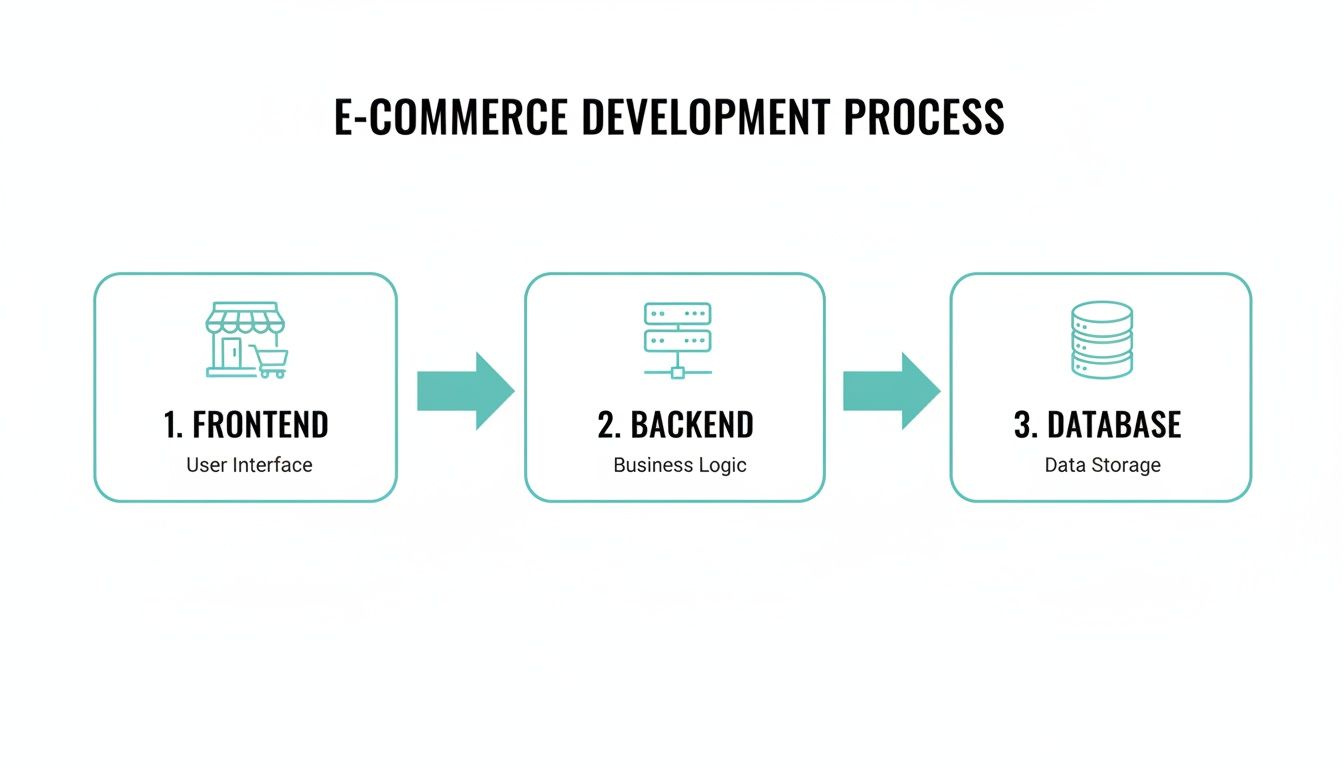
It breaks down how the frontend (what the customer sees), the backend (the engine running things), and the database all work in concert to create a functional ecommerce machine.
3. Development
This is where the magic happens. We take all those visual designs and strategic plans and turn them into a real, functioning online store. Our developers get to work, building both the beautiful frontend experience your customers will interact with and the powerful backend that makes it all tick.
Here’s a snapshot of what goes on in this phase:
- Platform Setup: We get your chosen ecommerce platform, whether it's Shopify or WooCommerce, configured and ready to go.
- Custom Theme Development: The approved designs are translated into a fast, responsive, and unique theme for your store.
- Feature Integration: We plug in all the essential tools, like payment gateways, shipping calculators, and inventory management systems.
This is the most hands-on, technical part of the whole web ecommerce development process. Precision and clean coding are everything here, as they lay the groundwork for great performance and future scalability.
4. Testing and Quality Assurance (QA)
Before we even think about launching, the entire website goes through some serious testing to hunt down and squash any bugs. A glitchy user experience can destroy trust and lose you sales in an instant, so we leave absolutely nothing to chance. Our QA team meticulously inspects every nook and cranny of the site.
We test everything from broken links and payment processes to how the site performs on different devices and web browsers. The goal is simple: ensure a completely seamless, error-free experience for every single user from the moment you go live.
5. Launch and Deployment
Once all the checks are done and we have your final sign-off, it’s go-time. This involves carefully migrating the site from our staging (testing) server to the live server. We manage this entire deployment process from start to finish, ensuring a smooth switch-over with little to no downtime.
6. Post-Launch Maintenance and Optimisation
Getting your store live isn't the finish line—it's actually the starting line. Ongoing maintenance is absolutely vital for security, performance, and keeping your site running on the latest software. Beyond that, we keep a close eye on your analytics, gather user feedback, and run A/B tests to find opportunities for improvement. This ensures your ecommerce platform doesn't just sit there, but actively evolves with your business and your customers' needs.
Choosing The Right Ecommerce Technology Stack
Picking the technology for your online store is a lot like choosing the engine for a new car. The decision you make here will dictate your store's speed, power, and how easily you can add new features down the track. This isn't just a techy detail; it's a fundamental business decision that shapes your day-to-day operations and your capacity for growth.
This part of the web ecommerce development journey is all about selecting the right platform and connecting it with the essential tools. The goal is to build a seamless ecosystem that works brilliantly for you and, just as importantly, for your customers. Get this right, and you'll have a foundation that not only supports your business today but can scale with you tomorrow.
Comparing The Two Most Popular Platforms
For most businesses here in Australia, the choice usually comes down to two major players: Shopify and WooCommerce.
Think of Shopify as a brand-new, reliable sedan—it comes with everything you need built-in, straight from the factory. It’s powerful, user-friendly, and perfect for businesses that want to get on the road quickly without needing a mechanic's license.
WooCommerce, on the other hand, is more like a customisable 4×4. Because it's built on WordPress, it gives you almost unlimited freedom to modify, adapt, and build completely unique features. It’s the ideal choice for businesses with very specific needs or those who want total control over every nut and bolt.
Both platforms are fantastic, but the "best" one really depends on your business model, how comfortable you are with technology, and what your long-term ambitions are. There's no one-size-fits-all answer here.
To help you figure out which path to take, have a look at our detailed guide comparing Shopify vs WooCommerce.
Here's a quick side-by-side to get you started:
Ecommerce Platform Comparison: Shopify vs WooCommerce
| Feature | Shopify | WooCommerce (WordPress) |
|---|---|---|
| Ease of Use | Very user-friendly, all-in-one hosted solution. Ideal for beginners. | Steeper learning curve. Requires separate hosting and some technical setup. |
| Cost Structure | Monthly subscription fee plus transaction fees (unless using Shopify Payments). | Free to install, but you pay for hosting, domain, theme, and premium plugins. |
| Customisation | Good customisation through themes and apps, but limited access to core code. | Almost limitless. Full control over code, design, and functionality. |
| Scalability | Excellent. Handles high traffic and large product catalogues effortlessly. | Highly scalable, but performance depends heavily on your hosting and optimisation. |
| Support | 24/7 support via phone, email, and live chat is included in all plans. | Relies on community forums, documentation, and paid support from developers. |
Ultimately, Shopify offers simplicity and peace of mind, while WooCommerce delivers unparalleled freedom and control.
Powering Your Store With Essential Integrations
Your ecommerce platform is the heart of your operation, but its real strength is unlocked when you connect it with other specialised tools. These integrations work behind the scenes to create a smooth, automated system for everything from payments and shipping to marketing.
For any serious Australian ecommerce business, these are the non-negotiables:
- Payment Gateways: You need a secure and easy way to take money. Stripe is a top choice for its smooth on-site credit card processing, while PayPal provides a trusted name that millions of customers already know and use.
- Shipping Solutions: To offer accurate, real-time shipping quotes, you need to connect directly with carriers. Integrations with Australia Post and couriers like Sendle can automate label printing and make fulfilment a breeze.
- Email Marketing and Automation: Building a customer base is everything. Tools like Klaviyo or Mailchimp sync with your store to send automated abandoned cart reminders, welcome emails, and targeted promotions based on what people buy.
- Analytics and Reporting: You can't improve what you don't measure. Installing Google Analytics 4 is absolutely essential for tracking visitor behaviour, seeing where customers drop off, and understanding how well your marketing is working.
Matching The Tech to The Australian Market
Australia’s online economy is booming, which makes choosing the right technology more important than ever. The B2C e-commerce space is huge, projected to make up 60.34% of the market in 2025. At the same time, B2B sales are growing at an incredible 13.12% CAGR through 2031.
This growth across the board creates a massive opportunity for agencies like Frank Digital, as we build specialised solutions for both ecommerce brands and local Adelaide service businesses that need to turn website visits into actual sales. Right now, fashion and apparel are leading the pack, driven by giants like The Iconic and Shein, which just goes to show the need for visually stunning and high-performance platforms. You can dive deeper into these trends in the Australian ecommerce market on Mordor Intelligence.
At the end of the day, whether you're a local Adelaide artisan just starting out or a national brand ready to scale up, your technology stack has to match your goals. By choosing your platform carefully and integrating the right tools, you're not just building a website—you're building a powerful engine designed to drive your business forward for years to come.
Designing A High-Converting User Experience
Let’s be honest: a beautiful website that doesn’t actually sell anything is just an expensive digital brochure. In the world of online retail, success comes down to one crucial thing: creating an experience that smoothly guides visitors from the moment they arrive to the final click of the “complete purchase” button.
This isn’t about chasing flashy design trends or using clever gimmicks. It’s a strategic process of removing friction, building trust, and making it ridiculously easy for customers to find what they want and buy it. When you get this right, every single element on your page works in harmony to drive your conversion rate, turning your website into a genuine sales machine.
Making Product Discovery Effortless
If a customer can't find what they’re looking for in a few seconds, they're gone. It's that simple. That’s why intuitive navigation is the absolute foundation of a great user experience. Your menu needs to be logical, your categories must be crystal clear, and your search bar has to be smart enough to handle typos and serve up relevant results instantly.
Think of your site’s navigation like the helpful signage in a physical store. It should point shoppers exactly where they need to go without a second thought. This means getting the basics right:
- Logical Categories: Group your products in a way that makes sense to your customers, not just how you’ve organised your inventory.
- Powerful Filters: Let people quickly narrow their options by size, colour, price, or brand. This is a non-negotiable.
- Predictive Search: A search bar that suggests products as someone types is a simple feature that dramatically speeds up the discovery process.
Crafting Compelling Product Pages
Once a shopper lands on a product page, that page has to do all the heavy lifting. It needs to answer every possible question, create desire, and dissolve any hesitation to buy. This is where high-quality visuals and persuasive descriptions truly shine.
A product page that converts must include:
- High-Resolution Imagery: We're talking crystal-clear photos from every angle, zoom capabilities, and lifestyle shots showing the product in a real-world context.
- Detailed Descriptions: Go beyond the basic specs. Explain the benefits, solve a customer’s problem, and tell a story that they can connect with.
- Visible Trust Signals: Prominently feature customer reviews, star ratings, and security badges to build confidence right away.
- Clear Calls-to-Action (CTAs): Your "Add to Cart" button should be bright, bold, and impossible to miss.
As you plan your ecommerce platform, always think about how you can improve e-commerce conversion rates by optimising these visual and informational elements.
The Frictionless Checkout Is Non-Negotiable
Cart abandonment is the silent killer of online sales. A complicated, confusing, or slow checkout is the number one reason people leave without buying. Every extra step or unnecessary field you force them to fill out increases the odds they'll just give up.
The goal is to make paying for an item so seamless that it feels like an afterthought. A checkout process should be fast, secure, and transparent, with no surprise shipping costs added at the very end.
One emerging trend that demands a frictionless experience is live commerce. This interactive shopping trend is revolutionising e-commerce in Australia, with the market set for a staggering 33.3% CAGR from 2025 to 2030. This boom requires agile web development that supports real-time streaming and instant payments—services Frank Digital Agency excels in for Adelaide's businesses. You can explore more about the rise of live commerce in Australia from Grand View Research.
Ultimately, a fantastic user experience isn't just one big thing; it's the sum of countless small, thoughtful details. You can explore more foundational concepts in our guide to user experience design principles. By focusing on clarity, speed, and trust, you create an online environment where customers feel confident and ready to make a purchase.
How To Budget For Ecommerce Development
Let's get straight to it—the two questions every business owner asks: "How much is this going to cost?" and "How long will it take?" But thinking about web ecommerce development isn't just about a line item on a spreadsheet; it's a strategic investment in what will become your most valuable, 24/7 sales engine.

There’s no one-size-fits-all price tag here. The final figure is shaped entirely by the scope and complexity of what you need your online store to do.
Key Factors That Shape Your Budget
A few core elements have the biggest impact on the final investment. Getting your head around these helps you see where the value is created and why a simple online shop costs far less than a custom-built powerhouse.
- Platform Choice: A straightforward Shopify build using a quality pre-made theme will naturally be more budget-friendly than a completely custom WooCommerce store that needs a lot of bespoke development work. The platform really is the foundation of your costs.
- Design Complexity: A clean, simple design based on a template is quick to get up and running. On the other hand, a completely bespoke design with unique layouts, slick animations, and a deeply branded user experience requires a lot more time from designers and developers, which bumps up the budget.
- Custom Features and Integrations: Do you need a unique product customiser? A recurring subscription model? Or maybe an integration with a specialised inventory management system? Every custom feature is like adding a new room onto your house—it adds incredible value but also requires a bigger investment.
- Data Migration: If you’re moving from an older platform, bringing across thousands of products, customer accounts, and order histories is a delicate operation. It requires careful planning and execution to make sure nothing gets lost, and it’s a cost that many businesses forget to factor in.
Think of it this way: a simple, template-based site is like a reliable, high-quality tool you buy off the shelf. A custom build is like commissioning a specialised machine, perfectly engineered for your factory's unique production line. Both get the job done, but they solve problems at very different scales and price points.
For a more detailed breakdown of how these factors influence the final numbers, take a look at our guide on understanding web development pricing.
Realistic Timelines and Investment Brackets
To give you a clearer picture, let’s run through a few common scenarios. A standard Shopify setup for a small business with a few dozen products might take around 4 to 8 weeks from start to finish.
In contrast, a large-scale, custom WooCommerce project for a mid-sized business with thousands of products and specific integrations could easily take anywhere from 3 to 6 months, and sometimes longer. The timeline really stretches with each layer of complexity you add.
Here’s a general guide to what you can expect at different investment levels:
- Small Business / Startup: Perfect for getting off the ground with a professional, template-based Shopify or WooCommerce site that includes all the essential features to start selling.
- Mid-Sized Business: This budget opens the door to a semi-custom design, more advanced features, and crucial integrations with systems like your accounting software or email marketing platform.
- Enterprise / Custom Solutions: This is for large-scale projects that demand a completely bespoke design from the ground up, complex backend integrations, and ongoing optimisation strategies built for high-volume sales.
Finding The Right Australian Ecommerce Partner
Choosing a partner for your web ecommerce development is one of the biggest calls you’ll make for your business. This isn’t just about hiring a coder to put up a website. You’re looking for a team that becomes a genuine extension of your own—one that’s as invested in your commercial success as you are.
The right agency thinks way beyond the launch date. They’re focused on your long-term growth and delivering results you can actually measure. They act as a strategic guide, bringing business smarts and market insights to the table, not just technical skills. This is the difference between simply getting a site built and launching a powerful sales engine.
Evaluating Potential Partners
When you start looking at agencies, it’s easy to get wowed by a slick sales pitch. But you need to look for real proof. The best partners are open and can back up their claims with tangible results. A strong portfolio is a great start, but you need to dig a bit deeper to find a team that’s the right cultural and strategic fit for your business.
A top-notch partner will have a solid track record in these areas:
- A Proven Portfolio: They should have a gallery of successful online stores that don't just look good but are also fast and dead simple to navigate. Make sure you ask to see examples from your industry.
- A Focus on Conversion Rate Optimisation (CRO): A great agency is obsessed with conversions. They should be able to talk you through A/B testing, user experience (UX) design, and how they use data to turn more of your visitors into paying customers.
- Local Market Knowledge: An agency that understands the Australian and, more specifically, the Adelaide market gives you a massive advantage. They get local consumer behaviour and can build your site to connect with Aussie shoppers.
Critical Questions To Ask Any Agency
To sort the genuine experts from the crowd, you need to ask the right questions. This is how you get a feel for their process, their transparency, and how they think strategically. Don't be shy about asking for detailed answers before you sign anything.
Your ecommerce partner should be as focused on your balance sheet as they are on beautiful design. Their success should be directly tied to yours, creating a relationship built on shared goals and mutual growth.
Here’s a practical checklist to keep handy during your conversations:
- How will you measure the success of my new online store?
- Can you walk me through your process, from our first chat to post-launch support?
- Who will be my main point of contact, and how often can I expect to hear from them?
- What's your approach to ongoing maintenance, security, and performance optimisation?
Ultimately, finding the right team is about building a long-term relationship. Choosing a partner like Frank Digital means you get a team that understands the Adelaide landscape and is committed to building a complete strategy that drives real, lasting business results.
A Few Common Questions We Hear
What Is The Best Ecommerce Platform For A Small Business In Australia?
For most Aussie small businesses, it really boils down to two main contenders: Shopify and WooCommerce.
Think of Shopify as the all-in-one, ready-to-go solution. It’s incredibly user-friendly, quick to get off the ground, and comes with brilliant 24/7 support. If your main goal is to start selling quickly without getting bogged down in technical details, Shopify is a fantastic choice.
WooCommerce, on the other hand, is built on top of WordPress and is all about flexibility. It’s the perfect fit if you need deep customisation or want total control over every pixel of your store's design. Just be aware that this freedom comes with a bit more responsibility for technical management.
How Much Should I Budget For Ongoing Website Maintenance?
Keeping your site running smoothly is just as important as building it in the first place. For a small to mid-sized ecommerce store, a good rule of thumb is to set aside between $100 and $500 per month.
So, what does that actually get you? Usually, it covers the essentials that keep your store secure and fast:
- Regular software and plugin updates
- Security monitoring and malware scans
- Consistent site backups (your safety net!)
- Performance checks to keep things loading quickly
Think of it as an insurance policy for your investment, ensuring your customers always have a great experience.
How Can I Make Sure My New Store Is SEO-Friendly?
You absolutely have to build Search Engine Optimisation (SEO) in from the very beginning—it’s not something you can just bolt on later. The key is working with your development partner to nail the technical fundamentals like clean URLs, a mobile-first design, and lightning-fast page speeds.
Beyond the technical side, you’ll want to focus on creating keyword-rich product descriptions, well-crafted meta titles, and a logical site structure. This makes it easy for Google to understand what you’re selling and show your products to the right people.
Can My Online Store Sync With My Physical Shop Inventory?
Yes, it certainly can! This is a common requirement, and it’s handled by integrating a Point of Sale (POS) system with your ecommerce platform.
Systems like Shopify POS or various WooCommerce POS solutions can connect your online and in-store inventory in real-time. When a customer buys a product in your physical shop, the stock count on your website updates automatically, and vice versa. It’s a brilliant way to prevent overselling and keep your operations running like a well-oiled machine.
Ready to build a high-performance online store that drives real results for your Adelaide business? The team at Frank Digital Agency specialises in conversion-focused web ecommerce development. Let's talk about your project.