

So, you're weighing up Shopify versus WooCommerce. The simplest way to think about it is this: Shopify is like leasing a fully-serviced retail space in a premium shopping centre, while WooCommerce is like buying the land and building your store from the ground up. One gives you streamlined simplicity, the other offers total creative freedom.
Comparing the Ecommerce Heavyweights
Choosing your e-commerce platform is a massive decision. It’s the foundation of your entire online business, affecting everything from how your store looks to how you handle inventory, payments, marketing, and customer data. For most Australian small and medium businesses, the choice boils down to these two giants. They both dominate the market but come from completely different places.
Shopify is built for ease and speed. It’s an all-in-one solution that takes care of the tricky technical stuff—like hosting, security, and performance—so you can pour all your energy into building your brand and selling. This makes it a brilliant choice if you're not a tech whiz and just want to get your store live, fast.
WooCommerce, on the other hand, is a plugin for WordPress, which means it’s a blank canvas. You get limitless potential for customisation. Because you manage your own hosting, you have absolute control over your store's design, features, and data. That incredible freedom comes with a trade-off: a steeper learning curve and the responsibility for all your own site maintenance and security.
Quick Decision Matrix Shopify vs WooCommerce
Making the right call often comes down to your priorities. Use this quick guide to see where your business needs align.
| Business Priority | Shopify Is Your Best Choice If | WooCommerce Is Your Best Choice If |
|---|---|---|
| Speed to Market | You want to launch ASAP with next to no technical fuss. | You’ve got a longer timeline and plan to build a truly unique storefront from scratch. |
| Ease of Use | You’d prefer an intuitive, drag-and-drop builder and a guided setup. | You’re comfortable inside the WordPress dashboard and managing plugins yourself. |
| Budget Predictability | You like the idea of a fixed monthly fee that covers hosting, security, and support. | You want lower upfront costs and are okay with variable hosting and add-on fees. |
| Customisation | You’re happy working with polished themes and apps from a curated App Store. | You need deep, code-level control and access to thousands of open-source plugins. |
| Technical Management | You want a hands-off approach where the platform handles all security, updates, and hosting. | You want full server control and are prepared to manage your own site maintenance. |
This table should give you a good starting point, but the numbers also tell a compelling story.
Here in Australia, as of Q2 2025, Shopify has a significant lead with 42,921 active stores, while WooCommerce powers 30,411. This trend shows why so many businesses, including clients we work with here at Frank Digital Agency in Adelaide, often choose Shopify to build high-performing online stores. If you want to dive deeper into other platforms as well, checking out a broader ecommerce platform comparison can provide even more context.
Evaluating Ease of Use and Customisation Potential
When we talk about Shopify vs WooCommerce, the conversation always comes back to one central trade-off: convenience versus control. This isn’t just a technical point; it’s about what your day-to-day life managing your online shop will look like. One platform helps you start selling almost immediately, while the other gives you a blank canvas to build your brand’s exact vision.
Shopify is engineered for speed and simplicity. Its guided setup literally holds your hand from the get-go, which makes it incredibly appealing for business owners who aren't tech-savvy. Everything from hosting and security to a clean user interface is handled for you. That means you can put all your energy into your products and marketing, not server maintenance.
For an Adelaide-based tradesperson wanting to start selling custom parts online, Shopify's approach is a clear winner. They can launch a professional, secure store in a weekend without ever having to look at a line of code.
The WordPress Learning Curve
WooCommerce, on the other hand, lives inside the WordPress ecosystem. This introduces a steeper learning curve, no question. While installing the WooCommerce plugin itself is easy, you're suddenly in charge of everything else—finding a good host, installing an SSL certificate, and keeping on top of all the updates and security patches yourself.
This initial setup definitely requires more technical confidence. But that responsibility is exactly what buys you complete freedom. You aren't playing by a platform's rules; you're building the entire playground.
The core difference is this: Shopify is a product you use, while WooCommerce is a tool you wield. Your comfort level with technology and desire for control should be the primary guide in your decision.
Customisation: Shopify's Curated Ecosystem
With Shopify, customisation happens mostly through its theme editor and the Shopify App Store. The themes are polished and mobile-ready straight away, and the app store is filled with thousands of vetted, one-click apps to add new features.
Think of it as a walled garden. The plants inside are high-quality and guaranteed to thrive, but you can only grow what’s available within those walls. This approach ensures your store is stable and secure, but it comes at the cost of some creative flexibility.
This curated model is a big part of what helps maintain high performance and security standards, which is a crucial part of building an e-commerce website for a competitive advantage.
Customisation: WooCommerce's Open-Source Freedom
Because it’s open-source, WooCommerce offers pretty much limitless customisation. You have the entire library of over 59,000 WordPress plugins at your disposal, plus thousands of extensions built just for WooCommerce. If you need a feature that doesn't exist, a developer can just build it for you.
This is where WooCommerce really pulls ahead. A niche Australian retailer selling products with complex shipping rules could build a highly specific system that Shopify just couldn't handle out of the box.
For businesses with tricky shipping needs, exploring the best shipping restriction plugins for WooCommerce can show you just how deep the platform's customisation power goes. You can fine-tune every single part of the checkout, from product variations to delivery zones, without any limitations.
Here’s how that practical trade-off really looks:
Shopify's Approach:
- Setup: Guided, wizard-based process.
- Interface: Clean and intuitive, made for beginners.
- Customisation: Done through themes and a vetted App Store.
- Best for: Business owners who need to get online fast and value ease of use over deep technical control.
WooCommerce's Approach:
- Setup: Manual process requiring you to handle hosting, WordPress, and plugin installation.
- Interface: Familiar if you know WordPress, but can be a lot for newcomers.
- Customisation: Almost infinite, thanks to open-source plugins and direct code access.
- Best for: Businesses with unique requirements that demand a truly bespoke solution and have the technical know-how (or agency support) to manage it.
Ultimately, choosing between Shopify and WooCommerce on ease of use and customisation comes down to your business priorities. Do you just need a reliable car to get from A to B quickly, or do you need a powerful engine you can tune and modify for a specific kind of race? Answering that question will point you to the right platform.
Breaking Down the True Cost of Each Platform
When you’re comparing Shopify and WooCommerce, it's easy to get drawn in by the headline price. Shopify has its straightforward monthly fee, and WooCommerce is famously "free." But let’s be honest, the true cost of running an online store on either platform is a lot more complex. Hidden fees and variable expenses can easily catch you off guard.
Before you commit to one or the other, you need a clear-eyed look at the real numbers. What seems cheaper on day one might not be the most cost-effective choice six months or a year down the track. So, let's peel back the layers and see what you'll actually be paying.

Unpacking Shopify's All-Inclusive Model
Shopify’s main appeal is its predictability. The pricing is built around a recurring subscription that bundles everything you need—hosting, security, and support—into a single monthly payment. It makes budgeting a whole lot simpler.
Here’s the breakdown of what you’re paying for:
- Monthly Subscription: Shopify has a few different plans, from the Basic tier for startups to the Advanced plan for businesses that are really scaling up. Moving up a tier unlocks more powerful features and gets you better transaction rates.
- Transaction Fees: This is a big one. If you use their own gateway, Shopify Payments, you’re in the clear. But if you want to offer other options like PayPal or Afterpay, Shopify will charge an additional fee on every sale. This ranges from 2% on the Basic plan down to 0.5% on the Advanced plan.
- App Costs: You'll find plenty of free apps, but as your store grows, you'll inevitably need premium ones for specialised features like loyalty programs, subscription boxes, or advanced SEO tools. These can easily add another $20 to $200+ to your monthly bill.
For a new Aussie retail startup, a Basic Shopify plan combined with a few essential apps will likely set you back around $100-$150 AUD per month. The upside is that your costs are clear and predictable.
Calculating WooCommerce's A La Carte Expenses
Yes, the WooCommerce plugin itself is free. But that's where the "free" part ends. Because it’s a self-hosted platform, you’re on the hook for sourcing and paying for every other component that makes a store work.
When people say WooCommerce is "free," they mean the software. They don't mean the operational costs. Building a fast, secure, and reliable store requires investment in all the key areas that Shopify includes by default.
This pick-and-mix approach gives you total control, but it also means your costs are variable and can add up fast. Here’s what you absolutely need to budget for:
- Website Hosting: Don’t cheap out on this. Good hosting is crucial for speed and security. For quality managed WordPress hosting, you should expect to pay anywhere from $20-$50 AUD per month.
- Domain Name: This is a simple annual cost, usually around $20-$30 AUD.
- SSL Certificate: Some hosts throw this in for free, but a dedicated certificate for stronger security might be an extra yearly expense.
- Premium Themes & Extensions: To match Shopify's out-of-the-box functionality, you'll need to buy premium extensions. Think payment gateways, shipping calculators, and marketing tools. A single one of these can cost $100-$300 AUD per year.
- Developer Support: Unless you’re comfortable diving into code, you’ll probably need a developer for the initial setup, troubleshooting, or customisations down the line. This can be a significant one-off or ongoing expense. It’s vital to get a clear picture of these costs, and you can learn more about what goes into a professional website design cost to help you budget properly.
For an established service business in Australia looking for a custom WooCommerce site, the first-year investment could easily fall between $1,500 and $5,000+. That would cover hosting, a suite of premium extensions, and some initial help from a developer. It sounds like a lot upfront, but that investment buys you complete ownership and the freedom to build literally anything you want.
How SEO and Digital Marketing Capabilities Stack Up
Your e-commerce platform isn't just a digital shopfront; it's the very foundation of your entire marketing strategy. Its performance directly affects your search rankings, the profitability of your ad campaigns, and your overall ROI. This is one area where the core differences between Shopify and WooCommerce really come into focus.
Shopify hands you a highly controlled, optimised environment right from the start. Because it’s a fully hosted solution, its servers are already fine-tuned for e-commerce performance, meaning you get reliable site speed out of the box. This is a massive plus, especially since page speed is a well-known ranking factor for Google.
WooCommerce, on the other hand, is self-hosted, which puts performance squarely in your court. Your site's speed is completely dependent on your hosting provider and how well you've configured everything. Opting for a cheap hosting plan or piling on poorly coded plugins can grind your site to a halt, kneecapping your SEO efforts before you've even started.
Mastering the Technical SEO Fundamentals
Let's be clear: you can achieve fantastic SEO results on either platform. The difference lies in how you get there. Success comes down to understanding the way each one handles the technical nuts and bolts that search engines pay close attention to.
Shopify simplifies a lot of the core SEO legwork. It automatically generates your sitemap, lets you edit title tags and meta descriptions with ease, and makes setting up redirects a simple task. Its themes are also generally built with clean code and mobile-friendliness in mind, ticking some of the most important boxes for Google right away.
Running on WordPress, WooCommerce offers a much deeper level of SEO control, but it relies on plugins. The combination of WordPress with a powerhouse plugin like Yoast SEO or Rank Math gives you incredibly granular control over every tiny aspect of your site’s optimisation—from advanced schema markup for rich snippets to in-depth content analysis.
Shopify delivers strong, built-in SEO features that are more than enough for 80% of businesses. WooCommerce gives you the toolkit for that final 20% of advanced, custom optimisation, but only if you have the expertise to use it properly.
A Head-to-Head on Key SEO and Marketing Features
To really dig into the Shopify vs. WooCommerce debate here, let's look at how each platform handles specific marketing jobs.
| Marketing Task | Shopify's Approach | WooCommerce's Approach |
|---|---|---|
| Site Speed | Reliable and fast out of the box thanks to its optimised, managed hosting. | Variable. Performance hinges entirely on your choice of hosting and site configuration. |
| SSL Certificate | Included and automatically switched on for site security (HTTPS) with all plans. | Requires manual setup. You’ll need to purchase and install an SSL certificate via your host. |
| Sitemaps | Automatically generated and kept up-to-date as you add products or pages. | Handled by plugins. Needs an SEO plugin like Yoast to generate and manage sitemaps. |
| Schema Markup | Basic schema for products and reviews is often baked into modern themes. | Highly customisable. Plugins unlock advanced schema for articles, FAQs, and local business info. |
This comparison highlights a clear pattern: Shopify goes for simplicity and reliability, while WooCommerce champions flexibility and control. For a lot of companies, figuring out what your business needs for a successful SEO strategy in Australia is the first real step in making the right choice.
Hooking Up Google Ads and Analytics
When it comes to performance marketing, you absolutely need seamless integration with tools like Google Ads and Google Analytics. This is often where Shopify takes the lead, particularly for businesses that rely heavily on paid advertising.
Shopify’s native integrations are built for pure simplicity. Setting up conversion tracking for Google Ads or connecting your Google Analytics account is a guided, clicks-based process. Syncing a product feed for Google Shopping is just as straightforward, helping you launch campaigns faster and with more accurate data. That speed is a huge advantage for agile businesses looking to jump on market trends.
With WooCommerce, these same integrations take a bit more elbow grease. You’ll usually have to install separate plugins to drop tracking codes into your site, configure specific conversion events, and generate a product feed. While this gives you the freedom to create more complex tracking setups, it also introduces more things that can break. A misconfigured plugin can pollute your data, wrecking your ability to optimise campaigns. For business owners who aren't tech-savvy, this can quickly turn into a costly and frustrating headache.
Australian Market Trends: Which Platform Has the Home-Ground Advantage?
When you’re choosing between Shopify and WooCommerce, you’re not just picking software—you’re plugging into an entire ecosystem. For any Australian business, that means you need to look at local market share, growth trends, and the strength of the community around each platform. The popularity of a platform has a direct knock-on effect on everything from finding skilled developers to getting local support, which is crucial for your long-term success.
In the Aussie e-commerce scene, there’s a clear favourite. While both are global heavyweights, Shopify has carved out a more dominant position down under. This isn't just a fluke; it's the result of Shopify's deliberate focus on making its platform work seamlessly for Australian businesses.
This local dominance really matters. A bigger user base translates into a more reliable support network, whether that’s through official channels or the sheer number of local agencies who live and breathe the platform.
Australian Payment and Shipping Integrations
One of the biggest reasons for Shopify's success in Australia is how effortlessly it connects with local payment gateways and shipping carriers. Getting set up with services like Afterpay, Zip, or Australia Post eParcel is often as simple as a few clicks. For a new business owner, this simplicity is a godsend, removing what can otherwise be a massive technical headache.
WooCommerce is known for its flexibility, but that flexibility often comes at the cost of more hands-on work. You’ll usually need to find, install, and keep an eye on separate plugins to connect with these same Australian-specific services. This gives you more control, sure, but it also introduces complexity and more potential breaking points—something many small to medium businesses would rather do without.
The ability to natively connect with essential Australian services like Afterpay or Shippit is a huge deal for getting to market quickly. Shopify's streamlined approach here gives it a clear edge for businesses that want to launch without getting bogged down in technical details.
Market Share and Finding a Good Developer
The numbers tell a pretty clear story about the Australian e-commerce landscape. Let's take a quick look at the data.
Australian E-commerce Platform Snapshot
| Metric | Shopify (AU) | WooCommerce (AU) |
|---|---|---|
| Australian Stores | 40,000+ | 28,000+ |
| Market Share | 18% – 31% | 13% – 27% |
Data compiled from various industry reports, including API2Cart's 2025 analysis.
This data shows that Shopify consistently holds a stronger position in Australia. For instance, API2Cart's 2025 report shows Shopify powering over 40,000 stores, grabbing an 18% market share, while WooCommerce sits at 28,000 stores with a 13% share. You can dig into more stats on Australian e-commerce platform usage on api2cart.com.
This isn't just a vanity metric; it has a real-world impact on finding expert help. With so many businesses running on Shopify, there’s a much larger pool of Australian developers, designers, and marketers who know the platform inside and out. It’s far easier (and often more affordable) to find a skilled agency partner like Frank Digital Agency to help build or grow your store. You can still find fantastic WooCommerce developers, of course, but the talent pool is definitely smaller and more specialised.
So, what does this all mean for you?
Shopify in Australia:
- Bigger Market Share: It's a proven choice for local businesses, with a solid track record.
- Stronger Local Integrations: It just works with the Aussie payment and shipping services you need.
- Wider Talent Pool: Finding an experienced agency or developer for support is much simpler.
WooCommerce in Australia:
- Solid User Base: It’s still a very popular and powerful option, especially if you need total customisation.
- More Setup Required: Local integrations rely on third-party plugins that you'll have to manage.
- Niche Expertise: Finding an expert developer might take a bit more digging.
Ultimately, siding with the platform that has a thriving local ecosystem is a smart, strategic move. Shopify's strong performance and widespread adoption in Australia offer a level of future-proofing and support that’s hard to ignore for any growing business. You're not just choosing software; you're investing in a network that will be there to back you up.
Making the Right Choice for Your Business
When it comes to Shopify vs WooCommerce, the decision boils down to one simple question: what does your business actually need? There’s no single correct answer, but once you get clear on your priorities, the best path forward usually reveals itself. It's all about matching the platform’s core strengths to your day-to-day operations, your comfort with technology, and your plans for growth.
One platform is built for speed and simplicity; the other offers almost limitless control. Nailing this choice from the get-go saves a massive amount of time, money, and headaches down the track, giving your online business the solid foundation it needs to succeed.
When to Choose Shopify
Go with Shopify if your main goals are a fast launch, predictable monthly costs, and top-notch support. It’s hands-down the best option for business owners who want to pour their energy into products and marketing, not tinkering with the website. If you want a smooth setup, reliable performance, and an interface that simply works out of the box, Shopify was made for you.
When to Choose WooCommerce
On the other hand, you should choose WooCommerce if you need deep customisation to support a unique business model and have the technical skills (or team) to manage it. It’s the perfect fit for anyone who wants total control over every single detail, from server settings right through to the checkout flow. If your vision requires a completely bespoke build and you’re comfortable with the hands-on responsibility that entails, WooCommerce gives you unparalleled freedom.
Your decision really hinges on this trade-off: Shopify is a powerful, guided service, while WooCommerce is a powerful, flexible toolset. The "best" platform is the one that lets you execute your business strategy most effectively.
This decision tree helps simplify the choice for many Australian businesses, reflecting current market trends and the local platform ecosystem.
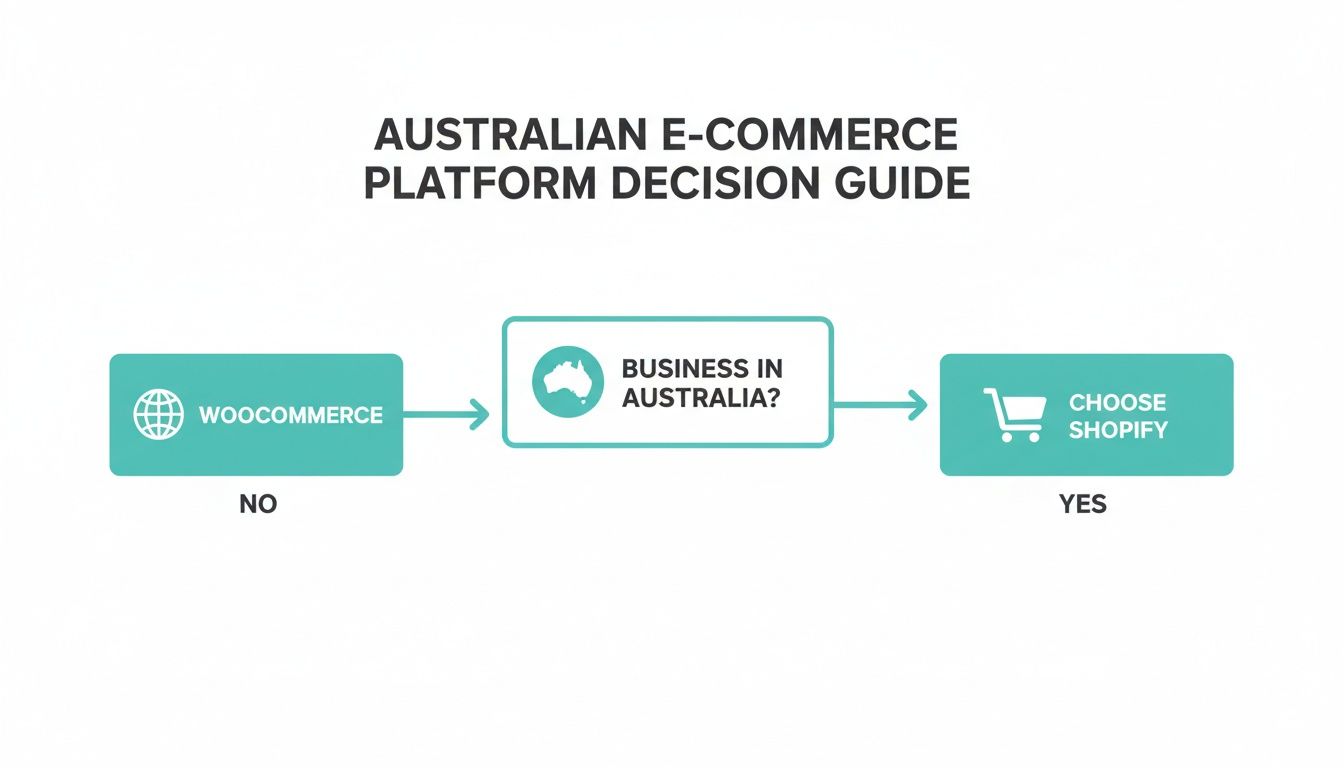
As you can see, Shopify has a particularly strong foothold in the Australian market, making it a very strategic pick for local growth.
The numbers back this up. Shopify’s store count in Australia is on track to hit a projected 120,481 by mid-2025. This kind of momentum makes it a future-proof choice for businesses aiming for scalable growth—a trend we see constantly with our clients at Frank Digital Agency. Looking further ahead, forecasts are even more optimistic, predicting 23.14 million Shopify users in Australia by 2029, a huge jump that mirrors e-commerce's global surge. You can read more about these compelling Shopify statistics on thehubcontent.com.
If you’re still on the fence or your business has complex needs, bringing in a digital agency is often the smartest move. An expert partner can do more than just help you pick the right platform; they can ensure you maximise its potential to build a high-performance online store that drives real results.
Got Questions? We've Got Answers
Choosing between Shopify and WooCommerce usually boils down to a few critical questions. Here are the straight-up answers to the queries we hear most often from business owners just like you.
Is WooCommerce Better Than Shopify For Beginners?
Honestly, no. If you're just starting out, Shopify is almost always the easier path. It’s designed from the ground up to be user-friendly.
Everything from the guided setup to the built-in hosting is made to get you selling fast, without needing to be a tech whiz. WooCommerce throws you in the deep end a bit more—you’re responsible for finding your own hosting and piecing together the right plugins, which can be a steep learning curve for a newcomer.
Do I Need to Know How to Code to Use WooCommerce?
Not strictly, but it makes a massive difference. You can definitely get a decent store running with pre-made themes and plugins without touching a single line of code.
But the moment you want to tweak something specific or fix a weird glitch, having some basic CSS or PHP knowledge becomes a huge advantage.
Think of it this way: Shopify is the best no-code solution out there. WooCommerce, on the other hand, gives you unlimited potential for customisation if you have the coding skills or a development team on your side.
Which Platform Is Better For SEO?
This one is a classic "it depends." Both platforms can be SEO powerhouses, but they get there in different ways.
Because it’s built on WordPress, WooCommerce gives you incredibly detailed control, especially with plugins like Yoast SEO. This is a big plus if your strategy is heavily driven by content marketing.
That said, Shopify gives you a rock-solid SEO foundation right away. You get fast-loading pages, an SSL certificate included, and clean code without any effort. For most businesses, this is more than enough to achieve great rankings. In the end, how you execute your SEO strategy matters far more than the platform you choose.
Can I Migrate From WooCommerce to Shopify Later?
Absolutely. It’s a well-trodden path. If you start on WooCommerce and decide it’s not the right fit down the line, moving to Shopify is entirely possible.
Shopify even has its own tools, like the Store Importer app, to help pull your products, customer lists, and order data across. It can get a bit tricky for massive stores with years of data, but it’s a very doable process.
Ready to build an e-commerce machine that doesn’t just look good, but actually converts visitors into loyal customers? At Frank Digital Agency, we blend sharp, conversion-focused design with smart, data-driven Google Ads management to fuel real growth. Let's talk about your project!