

Figuring out the final web page design cost can feel like trying to hit a moving target, but setting a realistic budget is more straightforward than you might think. For most small and medium businesses in Australia, a quality, professional website usually falls somewhere between $3,000 and $18,000. Where your project lands on that spectrum really boils down to its scope and complexity.
A Realistic Look at Website Costs in Australia

Thinking about website costs is a bit like buying a car. A local tradie might just need a reliable ute to get around, while a national logistics company needs a fleet of custom-fitted delivery vans. Both vehicles get the job done, but their features, capabilities, and price tags are worlds apart.
It’s the same with your website. The cost is a direct reflection of what you need it to do.
Are you just looking for a digital business card to build trust and share your contact info? Or do you need a powerful sales engine that generates leads, processes online orders, and handles customer bookings automatically? Each goal demands a different level of design, development, and strategic thinking, and that’s what ultimately shapes the price.
Understanding the Investment Spectrum
To give you a clearer picture, most Australian businesses invest between $3,000 and $18,000 for a professionally built website. The sweet spot for a lot of small to medium-sized enterprises tends to be in the $5,000 to $8,000 range.
If you just need a basic informational site—think 4 to 8 pages with standard features like a contact form and a services overview—you’re likely looking at something between $3,000 to $5,000. You can find some great Australian website cost insights on strong.digital if you want to dig deeper.
This gives you a starting point, but the real story is in what you get for your money. A lower-cost site might be built from a pre-made template, whereas a higher-end project will involve a completely custom design and unique functionality tailored to your specific business goals.
A website is more than just an online brochure; it's your hardest-working salesperson, operating 24/7. The investment should be measured against the value it creates, whether that’s through new leads, direct sales, or enhanced brand credibility.
To make things even clearer, the table below gives a simple breakdown of what to expect at different price points. Think of it as a guide to help you work out where your project might land and start putting together a realistic budget.
Typical Website Cost Brackets in Australia
| Website Type | Primary Goal | Typical Price Range (AUD) |
|---|---|---|
| Brochure / Informational Site | Establish a professional online presence and provide key business information. | $3,000 – $6,000 |
| Lead Generation Website | Actively capture and convert visitor interest into qualified business leads. | $6,000 – $12,000 |
| E-commerce Store (Basic) | Sell a small catalogue of products with standard payment and shipping options. | $8,000 – $15,000 |
| E-commerce Store (Advanced) | Manage a large inventory with custom features, integrations, and automation. | $15,000 – $30,000+ |
These brackets help set expectations, but remember that the final cost will always depend on the unique features and goals of your specific project.
How Web Design Agencies Price Their Work
Ever looked at a web design quote and wondered where the final number actually comes from? It’s not just plucked out of thin air. Agencies use a few common pricing models to figure out the cost, and understanding them is the first step to knowing what you're paying for.
Think of it like getting work done on your house. You could agree on a fixed price for a new deck, pay a builder by the hour for odd jobs, or keep a handyman on a monthly retainer for regular upkeep. Web design works in a very similar way. Each approach has its own perks and pitfalls, so let’s break down the four main ways agencies structure their pricing.
Fixed Project Pricing
This is probably the most common model you’ll come across, especially for projects with a clear start and finish. With fixed project pricing, the agency gives you a single, all-in price to deliver a specific result—say, a five-page business website or a small online store.
The biggest win here is cost certainty. You know exactly what you’re spending from day one, which makes budgeting a breeze. No nasty surprises.
The trade-off, however, is flexibility. If you're halfway through the build and suddenly decide you need a fancy, complex booking system, that’s going to fall outside the original scope. It will mean a new quote and a formal change to the agreement. This model is perfect when you have a rock-solid idea of what you need before you start.
Hourly Rates
Just like it sounds, with an hourly rate, you’re paying for the actual time the agency’s designers, developers, and strategists spend on your project. In Australia, these rates can swing from around $100 to over $250 per hour, depending on the agency's reputation and the level of expertise involved.
This model is your best friend when you need flexibility. It’s ideal for projects where the scope isn't set in stone or for ongoing tweaks and updates where the workload might change from month to month. If you suspect you'll be making adjustments as you go, paying by the hour can be a great fit.
The obvious risk? The budget can get away from you. Without a clear cap or tight project management, the hours can add up faster than you expect, turning a seemingly small task into a significant cost.
Monthly Retainers
A monthly retainer is a set fee you pay every month in exchange for a dedicated block of time or a specific set of ongoing services. This isn't usually for building a site from scratch; it’s for what comes after.
A retainer transforms an agency from a one-time vendor into a long-term digital partner. It's an investment in continuous improvement, ensuring your website doesn't just launch, but evolves to meet new challenges and opportunities.
This model is the go-to for services that need constant attention, like:
- Ongoing SEO: Keeping your site climbing the search rankings.
- Content Updates: Adding fresh blog posts or updating product info.
- Website Maintenance: Taking care of security patches, backups, and performance checks.
- Digital Marketing: Running your ad campaigns or managing social media.
The real benefit is having a dedicated team that’s proactively invested in your growth, always on hand to provide support and strategic advice.
Per Page Cost
Finally, you might see some agencies offering per-page pricing. This is most common for simple, template-driven sites where the main difference between projects is just the number of pages. For instance, they might charge a base setup fee and then $250-$500 for each extra page.
While it sounds straightforward, this model can be a bit deceptive. What really matters is the complexity within a page, not just that it exists. A basic "Contact Us" page with a simple form is a world away from an interactive "Our Work" page with custom animations and detailed case studies. Per-page pricing can be a useful starting point for a ballpark figure, but it rarely tells the whole story for a truly professional website.
The 10 Key Factors That Drive Your Website Cost
So, you've got two quotes for a five-page website. One is for $3,000, and the other is for $10,000. Why the huge difference? It's a common question, and the answer almost never comes down to just the page count. The real cost drivers are the complexity, features, and level of custom work needed to build a site that actually delivers results.
Think of it like building a house. Two houses can have the same number of rooms, but one built with premium materials, custom architecture, and high-end finishes will cost far more than a basic project home. Websites are exactly the same. Let's break down the 10 biggest factors that determine your final investment.
1. Design Complexity
This is probably the single biggest influence on your budget. Using a pre-made template is a bit like buying a suit off the rack—it's fast, affordable, and gets the job done. But it was made for everyone, not specifically for you.
A custom design, on the other hand, is a bespoke suit. It involves deep-dive strategy sessions, user experience (UX) research to understand your customers, and a unique user interface (UI) crafted to perfectly reflect your brand. This tailored approach is designed from the ground up to guide visitors toward specific actions, like making a purchase or filling out a form.
2. Your Choice of Content Management System (CMS)
The CMS is the engine of your website. It’s the behind-the-scenes platform that lets you add blog posts, update text, and manage your content without needing to be a developer.
Simple, all-in-one builders are great for getting started but can be restrictive. More powerful systems like WordPress offer almost limitless flexibility but demand more expertise to set up and maintain correctly. Then you have specialised platforms for e-commerce or enterprise-level needs, each with its own cost structure and capabilities.
3. E-commerce Functionality
If you want to sell products or services online, your website instantly shifts from being a simple brochure to a sophisticated retail machine. That complexity naturally adds to the cost.
Basic e-commerce might just be a handful of products with a simple checkout. But as soon as you need more advanced features, the development time climbs. This can include things like:
- Payment gateway integrations to connect with Stripe, PayPal, or Afterpay.
- Complex inventory management that syncs stock across multiple channels.
- Custom shipping rules based on location, weight, or order value.
- Customer accounts where users can view order history and save their details.
4. Custom Functionality
This is where the budget can really expand, because "custom" means building something from scratch just for you. A standard contact form is straightforward. But what about a multi-step quoting tool that pulls data from your CRM, calculates a unique price, and triggers an automated email sequence? That’s a serious development project.
Other examples include custom booking systems, private membership portals, interactive calculators, or any feature that isn't available "out of the box."
5. Content Creation and Migration
A website is just an empty frame until you fill it with compelling content. Are you providing professionally shot photos and well-written copy, or does the agency need to create that for you? While it's an added investment, high-quality content is what ultimately persuades and converts visitors.
And if you’re upgrading an existing site, don’t forget about content migration. Moving hundreds of blog posts, products, or user accounts over to a new platform is a technical task that takes time and precision.
6. Search Engine Optimisation (SEO)
You can have the most beautiful website in the world, but it’s completely useless if no one can find it. Foundational SEO isn't an optional extra; it’s a critical part of any professional web build.
This involves technical setup, keyword research, on-page optimisation, and structuring the site so search engines can easily understand what it's about. While a full-blown SEO campaign is a separate ongoing service, this initial groundwork is essential and is factored into the project cost.
A website without foundational SEO is like a shop with no sign on the door. It might be brilliant inside, but you're making it incredibly difficult for customers to walk in.
Website Feature Cost Impact Analysis
Not all features are created equal. The table below shows how the complexity of certain requirements can dramatically shift the budget from a low-cost, basic implementation to a high-cost, advanced one.
| Cost Driver | Basic Implementation (Low Cost) | Advanced Implementation (High Cost) |
|---|---|---|
| Design | Template-based with minor brand tweaks. | Fully custom UX/UI research and design. |
| E-commerce | 1-10 products, single payment gateway. | 100+ products, multiple gateways, custom shipping. |
| Custom Tools | Standard contact form. | Interactive quoting tool integrated with a CRM. |
| Content | Client provides all text and images. | Agency provides copywriting, photography, and video. |
| Integrations | Basic newsletter sign-up (e.g., Mailchimp). | Deep integration with ERP, CRM, and accounting software. |
As you can see, the scope of each feature is what really determines the work involved, and therefore the final price.
7. Third-Party Integrations
Modern websites rarely operate in a bubble. They need to "talk" to the other tools you use to run your business. This could mean connecting to your email marketing software like Mailchimp, your CRM like HubSpot, or an external accounting platform. Each of these connections, or APIs, requires development time to build and test, ensuring data flows smoothly and reliably between systems.
8. Responsive Design and Testing
It’s a multi-device world. Your website has to look and work perfectly whether it’s viewed on a giant desktop monitor, a tablet, or a smartphone. Following responsive web design best practices is non-negotiable.
This requires a meticulous design and development process, followed by rigorous testing across a wide range of browsers and screen sizes to iron out any bugs. This quality assurance step is crucial for providing a great user experience for everyone. To learn more, check out our guide on what responsive web design is and why it matters.
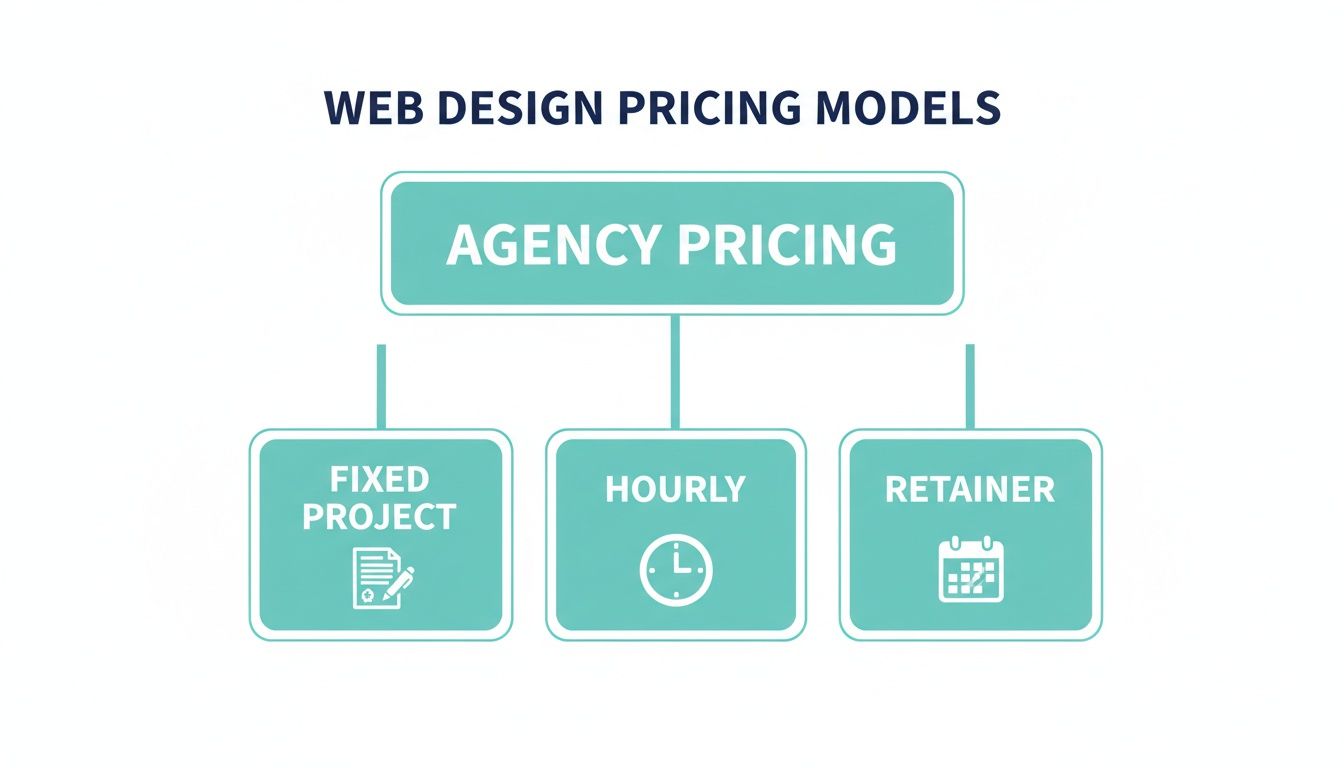
The pricing model an agency uses often reflects the project's complexity. A simple, fixed-scope project might have a fixed price, while complex builds with evolving needs might be better suited to hourly rates or an ongoing retainer.
9. Hosting and Domain
These aren't technically part of the design and build cost, but they're essential for your website to exist online. Your domain name is a small annual fee. Your web hosting, however, has a huge impact on your site's performance, speed, and security.
Skimping on cheap hosting is a false economy. A quality managed hosting plan is an investment in protecting your website, ensuring it’s fast for users and secure from threats.
10. Ongoing Maintenance and Support
A website is a living asset, not a one-and-done project. Just like a car, it needs regular maintenance to perform at its best. This means keeping the CMS and any plugins updated, running security scans, and taking regular backups.
Most professional agencies offer monthly care plans to handle all of this for you. It’s peace of mind that ensures your digital storefront stays secure, fast, and open for business 24/7.
Real-World Website Projects and Their Costs
Talking about pricing models in theory is one thing, but the numbers really start to make sense when you attach them to actual projects. To get a realistic grasp of the web page design cost for your business, it’s helpful to see how all those factors we discussed play out in the real world.
Let's walk through a few common examples for Australian businesses. By looking at the typical scope for different types of websites, you can start to benchmark your own needs and have a much clearer conversation with a web design agency about your budget.
The Professional Brochure Website
Let's say you're a local service business—maybe a plumber in Perth, an accountant in Adelaide, or an electrician in Melbourne. Your main goal is to look credible, show people what you do, and make it dead simple for potential customers to call or email you. You need a professional online front door that does its job.
For this kind of business, a standard brochure website usually includes:
- Custom Design: A unique, professionally branded design across 5-7 core pages (think Home, About, Services, Contact).
- Responsive Layout: It has to look and work perfectly on a phone, tablet, or desktop computer. No excuses.
- Content Management System (CMS): A user-friendly back end, usually WordPress, that lets you log in and make simple updates yourself.
- Lead Capture: A clear, easy-to-use contact form and obvious calls-to-action that tell visitors what to do next.
- Foundational SEO: All the technical basics are in place so Google can find, crawl, and start ranking your site.
For a project like this, you can expect the cost to be in the $4,000 to $8,000 range. The final figure really depends on the level of custom design work and whether things like professional copywriting or photography are rolled into the project. A site at the higher end of that bracket would likely involve more strategic thinking around user experience to really push for conversions.
The E-commerce Store
Now, picture a local retailer who wants to take their products online. This is a massive leap in complexity from a simple brochure site because you're now dealing with transactions. The website isn't just a source of information anymore; it's a digital cash register, warehouse manager, and sales engine all in one.
The feature list expands quite a bit:
- Product Management: A system to add and manage hundreds or thousands of products, each with its own photos, descriptions, and pricing.
- Shopping Cart and Checkout: A secure, intuitive process for customers to add items to their cart and pay.
- Payment Gateway Integration: Securely connecting with providers like Stripe, PayPal, or Afterpay so you can actually get paid.
- Shipping Logic: Setting up rules to calculate different shipping costs based on where the customer lives or how much they've spent.
Recent pricing data in Australia shows that e-commerce projects start from around AUD $6,000 and can easily push past AUD $25,000 for more complex builds. Most fall somewhere between $8,000 and $20,000, making them roughly two to three times more expensive than a comparable brochure website. You can explore more detailed website cost breakdowns from WebAlive to see how these figures line up. Costs climb quickly when you add features like customer accounts, advanced inventory systems, or integrations with your accounting software.
An e-commerce site is a complex ecosystem of technology. The investment isn't just for the visual design but for the secure, reliable, and seamless engine that powers every transaction, manages inventory, and protects customer data.
The Membership or Booking Portal
Finally, think about a business that runs on appointments or sells exclusive content. This could be a fitness studio, a consulting firm, or an online course creator. Their website needs a system to manage schedules, handle recurring subscription payments, and control who gets to see what. This is custom functionality, plain and simple.
Key features often include:
- User Registration and Profiles: A way for customers to sign up and manage their own accounts.
- Booking System: An integrated calendar for scheduling appointments or reserving a spot in a class.
- Membership Tiers: Setting up different access levels based on what subscription plan a user is on.
- Automated Communication: Sending out automatic emails for booking confirmations, renewal reminders, and more.
Building this kind of custom logic takes serious development time. A website with a solid booking or membership system will typically start at $12,000 and can easily head towards $25,000 or more, depending on how complex the business rules, payment schedules, and user management needs are.
How to Maximise Your Web Design Budget
Think of your website as a strategic investment, not just a line item on an expense report. It’s a powerful digital asset that should be working for you. But like any smart investment, it needs a thoughtful budget. The real goal here is to spend your money wisely, focusing on the elements that deliver a tangible return without cutting corners on quality.
One of the best ways to get started without a massive upfront cost is through phased development. You don’t need every single bell and whistle on day one. Instead, launch with a lean but rock-solid core website—a Minimum Viable Product (MVP). This first version should nail the essentials: clear messaging, a professional design, and a dead-simple way for customers to contact you.
Once that foundational site is live and starting to bring in business, you can reinvest the profits into adding more sophisticated features down the track. Maybe phase two introduces an integrated booking system, and phase three adds a secure client portal. This approach not only makes the cost more manageable but also lets real user feedback guide what you build next.
Take Control of Your Content and CMS
Here’s a practical way to keep costs in check: provide your own high-quality content. Professional copywriting and photography are fantastic, but they do add to the project's bottom line. If you have the skills to supply well-written text and professional images, you can reduce the agency’s scope and, consequently, your final bill.
Choosing the right Content Management System (CMS) from the get-go is another huge financial decision. A simple, proprietary platform might look cheaper initially, but it can get incredibly expensive when you inevitably outgrow it. Migrating an entire website to a new system is almost always more costly than just starting with a scalable platform like WordPress in the first place.
A cheap website that doesn't generate leads isn't a bargain; it's a wasted expense. Conversely, a well-planned website that consistently converts visitors into customers is an investment that pays for itself many times over.
It's all about focusing your spend on what directly drives growth. For instance, a custom-designed landing page for your most profitable service will almost certainly deliver a better ROI than a flashy animation on your "About Us" page. When you’re weighing up whether custom web design and development is worthwhile, always measure the potential cost against the potential return.
Strategic Planning and Testing for Better ROI
Clear planning is your most powerful budgeting tool. Before you even talk to an agency, get clear on your goals, define your target audience, and make a prioritised feature list. You need to know your 'must-haves' from your 'nice-to-haves'. This clarity is your best defence against scope creep—the slow trickle of new requests and features that can blow your budget out of the water.
To get the most out of every dollar, you should also plan for efficient UI validation. Proper user testing ensures the design is intuitive and effective before it's coded, which helps you avoid costly redesigns and frustrating post-launch fixes. A small investment in testing upfront can save you thousands in rework later.
Ultimately, maximising your budget comes down to one simple principle: invest in outcomes, not just aesthetics. Prioritise the features that will attract your ideal customer and make it easy for them to take action. That strategic mindset is what ensures every dollar you spend on your website is actively working to grow your business.
Getting a Clear and Accurate Website Quote
So, you’ve got a handle on all the moving parts that go into website pricing. What now? The final step is getting a quote you can actually trust, and that starts with you.
A vague project brief will always get you a vague—and likely inaccurate—price. The secret to avoiding surprise costs and painful scope creep is giving the agency a crystal-clear picture of what you want to achieve.
Think of it like building a house. You wouldn't just tell a builder, "build me a house," and hope for the best. You'd hand them architectural plans, specify the number of rooms, and list the exact fixtures and finishes you want. The more detail you provide upfront, the more precise their cost estimate will be.
Preparing Your Project Brief
To get a proposal that makes sense, you need to arm an agency with the right information. A well-prepared brief doesn't just help them calculate the cost; it proves you've thought strategically about your investment. It’s the foundation for a smooth project.
Before you start reaching out for quotes, pull these details together:
- Your Core Business Goals: What is this website for? Is it meant to generate qualified leads, sell products directly, or simply establish your professional credibility? Get specific.
- Your Target Audience: Who are you trying to connect with? Describe your ideal customer—what are their needs, their pain points, and what do they expect when they land on your site?
- Key Features and Functionality: Make a list of everything the website absolutely must do. It helps to split this into ‘must-haves’ (like a contact form or a basic e-commerce cart) and ‘nice-to-haves’ (like a blog or an interactive calculator).
- Examples of Websites You Admire: Share links to 2-3 websites you love, even if they're not in your industry. Crucially, explain what you like about them. Is it the clean design, the simple navigation, or a specific feature that caught your eye?
- Your Estimated Budget Range: Don't be afraid to talk numbers. Knowing whether you're working with $5,000 or $15,000 helps an agency propose a realistic solution that gives you the best bang for your buck.
Providing a detailed brief is the single most effective way to ensure a quote aligns perfectly with your expectations. It moves the conversation from guesswork to a strategic discussion about achieving your specific business outcomes.
Putting in this prep work is a massive first step. When you have this information ready, you're in the best possible position to evaluate different agencies and choose the right partner.
If you need a bit more guidance, our article on finding the ideal web design company for your project is packed with helpful insights. Taking this proactive approach ensures the proposal you receive is a true reflection of your vision, setting your project up for success from day one.
A Few Common Questions About Website Costs
Thinking about website design costs can bring up a lot of questions. Let's tackle a few of the most common ones we hear from business owners trying to plan their budget.
Why Does a Custom Website Cost More Than Using a Template?
Think of a template like buying a suit off the rack. It’s pre-made, so you can get it quickly and for a lower price. You can swap out the tie and shirt (your content and branding), but the fundamental cut and style are fixed. It works, but it's not made just for you.
A custom web design, on the other hand, is like getting a bespoke, tailored suit. It's built from scratch to fit your business perfectly—your goals, your brand, and most importantly, your specific customers. This involves in-depth strategy, creating a unique user experience (UX), and designing an interface (UI) that guides visitors exactly where you want them to go. The higher price reflects the hours of specialised expertise and creative energy needed to build something truly one-of-a-kind that performs better.
Do I Really Need to Pay for Ongoing Website Maintenance?
In a word, yes. Neglecting website maintenance is like never servicing your car. Sooner or later, something will break. Your website is built on software—like WordPress and its plugins—that needs constant updates to stay secure and run smoothly.
A solid maintenance plan is really an insurance policy for your online presence. It keeps your site fast, safe, and working as it should, giving your customers a reliable experience while protecting you from the nightmare of a hack or major crash.
Regular maintenance includes security scans, software updates, and backups. It’s all about catching small issues before they snowball into expensive, business-halting disasters.
How Much Does the Timeline Impact the Price?
The project timeline is a major factor in the final cost. A straightforward brochure website might take us 4-6 weeks, whereas a feature-rich e-commerce store could be a 3-4 month project.
At its core, the price is a reflection of the expert hours our strategists, designers, and developers invest. If you need a project done on a tight, rushed deadline, it almost always costs more. That's because we have to pull team members off other projects and often work after hours to hit your accelerated launch date, which disrupts our entire studio's workflow.
Ready to invest in a website that doesn't just look good, but actually grows your business? The team at Frank Digital Agency builds high-performing, conversion-focused websites that turn visitors into loyal customers. Get in touch today for a clear, accurate quote.