

So, how much should a new website really cost? In Adelaide, you'll find that web page design rates can start around $5,000 for a professional small business site and go north of $20,000 for a custom e-commerce build. The final price tag all comes down to what you need—the project’s size, the level of custom design, and who you choose to build it.
Decoding Web Page Design Rates in Adelaide
Trying to pin down a fair price for a new website can be a confusing exercise. You’ve probably seen quotes all over the map, leaving you wondering what a realistic budget even looks like.
The first step is a mindset shift. Stop thinking of your website as just another business expense. It’s your hardest-working sales tool, operating around the clock to bring in business.
A website is far more than a digital brochure; it's a dynamic asset built to generate leads and drive real revenue. Whether you're a local Adelaide tradie who needs the phone to ring or a retailer ready to sell online, a strategic website is the cornerstone of your growth. It’s the central hub for everything you do.
Agency Expertise vs Freelance Projects
As you start comparing quotes, you'll see a big difference in web page design rates between freelancers and agencies. A freelancer can often offer a lower upfront price, which is appealing if all you need is a simple, static site to show you exist. But if you’re after results, a performance-focused agency brings a whole different level of thinking to the table.
An agency project is built on a foundation of strategy. It typically includes:
- Strategic Planning: We start by understanding your business goals, not just your design preferences.
- Custom Design: Creating a unique user experience (UX) that makes it easy for visitors to take the next step.
- Technical SEO Foundations: Building the site correctly from the get-go so Google can find and rank you.
- Ongoing Support: Making sure your site stays fast, secure, and effective long after launch day.
The real value isn't just in the slick design or the clean code. It's in the strategy behind it. A great website answers your customer's questions, solves their problems, and makes it incredibly easy for them to choose you over the competition.
Investing in a High-Performance Asset
This strategic approach is precisely why a professional agency project is an investment, not just a cost. Across Australia, small and medium businesses are typically investing between $5,000 and $12,000 for websites that deliver a measurable return.
This price range is the sweet spot for Adelaide service providers who need a custom, mobile-friendly site that actually generates leads and helps them stand out from the crowd.
Quick Guide to Web Design Investment Levels in Adelaide
To give you a clearer picture, here’s a quick breakdown of what you can generally expect at different investment levels in the Adelaide market.
| Provider Type | Typical Price Range (AUD) | Best For | Key Outcome |
|---|---|---|---|
| DIY Website Builder | $300 – $1,000 / year | Hobbyists or brand-new startups on a shoestring budget. | A basic online presence, but with limited functionality. |
| Freelance Developer | $2,000 – $7,000 | Small businesses needing a simple, attractive "brochure-style" website. | A professional-looking site, often built on a template. |
| Performance-Focused Agency | $5,000 – $20,000+ | Businesses serious about growth, lead generation, and long-term ROI. | A strategic digital asset designed to convert visitors. |
This table helps illustrate that you're not just buying a "website"—you're investing in a specific outcome.
Ultimately, the aim is to build a powerful digital asset that works hand-in-glove with your other marketing, like your Google Ads campaigns. When designed right, your website becomes the engine of your lead generation, turning casual browsers into paying customers and ensuring your investment pays for itself many times over.
To learn more, check out our insights on building an effective small business website design in Adelaide.
Understanding the Three Core Pricing Models
When you start getting quotes for a new website, you'll see pretty quickly that web page design rates aren't a simple, one-size-fits-all number. It’s a bit like hiring a builder for a reno. You could pay them by the hour, agree on a fixed price for the whole job, or keep them on a monthly plan for ongoing maintenance. Each approach has its pros and cons, and knowing the difference is crucial.
The three main ways designers and agencies price their work are hourly rates, fixed-project fees, and monthly retainers. Let’s break down what each one means for you and your business.
The Hourly Rate Model
Paying by the hour is exactly what it sounds like. It's a common model for freelancers and works well for small, well-defined jobs. Got a pesky bug that needs squashing or need a few quick updates to an existing page? An hourly rate is perfect for that.
The danger comes with larger projects, like a full website build. An open-ended hourly agreement can easily spiral out of control if the scope creeps or unexpected problems pop up. You’re essentially paying for time, not necessarily a finished result, which can sometimes put you and the designer at odds.
In Australia, freelance web design rates usually fall somewhere between $110 and $170 per hour. While you might see the higher end of that in Sydney or Melbourne, Adelaide freelancers are typically closer to the $110-$160 per hour mark. This can be a decent option for a simple 3-5 page site, often coming in at around $1,500-$4,000, but it rarely includes the deeper strategic thinking you'd get from an agency.
The Fixed-Project Fee Model
Most agencies that are serious about getting you results will use a fixed-project fee. Back to our builder analogy: this is where you agree on one set price to get the job done, no matter what happens. This gives you absolute certainty on cost from day one, which is a huge relief when you're managing a budget.
A fixed-project fee changes the game. It shifts the focus from hours clocked to results achieved. The agency is motivated to be efficient and creative to hit your goals, because their success is tied to finishing the project, not just billing time.
This model is ideal for complete website builds where everyone agrees on the scope, the deliverables, and the business goals right from the start. It creates a real partnership. You and the agency are on the same team, working towards the same outcome for a price that's locked in. To see how this works in other industries, you can explore examples of different pricing models from other digital services.
The Monthly Retainer Model
Finally, there’s the monthly retainer. This is all about what happens after your shiny new website goes live. A website isn't a brochure you print and forget about; it’s a dynamic tool that needs ongoing attention to keep performing.
A retainer usually bundles together the essential services that keep your site working hard for you.
- Website Maintenance: Think of this as the regular service for your car. It covers software updates, security monitoring, and performance checks to keep hackers out and ensure your site loads quickly for visitors.
- Ongoing SEO: Getting found on Google is a marathon, not a sprint. A retainer can cover regular content creation, technical SEO adjustments, and strategy tweaks to help you climb the search rankings and stay there.
- Support & Optimisation: Want to add a new feature down the track? Or maybe run some A/B tests to see which headline converts more customers? A retainer gives you priority access to your web partner for continuous improvements.
This model protects your initial investment and makes sure it continues to pay dividends long after launch. It’s peace of mind, knowing an expert team is actively looking after your most valuable digital asset.
What Actually Drives Your Website Cost?
Ever get two quotes for a new website and just scratch your head? One comes in at $3,000, the other at $15,000. It's a huge difference. Is the expensive one a rip-off? Is the cheap one hiding something?
The truth is, the final price tag is almost always a direct reflection of the value and complexity being built into the site. Think of it like building a house. A pre-fab kit home is worlds away from an architect-designed custom build in both price and outcome. Both give you a roof over your head, but the experience, functionality, and long-term value are completely different.
Let's pull back the curtain on what you’re actually paying for.
Custom Design vs. Template Builds
This is probably the biggest fork in the road when it comes to cost. Are you getting a site built from a pre-made template, or is it a completely custom design crafted just for your business?
Template Websites: These use an existing layout that gets a new coat of paint with your brand’s colours, logo, and content. They’re much faster to assemble, which makes them cheaper. The downside? They can feel restrictive, look a bit generic, and often aren't optimised for the specific journey you want your Adelaide customers to take.
Custom Websites: Here, a designer starts with a blank slate to build a unique user experience (UX) from the ground up, all tailored to your specific business goals. It starts by asking the right questions: Who is your ideal customer? What do you need them to do? How do we make that process effortless? This costs more, but the result is a powerful conversion tool, not just an online brochure.
A proper custom design process involves things like wireframing, prototyping, and user feedback—steps that make sure the final website is built to perform. It's a bigger investment upfront, but it almost always delivers a far stronger return.
A template is like an off-the-rack suit. A custom design is like a tailored one. Both will get you into the event, but only one is guaranteed to fit perfectly and make the right impression.
Functionality and Special Features
Beyond the visuals, what your website does plays a massive role in the final cost. A simple five-page site for a local consultant has very different needs than an e-commerce store juggling hundreds of products.
Every extra feature requires specialist development time for building, integrating, and testing.
Common features that add to the scope include:
E-commerce Functionality: This isn't just a "buy now" button. It means adding a shopping cart, payment gateways (like Stripe or Afterpay), inventory tracking, and secure customer accounts.
Booking Systems: If you're a service business—a clinic, a tradie, a consultant—integrating a real-time booking and scheduling calendar is a common request that adds to the build.
Third-Party Integrations: Need your website to chat with other software you rely on? Connecting it to a CRM like HubSpot, an email platform like Mailchimp, or other specialised tools requires expert setup.
Member Portals: Creating password-protected areas where members or clients can access exclusive content is another feature that increases the complexity and cost.
Each of these adds powerful capabilities but also requires dedicated development hours. Learning more about the benefits of developing a dynamic website can really clarify why these features are often worth the investment.
At the end of the day, every quote you get is a calculation of the time, expertise, and specific features needed to hit your business goals. When you understand these cost drivers, you're in a much better position to compare proposals and put your budget where it will make the biggest impact.
Realistic Price Ranges For Adelaide Businesses
It’s one thing to talk about pricing models, but what does that actually look like for a small business here in Adelaide? To get a real-world feel for web page design rates, let's walk through a few common project scenarios. For each one, we’ll look at the business goal, the features needed to hit that goal, and a realistic price tag you'd expect from a performance-focused agency.
This gives you a solid benchmark for comparing quotes. The infographic below highlights the main things that drive up costs, showing how a project can scale from a basic template to a fully custom-built site.
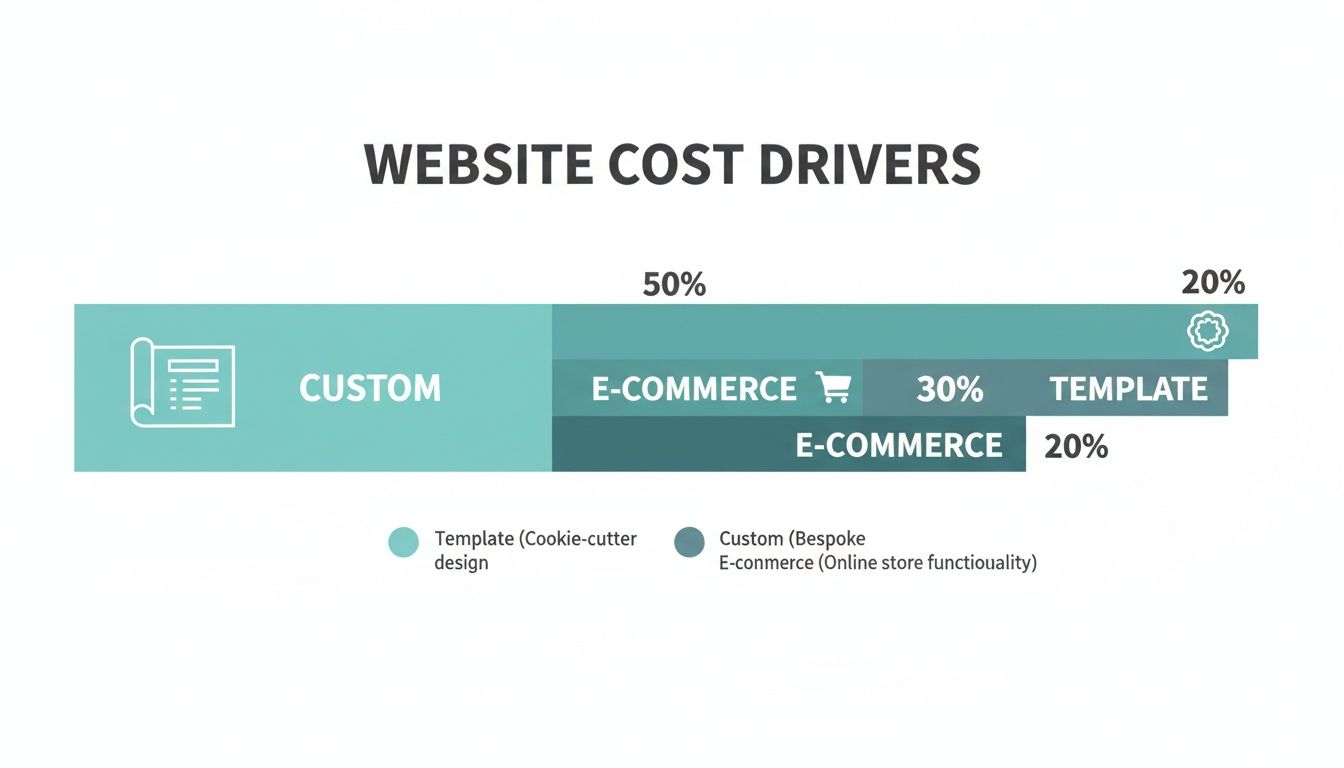
As you can see, the more custom features and e-commerce tools you add, the more complex the job becomes—and the investment naturally goes up to match that value.
To make this even clearer, I've put together a quick table outlining typical project scopes and their estimated costs for businesses right here in Adelaide.
Sample Web Design Project Costs In Adelaide
| Business Type | Project Goal | Key Features Included | Estimated Agency Cost (AUD) |
|---|---|---|---|
| Tradie (Plumber, Electrician) | Generate a steady flow of local leads (calls & forms) | Mobile-first design, click-to-call buttons, simple quote form, service area pages, photo gallery. | $6,000 – $9,500 |
| Professional Service (Lawyer, Accountant) | Build authority and capture high-value client consultations | Professional design, detailed service pages, team bios, blog/resource centre, online booking system. | $8,000 – $14,000 |
| Starter E-commerce Store | Create a secure and user-friendly online shop to sell products | Custom product catalogue, secure payment gateways, inventory management, customer accounts, shipping integration. | $12,000 – $25,000+ |
These examples show how web page design rates are directly tied to the business outcomes you're aiming for. It’s all about making sure your investment is working hard where it really counts.
Beyond the Launch: The Hidden Costs and True ROI
Getting your new website live feels like a massive achievement, and it is! But it’s not the finish line—it’s the starting block. A huge mistake I see business owners make is treating their website as a "set and forget" task. In reality, a website that actually works for your business needs ongoing care to protect your investment and keep the leads coming in.
The initial design and build price is just one piece of the puzzle. To really get a handle on your budget, you need to factor in the crucial running costs that keep your site secure, fast, and in front of the right people.
The Hidden Costs You Can't Afford to Ignore
Think of your new website like a brand-new work ute. You wouldn't drive it off the lot and then forget about insurance, registration, fuel, and regular servicing, would you? Of course not. The same logic applies directly to your website. These aren't optional extras; they're non-negotiable essentials for its long-term health and performance.
Here are the key ongoing costs to plan for:
- Website Hosting: This is essentially the rent you pay for your website's spot on the internet. Going for the cheapest shared hosting to save a few bucks a month is a classic false economy. It often leads to slow load times and outages, which frustrates visitors and can seriously hurt your Google rankings.
- Security & SSL Certificate: We live in an age of constant digital threats, making solid security a must-have. This means regular malware scans, a firewall, and an SSL certificate to encrypt data, protect your customers, and show everyone your site is trustworthy (it's that little padlock icon in the browser).
- Regular Maintenance & Backups: The software that runs your site, like WordPress and its plugins, needs updating all the time. These updates patch security holes and keep everything running smoothly. Regular backups are your safety net, ensuring you can quickly restore your site if the worst happens.
If you don't budget for these, that shiny new website can quickly become slow, insecure, and invisible—wasting the entire initial investment.
Shifting Your Mindset From Cost to Return
While it's important to know the costs, the real conversation should be about the return you're getting on your money. A cheap website that brings in zero customers is just an expense. On the other hand, a professionally built website that generates thousands in new business is one of the smartest investments you can make.
The question shouldn't be, "How much does a website cost?" It should be, "How much revenue can a great website generate for my business?" When you look at it through that lens, the whole decision changes.
A strategic website is a revenue-generating machine. Every part of it—from the user experience to the page speed—is built with one goal in mind: turning visitors into paying customers. To really dig into this, it's worth understanding the core concept of Return on Investment (ROI).
Let’s look at a realistic Adelaide example:
- The Investment: A local plumber in Adelaide invests $8,000 into a professional website built to convert visitors.
- The Result: The new site is properly optimised for local search, bringing in an extra 5 qualified leads each month.
- The Conversion: The plumber is good at their job and closes 2 of those 5 leads.
- The Value: Each new plumbing job is worth, on average, $1,500.
With these numbers, the website is now generating an extra $3,000 in revenue every single month ($1,500 x 2). That's $36,000 in new business over the year, all from that initial $8,000 investment. The site paid for itself in less than three months and will continue to be a profitable asset for years. That’s the power of thinking beyond the initial cost.
How to Choose the Right Web Design Partner

Getting a few quotes is a smart start, but the real test is knowing how to read them. Think of choosing a web designer less like hiring a tradie and more like bringing on a key business partner. The cheapest price tag is almost never the best value, especially when you're after real growth, not just a pretty online brochure.
To make the right call, you have to look beyond the final number. It’s about digging into the value, the strategy, and the expertise behind the proposal. You're searching for a strategic partner who gets your Adelaide business inside and out, not just a service provider ticking off a list.
Evaluate Their Portfolio with a Critical Eye
Any designer’s portfolio is their highlight reel, but you need to read between the lines. Don’t get distracted by flashy graphics; look for proof of real-world results. When you review their past projects, ask yourself: are these websites easy to use? Do they clearly point me towards a goal?
As you click through their work, keep these questions in mind:
- Is it relevant to me? Have they worked with businesses in your industry? A designer who’s built successful websites for other Adelaide businesses similar to yours will already understand your customer and what makes them tick.
- Is it focused on performance? Do their case studies talk about tangible business outcomes, like "boosted lead generation by 40%," or do they just list design features? You want proof they build websites that actually do something.
- What's the user experience (UX) like? Open up a few of their live client sites on your phone and computer. Is the experience smooth? If you find it clunky or confusing, your potential customers definitely will.
Understand Their Process and Communication Style
A clear, well-defined process is the sign of a true professional. It shows they have a system for delivering quality work on time and on budget. If their process feels vague or they can't explain it clearly, that's a massive red flag that often leads to blown deadlines and surprise costs down the track.
The very first phone call is your best clue. A great partner will spend most of the time asking about your business goals, your customers, and your revenue targets—not your favourite colours.
Before you sign on the dotted line, make sure you understand their project roadmap from start to finish. It's well worth your time to get a complete guide on how to find the ideal web design company to ensure you’re set up for long-term success.
Ask the Right Questions to Uncover True Value
The questions you ask should be designed to uncover their strategic brain, not just their technical skills. Their answers will tell you if they're simply a 'doer' or a genuine growth partner. This is how you connect their web page design rates to the real return you can expect for your business.
Here are a few must-ask questions for any potential partner:
- How do you measure a website’s success? A top-tier answer will focus on business metrics like conversion rates and lead quality, not just fluffy numbers like website traffic.
- What happens after the website goes live? This question reveals their commitment to your ongoing success. Listen for words like "monitoring," "optimisation," and "support."
- Can you walk me through your approach to mobile-first design and page speed? With over 60% of searches happening on mobile, a fast, easy-to-use site on a phone is non-negotiable. Their answer should be confident and packed with detail.
- What do you offer for ongoing maintenance and security? A professional agency will have a clear plan to keep your new digital asset safe, secure, and running smoothly.
By digging deeper than the price, you’ll be able to confidently pick a partner who will build you a website that acts as a true engine for your business's growth.
Your Top Questions About Web Page Design Rates Answered
It's completely normal to have a bunch of questions when you start looking into web page design rates. It can feel like a minefield of confusing numbers and technical jargon. Let's clear the air and break down the most common questions we hear from Adelaide business owners, so you can make a decision you feel good about.
Why Is There Such a Massive Gap in Web Design Quotes?
This is the big one, isn't it? You get one quote that seems too good to be true and another that feels like a deposit on a house. The huge difference almost always comes down to one key thing: strategy versus assembly.
A low quote usually buys you assembly. Someone takes a pre-made template, slots in your content, and calls it a day. It’s a bit like buying a flat-pack shed – you get the basic structure, but it’s not designed specifically for your backyard or what you plan to store in it. It does a job, but it’s not a tailored solution.
A higher quote from an agency like ours is priced for strategy. This isn't just about building a website; it's about crafting a business tool. We're digging into your competitors, mapping out how your ideal customer will use the site (UX design), building it to be found on Google (SEO foundations), and engineering it to turn visitors into actual leads.
The price difference isn't about a 'cheap' versus an 'expensive' website. It’s about choosing between a simple online flyer and a hard-working digital asset built to grow your business.
Can I Get a Good Website for Under $3,000?
Honestly, it’s tough. While you can certainly get a website for under $3,000, the real question is whether it will be a good website for your business goals. At that price point, you’re almost always looking at a basic template site with very little customisation and zero strategy for generating leads.
For a competitive Adelaide business, that kind of site often falls short. It might lack the security, speed, and conversion-focused design needed to actually win you customers. A "good" website doesn't just look pretty; it brings in measurable results. That's incredibly difficult to pull off with a sub-$3,000 budget.
How Long Does a Typical Web Design Project Take?
The timeline really depends on what we’re building. No two projects are the same, but here’s a general idea to set your expectations:
- Standard Informational Website (5-10 pages): Perfect for a local service business, this kind of project usually takes 4 to 8 weeks from our first chat to the final launch.
- E-commerce Website: If you’re selling products online, the extra complexity of payment gateways, product catalogues, and inventory systems means a longer timeline, typically around 8 to 14 weeks.
Any professional agency worth its salt will give you a clear, detailed project timeline right from the start. You should never be left guessing what's happening and when.
Do I Really Need to Pay for Ongoing Website Maintenance?
Yes, 100%. Think of your website like your work ute. You wouldn't skip its regular service, right? Because you know a small problem now could become a massive, expensive breakdown later. Website maintenance is exactly the same.
It’s not an upsell; it’s essential protection for your investment. A good maintenance plan will cover:
- Software and Plugin Updates: To close security loopholes as they’re discovered.
- Regular Security Scans: To find and remove any malware or hacking attempts.
- Site Backups: So if the worst happens, you can get back online fast without losing everything.
Most agencies offer simple, affordable monthly plans that take all that worry off your plate.
Ready to invest in a website that delivers real results for your Adelaide business? Frank Digital Agency builds high-performance digital assets designed to convert visitors into customers. Get in touch today for a clear, no-obligation quote.