

So, what does it actually cost to get a click on Google Ads in Australia? The short answer is: it depends. But for most businesses, you're looking at a cost per click (CPC) somewhere between $2 and $4 AUD. Keep in mind, this is just a ballpark figure – in highly competitive industries, that number can shoot up dramatically.
What You Can Expect to Pay for Google Ads in Australia
Think of your Cost Per Click (CPC) as the price of admission for a potential customer to visit your website. The best part? You only pay this fee when someone is interested enough in your ad to actually click it. This makes it an incredibly efficient, performance-based way to drive traffic. You're not just paying for your ad to be seen; you're paying for genuine engagement.
Of course, "average" costs are just a starting point. The reality for Australian businesses is that Google Ads costs are on the rise, and you need to factor that into your budget. While some older benchmarks might quote an average CPC of around $1.31 AUD on the Search Network, that number doesn't tell the whole story.
More up-to-date analysis for 2025 shows that most Aussie businesses are seeing CPCs in that $2 to $4 AUD range. Some data even points to a market-wide average of $5.26 AUD when you lump all industries together.
Let's quickly summarise what you can expect to pay.
Australian Google Ads Costs at a Glance
Here’s a snapshot of the key cost metrics for Australian businesses. Think of this as a quick reference guide to help you set realistic expectations for your advertising budget.
| Metric | Average Cost (AUD) |
|---|---|
| Average CPC (Search Network) | $2 – $4 |
| Competitive Industry CPC | Can exceed $10+ |
| Market-Wide CPC (All Industries) | ~$5.26 |
These figures give you a solid baseline, but remember that your actual costs will be unique to your industry, location, and campaign setup.
Understanding the Pay-Per-Click Model
The brilliance of this system, often called Pay-Per-Click (PPC) advertising, is how directly it links your spending to results. It’s a world away from traditional advertising, like putting an ad in a newspaper or on a billboard, where you pay for potential views. With PPC, your budget is spent on real, tangible interactions.
The core idea is simple but powerful: your ad spend is directly tied to customer interest. No click, no cost. This makes it one of the most accountable forms of digital marketing out there.
Grasping this is the first step to understanding the value of your ad spend. Before we get into the nitty-gritty of ad auctions and bidding strategies, just remember this: every dollar you put in is a direct attempt to bring someone who is actively looking for what you offer straight to your digital doorstep.
Here’s why the CPC model is so effective for businesses:
- You're in Control: You decide the absolute maximum you’re willing to pay for a single click, which gives you complete command over your daily and monthly ad spend.
- It’s Measurable: Tracking your return on investment is straightforward. You can see exactly how many clicks your budget bought and what those visitors did once they got to your site.
- It’s Highly Targeted: You only pay for clicks from people who are searching for keywords related to your products or services. This means the traffic you get is much higher quality from the get-go.
With this foundation, you can start to see the true potential behind your advertising budget and how to make every click count.
How Google Figures Out What You Actually Pay Per Click
Most people assume the Google Ads game is simple: the person willing to pay the most for a click gets the top spot. It makes sense, but it's not how it works. The Google Ads auction is less about the size of your wallet and more about the quality of your ad.
Think of it like this: Google’s main job is to give searchers the best possible answers. So, its ad system is built to reward advertisers who create a great experience for users. This means you can actually pay less than your competitors and still grab a better position on the page.
So, how does this all work? It all boils down to two key ingredients that Google looks at every single time your ad is eligible to show.
The Two Pillars of the Ad Auction
To win at the Google Ads auction, you need to understand the two things that decide your fate: your Maximum Bid and your Quality Score. Get these right, and you're in the driver's seat.
- Maximum Bid (Max CPC): This one's straightforward. It's the absolute most you're willing to shell out for a single click on your ad. You set this limit, so you're always in control of your spend.
- Quality Score: This is Google's report card on your ads. It's a score from 1 to 10 that grades the relevance of your keywords, your ad copy, and the experience on your landing page. A high score tells Google you're giving searchers exactly what they want.
These two numbers aren't just for show; they're multiplied together to create your Ad Rank. This is the score that really matters because it's what Google uses to decide where your ad shows up.
Ad Rank = (Your Maximum Bid) x (Your Quality Score)
This simple formula is the secret to cracking the CPC code. A higher Ad Rank means a better ad position, but you don't always need the biggest bid to get there. An amazing Quality Score can make a modest bid punch well above its weight, letting you leapfrog competitors who are spending more but delivering a sloppy user experience.
The diagram below gives you a feel for the different cost ranges Australian businesses can expect to see.
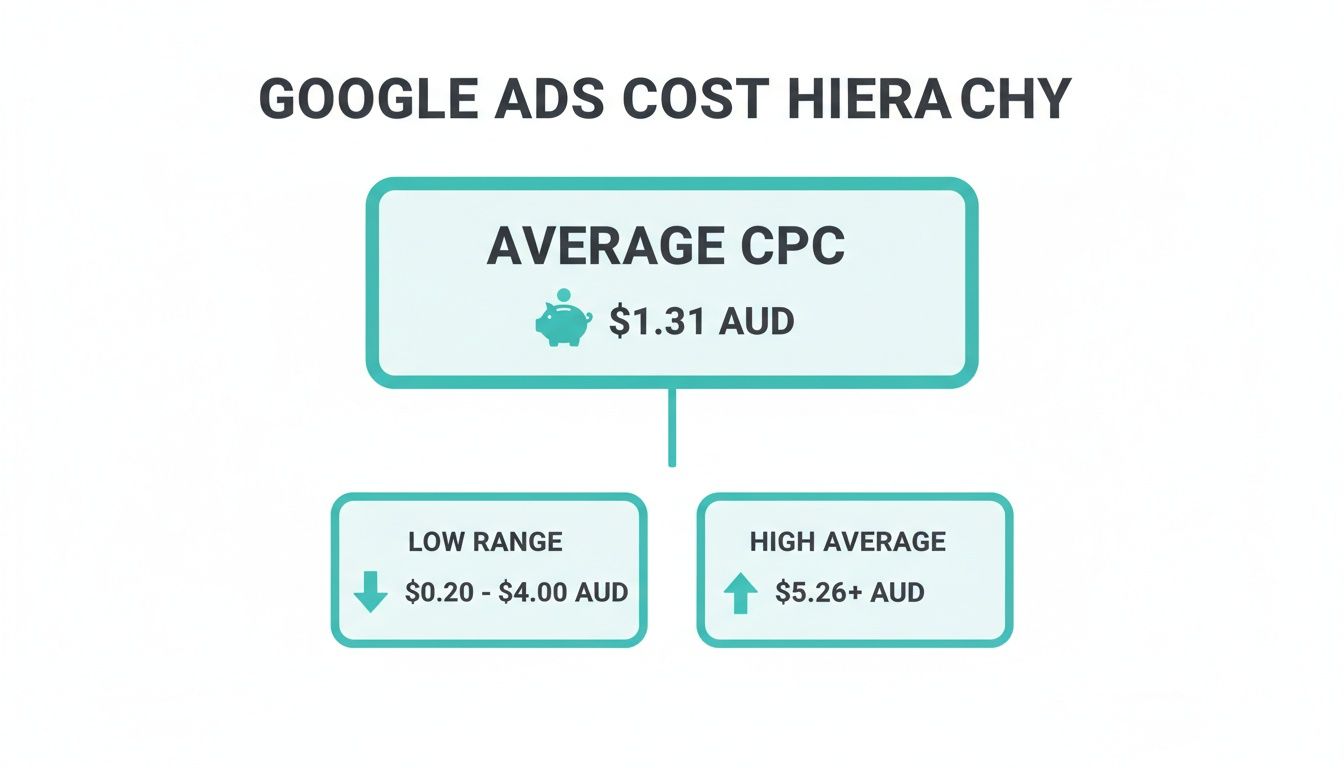
While the average CPC sits around $1.31 AUD, it’s common for many businesses to pay in the $2-$4 AUD range, especially in competitive industries where the fight for clicks is more intense.
Calculating Your Actual Cost
Now for the really clever part. Even if you win the top spot, you don't pay your maximum bid. You only pay the bare minimum needed to beat the advertiser ranked just below you, plus a single cent.
Here’s the formula Google uses:
Actual CPC = (Ad Rank of the advertiser below you / Your Quality Score) + $0.01
Let's run through a quick example. Imagine two plumbers in Adelaide are bidding on the same keyword.
| Advertiser | Max Bid | Quality Score | Ad Rank (Bid x QS) |
|---|---|---|---|
| Plumber A (You) | $3.00 | 10/10 | 30 |
| Plumber B | $5.00 | 4/10 | 20 |
Even though Plumber B is bidding a whole two dollars more, your perfect Quality Score gives you a much higher Ad Rank (30 vs. 20). You win the top spot. Easy.
But what do you actually pay? Let's plug the numbers into the formula. We take Plumber B's Ad Rank (20), divide it by your fantastic Quality Score (10), and add one cent.
(20 / 10) + $0.01 = $2.01
Just like that, you’ve secured the number one position and only paid $2.01 for that click. That’s nearly a dollar less than your $3.00 maximum bid and less than half of what your competitor was willing to pay. This is concrete proof that focusing on your Quality Score is the single most effective way to lower your Google Ads cost per click and get a far better return on your ad spend.
How to Set Realistic CPC Benchmarks for Your Industry
Ever wondered why a click for a lawyer in Adelaide costs an arm and a leg, while a click for a local coffee shop is pocket change? It all comes down to competition and what a new customer is actually worth to the business. Getting your head around this is the first step to setting an advertising budget that works, without any nasty surprises.
Plain and simple, not all clicks are created equal. Your Google Ads cost per click is massively shaped by your industry because some fields are just more cutthroat—and more profitable—than others. Think of it like real estate. A shop on Rundle Mall is always going to have a higher rent than one on a quiet suburban street. On Google, your keywords are your digital real estate.
Why More Competition Means Higher Costs
In high-stakes industries like law, finance, or even specialised trades like commercial plumbing, businesses are willing to pay top dollar for a single click. It's not because they're throwing money away; it's a strategic investment. One new conveyancing client or a major plumbing contract could easily be worth thousands of dollars.
This high customer lifetime value (CLV) means competitors are ready to bid aggressively to snap up that lead. This bidding war for the top ad spots is what sends the average cost per click through the roof. For these businesses, paying $10 or even $20 for a click makes perfect sense if it lands a high-value client. On the flip side, a bookstore with much smaller profit margins just can't afford to play in that league, which is why their average CPC is so much lower.
Average Google Ads CPC by Industry in Australia
So, how does this actually look on the ground here in Australia? To give you a real-world picture, we've pulled together some numbers that show just how much CPCs can vary from one industry to the next.
This table gives a comparative look at the average Cost Per Click across different industries relevant to Adelaide businesses, highlighting the significant cost variations.
| Industry | Average CPC (AUD) | Competition Level |
|---|---|---|
| Legal | $13.40 | Very High |
| Insurance | $12.80 | Very High |
| Finance | $11.70 | High |
| Real Estate | $2.40 | Medium |
| Arts & Entertainment | $2.24 | Low |
As you can see, the difference is huge. A click in the legal field costs almost six times more than one in arts and entertainment. It really hammers home why comparing your CPC to a national, all-industry average is a waste of time. You can explore more data on Australian industry costs to see where you fit in.
The main thing to remember is this: your expected Google Ads cost per click is a direct reflection of how competitive your industry is and the potential profit each new customer brings. Don't worry about what a cafe is paying—benchmark yourself against your direct competitors.
What About the Local Adelaide Market?
While industry averages give you a great starting point, what's happening right here in Adelaide also matters. A plumber based in Norwood might be up against different competitors—and therefore paying different CPCs—than one working out of Salisbury.
Here’s how local factors can shake things up:
- Number of Competitors: The more businesses in your service area bidding on "emergency plumber Adelaide," the more you're all going to have to pay for a click. It's basic supply and demand.
- Local Economy: When Adelaide's economy is doing well, more businesses have the confidence to advertise, which heats up the competition for ad space and nudges prices up.
- Seasonal Demand: A roofer in Adelaide will see CPCs jump after a big hailstorm. An air conditioning technician will see the same thing happen during a summer heatwave.
By getting a handle on these benchmarks and local market quirks, you can stop guessing. You'll be able to set a budget that’s realistic and smart for your specific business in your specific part of Adelaide. This avoids the two biggest pitfalls: either spending too little and getting lost in the noise, or overspending on clicks that don't deliver a return. It's all about finding that sweet spot where your ad spend brings in more than it costs, time and time again.
The 5 Key Factors That Drive Your Ad Costs
Trying to understand your Google Ads cost per click without looking at the underlying factors is like trying to guess the price of petrol without knowing about crude oil prices or local taxes. It’s not just about what your competitors are bidding. The real control comes from knowing which levers you can pull to directly influence what you pay.
Think of it like tuning an engine—several interconnected parts need to work in harmony for peak performance. Your ad costs are the result of this dynamic interplay. By getting a handle on these core elements, you can gain a serious advantage, often paying less for a better spot on the page. Let's break down the five most critical drivers that dictate what you actually pay for each click.
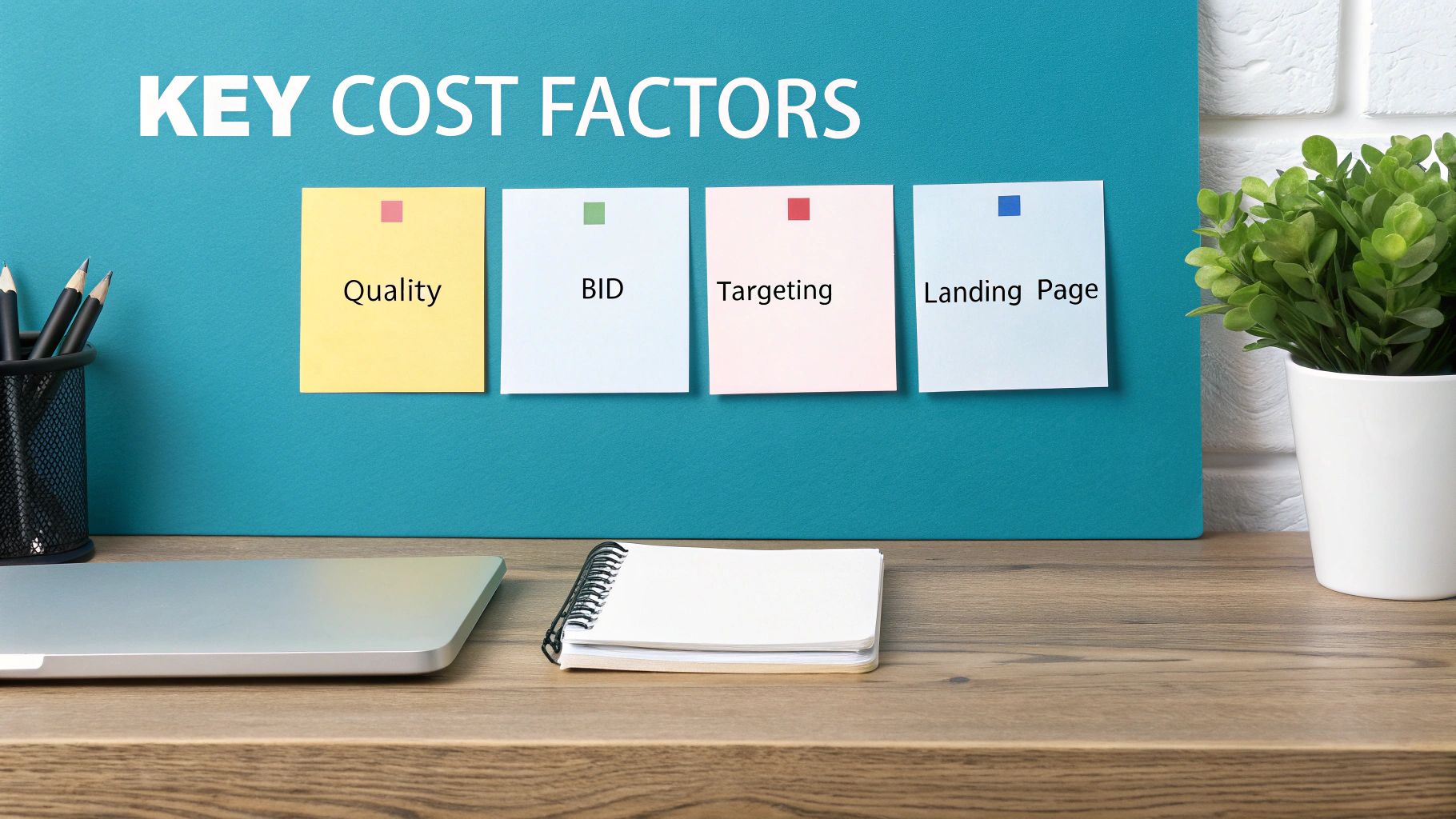
1. Quality Score: Your Most Valuable Asset
If there’s one metric you should obsess over, it’s your Quality Score. This is Google's rating, from 1 to 10, of how relevant and high-quality your ads, keywords, and landing pages are. A high score is basically Google giving you a thumbs-up for providing a great user experience, and it rewards you with lower costs and better ad placements.
A low score, on the other hand, flags a mismatch between what someone searched for and what your ad is offering. As a penalty, you'll be forced to pay a premium just to show up.
Quality Score is the great equaliser in the Google Ads auction. A small business in Adelaide with a Quality Score of 9/10 can easily outrank and pay less than a large national competitor with a huge budget but a lazy 3/10 score.
Your score boils down to three main components:
- Expected Click-Through Rate (CTR): Based on past performance, how likely is someone to click your ad when it appears?
- Ad Relevance: How closely does your ad copy match the intent behind the keyword?
- Landing Page Experience: Once someone clicks, is your landing page useful, easy to navigate, and directly related to the ad?
Nailing these three areas is the single most effective way to lower your cost per click.
2. Ad Rank and Competitive Pressure
Next up is your Ad Rank, which is the formula Google uses to decide your ad's position on the page. It’s a simple calculation: your maximum bid multiplied by your Quality Score. The higher your Ad Rank, the better your position. It's not just about who bids the most.
But here's the kicker: the auction is live and dynamic. What you actually pay is heavily influenced by the Ad Rank of the advertiser directly below you. You only pay the bare minimum needed to beat their score (plus one cent). This means that even with a sky-high Ad Rank, you'll still pay more if you're up against another really strong competitor. That’s the competitive pressure that drives up costs in crowded industries.
3. Your Targeting Settings
Where, when, and who you show your ads to has a massive impact on your costs. Casting your net too wide is one of the quickest ways to blow your budget on clicks that will never convert.
Smart targeting gives you precise control over your ad spend. The key settings you need to master are:
- Geographic Targeting: An Adelaide-based plumber has no business paying for clicks from someone in Sydney. By targeting specific suburbs or a radius around your service area, you ensure every dollar is spent on potential local customers.
- Device Targeting: Do your customers tend to call you from their mobile, but fill out forms on a desktop? You can adjust your bids to prioritise the more profitable device, putting your money where the conversions happen.
- Audience Targeting: This is where you can get really specific. You can layer on audiences based on their demographics, interests, or even if they've visited your website before (remarketing). For a deeper look, you can explore the types of audiences to target for Google Search Ads to really fine-tune your approach.
4. Keyword Selection and Match Types
The keywords you bid on are the very foundation of your campaign and a huge cost driver. Broad, competitive, single-word keywords almost always have a much higher cost per click.
Take a keyword like "plumber." It's incredibly broad and expensive. The person searching could be looking for a job, TAFE courses, or plumbing supplies—not necessarily your services. This is where strategic keyword selection becomes your secret weapon.
To get ahead, you need to invest in effective keyword research. Focus on what we call long-tail keywords—these are longer, more specific phrases that show clear intent. A search for "emergency plumber norwood" is far more valuable and usually cheaper to bid on because that user has an obvious, urgent problem they need solved right now.
5. Ad and Landing Page Relevance
The final piece of the puzzle is creating a seamless journey from the keyword to your ad and finally to your landing page. When someone clicks your ad, the page they land on absolutely must deliver on the promise you made in your ad copy.
Imagine your ad promotes "fixed-price conveyancing," but it clicks through to a generic homepage where that service is buried three menus deep. That person is going to hit the back button immediately. This poor experience tanks your Quality Score and drives up your costs. You need to make sure your landing page is hyper-relevant, loads fast, and has a crystal-clear call-to-action that directly matches what the user was looking for. This relevance is what turns clicks into customers and keeps your CPC in check.
Actionable Ways to Lower Your Cost Per Click
Knowing what goes into your Google Ads Cost Per Click is one thing, but actually doing something about it is where the magic happens. Lowering your CPC isn't about flicking a switch; it's about a series of smart, deliberate improvements that make your campaigns more valuable to both your audience and your budget.
This is where you get to pull the levers. By zeroing in on a few key areas, you can make every dollar of your ad spend work harder, bringing in better-quality traffic for less. Let's get into the practical strategies you can use right now to bring those costs down without hurting your results.
Master Your Quality Score
As we've touched on, your Quality Score is the most powerful tool you have for cutting down ad costs. A high score is basically Google giving you a pat on the back (and a discount) for creating a relevant, user-friendly experience from search to landing page.
Think of it like a three-legged stool: your ad copy, your keywords, and your landing page experience. If one leg is wobbly, the whole thing falls over. You need all three working together seamlessly.
To get your CPC down and really crank up performance, you have to send people to pages that match their search perfectly. It’s crucial to optimize your landing pages for profit and turn that valuable traffic into actual customers.
Here’s how to strengthen each component:
Write Compelling Ad Copy: Your ad needs to do more than just announce what you sell. It has to connect with the user's problem, feature the keyword they just typed, and give them a clear, simple next step (your call to action). Constantly A/B test different headlines and descriptions to see which ones get the best response.
Nail Landing Page Relevance: If someone clicks your ad for "emergency plumbing in Norwood," they better land on a page that’s all about exactly that. Dumping them on your generic homepage makes them do the work, which is a big turn-off for them and a red flag for Google.
Get Smart With Your Keyword Tactics
Your keyword strategy is the bedrock of your whole campaign. Choosing the right keywords—and just as importantly, blocking the wrong ones—is absolutely vital for keeping your CPC in check and making sure your budget isn't being wasted.
A classic mistake is to bid on really broad, competitive keywords that bring in a mixed bag of searchers. It's an expensive and inefficient way to advertise. The real win is in being specific.
The aim isn't just to get clicks; it's to get the right clicks. A cheaper, more specific keyword that converts is worth infinitely more than an expensive, general keyword that just brings in tyre-kickers.
Start sharpening your keyword list with these two powerful moves:
Embrace Long-Tail Keywords: Instead of a broad term like "lawyer," get specific with a high-intent phrase like "conveyancing lawyer in Adelaide CBD." These longer keywords have less search traffic, but the people using them are much closer to making a decision, which means higher conversion rates and a lower CPC for you.
Build a Rock-Solid Negative Keyword List: This is one of the quickest ways to stop wasting money. Negative keywords tell Google which searches you don't want to show up for. For example, a conveyancer should add words like "jobs," "course," and "free advice" to their negative list to avoid paying for clicks from people who will never become clients.
Regularly checking your search terms report is one of the most fundamental practices for optimising Google Ads campaigns, as it will constantly show you new negative keywords to add to protect your budget.
Choose the Right Bidding Strategy
Google Ads gives you a whole menu of bidding strategies, from completely hands-off automation to full manual control. The right choice depends on your campaign goals, your budget, and how much conversion data you've got under your belt. The wrong strategy can lead you to overspend or, just as bad, miss out on great opportunities.
If you're new to Google Ads, starting with an automated strategy that aims for clicks or conversions is often a good first step. As your campaign runs and collects data, you might find that shifting to a more hands-on approach gives you better control over your CPC.
Let’s look at two popular options:
Automated Bidding (e.g., Maximise Conversions): This strategy lets Google's machine learning do the heavy lifting, setting bids automatically to get you the most conversions possible within your budget. It’s a great fit if you have clear conversion goals (like a form fill or a purchase) and enough data for the algorithm to learn from.
Manual CPC Bidding: This puts you in the driver's seat. You set the maximum bid for every ad group or even individual keywords, letting you bid more on what you know works best. It takes more time and attention, but it offers the ultimate control for fine-tuning your spend.
Looking at the Australian Google Ads market, it's clear that while benchmarks are a useful guide, the real-world costs for an Adelaide business come down to smart campaign setup and strategic keyword choices. Professional campaign management can range from $500 to over $5,000 per month, a reflection of the complexity involved. In fact, data shows that a staggering 78.2% of advertisers find it hard to turn a profit, proving that just knowing your CPC isn't enough to guarantee success.
Looking Beyond Clicks to Maximise Your ROI
Getting a low Google Ads cost per click feels great, and it's definitely a milestone worth celebrating. But let's be honest: cheap clicks aren't the real prize. Profitable customers are.
It’s easy to get tunnel vision and focus only on driving down that CPC. The problem is, the cheapest click is rarely the best one. It might come from someone half-interested or tapping on an ad by mistake, meaning you’ve just paid for a website visit that was never going to convert. True success isn’t measured by how little you spend on clicks, but by your Return on Investment (ROI).
The Real Goal: Conversion and Profit
Think of your marketing as a relay race. Your Google Ads campaign runs the first leg, bringing the baton (a potential customer) to your website. But if your website fumbles the hand-off, the race is lost.
You could have the most brilliantly optimised, cost-effective Google Ads campaign in Adelaide, sending a steady stream of affordable traffic your way. But if that traffic lands on a website that's slow, confusing, or just doesn't convince them to act, that entire ad spend goes down the drain. This is where a sharp focus on conversion rate optimisation comes in.
A low cost per click paired with a high-converting website is the formula for exceptional ROI. It ensures the affordable traffic you're attracting is being effectively transformed into tangible business growth and revenue.
Tying It All Together
At the end of the day, a holistic approach is the only way to make sure your advertising budget is actually making you money. It means looking past the individual google ads cost per click and seeing the entire journey from the first search to the final sale.
This involves two key parts working together:
- Ad Optimisation: Constantly tweaking your ads to attract the right people for the best possible price.
- Website Performance: Making sure your landing pages are fast, clear, and persuasive, guiding visitors smoothly towards becoming a customer.
When you get both your ads and your website working in harmony, you create a powerful system where every dollar spent is a strategic investment in growing your business.
Got Questions About Your Google Ads Costs? We've Got Answers
Even when you've got a handle on the basics of Google Ads, a few specific questions always seem to pop up. Here are some quick, straight-to-the-point answers to what we hear most often from Adelaide business owners about their ad spend.
What’s a Good Cost Per Click for My Business in Adelaide?
This is the million-dollar question, but the honest answer is: it depends entirely on your business. There's no magic number. A 'good' CPC is one that's profitable for you.
Think about it this way: a commercial lawyer could happily pay $15 for a single click if that click turns into a new client worth thousands. On the other hand, an online store selling a $50 pair of shoes would go broke paying even $2 per click.
Instead of hunting for some universal "good" CPC, the real goal is to figure out your maximum profitable cost per click. You do this by working backwards from your customer's value and your website's conversion rate. Profitability is the only metric that truly matters, not just a low click cost.
Can I Actually Run Google Ads on a Small Budget?
Absolutely. You don't need a massive budget to get results, but you do need to be smart and strategic with every dollar you spend.
The trick is to make your budget work harder by focusing on precision. Instead of bidding on a broad, expensive term like 'lawyer', you could target a super-specific phrase like 'affordable conveyancing in Glenelg'. Clicks like that come from people who know exactly what they want.
You’ll also want to tighten up your location targeting so you’re only showing ads to people in your service area. And don't forget to build a solid negative keyword list—it's your best defence against wasting money on clicks that will never lead to a sale.
How Long Does It Take to Actually Lower My CPC?
You can get traffic flowing within hours of launching a new campaign, but bringing your costs down is more of a marathon than a sprint. It's a gradual process that's all about collecting and acting on data.
Realistically, it takes a few weeks to a month just to gather enough performance data to make smart decisions. Improving your Quality Score, refining keywords, and testing ad copy all need time to pay off.
You should start to see some noticeable, stable improvements to your costs within the first one to three months of consistent, hands-on campaign management. Patience is key here; methodical tweaks are what lead to long-term efficiency and a lower CPC.
Ready to stop guessing and start getting real, profitable results from your Google Ads budget? Frank Digital Agency combines conversion-focused web design with data-driven ad management to turn your clicks into customers. Let's build a strategy that delivers a powerful return on your investment.