

The whole Google Ads versus Facebook Ads debate really comes down to one thing: are you capturing existing demand or are you creating new demand? It’s a simple but powerful distinction. Google Ads gets you in front of people who are right now, this very minute, looking for what you offer. Facebook Ads, on the other hand, lets you introduce yourself to people who don't know they need you yet.
So, are you trying to answer a question or start a conversation? That's the real starting point.
Choosing Your Digital Battlefield: Google vs. Facebook Ads
Think of it in real-world terms. Running ads on Google is like opening a shop on the busiest high street in town, right where people are actively searching for your specific product. They have their wallets out, they know what they want, and your job is to convince them your store is the best one. This is all about search intent.
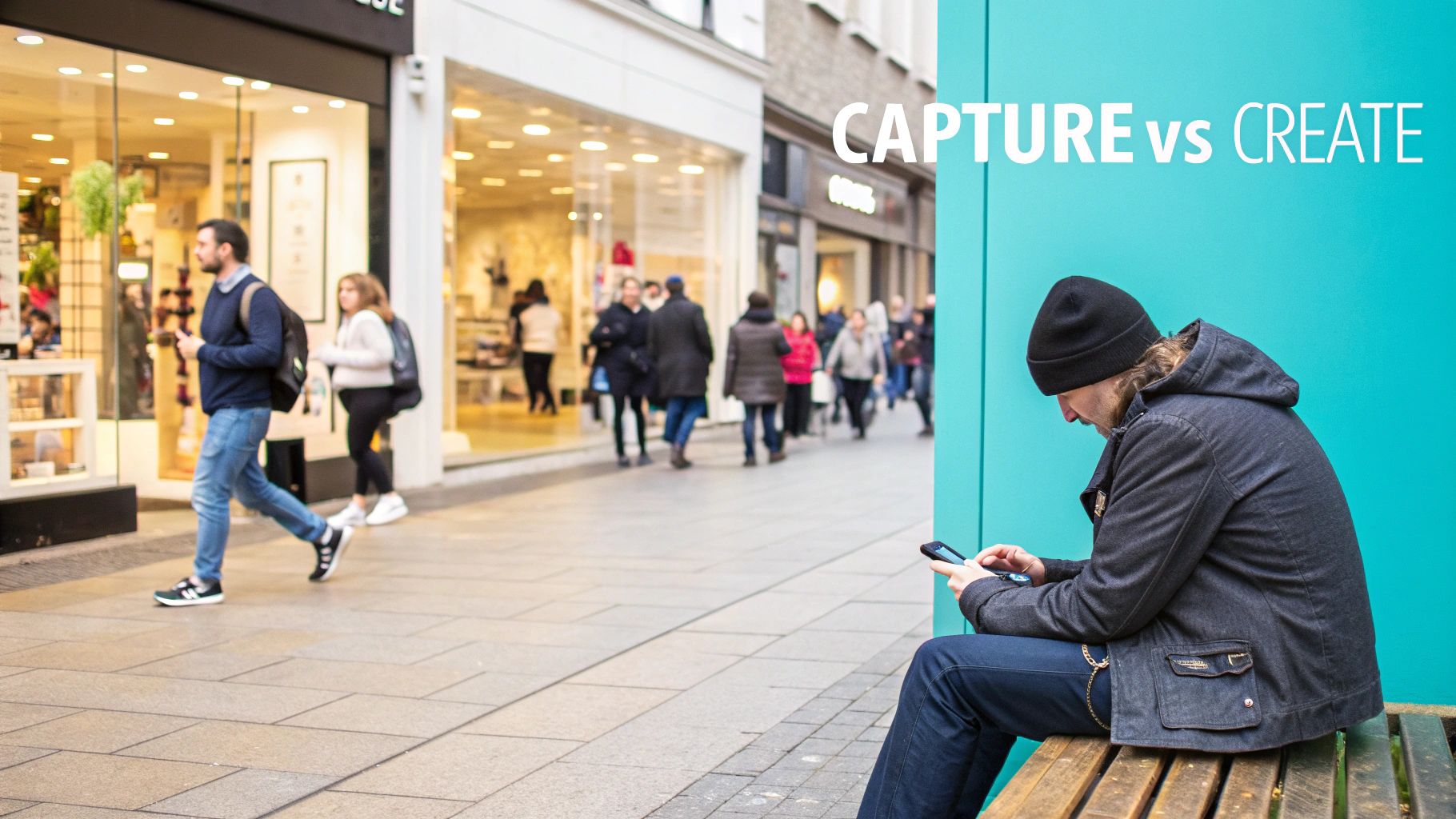
Facebook Ads is more like a stunning billboard on a busy highway or a clever ad that pops up during their favourite TV show. It's an interruption. Your ad appears while they're scrolling through photos of friends and family, so it needs to be compelling enough to stop their thumb and spark an interest they didn't know they had. Here, you’re creating demand based on who they are and what they like.
Nailing this difference is the key to building a profitable ad strategy for your Australian business. It’s less about which platform has cooler features and more about which one aligns with your immediate goals.
The question isn't "Which platform is better?" but rather, "Which platform is better for my specific goal right now?" One captures wallets already open; the other opens minds to a new possibility.
The Core Strategic Difference
This "capture vs. create" model dictates everything—your budget, your ad copy, the visuals you use, and the kind of return you can expect. An Adelaide plumber who needs their phone to ring now for an ‘emergency blocked drain’ will get immediate traction from Google's high-intent searchers. On the flip side, a new online fashion boutique needs to build hype and desire for its new collection, making Facebook’s powerful, visual-first targeting the perfect place to start.
To make this crystal clear, let's break down how each platform's strategy fits with different business goals.
Platform Strategy at a Glance: Intent vs. Awareness
The table below offers a quick snapshot of the core strategic differences and where each platform truly shines.
| Key Function | Google Ads (Capturing Demand) | Facebook Ads (Creating Demand) |
|---|---|---|
| Primary Goal | Generate leads and sales from active searchers. | Build brand awareness and audience engagement. |
| User Mindset | Problem-aware, actively seeking a solution. | Passive, browsing for entertainment or connection. |
| Best For | Services with urgent needs (trades, legal). | Visual products, new concepts, and community building. |
| Typical ROI | Often faster, tied directly to high-intent clicks. | Slower, requires nurturing from awareness to conversion. |
Once you properly grasp this—capture versus create—you’re no longer just comparing two ad platforms. You're making a strategic decision about where to invest your next dollar to get the best possible return, whether that’s making the phone ring today or building a loyal tribe of customers for tomorrow.
Comparing Platform Mechanics and Targeting Capabilities
We've covered the core difference: capturing demand versus creating it. Now, let’s get our hands dirty and look under the bonnet at the actual tools each platform gives you to find your customers. This is where the strategic thinking in the Google Ads vs Facebook Ads debate really comes alive.
At their core, Google and Facebook operate on fundamentally different targeting philosophies. Google's power is its direct line to a user's immediate need, while Facebook’s strength is its deep, nuanced understanding of who a person is. Knowing how to work with these distinct toolkits is what separates a wasted budget from a profitable one.
Google Ads: Keyword Targeting and the Auction System
Google Ads is built entirely on the back of keyword targeting. Its main job is to match your ad with someone's search query at the very moment they express a need. This all happens through a real-time auction system that runs billions of times a day.
When someone types something into Google, the platform instantly looks for all the advertisers bidding on keywords relevant to that search. It then runs an auction to decide which ads get shown and in what order. But it's not just about who throws the most money at it; Google also factors in your Ad Rank, which is a score based on your bid, the quality of your ad, and how relevant your landing page is.
This system gives you incredible precision. Think about an Adelaide plumber. They aren't just bidding on "plumber"; they're bidding on high-intent phrases like "emergency plumber Adelaide" or "blocked drain Kent Town". This puts their ad right in front of someone with an urgent, specific problem who is extremely likely to convert.
Getting this right means understanding keyword match types:
- Broad Match: Casts the widest net, showing your ad for searches loosely related to your keyword.
- Phrase Match: Gives you more control, showing your ad for searches that include the meaning of your keyword.
- Exact Match: Offers maximum precision, displaying your ad only when the search intent is identical to your keyword.
Google Ads turns the search bar into a direct line to your most motivated customers. Your entire strategy hinges on anticipating the exact words they will use when they need you most.
By mastering keywords and the auction, you tap into a constant stream of users who have already put their hands up and declared their intent. It’s a powerful, direct way to drive immediate leads and sales. For a deeper look, it’s worth learning about the different https://frankdigital.agency/google-ads/types-of-audiences-to-target-for-google-search-ads/ and how they layer onto your keyword strategy.
Facebook Ads: Sophisticated Audience Building
While Google targets what people are looking for, Facebook targets who people are. Its whole system is built on an enormous dataset of user demographics, interests, and behaviours, letting you construct incredibly detailed audience profiles.
Instead of waiting for a search, you’re proactively putting your ad in the social feeds of people who match your ideal customer. When you start exploring the platform, you'll see that advanced AI Facebook Ads features give social campaigns a unique edge, as the platform's machine learning gets smarter about who sees your ads.
This "people-based" targeting is what makes Facebook a discovery engine. A local Adelaide fashion boutique can use it to do more than just find people interested in "fashion." They can specifically target women aged 25-40, living within a 15km radius of their store, who have shown an interest in sustainable brands and follow certain fashion influencers on Instagram. That's real precision.
Facebook’s most powerful audience-building tools are:
- Custom Audiences: These let you reconnect with people who already know you. You can upload a customer email list, target website visitors (using the Meta Pixel), or reach users who've engaged with your Facebook or Instagram page.
- Lookalike Audiences: This is arguably Facebook's killer feature. You give it a source audience—say, your best customers from an email list or website visitors who made a purchase—and Facebook’s algorithm will go out and find new people who share similar traits.
This means our fashion boutique can upload their list of top 200 customers and ask Facebook to create a "lookalike" audience of thousands of new, highly relevant potential customers in the Adelaide area. It's an incredibly effective way to scale your business by finding more people just like your existing best clients.
Gauging the Costs and Measuring Your Real Return
Every business owner asks the same question: where will my ad dollars work hardest? When you put Google Ads and Facebook Ads head-to-head, the answer isn’t simply about which one is cheaper. It’s about which platform delivers a better return for your specific goals.
The way you measure success on each platform has to be different because they play fundamentally different roles. You might see a lower Cost Per Click (CPC) on Facebook and jump to the conclusion that it’s the better deal, but that’s rarely the full picture. The real story is told by your Return on Investment (ROI) and Cost Per Acquisition (CPA).
Understanding Cost Per Click vs. Cost Per Acquisition
On the surface, Google Ads almost always has a higher CPC. Why? Because you're paying a premium to get in front of someone who is actively looking for what you sell. It’s like renting a shop on the busiest high street; the rent is higher, but the people walking past are there to buy.
Facebook Ads, on the other hand, tend to have a much lower CPC. You’re paying for attention in a social feed where people are catching up with friends, not necessarily looking to make a purchase. While that initial click is cheap, it often takes a much longer journey to turn that casual interest into a sale, which can drive up your overall CPA.
Let's break that down:
- Google Ads: Expect a higher CPC. But because the path from search to sale is so direct, you’ll often see a lower CPA and a faster return, especially for industries driven by immediate need.
- Facebook Ads: The CPC is generally lower, making it fantastic for building brand awareness and creating audiences. Just be prepared for a potentially higher CPA, as you're nurturing leads over a longer period.
Setting Your Budgets and KPIs
Your budget and Key Performance Indicators (KPIs) need to match the job you've given each platform. It’s a classic mistake to apply the same metrics to both—it’s a surefire way to misread your results and waste money. It's vital to know is your PPC budget spent wisely to sidestep these common traps.
With Google Ads, your focus should be laser-sharp on direct-response metrics. You are paying for leads and sales, plain and simple.
Your Google Ads budget is an investment in capturing immediate demand. The most important metric is Return on Ad Spend (ROAS)—for every dollar you put in, how many are you getting back?
Key Google Ads KPIs to watch:
- Return on Ad Spend (ROAS): The ultimate measure of profitability.
- Cost Per Acquisition (CPA): How much you're actually paying for each new customer or qualified lead.
- Conversion Rate: The percentage of clicks that turn into meaningful action.
- Click-Through Rate (CTR): A great health check for how well your ad copy resonates with searchers.
For Facebook Ads, your measurement needs to be more patient and nuanced, especially when you're running top-of-funnel campaigns. You’re building an audience and creating brand recognition, which doesn't always lead to an immediate purchase. Remember, to get the most out of either platform, you also need to optimize your website's conversion rate to turn that traffic into customers.
Key Facebook Ads KPIs to track:
- Audience Growth: How much is your retargeting pool or follower count growing?
- Engagement Rate: Are people liking, commenting, and sharing? It’s a strong signal of interest.
- Lead Quality: For lead gen campaigns, track how many leads from Facebook actually become paying customers down the line.
- Cost Per Landing Page View: A great metric for understanding the cost of driving relevant users to your site for discovery.
Insights from Australian agencies consistently back this up. For businesses that need to see immediate, measurable revenue, ROAS almost always swings in favour of Google Ads. This holds particularly true for high-value local sectors like trades and legal services in Adelaide, where Google's ability to catch customers with their "wallets out" delivers a much faster and more direct ROI. It's why many agencies allocate the lion's share of performance budgets to Google, capitalising on its higher conversion rates even if the clicks cost more.
A Showdown of Ad Formats and Creative
It’s one thing to get in front of the right people, but it’s another thing entirely to show them a message that actually sticks. This is where Google Ads and Facebook Ads really part ways. Their creative demands are worlds apart, shaped by what the user is doing and thinking at that very moment.
Think of it like this: Google is the pragmatic problem-solver, while Facebook is the charismatic storyteller. To win on either platform, you need to master a completely different creative language. Are you answering a question, or are you trying to stop someone from scrolling?
Google Ads: Where Precision and Text Reign Supreme
Google's heavyweight champion is the Search Ad, and it’s almost all about the words you choose. Great copywriting isn't just a nice-to-have; it's everything. Your ad is the direct answer to someone's question, so it needs to be crystal clear, hyper-relevant, and have a call-to-action that makes sense. The whole game is about packing as much value and relevance as you can into a few lines of text that perfectly match what someone just typed into the search bar.
Let’s say a law firm in Adelaide is targeting the search term "conveyancing services Adelaide." Their ad needs to be direct, professional, and reassuring.
- Headline 1: Expert Conveyancing Services Adelaide
- Headline 2: Fixed-Fee Quotes & Fast Settlements
- Description: Stress-free property transfers. Our experienced conveyancers handle all legal work, ensuring a smooth process from contract to settlement.
See? It’s not flashy. It’s a solution. It uses the keywords, highlights the main benefits (fixed-fee, fast), and immediately addresses the user's need for a trustworthy service.
While text is king, Google does have a few visual tricks up its sleeve:
- Shopping Ads: These are all about the product. They pop up with an image, price, and title right in the search results. Here, the only creative you need is a clean, high-quality product photo that stands out from the rest.
- Display Ads: These are the classic image-based banner ads you see across the web. They're brilliant for retargeting, requiring simple, on-brand visuals and a clear offer to jog someone's memory.
On Google, your creative has one job: to be the most direct and compelling answer to a query. It’s less about artistic flair and more about surgical precision. You have to match your message to the user's intent with absolute clarity.
Facebook Ads: Winning the Battle for Attention
Over on Facebook and Instagram, your ad is an uninvited guest in someone’s personal, visual feed. Your job isn't to answer a question; it's to stop the scroll. Text-only ads are dead on arrival here. Success is almost entirely down to high-quality, eye-catching visuals that feel like they belong on the platform.
People are kicking back, scrolling passively, and in a discovery mindset. Your ad has to ignite a spark of curiosity or create a feeling of desire out of thin air. A local Adelaide cafe isn’t going to win by just writing "Great Coffee Here." They need to sell the experience with a vibrant, high-energy video.
- Video Ad: Imagine a quick, 15-second reel. A barista pours perfect latte art, steam wafts off a freshly baked pastry, friends are laughing at a sunny table. The text overlay is simple: "Your Morning Escape. King William Road."
- Carousel Ad: A swipeable ad that lets users flick through photos of signature brunch dishes, each one looking more delicious than the last, with a short, enticing description.
These ads work because they tell a story. They sell a vibe, not just a product. They’re designed to blend in with a user's feed but be just captivating enough to grab their attention. Every creative asset needs to be built for a mobile screen—bold visuals, clear branding, and subtitles for sound-off viewing are non-negotiable. It’s all about building a connection through visuals in a way that text just can’t.
Choosing the Right Platform for Your Industry
Theory is one thing, but making money is another. When it comes to Google Ads versus Facebook Ads, the right choice isn't about which platform has more features; it’s about understanding how your specific customers find and buy from you. What works for an online boutique is a world away from what a local electrician needs.
Making the right call means matching the platform’s core strength to your customer's journey. Let's break down some tailored recommendations for key Australian business sectors, giving you clear, practical advice you can use today.
Local Services and Trades
If you're a plumber, electrician, locksmith, or builder, your customer's journey is often short, sharp, and urgent. When a pipe bursts, people don't scroll through their social media feed for inspiration. They grab their phone and search for someone who can fix their problem now.
For this reason, Google Ads is the undisputed king for tradies and local services.
Your entire strategy should be built around capturing high-intent, location-based searches. Think "emergency plumber Adelaide," "blocked drain Kent Town," or "24/7 electrician near me." These aren't casual browsing queries; they are cries for help from people ready to pay. Google Search Ads put your business directly in front of them at the precise moment of need, making it the most direct path to a ringing phone and a new job.
For service-based businesses, a click on a Google Ad is a direct signal of commercial intent. You aren't just buying traffic; you're buying an opportunity to solve an urgent problem, which is the fastest path to revenue.
This decision tree helps visualise how your main goal—whether it's getting immediate clicks or building brand awareness—should shape your creative strategy.
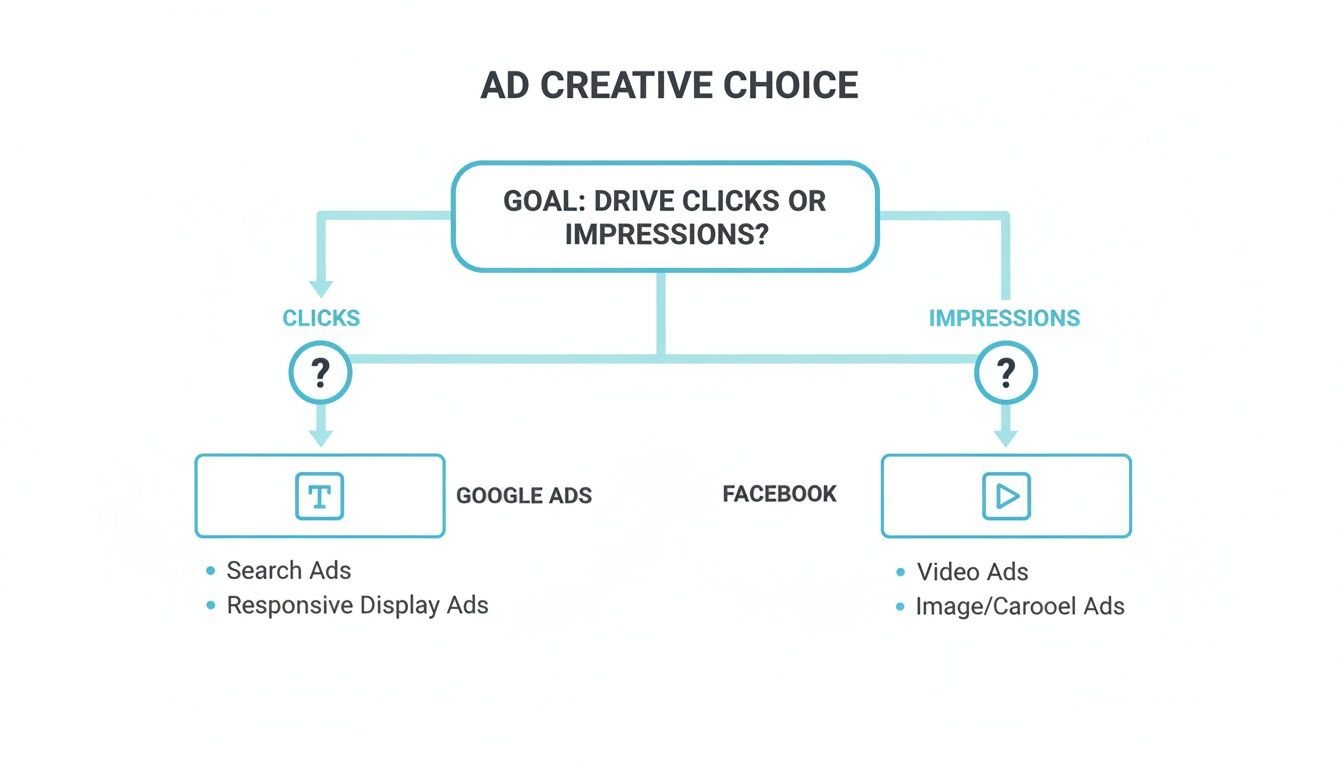
As the graphic shows, for the direct-response goals that are typical in local services, text-based Google Ads are the most efficient tool. In contrast, visually-driven Facebook Ads are brilliant for generating broader awareness and demand.
E-commerce Businesses
For online stores, the question isn't "either/or" – it's "when and how." The most successful e-commerce brands run a powerful hybrid strategy, using both platforms for different stages of the buying cycle. Each plays a distinct, crucial role in turning a passive scroller into a loyal customer.
A smart e-commerce strategy looks something like this:
- Audience Discovery (Facebook Ads): Use eye-catching video, carousel, and collection ads to introduce your brand and products to new, highly-targeted audiences who don't know you exist yet. This is perfect for building brand awareness and filling the top of your sales funnel.
- Capturing Intent (Google Shopping): When those same people later decide they need what you sell and search for "linen sheets Australia," your Google Shopping ads are right there to grab their click with a clean image and price.
- Cart Recovery (Facebook Retargeting): Did someone add an item to their cart but get distracted? Dynamic retargeting ads on Facebook and Instagram can follow them, serving as a powerful visual reminder—often with a small discount—to bring them back and close the sale.
This integrated approach creates a seamless customer journey. You use Facebook’s discovery engine to create demand and Google’s search engine to convert it.
Professional Services
Firms like lawyers, accountants, mortgage brokers, and financial advisors operate in a high-consideration market. Clients aren't making impulse buys. They are doing their research, comparing experts, and looking for a trustworthy partner to help with a complex, often expensive, problem.
Just like the trades, Google Search Ads are typically the primary lead generation tool.
Your potential clients are actively searching for specific solutions, using queries like "business accountant Adelaide" or "conveyancing services Unley." These are highly qualified prospects looking for professional help. A well-crafted text ad that highlights your expertise, credibility, and a clear call-to-action (like "Book a Free Consultation") can attract high-value leads with incredible efficiency.
Data from the Australian market backs this up. In the digital advertising space, Google Ads consistently deliver higher conversion rates for professional services, especially for Adelaide-based businesses seeking qualified leads. Research shows Google Search Ads achieve an average conversion rate of 2.85%, which is significantly higher than what Facebook can offer for this type of bottom-funnel activity. With proper optimisation, these rates can easily climb to 3-5%. That's a vital advantage, especially when you consider Google commands 93% of all search traffic in Australia. You can discover more insights about these performance benchmarks and how they can inform your strategy.
How to Build an Integrated Strategy for Maximum Growth
The whole "Google Ads vs. Facebook Ads" debate is a bit of a red herring. Experienced marketers know the real game isn't about picking a winner, but figuring out how to make them work in concert. Think of them as two specialists on the same team, each playing a critical role in guiding a customer from a fleeting thought all the way to a final purchase.
A properly integrated strategy stops you from running disconnected campaigns and starts building a cohesive, full-funnel machine. The idea is simple but powerful: create demand with one platform and then be there to capture it with the other. This way, you meet buyers at every stage of their journey, ensuring no opportunity is missed.
Generating Demand with Facebook Ads
For many customers, the journey starts on social media. This is where Facebook Ads truly shine, excelling at building brand awareness and creating targeted audiences from the ground up. You can hook people who fit your ideal customer profile—but aren't actively looking for you yet—with compelling video or carousel ads.
This is the "demand creation" phase. You’re not going for the hard sell right away. Instead, you're planting a seed of interest, making your brand memorable, and building a valuable pool of warm leads to nurture later on.
Capturing Intent with Google Ads
Once you've sparked that interest on social media, Google Ads comes in to close the deal. When someone who saw your Facebook ad eventually decides they need what you offer, where do they go? Straight to Google Search. By having search and shopping campaigns ready for relevant keywords, your brand is right there at the top, ready to capture their intent the moment they decide to buy.
It's a classic one-two punch that works beautifully:
- Awareness: A user scrolls through their Instagram feed and sees your visually striking ad for outdoor furniture. They aren't buying today, but they take notice.
- Action: A week later, they search "buy outdoor dining set Adelaide," and your Google Ad is the first thing they see. That initial awareness is immediately converted into a high-value click and, ultimately, a sale.
An integrated strategy ensures the brand awareness you build on Facebook isn't wasted. It positions Google as the final, decisive touchpoint that turns passive interest into profitable action.
The Power of Cross-Platform Retargeting
The real magic begins when you get these platforms talking to each other. One of the most effective tactics in the playbook is using the Meta Pixel to retarget users on Facebook and Instagram who originally found you through a Google Ad.
Picture this: someone clicks your Google Search ad, browses your website for a bit, but gets distracted and leaves. Without a smart follow-up, that lead is gone. But with cross-platform retargeting, you can show them a compelling video testimonial or a dynamic product ad on their social feed the very next day. This keeps your brand top-of-mind and gives you a powerful second chance to convert a highly qualified prospect. It’s a perfect example of how SEO and PPC work together to create a unified marketing front.
This full-circle approach guides customers from their first casual glance to their final, confident click, building a revenue-generating system that works for you 24/7.
Frequently Asked Questions
When you're trying to figure out where to put your ad spend, a few questions always seem to pop up. Let's get them answered so you can move forward with confidence.
Which Platform Is Cheaper: Google Ads or Facebook Ads?
On paper, Facebook Ads often looks cheaper because the cost-per-click (CPC) is typically lower. But that's not the full story. The real measure of "cheaper" is your cost-per-acquisition (CPA) – how much you actually pay to get a customer or a solid lead.
While Google Ads might have a higher CPC, it frequently delivers a better return for businesses that rely on direct sales or immediate leads. You're catching people at the exact moment they're searching for what you sell, and that intent is incredibly valuable.
Do I Need a Big Budget to Get Started?
Not at all. You can absolutely see results without a massive budget. A great starting point for either platform is around $20-$30 per day. This is enough to get your ads in front of people and start gathering real-world data.
The trick is to be laser-focused. With a smaller budget, you need to concentrate your spending on a very specific audience or a tight group of keywords. Once you see what's working and start getting a return, you can reinvest those profits to scale up. Just make sure your conversion tracking is set up perfectly from day one.
When you're starting small, it's not about how much you spend. It's about how meticulously you track the result of every single dollar.
Can I Run Google Ads and Facebook Ads at the Same Time?
Yes, and you absolutely should if you can. Running them together is where the magic really happens. This is how you build a powerful, full-funnel strategy that guides people from their first flicker of interest right through to making a purchase.
Think of it this way: you can use Facebook to build awareness and introduce your brand to new audiences. Then, you use Google to be there when those same people finally decide they're ready to buy. A classic, high-impact tactic is to run Google Search ads and then retarget anyone who visited your site but didn't convert with ads on Facebook.
Ready to turn clicks into customers with a data-driven ad strategy? Frank Digital Agency builds performance-focused Google Ads campaigns that deliver measurable ROI for Adelaide businesses. Get in touch with us today to start growing.