

So, what exactly is a click-through rate calculator? Think of it as a simple tool that tells you what percentage of people who saw your ad or search result actually clicked on it. It just divides the total clicks by the total times your ad was shown (impressions) to give you a clear, honest score of how compelling your marketing really is.
Understanding Click-Through Rate and Why It Matters
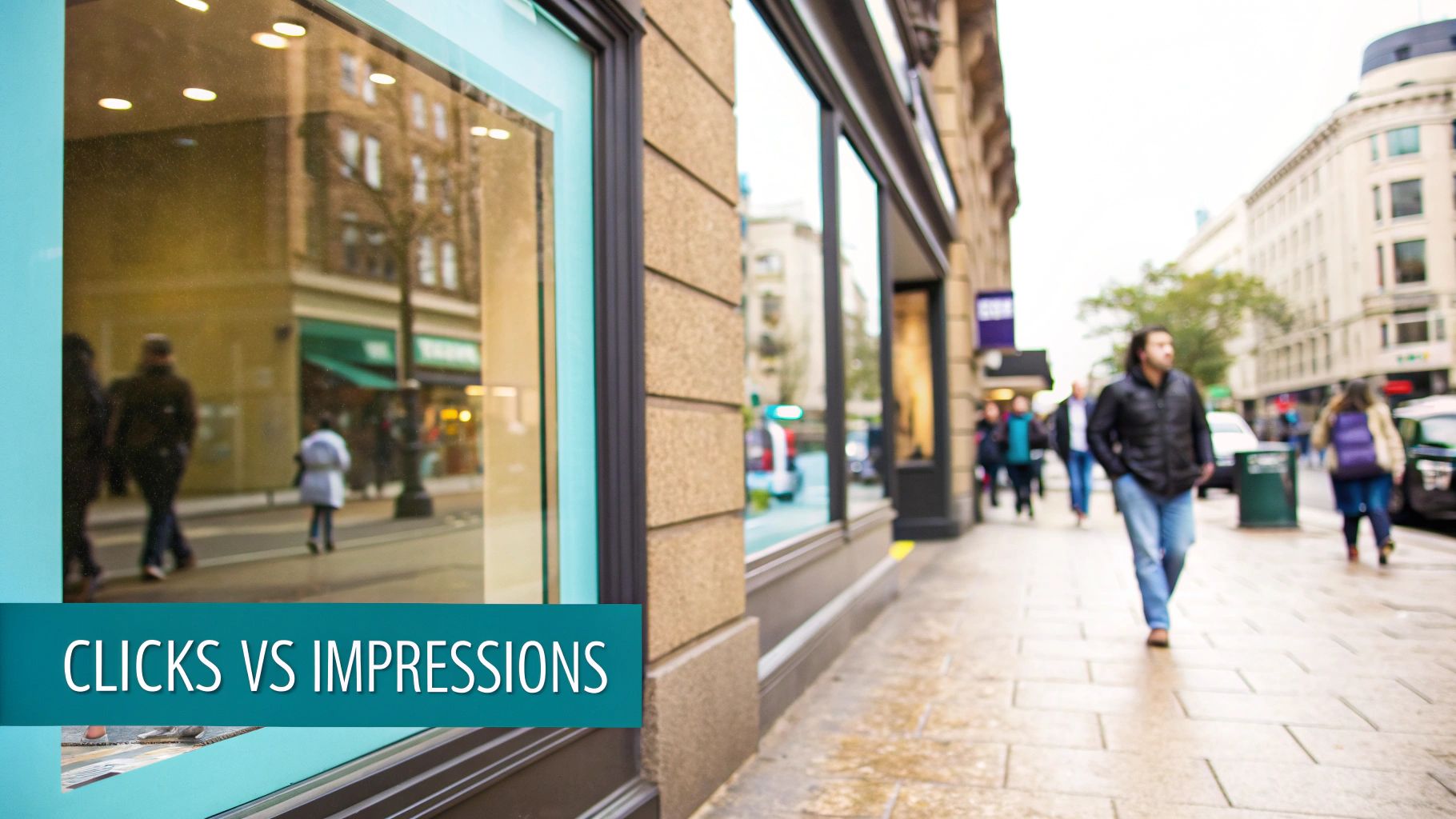
Picture your website or online ad as a shop window on a busy Adelaide street like Rundle Mall. The number of people who walk past and glance at your display? Those are your impressions. The number who are intrigued enough to stop and come inside? Those are your clicks.
Click-Through Rate (CTR) is simply the percentage of people who saw your digital shop window and decided to step through the door. This one number is a crucial health check for your marketing, telling you how well your message is connecting with your audience.
The Simple Formula Behind CTR
At its heart, the calculation is incredibly straightforward, which is what makes it so powerful. It gives you instant insight into performance. The formula for click-through rate is:
(Total Clicks ÷ Total Impressions) x 100 = Click-Through Rate (%)
Let's say your Google Ads campaign was shown to 5,000 people (impressions) and got 150 clicks. Your CTR would be 3%. This percentage is a direct measure of how relevant and appealing your ad was to the people who saw it.
Why Every Business Should Track CTR
A strong CTR isn't just a number to feel good about; it directly affects your campaign's success and how much you spend. Search engines like Google see a high CTR as a big thumbs-up, signalling that your ad or page is genuinely helpful to users.
This has some very real benefits for your business:
- Better Ad Performance: A higher CTR boosts your Quality Score in Google Ads. A better Quality Score can lead to lower ad costs and better ad positions. It's a win-win.
- Improved Organic Rankings: In the world of search engine optimisation (SEO), a high organic CTR tells Google that your page title and meta description are hitting the mark. Over time, this can help you climb the search rankings.
- Greater Return on Investment: By bringing more of the right people to your website, a healthy CTR means your marketing budget is working harder for you, leading to more qualified leads and sales.
Getting your head around this metric is the first step to making your campaigns work better. Using a click-through rate calculator takes the guesswork out of the equation, empowering you to make smart, data-driven decisions that will grow your business.
Putting the CTR Calculator to Work
Alright, let's get practical. We’ve built a simple click-through rate calculator to do the heavy lifting for you. Forget spreadsheets and manual calculations; all you need are two numbers from your analytics dashboard: total clicks and total impressions.
Pop those two figures into the calculator, and it will instantly spit out your CTR. It’s that easy. This means you can spend less time crunching numbers and more time figuring out what they’re telling you about your marketing.
To show you how this plays out in the real world, let's look at three common scenarios for businesses right here in Adelaide.
Example 1: A Local Plumber's Google Ads Campaign
Imagine a plumbing business in Adelaide running a Google Ads campaign. They’re targeting people desperately searching for an "emergency plumber Glenelg". The big question is: is their ad actually convincing people to click?
- Total Clicks: 75
- Total Impressions: 1,500
- Calculation: (75 ÷ 1,500) x 100
Resulting CTR: 5%
A 5% CTR is fantastic for a high-stakes search like this. It’s a clear signal that the ad copy—which probably screams "24/7 service" and "fast response"—is hitting the mark with people in a panic. The ad is cutting through the noise and getting those crucial clicks.
Example 2: An Adelaide Law Firm's Blog Post
Now, let's switch gears to a law firm in the CBD. They’ve written a comprehensive blog post on "Understanding Conveyancing Costs in South Australia" and want to see how it’s performing in organic search results after a few months.
- Total Clicks: 120
- Total Impressions: 6,000
- Calculation: (120 ÷ 6,000) x 100
Resulting CTR: 2%
For organic search, a 2% CTR for an informational article is pretty solid. It tells the firm that their page title and meta description are doing their job. But there’s always room to grow. They could experiment with more compelling headlines to see if they can nudge that figure up and attract even more readers.
Example 3: A Norwood Boutique's Shopping Ad
Finally, picture an e-commerce store in Norwood selling handmade leather bags. They're running a specific Google Shopping ad for one of their most popular items and need to check its performance.
- Total Clicks: 40
- Total Impressions: 2,500
- Calculation: (40 ÷ 2,500) x 100
Resulting CTR: 1.6%
A CTR of 1.6% isn't terrible, but it suggests the ad isn't quite grabbing attention. The product is getting seen, but shoppers aren't clicking. This is a cue for the store to look closer at the ad itself—is the product photo stunning? Is the title clear? Is the price competitive? A few small tweaks could make a big difference.
What Is a Good Click-Through Rate in Australia?
So, you’ve calculated your click-through rate. The next question that almost always follows is, "Is this CTR any good?"
Honestly, there’s no simple yes or no answer. A "good" CTR is completely dependent on context. Your industry, the platform you're on, and even the type of search you’re targeting all play a huge role in what you should be aiming for.
Think of it this way: your CTR is just a number floating in space until you compare it to the right benchmarks. For a local Adelaide business, understanding how you stack up against others in your field is the first real step to knowing if you're on the right track.
This simple diagram shows exactly how those clicks and impressions come together to give you your final CTR percentage.
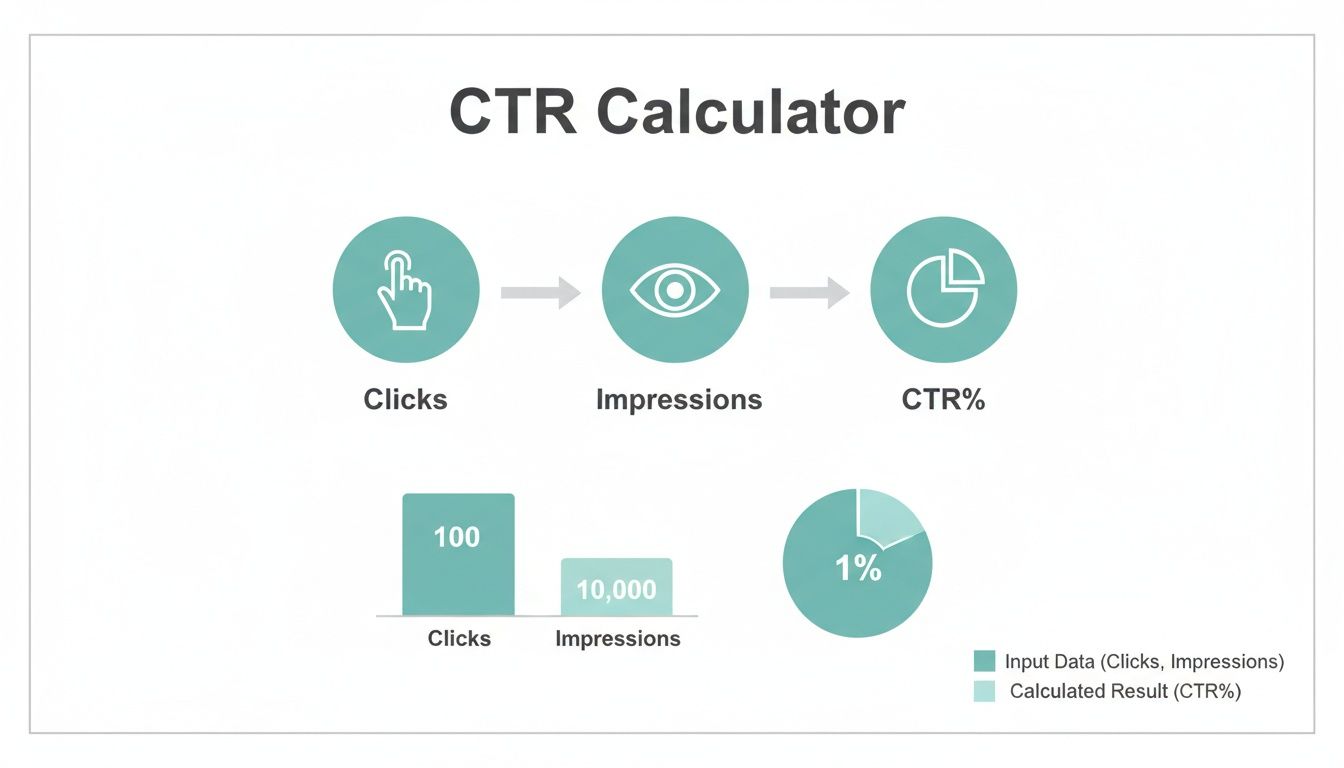
It’s a clear visual reminder that CTR is all about turning eyeballs into genuine engagement.
Google Ads Benchmarks for Aussie Businesses
When it comes to Google Ads in Australia, CTRs can be all over the map depending on the industry. It really brings home the point that a one-size-fits-all approach just doesn't work.
For instance, an Adelaide real estate agent might see great results around the 3.71% mark on the search network, while a local IT support company in the technology sector might be doing well at 2.09%. It’s a completely different ball game.
These benchmarks are your guideposts. They help local businesses gauge performance and set realistic goals.
Average Google Ads CTR Benchmarks By Industry in Australia
The table below breaks down the average click-through rates across both the Google Search and Display Networks for some common industries we see here in Adelaide.
| Industry | Average Search Network CTR | Average Display Network CTR |
|---|---|---|
| Real Estate | 3.71% | 0.71% |
| Health & Beauty | 2.69% | 0.59% |
| Technology | 2.09% | 0.39% |
| Finance & Insurance | 2.91% | 0.52% |
| Home Services | 2.45% | 0.49% |
| Legal | 2.93% | 0.59% |
Notice the huge difference between Search and Display? It all comes down to user intent. Someone actively searching for "emergency plumber Adelaide" is ready to click and solve a problem. In contrast, someone browsing a news site who sees a display ad for "kitchen renovation ideas" is in a much more passive, research-oriented mindset.
Key Takeaway: A good CTR isn’t about hitting some magical number. It's about meeting or, even better, beating the standard for your specific industry and for what you're trying to achieve with that particular campaign.
Organic vs. Paid Search CTR
It’s also crucial to remember that paid ads and organic search results are two different beasts. Their average click-through rates behave very differently.
- Paid Search (Google Ads): You're paying for prime real estate, often right at the top of the search results page. A well-written ad with a compelling offer can pull in a fantastic CTR, especially for keywords that signal someone is ready to buy.
- Organic Search (SEO): Earning a top spot organically is a long-term strategy built on trust and relevance. The number one organic result is the undisputed king, often grabbing over 25% of all clicks. But the click-through rate drops off a cliff for positions further down the page.
While our focus here is on Australia, it's always smart to have a wider perspective. Looking at benchmarks for other platforms, like the average click-through rate for Facebook ads, helps you understand user behaviour across your entire marketing funnel.
Ultimately, evaluating your CTR requires a bit of detective work. Use these benchmarks as your starting point, but always dig deeper to understand the "why" behind your numbers. For a more detailed look, check out our complete guide on what a good click-through rate is. It'll help you pinpoint your best opportunities for improvement.
How AI and Zero-Click Searches Are Changing CTR
The way we all use search engines is being completely reshaped, and your click-through rate is right in the crosshairs. Game-changing features like Google's AI Overviews are designed to give people answers instantly, right at the top of the search results.
This is fuelling the rapid growth of "zero-click searches". It’s exactly what it sounds like: a user finds what they need on the search results page itself and never actually clicks through to a website.
Just think about a common local search. Someone types in "what time does the Adelaide Central Market close?" and Google serves up the answer right away. In that moment, the need to visit the market's website vanishes. While this is great for the user, it presents a serious new hurdle for businesses that have always relied on website traffic to get customers.
The New Reality of Organic Traffic
We're not just talking about a small adjustment here; this is a fundamental shift in how people behave online. The old model—rank high in the organic results, get the click—is no longer a sure thing. As search engines get better and better at answering questions directly, every single click you do manage to earn becomes that much more precious.
Recent Australian studies are already showing us the impact. The arrival of AI Overviews has reportedly cut organic click-through rates by a staggering 35% on any search where they show up. At the same time, zero-click queries have jumped to 58%. For businesses built on providing great information, this trend has already seen organic traffic dip by as much as 61%. You can dig deeper into the numbers with the latest AI Overview statistics and their impact.
This means that simply ranking high is no longer enough. Your strategy must now focus on maximising the value of fewer, but potentially more qualified, clicks.
Why an Integrated Strategy Is Essential
In this new world, putting all your eggs in the organic search basket is becoming a risky bet. The ground is shifting far too quickly. Now more than ever, a robust, integrated digital strategy that combines the strengths of both paid and organic search is absolutely critical.
Here’s a look at why this blended approach is so effective:
- Paid Ads Capture High Intent: Running Google Ads lets you buy your way to the top of the page. You get to bypass the volatility of organic results for the keywords that matter most to your bottom line.
- SEO Targets Complex Queries: While AI is great at answering simple questions, SEO is still king for attracting people with more complex problems that demand in-depth, authoritative content.
- Optimisation Becomes Paramount: With fewer clicks to go around, every element has to work harder. Fine-tuning your ad copy, landing pages, and calls-to-action is no longer optional. Every click is a golden opportunity you can't afford to waste.
Getting your head around this changing search world is the first step. The next is taking clear, decisive action to make sure your business doesn't just survive, but actually thrives. We'll dive into how to do that next.
How To Actually Improve Your Click-Through Rate

Knowing your CTR is one thing, but making it better is where the real magic happens. A high CTR is a clear signal that you’re not just showing up in search results; you’re genuinely connecting with people. This is the point where you turn raw data into real-world action, converting passive impressions into interested clicks.
But here’s the thing: boosting your CTR isn’t about finding a single magic bullet. It’s a deliberate process of refining every touchpoint a potential customer has with you on a search results page. Let's walk through the four key areas you need to focus on to get more of the right people clicking on your links.
Craft Compelling Ad Copy and Headlines
Think of your headline and ad copy as your digital shopfront. You have a split second to convince a searcher that your link holds the best answer to their problem. The secret is to be specific, create a sense of urgency, and lead with the benefit to them.
For example, a generic headline like "Plumber in Adelaide" is easily ignored. But what about "24/7 Emergency Plumber | Fixed-Price Quotes"? This speaks directly to a searcher's immediate pain point and tackles a common worry (unexpected costs), making it infinitely more clickable.
Try these simple tactics to make your copy impossible to scroll past:
- Use Power Words: Words like "guaranteed," "fast," "certified," and "sale" build instant trust and urgency.
- Ask a Question: A headline like "Struggling with Blocked Drains?" immediately resonates with someone facing that exact problem.
- Include Numbers: Digits naturally draw the eye. Seeing "Over 500 Five-Star Reviews" or "30% Off All Services" can make a huge difference to your CTR.
Refine Your Keyword Targeting
Targeting the right keywords is the bedrock of any good campaign. Your goal is to attract searchers with high intent—the people who are ready to buy, book, or call. This usually means homing in on long-tail keywords, which are the longer, more specific phrases people type into Google.
A local electrician in Adelaide will struggle against immense competition for a broad term like "electrician." But targeting a long-tail keyword like "install outdoor lighting Unley" attracts a user with a specific, urgent need. They are far more likely to click because your ad is a perfect match for their query.
Focusing on high-intent, long-tail keywords means you get fewer impressions, but the clicks you do get are far more valuable. This isn’t just about improving CTR; it’s about improving the quality of your website traffic and generating much better leads.
Leverage Ad Extensions and Rich Snippets
Think of ad extensions and rich snippets as free, high-impact upgrades for your search listings. They make your ad or organic result physically larger, pack it with more useful information, and make it stand out from the crowd—all of which encourages more clicks.
- For Google Ads: Sitelink extensions are a must. They let you add extra links to important pages like "Our Services" or "Contact Us." For mobile users, call extensions are brilliant, letting them phone you with a single tap.
- For Organic SEO: Get familiar with schema markup. This is code you add to your website that helps Google understand your content. In return, Google might reward you with rich snippets like star ratings, FAQs, or product prices right there in the search results.
These features simply take up more valuable screen real-estate, pushing your competitors down the page and giving users more reasons to click on your result first. Of course, getting the click is only half the battle. You also need to improve ecommerce conversion rates once they land on your site.
A well-oiled campaign goes far beyond the initial click. For a deeper look, check out our guide on the best practices for optimising Google Ads campaigns.
Turning Higher Clicks Into Loyal Customers
A high click-through rate is a fantastic sign. It tells you your ads and headlines are resonating with your audience and cutting through the noise. But let's be honest, getting the click is only half the battle. If that hard-won traffic lands on a page that doesn't deliver, all that effort—and money—goes down the drain.
The focus has to shift instantly from the click to what comes after the click. Your landing page experience is where the real magic happens. Is your site fast? Is it a breeze to use on a mobile? Does it give visitors an obvious next step? These aren't just technical details; they're the critical bridge between a promising CTR and actual business growth.
From Clicks to Conversions
At the end of the day, every click needs a clear purpose. When someone clicks your ad, they're essentially putting their hand up and saying, "I'm interested." Your website's job is to welcome that interest and guide them confidently forward.
This is especially true on social media, where attention spans are short. Take the latest Australian Facebook Ads benchmarks, for instance. They show a massive 146% year-over-year jump in CTR for e-commerce Shopping campaigns, which now sit at an impressive 4.13%. For a local Adelaide retailer, this proves that when you combine high-intent traffic with a smooth path to purchase, you've got a recipe for success.
Think of your website as your digital salesperson. It needs to be just as compelling and effective as the ad that brought the visitor there. A high-performing site is what ensures the interest you generated with a great CTR actually turns into leads and sales.
Here at Frank Digital, we build websites designed for conversion, making sure your marketing spend delivers a real return. We create a seamless user experience with clear calls-to-action, helping you capitalise on every single click. After all, once someone is on your site, the journey has just begun. Nurturing that new relationship is crucial, and that's often where a smart strategy for email marketing for your small business can make all the difference.
Got Questions About CTR? We’ve Got Answers.
Here are a few of the most common questions we get from clients about click-through rates. Let's clear them up so you can get back to refining your strategy.
Is a High CTR the Ultimate Goal?
Not always, no. Think of a high CTR as a fantastic sign that your ad or search result is doing its job—it's grabbing attention and making people want to learn more. That's a huge win in itself.
But the click is just the first step. If all that traffic arrives on your website and doesn't convert—meaning they don't buy, fill out a form, or pick up the phone—then a high CTR doesn't actually help your bottom line. It's vital to look at CTR in partnership with your conversion rate to see what's really driving business growth.
How Often Should I Be Checking My CTR?
It really depends on where you're looking.
For your paid campaigns on platforms like Google Ads, a weekly check-in is a smart move. Things move fast in the ad world, and this rhythm lets you spot trends and tweak your ad copy or targeting before you waste too much of your budget.
When it comes to your organic search performance (SEO), the pace is much slower. Checking your CTR on a monthly basis is usually plenty. You're looking for gradual shifts and longer-term trends here.
The Bottom Line: Don't just set and forget. Keeping a regular eye on your CTR—whether weekly or monthly—is key. It helps you quickly fix what isn’t working and lean into what is, making sure every dollar and every minute you invest is pulling its weight.
Ready to turn those clicks into actual customers? Here at Frank Digital Agency, we specialise in building high-converting websites and running ad campaigns that deliver real results for Adelaide businesses. Let's have a chat about what your numbers could look like. Get in touch with Frank Digital Agency.