

Think of your website as your hardest-working salesperson. It’s the one that never sleeps, tirelessly pitching your business 24/7 right in the middle of Brisbane's bustling market. A great Brisbane website design is far more than an online brochure; it's a genuine business asset, built to pull in local customers, generate leads, and make sales long after you've clocked off for the day. For local tradies, professional services, and e-commerce stores, it's the single most important tool for getting noticed.
Your Digital Storefront in Brisbane
In a city as spread out as Brisbane, your physical shop or work van can only be in one place at a time. Your website, on the other hand, is your digital storefront on the busiest high street in the world—the internet. For most potential customers, it's the very first impression they'll have of your business. That first look has to count.
A clunky, outdated website is like a shop with a messy window display and a door that sticks. People will glance at it and walk right on by. In contrast, a clean, modern, and intuitive site welcomes visitors in, shows them exactly what they’re looking for, and makes it dead simple for them to take the next step. It’s the foundation for every other piece of marketing you do online.
Standing Out in a Crowded Market
The real challenge for Brisbane businesses today isn’t just getting online; it's getting seen. With over 86% of Australian businesses now having an online presence, a professional website design in Brisbane has gone from a "nice-to-have" to an absolute necessity. It’s what separates you from the crowd. This huge jump in online competition is precisely why a cheap, cookie-cutter site just doesn't cut it anymore for local plumbers, financial advisors, or retailers.
To really capture attention, many Brisbane businesses are now incorporating things like engaging AI-generated videos to make their websites more dynamic and keep visitors hooked.
A great website answers questions, solves problems, and builds trust before a customer ever picks up the phone. It's the silent partner that qualifies leads and primes them for a sale, turning online visitors into loyal customers.
More Than Just a Pretty Picture
Looks are important, but a website that actually grows your business needs to be more than just a pretty face. It has to be engineered from the ground up to drive results, blending smart design with powerful, behind-the-scenes functionality.
That means a sharp focus on three core areas:
- User Experience (UX): Making sure the site is incredibly easy to use, loads lightning-fast, and works perfectly on a mobile phone for customers searching on the go.
- Conversion Rate Optimisation (CRO): Purposefully designing every page to guide visitors towards a single, clear action—whether that’s filling out a form, making a booking, or buying a product.
- Local SEO Integration: Building the site with Google in mind from day one, so local customers in Brisbane can actually find you when they search for the services you offer.
This guide will give you a practical, no-fluff roadmap to getting it right.
What Does a Professional Website Actually Cost in Brisbane?
Trying to get a straight answer on website design costs can be a frustrating exercise. You see ads for super-cheap sites, hear quotes that sound astronomical, and it’s tough to figure out what a realistic budget even looks like for a Brisbane business.
Let’s cut through the noise. The price of a website really comes down to what you need it to do. It’s a bit like building a house – a simple, pre-designed project home is going to have a very different price tag and build time than a custom architectural masterpiece with all the bells and whistles. The same logic applies here.
What’s Behind the Price Tag?
When an agency gives you a quote, they're pricing out a few key things. Understanding what goes into the mix helps you see exactly where your investment is going.
- Custom vs. Template: Is your site being built from the ground up, a complete one-of-a-kind design that perfectly matches your brand? Or is it a customised version of a pre-built template? A fully custom design gives you total creative freedom but naturally requires a bigger budget and more time.
- The Number of Pages: A local tradie might only need a sharp five-page website to showcase their work and get quotes. A larger accounting firm, on the other hand, might need 30+ pages to detail their different services, team members, and resources. More pages mean more work.
- Selling Online (E-commerce): If you want to sell products directly from your site, you're adding a whole new layer of complexity. Things like setting up secure payment gateways, managing product inventory, and streamlining the checkout process all add to the scope and cost.
- Special Features: Do you need a system for clients to book appointments? A secure portal for them to log in? Maybe a sophisticated calculator for instant quotes? Every unique feature like this requires specialised development time, which is reflected in the final price.
Typical Brisbane Website Design Investment Tiers
To give you a clearer picture, here’s a breakdown of what you can generally expect to invest in the Brisbane market.
| Website Type | Typical Cost Range (AUD) | Best For | Estimated Timeline |
|---|---|---|---|
| Starter / "Brochure" Site | $3,000 – $7,000 | Small businesses, tradies, or startups needing a professional online presence to build trust and generate leads. | 4-8 Weeks |
| Custom Business Website | $8,000 – $20,000 | Established SMEs, professional services, and companies wanting a unique design with features like booking systems or integrations. | 8-12 Weeks |
| E-commerce Store | $10,000 – $30,000+ | Retail businesses looking to sell products online with secure payments, inventory management, and a focus on conversions. | 12-16+ Weeks |
| Large-Scale / Custom Web App | $30,000+ | Businesses requiring complex, bespoke functionality like client portals, custom software integrations, or unique platforms. | 16+ Weeks |
This table provides a solid starting point for budgeting. Remember, these are ballpark figures – a detailed quote will always depend on your specific needs.
How Long Does It Take to Build a Website?
Just like the cost, the timeline for building a website isn't one-size-fits-all. A good, structured process is key to avoiding delays and making sure you’re not left wondering what’s going on. Trying to rush it is usually a recipe for a site that looks okay but doesn't actually help your business grow.
Here's a realistic look at the phases of a project:
- Discovery & Strategy (1-2 weeks): This is the foundation. We'll get to know your business inside and out—your goals, your customers, your competition—to map out a winning game plan.
- Design & Wireframing (2-4 weeks): This is where your site starts to take shape visually. We begin with simple layouts (wireframes) to nail the user experience before moving on to applying your brand's colours, fonts, and imagery.
- Development & Coding (3-6 weeks): The approved designs are now turned into a real, working website. This is usually the longest part of the process, especially if we're building custom features or an online store.
- Content & Launch (1-2 weeks): We'll load up all your text and images, run a fine-tooth comb over every page to test for bugs, and get everything ready for the big launch day.
One of the biggest hold-ups in any web project? Waiting on content and feedback. A good agency provides a clear schedule, but your timely input is what really keeps the wheels turning.
All up, you can expect a standard business website to take around 6-10 weeks from our first chat to launch. For more complex projects like a large e-commerce site, it's more realistic to plan for 12-16 weeks or even longer. Want to dive deeper? You can learn more about website design costs in our detailed guide.
Knowing what to expect with costs and timelines puts you in the driver's seat. You can approach your Brisbane website design project confidently, ready to partner with an agency that will deliver a powerful business asset on time and on budget.
The Blueprint for a Website That Actually Converts
You wouldn't hire a builder in Brisbane to start work on a new house without a detailed set of plans, right? The same logic absolutely applies to your website. A well-defined, conversion-focused design process is the difference between a powerful business asset and an expensive online brochure. It's the strategic roadmap that turns your business goals into a machine for generating customers.
This isn't just about picking nice colours and fonts. It's a methodical journey that starts with understanding your customer and ends with launching a site specifically engineered to get them to take action. Every single step is built around answering one question: "How does this feature help turn a visitor into a paying customer?"
For a local Brisbane tradie, this means a mobile-first design where a stressed-out homeowner can find your ‘Click-to-Call’ button in under three seconds. For an online store, it means a dead-simple checkout process that stops people from abandoning their carts. This structured approach is the secret sauce to a website that delivers a real, measurable return.
Stage 1: Discovery and Strategy
This first phase is the most important, and it's all about deep listening and planning. Before a single pixel is pushed, a good agency will dive deep into your business. This isn't just a quick chat; it's a strategic mission to lay the project's foundation.
Here’s what happens:
- Defining Your Goals: We go way beyond "I need a new website." Are you looking to increase online bookings by 20%? Do you need to generate 50 qualified leads a month? Or maybe you want to cut down on admin by building a killer FAQ section? We need clear, measurable targets.
- Profiling Your Audience: We build a crystal-clear picture of your ideal Brisbane customer. What are their biggest problems? What are they actually typing into Google? Getting inside their head is the key to building a site that genuinely resonates.
- Analysing the Competition: We take a good look at what your local competitors are doing online—both the good and the bad. This helps us spot gaps in the market and find opportunities to make your brand stand out with a better user experience.
Getting this planning stage right ensures every decision made from here on out is directly tied to your business goals, saving a lot of costly guesswork later on.
Stage 2: Wireframing and User Experience (UX)
With a solid strategy locked in, the next step is to create the website's skeleton. We call this a wireframe. Think of it as the floor plan for your digital shopfront. It’s a simple, black-and-white layout that focuses entirely on structure, function, and the user’s journey—we deliberately ignore all visual design for now.
This step is critical because it gets everyone focused on how the site works before we start arguing about how it looks. We map out where crucial elements like contact forms, call-to-action buttons, and service info should go to create the most intuitive path for the user. It’s here that we iron out the user experience (UX), making it ridiculously easy for visitors to find what they need and do what you want them to do.
Stage 3: Visual Design and Development
Once the blueprint (the wireframe) gets the green light, it’s time to bring it to life. This is where we apply your brand's personality—your colours, fonts, and images—to the approved structure. The aim is to create a visually appealing site that not only looks professional but also builds immediate trust and reinforces what your brand is all about.
With the visual design finalised, the project moves into development. This is where our developers get on the tools and write the code that turns a static picture into a fully functioning, interactive website. This phase involves:
- Front-end Development: Building the part of the site that people actually see and click on.
- Back-end Development: Constructing the "engine" under the hood, like the content management system (CMS) and other special functions.
- Responsive Coding: Making sure the website looks and works perfectly on desktops, tablets, and smartphones—a non-negotiable for capturing busy Brisbane customers on the go.
This graphic gives you a rough idea of project timelines based on how complex the build is.
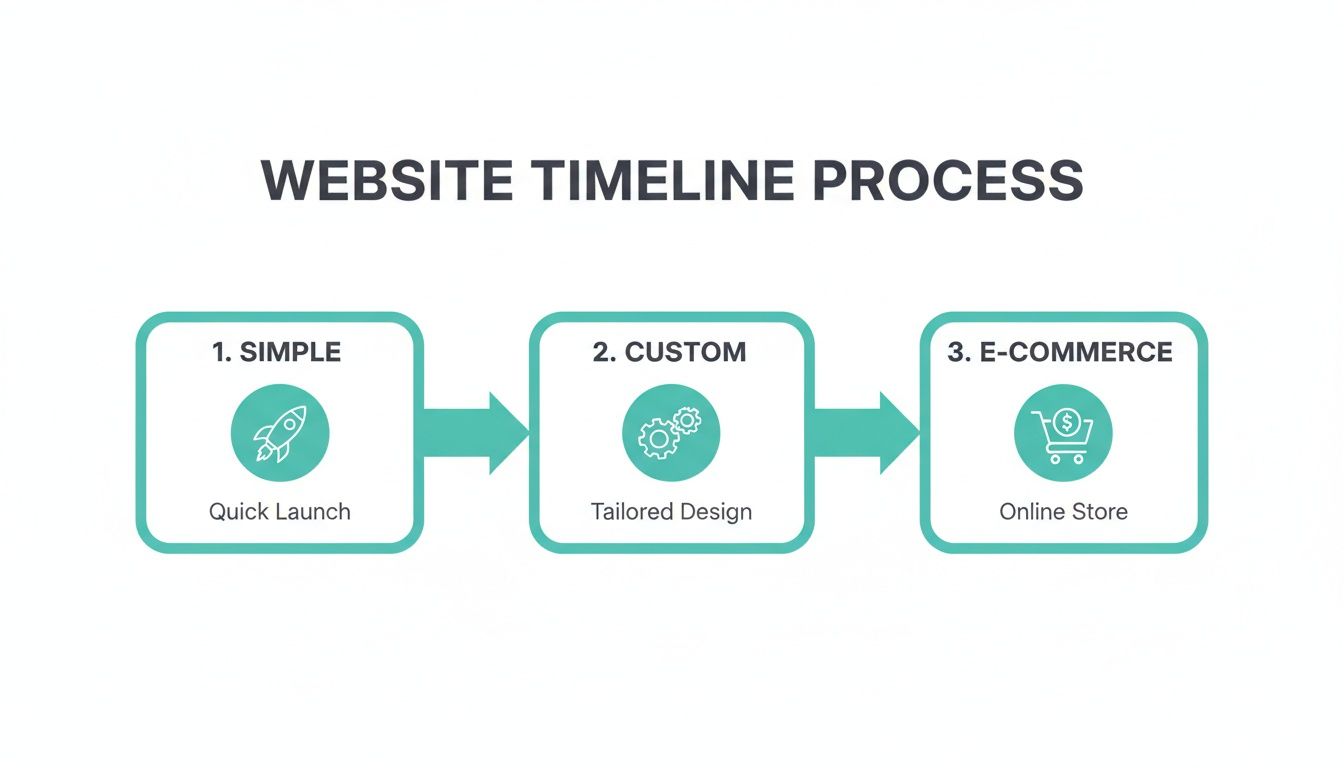
As you can see, the more custom features or e-commerce functions a site needs, the more time the development phase will naturally take.
A successful website is never an accident. It is the direct result of a disciplined, user-focused process where every decision, from the first strategy session to the final line of code, is made with one goal in mind: converting visitors into valuable customers.
Attracting Local Customers with SEO and Google Ads
Having a stunning website is a bit like setting up a beautiful shop on a hidden laneway with no sign. It might be brilliant inside, but if nobody can find it, it doesn't do you much good.
To turn your website into a genuine lead-generating machine, you need a smart way to connect with customers right here in Brisbane. This is where Search Engine Optimisation (SEO) and Google Ads come into play. They work together to put your business directly in front of people who are actively looking for your exact services.
Think of it like this: SEO is your long-game, building a magnetic presence that draws customers in naturally. Google Ads are your targeted, fast-acting campaigns to get noticed immediately. A great Brisbane website design is the foundation that makes both of these marketing channels work, ensuring your investment pays off.
Amplifying Your Reach with Local SEO
Local SEO is all about making sure you show up when a potential customer in your area needs you. When someone in The Gap searches for an "emergency plumber," or a local in New Farm is looking for a "boutique financial planner," local SEO is what helps your website pop up at the top of their results.
It's about proving to Google that you are the most relevant and trustworthy local answer to their problem.
A huge piece of this puzzle is your Google Business Profile. This free listing is essentially your business's digital front door on Google Maps and in local search. A well-managed profile is non-negotiable and should include:
- Consistent Information: Your business name, address, and phone number need to be identical everywhere online. No exceptions.
- Service Areas: Clearly tell Google which Brisbane suburbs you serve.
- Positive Reviews: Actively encourage your happy customers to leave feedback. It’s gold.
- High-Quality Photos: Show off your work, your team, and what it’s like to work with you.
By focusing on local SEO, you're not just hoping for random website traffic. You're strategically placing your business directly in the path of motivated Brisbane customers who are ready to buy. For a deeper dive, this Ultimate Guide to Local SEO for Small Businesses is an excellent resource.
Turning Clicks into Customers with Google Ads
While SEO builds your organic authority over time, Google Ads let you jump the queue. You can appear right at the top of the search results, instantly.
These paid ads give you immediate exposure for specific, high-intent keywords like "commercial electrician Chermside" or "divorce lawyer Brisbane CBD." But getting someone to click your ad is only half the battle.
This is where your website's design becomes your most valuable player. When a user clicks your ad, they get sent to a specific page on your site—a landing page. The quality of that page experience is a massive factor in how much you pay for each click and, more importantly, whether that click ever becomes a real lead.
A high-performing landing page absolutely must:
- Be hyper-relevant: The message on the page must perfectly match the promise you made in the ad.
- Have a clear call-to-action: Tell the visitor exactly what to do next, like "Request a Free Quote."
- Load lightning-fast: A slow page will send potential customers packing, wasting your ad spend.
- Be mobile-friendly: Most local searches happen on a phone, so the experience needs to be flawless.
A well-designed landing page improves what Google calls your "Quality Score." A better score can seriously lower your advertising costs and get your ads shown more often. It’s the key to making sure your marketing budget isn't just buying clicks, but is actually building a predictable and profitable stream of local leads.
To see more on how these two powerful channels complement each other, check out our article on whether SEO and PPC strategies work together.
Choosing the Right Brisbane Website Design Partner
Picking a partner to build your new website is a huge decision. It's one of those choices that will echo through your business for years. You’re not just hiring someone to make things look pretty; you're trusting a team with your brand's online front door, your lead generation engine, and a massive part of your sales process. Get it right, and the results speak for themselves. Get it wrong, and it can be a costly mistake.
This isn't about running through a generic checklist. We want to give you a solid framework for digging deeper during your discovery calls. Let's cover the crucial questions you need to ask any potential agency to truly understand their process, their obsession with results, and whether they're genuinely the right fit to grow your Brisbane business.
Beyond the Portfolio: What to Really Ask
Any decent agency can show you a gallery of their best-looking work. That's the easy part. Your job is to peel back the curtain and see the strategic thinking that actually delivered for the client. After all, a stunning website that doesn’t bring in a single lead is just an expensive digital brochure.
Here are the questions that get to the heart of the matter:
- How do you actually measure a project's success? If they give you fluffy answers like "more traffic" or "better engagement," be wary. A great partner will immediately start talking about conversion rates, cost per acquisition, and how they tie everything back to your bottom line.
- Can you walk me through a case study for a business like mine? Ask them to detail a project for another Brisbane tradie, e-commerce shop, or professional services firm. You want to hear the story: What was the problem? How did they approach it? And most importantly, what were the tangible results in dollars and cents?
- What's your design and development process look like? You're listening for a structured, strategy-first approach. Do they start with research and understanding your customers, or do they jump straight to picking colours?
- Who will be my day-to-day contact? It's vital to know if you'll have a dedicated project manager who knows your project inside and out, or if you'll be bouncing between different people. Clear and consistent communication is non-negotiable.
- Where does SEO fit into all of this? SEO can't be a "bolt-on" at the end. A top-tier agency builds for Google from the ground up, making sure the site structure, page speed, and content strategy are optimised from the very first line of code.
A true partner is transparent about their process and obsessed with your ROI. They should be as excited about your business growth as you are, providing clear data that proves their value long after the launch day.
Comparing Your Brisbane Web Design Options
Finding the right team isn't a one-size-fits-all deal. The Brisbane website design scene has a few different types of providers, and knowing who's who will help you find the perfect match for your goals and budget. We break this down even further in our guide to what makes the ideal web design company.
To get you started, here’s a quick overview of the main players you'll come across.
Comparing Your Brisbane Web Design Options
| Provider Type | Pros | Cons | Best Suited For |
|---|---|---|---|
| Local Brisbane Agency | Face-to-face meetings, deep understanding of the local market, and an integrated team of specialists (design, dev, SEO). | Typically a higher investment than freelancers due to overheads and comprehensive service. | Businesses seeking a strategic, long-term partner for growth who can handle all aspects of the project. |
| National/Remote Agency | May have a larger portfolio and experience with big brands. Can offer competitive pricing due to scale. | Can feel impersonal, with less understanding of specific Brisbane market dynamics. Time zone differences can be a factor. | Companies with larger budgets who don't require in-person collaboration and are comfortable with a fully remote process. |
| Freelancer | Often the most budget-friendly option. You work directly with the person doing the work, which can be very efficient. | A single person has limited bandwidth and a narrower skill set. Risk of them getting sick, busy, or disappearing. | Startups or small businesses with straightforward projects, tight budgets, and a good understanding of project management. |
Ultimately, choosing the right partner is about finding that sweet spot between expertise, process, communication, and cost. Do your homework, don't be afraid to ask tough questions, and find a team that feels like a genuine extension of your own.
Beyond Launch Day: Keeping Your Website Healthy and Growing
Getting your new website live feels like crossing the finish line, but in reality, it's just the start of the race. Think of it like buying a brand-new car. It looks great and runs perfectly off the lot, but its long-term performance hinges entirely on regular servicing. Without fuel and check-ups, even the slickest machine will eventually grind to a halt.
Ongoing maintenance isn’t some optional add-on; it’s the essential servicing that protects your investment and keeps your Brisbane website design fast, secure, and working hard for your business. It's the foundation for everything that comes next.
The Essentials of Website Health
To keep your digital storefront in top shape, a few non-negotiable tasks need to happen behind the scenes. These are the regular check-ups that stop small glitches from snowballing into business-stopping disasters. Any solid maintenance plan will cover these vitals.
Key maintenance tasks include:
- Reliable Hosting: This is the plot of land your website is built on. Good hosting ensures your site loads lightning-fast for visitors in Brisbane and beyond, a massive factor for both user experience and how Google sees you.
- Security Monitoring: The internet is full of bots and hackers constantly probing for weaknesses. Regular security scans are like a 24/7 alarm system for your site, stopping threats before they can do any real damage.
- Software Updates: The platforms and plugins your site runs on (like WordPress or Shopify) are constantly being updated to fix security gaps and boost performance. Staying on top of these updates is one of the simplest yet most effective ways to keep your site safe.
Neglecting maintenance is like ignoring the check engine light on your car's dashboard. You might get away with it for a while, but you’re risking a much bigger, more expensive breakdown down the road.
From Maintenance to Continuous Growth
While technical upkeep keeps the engine running, the real magic happens when you move beyond just protecting your site and start actively improving it. This is where we talk about continuous improvement—turning your website from a static brochure into a smart, dynamic tool that gets better and better over time.
This means digging into real user data to see how people are actually using your site. Are they clicking where you expect? Do they abandon their cart at the same spot? Answering these questions lets you make small, informed changes. You’d be amazed at what can happen; sometimes, something as simple as changing a "Get a Quote" button colour or tweaking a headline can lead to a 10-15% lift in enquiries.
This approach transforms your website from a one-off expense into an evolving asset. It constantly refines its ability to attract and convert customers, ensuring your initial investment delivers a bigger and bigger return for your Brisbane business.
Answering Your Top Brisbane Website Design Questions
Getting into the world of web design can feel a bit like navigating a maze. As a Brisbane business owner, you've got enough on your plate without having to decipher technical jargon. Let's clear up some of the most common questions we get asked.
How Long Does a New Business Website Take to Build?
The timeline really comes down to the size and complexity of the job. Think of it like a construction project: a small renovation is much quicker than building a multi-storey complex from scratch.
For a local trade business—say, a plumber or an electrician—a straightforward, lead-generating website usually takes about 4-6 weeks to get right. If you're a professional services firm, like a law practice or an accounting agency, you're probably looking at a more customised build, which often takes 8-12 weeks.
Building a full-blown e-commerce store with all the bells and whistles, like payment systems and inventory management, is a bigger undertaking. For these, a 12-16+ week timeframe is a realistic expectation. A good agency will always give you a clear project map with key dates, so you're never left guessing.
What’s More Important: A Good-Looking Website or Good SEO?
That's a bit like asking what's more important for a car: the engine or the wheels? You can't have one without the other. They're completely intertwined.
Great SEO is like having fantastic signage all over Brisbane, directing traffic right to your front door. But if your website (your "shop") is messy, confusing, or just plain off-putting, those potential customers will walk straight back out. On the flip side, you could have the most stunning website in the world, but it's useless if nobody can find it in the first place.
The best approach is to weave SEO into the fabric of the website from day one. This way, your site is built on a solid foundation for ranking well on Google, while also giving visitors a fantastic experience that actually converts them into paying customers.
When the Website is Finished, Do I Actually Own It?
Yes, you should. 100%. Once that final invoice is paid, you must have full ownership of everything—your website files, your domain name, and every bit of content on it.
This is a non-negotiable you need to confirm right at the start. Be very wary of any provider that uses their own proprietary platform that locks you in. This can make it incredibly difficult, or even impossible, to move your site to another host down the track if you ever need to.
How Much Should I Budget for Website Maintenance After Launch?
It’s smart to think of your website as a crucial business asset, and like any asset, it needs a bit of upkeep to stay in top shape. For a small Brisbane business, a monthly maintenance plan can run anywhere from $50 to over $300.
This usually covers the essentials: secure hosting, regular backups, security scans to keep hackers out, and software updates. It’s peace of mind, really—ensuring your site is safe, secure, and running smoothly 24/7.
Ready to build a website that delivers real results for your business? The team at Frank Digital Agency specialises in performance-driven website design and Google Ads that turn clicks into customers. Get in touch today for a free consultation!