

In Perth's bustling market, just having a website isn't enough anymore. To really cut through the noise and grab local customers, you need a performance-driven online presence. Think of it less like an online brochure and more like your hardest-working salesperson, on the clock 24/7.
Why Your Perth SMB Needs a Performance Website
For a lot of small and medium businesses I talk to in Perth, their website feels like a box-ticking exercise. It's just there. But a professionally built website is so much more than an online placeholder; it's a powerful asset designed to deliver measurable growth. It becomes the heart of your digital strategy, built to attract, engage, and convert your ideal customers.
This means getting away from generic, off-the-shelf templates and focusing on a site that’s built for performance from the ground up. It needs to load in a snap, look fantastic and work flawlessly for mobile users, and be properly optimised to show up when West Australians are searching for the exact services you offer.
The True Cost of a Cheap Website
Going for a cheap, quick-fix website can seem like a smart move at first, but believe me, it often costs you a lot more down the track. These sites are almost always plagued by a clunky user experience, painfully slow loading times, and practically zero visibility on search engines. The result? Missed opportunities, lost leads, and a brand image that just doesn't build trust with potential customers.
Investing in a quality Perth website design is an investment in a tool that delivers a real, tangible return. It’s the difference between a digital business card and a genuine lead-generating machine.
A great website isn't an expense; it's an investment in your business's future. It should work for you, actively generating leads and sales, not just sit there looking pretty.
This isn’t just about aesthetics. A strategic approach is what turns your initial plan into real, tangible business growth, as this process shows.
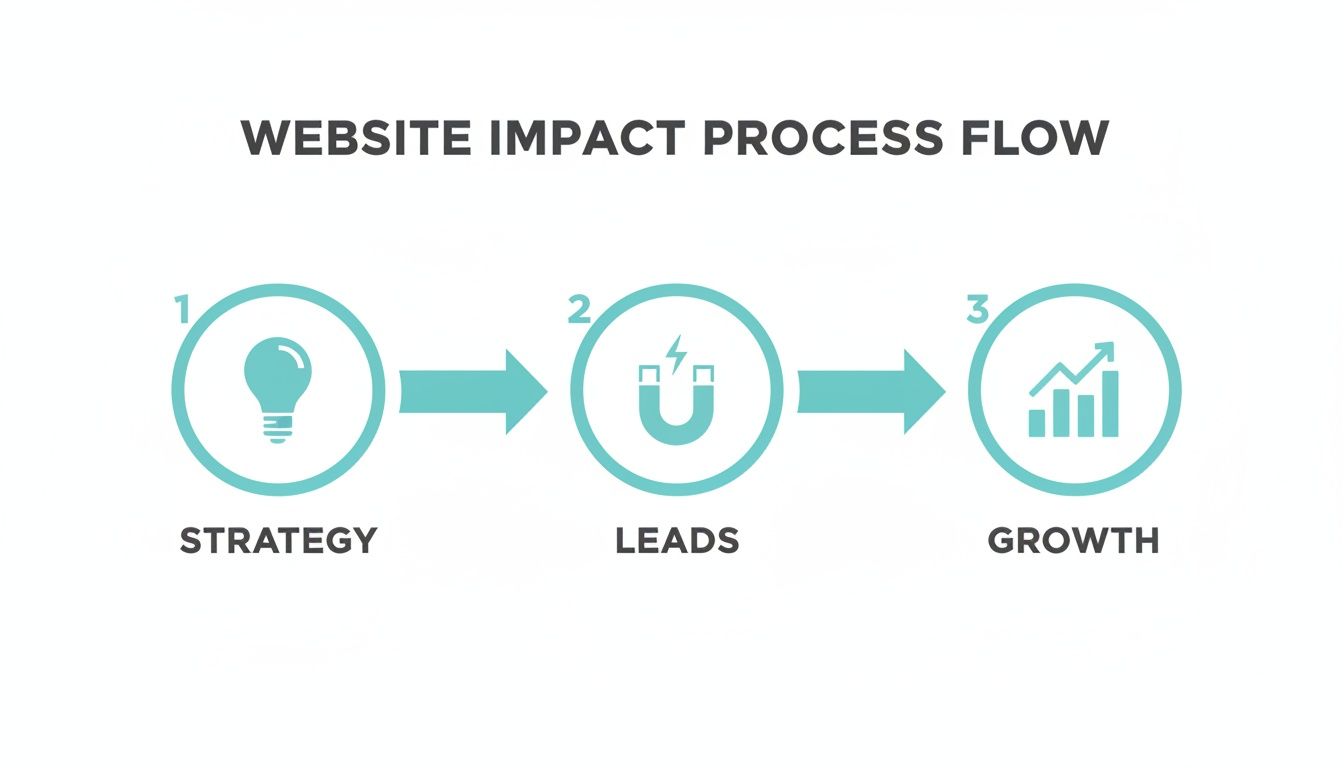
As you can see, everything starts with a clear strategy. That strategy is what fuels lead generation, which ultimately leads to sustainable growth for your business.
Capitalising on the Local Digital Gap
The opportunity right here in Perth is massive. In the metro area alone, there are around 58,000 small and medium businesses. The staggering part? A full 41% of them don't even have a website. With 76% of consumers jumping online to find local businesses, a professional online presence immediately puts you light-years ahead of thousands of competitors.
One of the absolute cornerstones of a performance website is speed. Understanding how to improve website speed is non-negotiable for keeping users happy and getting Google’s attention. In fact, page speed has such a direct impact on your search rankings and conversion rates that we put together a guide explaining why website speed is downright necessary.
At the end of the day, a performance-driven website is built with specific, local goals front and centre:
- Attracting Local Customers: It’s optimised for searches that matter, like "plumber in Joondalup" or "cafe near me."
- Mobile-First Experience: It caters to the 68% of West Australians who do most of their browsing on their phones.
- Building Credibility: A sharp, professional design inspires confidence and makes people trust your brand.
- Driving Conversions: It actively guides visitors to take the next step, whether that’s picking up the phone, filling out a form, or hitting "buy now."
How to Create a Website Brief That Gets Results
A great website doesn't start with code or a fancy design. It starts with a conversation, and the best way to kick that off is with a crystal-clear, detailed project brief. This document is your project’s North Star. It ensures any Perth website design agency you talk to understands exactly what you want to achieve, who you're trying to reach, and what success actually looks like for you.
Think of it like building a house: you wouldn't start without architectural plans. A website brief serves the same critical purpose. It cuts through confusion, keeps the project on budget and on time, and makes sure you end up with a high-performance asset, not just a digital brochure. Honestly, a well-thought-out brief is the single best tool for getting accurate quotes and finding a web partner who is genuinely invested in your growth.

Defining Your Core Business and Audience
Before you can map out what your website needs to do, you have to get laser-focused on who you are and who you serve. This is more than just a mission statement; it’s about getting into the nitty-gritty of your business and your ideal customer.
Start by jotting down what makes your business different. Is it your incredible customer service? Your sustainable, locally-sourced materials? Maybe it's your specialised expertise right here in the Perth market. For example, a Fremantle-based electrician might highlight their 24/7 emergency service for heritage homes—a massive selling point in that specific area.
Next, paint a vivid picture of your perfect customer. Don't just settle for "homeowners in Perth." Dig deeper. Are they young families in new developments out in Baldivis who need smart-home installations? Or are they retirees in Nedlands looking for reliable, ongoing maintenance? This level of clarity is gold dust for a designer trying to build an experience that truly connects with people.
Setting SMART Goals for Your Website
One of the biggest traps businesses fall into is setting vague goals like "get more leads" or "increase sales." These are wishes, not goals. To create a brief that actually gets results, you need to define SMART goals: Specific, Measurable, Achievable, Relevant, and Time-bound.
This simple framework transforms fuzzy ideas into concrete targets that a web design agency can build a real strategy around.
Vague Goal: "I want more online enquiries."
SMART Goal: "Increase qualified quote requests through the website contact form by 25% within six months of launch."
Vague Goal: "I want to sell more products online."
SMART Goal: "Achieve a 15% increase in online sales for our top three product categories in the next financial quarter."
A great website brief doesn't just list features; it connects every element of the project back to a measurable business outcome. It forces you to think about ROI from day one.
This level of detail is a game-changer. It signals to a potential design partner that you're serious about results and helps them propose a solution that’s truly aligned with your business's growth.
Outlining Functionality and Content Needs
Once your goals are locked in, you can start thinking about the practical tools and information your website needs to hit them. This isn't about you playing designer; it's about outlining the necessary components for success.
Walk yourself through the user journey. What path should a visitor take from the moment they land on your homepage to the moment they become a lead or customer?
Your list of must-have functionality might include things like:
- An easy-to-use quote request form that captures all the key project details upfront.
- A stunning project gallery to showcase your best work with high-quality photos and videos.
- An integrated booking system for appointments, consultations, or service calls.
- An e-commerce storefront with a secure and simple checkout process.
Do the same for your content. You’ll obviously need compelling copy for your main pages (Home, About, Services), but think bigger. What other content will build trust and establish you as an authority? This could be detailed case studies, glowing client testimonials, or a helpful blog that answers the questions your customers are always asking.
Providing this structure helps an agency grasp the real scope of the project, which means you'll get a much more accurate and realistic proposal in return.
Key Components of a Powerful Website Design Brief
To pull all of this together, use the following checklist. It will help you define your project's scope, goals, and specific needs before you even start talking to a Perth web design agency.
| Component | Key Questions to Answer | Example for a Perth Electrician |
|---|---|---|
| Company Profile | Who are you? What makes you unique in the Perth market? What are your core values? | Family-owned electrical contractor in Joondalup with 20+ years of experience. We specialise in reliable, on-time service for residential clients in the northern suburbs. |
| Project Goals (SMART) | What is the #1 objective? Increase leads by X%? Boost online sales? Streamline bookings? | Increase qualified quote requests from homeowners in NOR suburbs by 30% within 12 months. |
| Target Audience | Who are your ideal customers? Demographics? What problems are they trying to solve? | Dual-income families (30-50) in suburbs like Currambine and Ocean Reef. They are time-poor and value reliability and clear communication. |
| Competitors | Who are your top 3-5 local competitors? What do they do well online? Where are the gaps? | List 3 local electricians. Note that Competitor A has great reviews but a slow website. Competitor B ranks well on Google but their site looks dated. |
| Functionality | What must the website do? E-commerce? Booking form? Portfolio gallery? Blog? | Must have: Mobile-first design, prominent click-to-call buttons, a detailed service request form, and a gallery to showcase recent work. |
| Design & Branding | Do you have existing brand guidelines? What's the desired look and feel (e.g., modern, trustworthy, premium)? | Use existing logo and brand colours (blue/yellow). The feel should be professional, clean, and trustworthy—not cheap or flashy. |
| Timeline & Budget | When do you need the site to be live? What is your realistic budget range for this project? | Ideal launch date is in 3 months. Budget is in the range of $8,000 – $12,000. |
Spending an hour or two filling this out will not only make your conversations with agencies more productive, but it will also give you incredible clarity on your own business objectives. It's the foundation for a website that truly works for you.
Understanding Perth Website Design Costs and Timelines
So, let's get straight to the big question on every business owner’s mind: "What's this actually going to cost me?" When we're talking about a high-performance Perth website design, the answer isn't a simple number pulled out of a hat. You're not just buying a few pages online; you're commissioning a strategic business asset built to deliver a real, measurable return.
It’s easy to get drawn in by those ultra-cheap, quick-fix offers promising a website for a few hundred dollars. But in my experience, those almost always end up costing you more down the track. You pay for it with lost opportunities, terrible performance, and eventually, the need to scrap it and start over. A professional website is an investment, and knowing where that money goes is the first step to budgeting properly.
What Determines the Price Tag?
At its core, the cost of a website is tied directly to its complexity and the expertise needed to bring it to life. A straightforward, five-page brochure site for a local consultant is naturally going to be less of an investment than a sophisticated e-commerce platform for a retailer managing hundreds of products.
A few key factors will always shape the final quote:
- Scope and Size: How many pages are we talking about? A basic site might just need a homepage, about, services, and contact page. A larger business might need individual pages for every service, detailed case studies, an extensive blog, and more.
- Custom Features: Do you need something beyond the standard? This could be anything from an online booking system for appointments, a secure client login area, or a tricky integration with your inventory management software.
- E-commerce Functionality: Selling online adds a whole other layer of complexity. We're talking product pages, payment gateway integrations, shipping calculators, and inventory management. This all requires specialised development to keep the customer experience smooth and your transactions secure.
- Content and SEO Strategy: A website is just a container; it needs high-quality, optimised content to actually attract and convert visitors. A good project quote will factor in foundational on-page SEO, keyword research, and professional copywriting to make sure your message hits the mark.
Think of it this way: are you buying a pre-built shed from Bunnings or commissioning an architect-designed home? Both give you shelter, but one is crafted specifically for your needs, designed to grow with your family, and built to increase in value over time.
Realistic Cost Brackets in Perth
To give you a clearer picture, let’s break down some typical investment ranges. For a small to medium Perth business that wants genuine results, a professional website typically ranges from $8,000 to over $20,000. This budget covers the essentials that cheap DIY solutions just can't deliver: strategy, conversion-focused design, and quality responsive development.
When you remember that 92% of West Australians are online, skimping here means making your business invisible to nearly all of your potential customers.
Here's a general guide to what you can expect:
| Website Type | Typical Perth Price Range (AUD) | Ideal For |
|---|---|---|
| Small Business / Lead Generation Site | $8,000 – $15,000 | Trades, consultants, and local service businesses focused on generating calls and form submissions. |
| Custom Business Website | $15,000 – $25,000+ | Growing businesses needing more pages, custom features like calculators or portals, and deeper content strategy. |
| E-commerce Store | $15,000 – $50,000+ | Retailers and businesses selling products online, requiring a robust, secure, and user-friendly shopping experience. |
If you're looking for a deeper dive on this, our guide on how much a website should cost is a great place to start.
Typical Project Timelines
Just as the cost varies, so does the time it takes to properly plan, design, and build a quality website. A rush job is a recipe for a poor outcome, so it’s crucial to have realistic expectations from the get-go. A disciplined process ensures no stone is left unturned and the final product is built to perform from day one.
A standard professional web project in Perth usually breaks down like this:
- Discovery & Strategy (1-2 weeks): We kick things off with workshops, research, and planning to nail down your goals, audience, and the overall project scope.
- UX/UI Design (2-4 weeks): Next, we create wireframes to map out the user journey, then move into high-fidelity visual designs that bring your brand to life.
- Development (4-8 weeks): This is usually the longest phase, where our developers get on the tools and write the code to build a fully functional website based on the approved designs.
- Content & SEO (Ongoing): While development is underway, we start loading content and implementing all the foundational SEO elements.
- Testing & Launch (1 week): Before the big day, we rigorously test the site across every imaginable browser and device to iron out any bugs. Then, we push it live.
All up, you should expect a typical project to take anywhere from 8 to 16 weeks from the first call to the final launch. This breathing room allows for proper collaboration, feedback, and quality control, ensuring your new site is ready to deliver results immediately.
Choosing the Right Perth Web Design Partner

This is it. Choosing your Perth website design partner is easily the most critical decision you'll make. You’re not just hiring someone to slap a few pages together; you’re bringing someone into your business's inner circle. Get it right, and you’ll have a strategic partner who’s as invested in your success as you are.
Get it wrong, though, and you’re in for a world of pain. I've seen it happen: a costly, frustrating project that delivers a website that's dead on arrival—a digital paperweight that fails to generate a single lead. The trick is to look past the slick presentations and shiny portfolios to find a team that’s obsessed with tangible results, not just pretty pictures.
Moving Beyond the Portfolio
Every agency will show you their highlight reel. That's a given. But a beautiful website that doesn’t convert is just an expensive piece of art. When you're looking at a potential partner’s work, you need to think like a business owner, not an art critic.
Don't just ask, "Does this look good?" Instead, your first question should be, "Did this actually work?"
Look for case studies that clearly outline the business challenge, the agency's strategy, and most importantly, the measurable outcomes.
- Did their client's website traffic go up? By how much?
- Did they improve the conversion rate for quote requests?
- Did online sales for their e-commerce client actually grow?
- Can they show you cold, hard evidence of a positive return on investment?
If an agency gets defensive or can’t share this kind of data, that's a massive red flag. A true performance-focused agency is proud of the results they get for their clients and will be more than happy to show you the proof.
The most critical question you can ask a potential web design partner is not 'What can you build for me?' but 'What business results can you achieve for me?' This simple shift in focus separates the designers from the genuine growth partners.
The Green Flags and Red Flags Checklist
Navigating those initial chats with agencies can be tricky. They all sound confident, but certain phrases and approaches tell you everything you need to know. Keep this checklist handy during your discovery calls to spot the tell-tale signs of a great partner versus one you should run from.
Green Flags (Signs of a Great Partner)
- They ask about your business goals first. Their opening questions are about your revenue targets, ideal customer, and operational headaches, not just colours and fonts.
- They talk about conversion rate optimisation (CRO). They'll bring up things like A/B testing, user journey mapping, and data-driven design. This shows they're focused on what matters: results.
- They have a clear, documented process. They can walk you through their exact project stages, from discovery and strategy to design, development, and what happens after launch.
- Their proposals are value-based, not just a price list. They connect every part of the project back to the specific business value it will deliver for you.
Red Flags (Signs to Be Wary Of)
- They guarantee a #1 ranking on Google. This is an impossible promise and a classic sign of someone who overpromises and underdelivers. Real SEO is a marathon, not a sprint.
- They hide behind technical jargon. If they're trying to impress you with confusing acronyms instead of explaining things in plain English, they might be masking a lack of genuine strategy.
- They rush to give you a price. A professional agency needs to properly dig into your business and project scope before giving you a realistic quote. An instant price usually means a cookie-cutter solution.
- They don't ask challenging questions. A great partner will push back on your ideas, question your assumptions, and offer strategic advice—not just nod and agree to everything you say.
Choosing your Perth website design partner is a decision that will impact your business for years. Take your time, do the homework, and find a team that feels like a true ally. This investment in due diligence now will pay for itself many times over.
Getting Found By Perth Customers With Local SEO
Here's a hard truth: a beautiful website that nobody in Perth can find is just a very expensive digital brochure. If you want that investment to actually deliver leads and sales, you need customers to find you the moment they start searching. That's precisely where a smart local SEO (Search Engine Optimisation) strategy comes into play.
Think of local SEO as making your business impossible to miss for customers right in your neighbourhood. It’s not about trying to rank nationally; it’s about owning the search results for phrases that matter, like "plumber in Scarborough" or "best cafe in Leederville." You're tapping directly into a stream of motivated buyers who are ready to act.
Nailing Your On-Page Local SEO
It all starts with your website. On-page SEO is about tweaking the content and structure of your site to send crystal-clear signals to Google about who you are, what you do, and—most importantly—where you do it.
One of the most effective tactics I've seen work time and again is creating location-specific pages. Don't just have a generic "Services" page. Build out dedicated pages for each core service you offer in the specific Perth suburbs you target.
For example, a local electrician shouldn’t just list "wiring." They should create pages for:
- "Emergency electrical repairs in Joondalup"
- "Switchboard upgrades in Fremantle"
- "LED lighting installation in Claremont"
Each of these pages becomes a highly relevant landing spot for someone searching for that exact service in that exact area. It’s a powerful way to capture people with clear intent. To get a deeper understanding of how these elements fit together, our guide on website design for SEO is a great place to start.
Owning the Google Map Pack
Think about the last time you searched for a local business. What popped up first? I’d bet it was the "map pack"—that little box showing a map and three business listings right at the top of the page. Getting your business in there is like snagging the best shopfront on Hay Street.
Your ticket to that prime spot is your Google Business Profile (GBP).
Your Google Business Profile is, without a doubt, the single most important local SEO tool for any Perth business. It's your digital front door, building instant trust and driving calls and visits directly from the search results page.
Don't just set it and forget it. Fill out every single section. Upload high-quality photos of your team and your work. Actively encourage customers to leave reviews (and respond to them!). Use the Q&A feature to address common queries. This is non-negotiable for standing out in Perth's competitive market.
Boosting Your Reach With Local Paid Ads
SEO is a long game. It builds a solid foundation for organic traffic over time. But what if you need leads now?
This is where Google Ads, especially local campaigns, work perfectly alongside your SEO efforts. You can run hyper-targeted ads that show up only for users within a few kilometres of your business or in specific postcodes you want to reach.
This dual approach creates a serious growth engine. Your SEO builds long-term authority and a steady stream of free traffic, while Google Ads lets you turn on a tap for qualified leads whenever you need them. It's a smart investment, especially as Australia’s web development market explodes. The sector hit $679.51 million in 2024 and is on track to grow 10.2% annually through 2031, with Perth’s creative scene being a huge part of that.
While local SEO is your primary focus, broadening your knowledge with other free SEO strategies can give you an extra edge.
Perth Web Design FAQs
Investing in a new website is a big decision, and it’s smart to have a lot of questions. Getting straight answers upfront is the key to a smooth project and a great result. Here are some of the most common questions we get from Perth business owners just like you.
Once It's Built, Do I Actually Own the Website?
Yes, absolutely. Once the final invoice is settled, you have 100% ownership of everything. That includes all the design files, the code, the content – the lot. It's all yours.
We build websites to empower your business, not to lock you into a never-ending contract. You should have the freedom to take your site to any hosting company or work with another developer down the track if you choose. Any decent Perth web designer will make sure you get a clean and complete handover of all your files when the project wraps up.
What Are the Ongoing Costs After We Launch?
Getting your new site live is a massive milestone, but it's not the finish line. To keep it running smoothly, securely, and showing up on Google, there are a few standard running costs to factor into your budget.
- Website Hosting: Think of this as the rent for your website's space on the internet. For good quality, reliable Australian hosting, you’ll typically be looking at $30 to $100 per month, depending on how complex your site is and how much traffic you get.
- Domain Name Renewal: This is your website's address (like yourbusiness.com.au). It needs to be renewed each year, but it's a small cost, usually around $20 to $50 annually.
- Maintenance Plan: We can't recommend this enough. A solid maintenance plan covers all the crucial software updates, security monitoring, and regular backups. It’s a proactive way to stop problems before they start, and usually costs somewhere between $100 and $300 a month.
Think of these as an investment in keeping your new business asset healthy and working hard for you long after launch day.
Website maintenance is a lot like servicing your car. You wouldn't drive it for years without an oil change and expect it to run perfectly. Regular upkeep is vital for performance and security.
Can You Work With My Existing Branding?
Of course. In fact, we insist on it! Your website should feel like a natural extension of your business. We'll dive into your existing logo, brand colours, and overall voice to build a site that feels familiar and professional to your customers.
And if you feel your branding is looking a bit tired? We can talk about a refresh as part of the overall project. The end goal is always to make your business look its best.
What Do You Need From Me to Get Started?
The best starting point is a clear idea of what you want to achieve. A simple project brief that outlines your goals, who your customers are, and what you want to say is the perfect launching pad.
To get the ball rolling, we’ll generally need:
- Your Logo & Brand Guidelines: Any high-resolution logos, specific fonts, or colour codes you have.
- Website Content: The words and photos for your main pages are essential. Think Home, About Us, and your core Services pages.
- Access Details: If you have a current website, we might need logins for your hosting or domain registrar to manage the switchover.
Don't stress if you haven't got all of this perfectly organised yet. A huge part of our job is to guide you through this process and help pull all the pieces together.
Ready to build a website that doesn't just look good, but actually delivers results? Frank Digital Agency is a Perth-based team focused on performance-driven web design and Google Ads that turn clicks into customers. Let's talk about what's possible for your business. Start the conversation at https://frankdigital.agency.