

Working with a specialist Google Ads agency in Melbourne isn't just about outsourcing a task; it's about gaining a strategic partner with deep local market knowledge. They go far beyond a basic campaign setup, transforming your ad spend into a predictable and powerful revenue stream.
Why a Specialist Google Ads Agency Is a Game-Changer in Melbourne

Trying to manage Google Ads yourself can feel like navigating the CBD during peak hour—confusing, expensive, and frustratingly slow. Melbourne is one of Australia's most competitive markets, and a generic, one-size-fits-all approach is a recipe for wasted budget. This is exactly why partnering with a specialist agency is a real advantage, not just another business expense.
These experts live and breathe the local market. They understand the sky-high click costs for a plumber in the eastern suburbs or the hyper-specific search terms a café in Fitzroy needs to own to capture the weekend brunch crowd. It's not just about managing bids; it’s about deploying genuine market intelligence that your competitors are likely missing.
Gaining a True Competitive Edge
A professional agency brings a strategic depth that’s nearly impossible to build overnight. Their work isn't a "set and forget" affair. Instead, it’s a constant cycle of testing, learning, and optimising to squeeze the most out of every dollar you spend.
What they really bring to the table is:
- Advanced Strategy: You get access to sophisticated techniques that give you an immediate edge.
- Market Intelligence: They have deep insights into local consumer behaviour and your industry's specific quirks.
- Dedicated Expertise: You're hiring a team whose only job is to master Google's ever-changing platform.
A top-tier Google Ads agency understands the nuances of advanced tactics, like the often-overlooked benefits of running search ads for brand keywords, which can dramatically improve overall campaign performance.
From Ad Spend to Revenue Engine
The numbers don't lie. With nearly 65% of small and medium businesses using Google Ads, simply being on the platform isn't enough. You need to stand out.
High-performing campaigns often need 15-20 hours of expert attention every month. For businesses that switch from self-management to a pro agency, it’s common to see a 40–65% uplift in return on ad spend (ROAS) within the first 90 days.
Ultimately, finding the right Google Ads agency in Melbourne is about turning your advertising from a cost centre into a reliable revenue engine. They bring the experience needed to get not just any clicks, but the right clicks that convert into loyal, profitable customers.
To learn more about how this works in practice, explore our guide on the advantages of a Google Ads search campaign and see how targeted strategies truly drive growth.
What to Do Before You Contact Any Agencies
Walking into a call with a potential agency unprepared is the fastest way to end up with the wrong partner. Before you even draft that first email, you need to get your own house in order. A little bit of homework upfront makes a world of difference, turning those initial chats from vague sales pitches into productive, goal-focused strategy sessions.
This isn't about you becoming a Google Ads pro overnight. It's about getting crystal clear on what you actually want to achieve, what you can realistically spend, and what a "win" truly looks like for your business. Think of it this way: the agency builds the car, but you have to give them the destination. A sharp, well-thought-out brief is what allows a top-tier Google Ads agency in Melbourne to come back with a genuinely tailored proposal, not just a generic quote.
First, Define What Success Looks Like
The biggest mistake I see businesses make is coming to the table with a fuzzy goal like "I just want more leads." That's not a goal; it's a wish. A great agency needs specifics to build a potent strategy. What kind of lead is a good lead? How many do you need each month to move the needle on your revenue?
You need to think in concrete numbers. For a Melbourne-based plumber, success might be 20 qualified phone calls a month from homeowners in their service suburbs. For a national e-commerce store, it’s probably hitting a 5x return on ad spend (ROAS).
Having clear, quantifiable goals is the single most important step. It transforms your agency relationship from a guessing game into a focused partnership aimed at hitting measurable targets that directly impact your bottom line.
Set a Realistic Budget
Let's talk money. This conversation needs to be grounded in reality. Before you speak to anyone, you need to have two figures worked out:
- Your Maximum Ad Spend: This is the absolute ceiling on what you're willing to let Google charge your card for clicks each month. Be firm on this.
- Your Agency Management Fee: This is the separate fee you pay the agency for their time, tech, and expertise. It's usually a percentage of your ad spend or a flat monthly retainer.
Do a bit of digging into the average cost-per-click in your industry here in Melbourne. For instance, if you're in a cut-throat space like conveyancing, clicks can easily top $20. A tiny $1,000 monthly ad spend just won't get you much traction. Being upfront about your budget from the start helps an agency immediately gauge whether they can actually deliver the results you're after.
Gather Your Essential Data
Finally, bring some data to the conversation. Any agency worth its salt will be far more impressed—and able to help—if you come prepared with some key metrics. Don't stress if they're not perfect; even back-of-the-napkin figures are a massive step up from nothing at all.
Pull together what you can from this list:
- Customer Lifetime Value (LTV): On average, how much profit does a single customer bring to your business over their entire time with you?
- Current Customer Acquisition Cost (CAC): Right now, what does it cost you to land a new customer through your existing marketing efforts?
- Website Conversion Rate: Of all the people who visit your website, what percentage actually takes the action you want them to (like filling out a form or buying something)?
With this information ready, you're not just another enquiry in their inbox. You're a serious business owner looking for a strategic growth partner.
How to Properly Vet a Potential Google Ads Agency
Any agency can throw together a slick sales pitch, but genuine, in-the-trenches expertise is something else entirely. Your job is to peer behind the curtain of a polished slide deck and ask the tough questions that reveal a potential partner's real-world capabilities. Vetting a Google Ads agency in Melbourne isn't just ticking boxes; it's about finding a strategic ally who is transparent, accountable, and genuinely invested in your growth.
Those first few conversations are where you'll find the gold. Don't be afraid to go beyond their standard process overview and really dig into how they operate, communicate, and—most importantly—what they do when things go wrong. This is how you separate the seasoned pros from the slick talkers.
Asking the Right Questions
A good agency will not only welcome your detailed questions but will likely be impressed by them. Vague answers, deflection, or hiding behind industry jargon are massive red flags. You need to come to the table prepared with a list of questions that force them to prove their expertise and commitment to transparency.
Here are a few non-negotiables to get you started:
- Who will actually be managing my account day-to-day? It’s crucial to know if you'll be working directly with a senior strategist or if your account will be handed off to a junior team member after you sign on the dotted line.
- Talk me through what you do when a campaign is underperforming. Listen closely to their answer. You're looking for a clear problem-solving process that involves deep data analysis and hypothesis testing, not just a vague promise to "try something different."
- What does your communication and reporting rhythm look like? A great partner provides regular, easy-to-digest reports that tie ad metrics directly to your actual business goals, like leads, sales, and revenue. Vanity metrics don't pay the bills.
- Will I have full ownership and admin access to my Google Ads account? The answer must be an immediate and unequivocal "yes." Your ad account is a valuable business asset, and you should never, ever be locked out of it.
Before you even start these conversations, you need to get your own house in order. This simple process chart highlights the groundwork you need to lay internally.
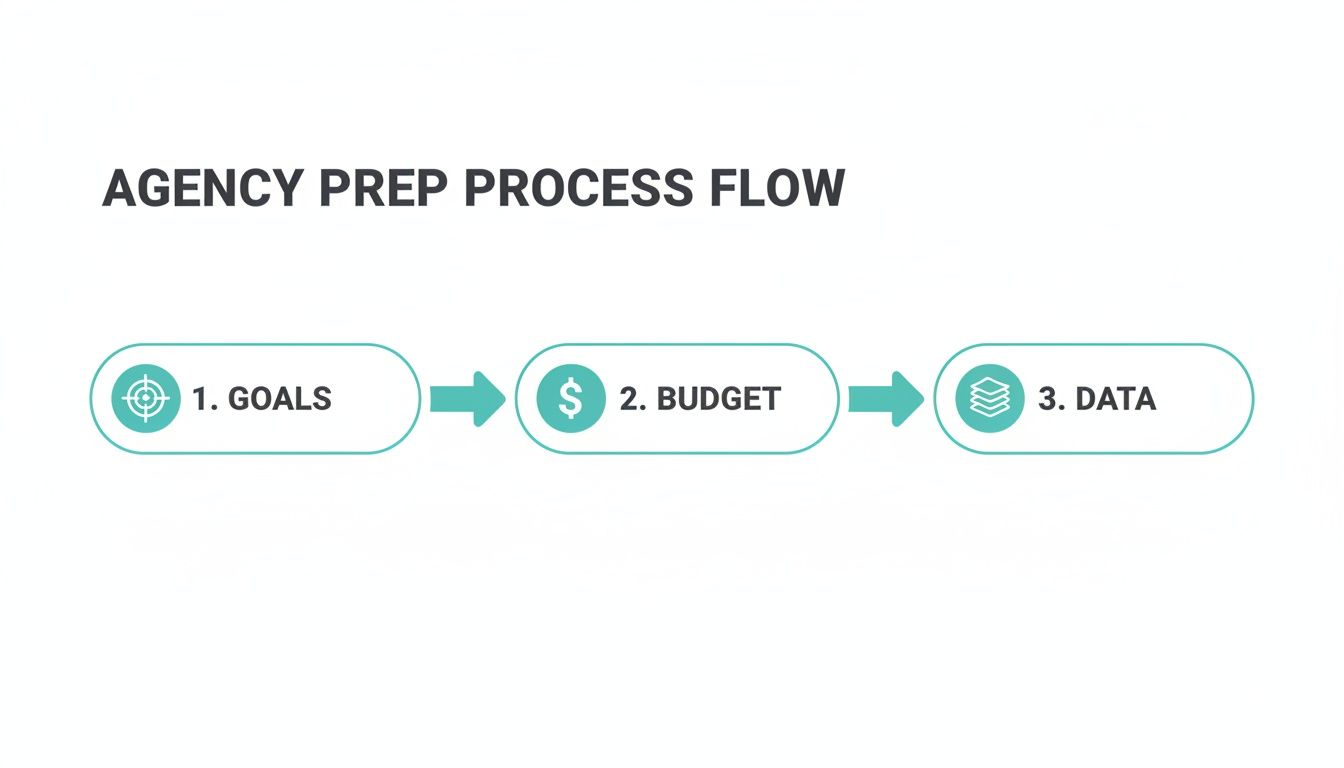
Walking into a meeting with clear goals, a defined budget, and your data ready to go is the best way to ensure you have productive, meaningful discussions from day one.
Looking Beyond the Case Studies
Case studies are a fantastic starting point, but let's be honest—they're highlight reels. They are carefully selected success stories. To get the full picture, you need to read between the lines and ask for the unvarnished context. An agency that is truly proud of their work won't hesitate to pull back the curtain.
When they present a case study, try asking:
- "What was the single biggest challenge you ran into on this campaign, and how did you navigate it?"
- "Can you walk me through the specific optimisations that really moved the needle for this client?"
- "Would you be able to provide a reference from a current client, perhaps in an industry similar to mine?"
A top agency won't just show you the 'what' (the final result); they'll be able to clearly explain the 'how' and the 'why' behind their strategy. This transparency is a key indicator of a trustworthy partner.
Don't just take their word for it, though. Look for meaningful credentials that validate their claims, like an official Google Premier Partner badge. This isn't just a shiny logo for their website; it signifies that the agency has met Google’s rigorous requirements for client growth, ad spend, and team certifications. It's a powerful, third-party signal of competence and reliability in what can be a very crowded marketplace.
To get a deeper understanding of what separates the best from the rest, it’s worth learning more about how top-tier search engine marketing agencies operate and what you should really expect from a high-performing partnership.
Agency Evaluation Scorecard
To keep your thoughts organised and make an objective decision, use a simple scorecard. It’s a great way to compare agencies side-by-side instead of relying on memory alone.
| Evaluation Criteria | Agency A | Agency B | Agency C |
|---|---|---|---|
| Industry Experience (Similar to yours?) | |||
| Team Expertise (Who manages the account?) | |||
| Transparency (Account ownership, reporting) | |||
| Strategy & Communication | |||
| Google Premier Partner Status | |||
| Case Studies & References | |||
| Cultural Fit & Proactiveness |
This tool helps you move past the sales pitch and focus on the factors that truly predict a successful, long-term partnership. It ensures your final choice is based on a balanced view of each agency's strengths and weaknesses.
Understanding Campaign Metrics and Realistic Timelines
When you first dive into a Google Ads report, it's easy to get lost in a sea of data. You’ll see clicks, impressions, and cost-per-click (CPC), but honestly, these are just the tip of the iceberg. A seasoned Google Ads agency in Melbourne knows to look past these surface-level numbers and focus on what truly drives your business forward.
These are the metrics that show whether your ad spend is actually making the phone ring or filling your order book. Instead of getting fixated on vanity metrics, you and your agency need to be obsessed with the real drivers of growth.
The Metrics That Actually Matter
The real story always starts after the click. Did that person who clicked your ad actually do what you wanted them to? Was it profitable for you?
Here are the three core metrics that should be on your radar:
- Conversion Rate: This is simply the percentage of people who clicked your ad and then took a valuable action—like making a call, filling out a form, or buying a product. It's the ultimate test of how well your ads and landing pages are working together.
- Cost Per Acquisition (CPA): Sometimes called Cost Per Lead (CPL), this tells you exactly how much money you’re spending to land one new customer or lead. This number is absolutely crucial for figuring out if your campaigns are actually profitable.
- Return On Ad Spend (ROAS): This is the holy grail, especially for e-commerce businesses. It shows you the total revenue you’ve earned for every single dollar you've put into advertising. A 5x ROAS means you made $5 for every $1 you spent. It doesn't get much clearer than that.
And don't forget about lead quality. It’s one thing to get leads, but it's another to get good ones. Many top agencies now use some of the best call tracking software platforms to get deep insights into not just how many calls you're getting, but how valuable they are.
Setting Realistic Timelines
One of the biggest mistakes I see business owners make is expecting overnight success. Google Ads is incredibly powerful, but it's not a magic button you press for instant profit. That first month is almost always about gathering data and learning, not raking in massive returns.
Here’s a rough idea of what to expect:
- First 30 Days (The Learning Phase): Think of this as the intelligence-gathering stage. Your agency is testing everything—ad copy, keywords, audiences—to see what resonates. The goal isn't immediate profit; it's about collecting enough data to make smart decisions down the track.
- 30-60 Days (The Optimisation Phase): Armed with that initial data, the agency starts to refine. They’ll cut what isn’t working and pour more budget into what is. You should start seeing improvements in your CPA and Conversion Rate during this period.
- 90 Days and Beyond (The Scaling Phase): By now, the campaigns should be a well-oiled machine. The focus shifts from tweaking to scaling. The goal is to crank up the volume on the successful parts of your campaign without hurting profitability.
Patience is everything here. That initial phase is an investment in knowledge. A great agency uses this time to build a rock-solid foundation for long-term growth, steering clear of the temptation to chase quick, unsustainable wins.
To give you some context, Australian benchmarks show that well-managed search campaigns can often hit 5–8% conversion rates. We also know that 35% of people who click an ad will go on to buy something within five days. The average cost-per-lead (CPL) in Australia sits somewhere between $60–$120, though this can vary wildly by industry, so it's vital to measure this against your own profit margins.
Understanding this timeline helps you have much more productive, data-driven conversations with your agency. To get a better handle on the budget side of things, check out our guide on how Google Ads cost-per-click is calculated.
Critical Red Flags to Watch Out For When Hiring

Getting this decision wrong can be a painful and expensive lesson. A bad agency choice doesn't just waste your ad spend; it costs you months of lost opportunities and can set your growth back significantly.
To protect your investment, you need to learn how to spot trouble before you sign on the dotted line. Think of this as your field guide to identifying the warning signs that separate a genuine growth partner from someone who will just burn through your cash.
Knowing what to look for will give you the confidence to walk away from a deal that just doesn't feel right. A great Google Ads agency in Melbourne will be an open book and welcome your questions. A dodgy one? They'll often try to rush you or get defensive.
Vague Strategies and Overblown Guarantees
Let's get this one out of the way first. If an agency guarantees you a '#1 ranking on Google', run. No one can promise this, period. Google's auction is a complex, live environment, and anyone claiming they have a secret formula to guarantee top spots is either clueless or lying.
Be just as wary of agencies that can't explain their strategy in plain English. If their plan sounds like a string of buzzwords—"we'll optimise your campaigns for maximum ROI"—without any substance, press them for details. How? What's the process? What data will they use?
A proper agency will be able to walk you through a clear, data-driven approach designed specifically for your business and your corner of the Melbourne market.
A genuine expert talks process, methodology, and metrics that matter, like Cost Per Acquisition (CPA) and Return On Ad Spend (ROAS). A salesperson just promises you the moon without showing you the rocket ship.
Ownership and Transparency Issues
This one is a deal-breaker. Your Google Ads account is a business asset, plain and simple. It contains a goldmine of historical data on what works and what doesn't. You absolutely must have full administrative access and ownership of this account from day one.
Here are the biggest warning signs in this area:
- They won't give you admin access. Some agencies build your campaigns inside their master account. This is a massive red flag. It means if you leave, they keep all your data, and you're forced to start over from zero.
- Their reporting is fuzzy. You get pretty PDF reports full of vanity metrics like impressions and clicks, but they're cagey about giving you direct dashboard access to see the raw data for yourself. What are they hiding?
- They push for long, inflexible contracts. A 3-6 month initial term is fair enough; it takes time to get results. But be very careful with rigid 12-month lock-in contracts that have no clear performance clauses or get-out options.
Imagine this scenario: you spend a year with an agency, they build some great campaigns, but it's all under their account. You decide to part ways, and suddenly all that history, all that learning, is gone. You've essentially been renting your own success. It’s a common and costly trap.
Insist that the account is set up under your business's name and that you are listed as the owner. No excuses.
Final Questions Before You Hire a Melbourne Agency
You've done the research, you've shortlisted a few agencies, but a couple of nagging questions might still be holding you back. That's completely normal. Choosing a Google Ads agency in Melbourne is a big step, and you want to be sure you're making the right call before signing on the dotted line.
Let's clear up some of the most common final-hurdle questions we see from businesses. These are the practical, nitty-gritty details that can make or break a partnership.
Who Actually Owns the Google Ads Account?
This is a deal-breaker, plain and simple. You, the business owner, must always retain full ownership and admin access to your Google Ads account. Think of it as a core business asset—it holds all your historical campaign data, audience insights, and performance history.
A reputable agency will either ask for access to your existing account or set up a new one under your name. If an agency insists on running your campaigns through their own master account, that's a massive red flag. It means if you ever decide to leave, they take all your valuable data with them, and you're left starting from square one.
How Do Agencies Structure Their Fees?
You'll typically run into one of three pricing models, and it's crucial to know what you're getting into. There isn't a single "best" way—it really depends on your budget, business goals, and how involved you want the agency to be.
- Percentage of Ad Spend: This is very common. The agency takes a cut of your monthly ad spend, usually somewhere between 10-20%. It’s a model that scales up or down with your marketing budget.
- Flat Monthly Retainer: Simple and predictable. You pay a set fee every month for their management services. This makes budgeting a breeze.
- Performance-Based Fee: Here, the agency's pay is tied directly to the results they generate, like cost-per-lead or a percentage of revenue. This model really puts their skin in the game.
One crucial tip: Make sure the agency's management fee is billed separately from what you spend on ads. Your ad spend should always be paid directly to Google from your own business credit card. This keeps everything transparent and gives you complete control.
How Long Should the Contract Be?
A good contract gives the agency enough time to show you what they can do while giving you the flexibility to move on if things aren't working. The first 90 days are really about learning, testing, and laying the groundwork, so expect an initial commitment period.
A 3-month initial agreement that then rolls over to a month-to-month basis is a fair and standard approach. Be very cautious of agencies pushing for rigid 12-month lock-in contracts from the get-go. A great agency is confident they'll keep your business by delivering results, not by trapping you in a contract.
Ready to partner with a performance-driven agency that turns clicks into customers? The team at Frank Digital Agency combines conversion-led design with data-driven Google Ads management to deliver real, measurable results for Melbourne businesses. Get in touch with us today at https://frankdigital.agency.