

Ever wondered what a digital marketing consultant really does?
Think of them as a specialist doctor, but for the health of your business online. You wouldn't see a general practitioner for a complex heart issue, right? In the same way, a consultant doesn't just offer generic advice. They dive deep to diagnose the specific problems holding you back—maybe it's a trickle of website traffic, a flood of low-quality leads, or ad campaigns that burn cash with no return.
From there, they don't just give you a pamphlet of suggestions; they prescribe a clear, actionable plan to turn your online presence from a confusing cost centre into a predictable revenue-generating machine.
Why Digital Marketing Consulting Matters Now

Trying to get noticed online today can feel like shouting into the wind at a sold-out footy match. Everyone's making noise, but very few are actually getting their message heard by the right people. This is precisely where professional digital marketing consulting steps in, acting as both a sharp-minded strategist and a hands-on engineer for your business growth.
The whole point isn't just to chase vanity metrics like more website clicks or a bigger social media following. It's about engineering real-world business results. A good consultant is relentlessly focused on turning your digital spending into measurable revenue and making the process of acquiring new customers far more efficient.
From Theory to Tangible Outcomes
Great consulting cuts through the jargon and buzzwords. It's firmly rooted in data-driven action, particularly within high-impact channels like Search Engine Optimisation (SEO) and Google Ads. This practical approach means every dollar is accountable and aimed squarely at activities that boost your bottom line.
For small and medium businesses across Australia, this kind of strategic guidance is no longer just a "nice-to-have"—it's a critical part of a solid growth plan. The numbers tell the story. The Australian Bureau of Statistics reported that by 2023, 55% of Australian businesses were buying paid online advertising, a massive jump from 44% in 2019. With competition this fierce, getting expert help to fine-tune your strategy is more important than ever.
Just look at the local impact: Google's 2023 Economic Impact Report calculated that its Search and Ads platforms generated about $4.4 billion in economic activity in South Australia alone. It’s a powerful reminder of how critical online visibility is. You can discover more insights about Australia's digital advertising growth and its local impact.
A consultant’s core job is to build a predictable system for acquiring customers. They connect your business goals to a clear digital strategy, ensuring your marketing efforts are an investment, not an expense.
Building Your Growth Engine
At the end of the day, a digital marketing consultant helps you build, tune, and accelerate your business's growth engine. This process breaks down into a few key stages:
- Diagnosing weaknesses: They pinpoint why your current marketing isn't working. Is it poor audience targeting? A website that confuses visitors? Or are you simply invisible on Google?
- Creating a roadmap: They map out a clear, step-by-step plan that puts the most impactful actions first, all aligned with your specific business goals.
- Implementing and optimising: They get to work executing the plan, but they don't stop there. They constantly analyse the performance data, making smart adjustments to improve results and maximise your return on investment.
Exploring the Core Services of a Digital Consultant
Think of a digital marketing consultant's services less like a rigid menu and more like a specialist's toolkit. Each tool is designed to solve a specific problem, and the real expertise lies in knowing which one to use, and when, to build a reliable growth engine for your business.
A consultant's first job is always to diagnose the real challenge holding you back. Are you practically invisible to people actively searching for your services? That's a visibility problem. Or maybe you get plenty of website visitors, but they leave without ever making a purchase or picking up the phone? That's a conversion problem. Each one needs a completely different approach.
Search Engine Optimisation (SEO) for Long-Term Visibility
Let's be blunt: if your business isn’t on the first page of Google, it might as well not exist for most potential customers. Search Engine Optimisation (SEO) is the long-game strategy of making your website more appealing to search engines so you rank higher for the phrases and questions your ideal customers are typing in.
This isn’t a quick fix or an overnight trick. It’s a serious, long-term investment in building a powerful digital asset. The ultimate goal is to generate a steady stream of organic traffic—visitors you don’t have to pay for with every click—by establishing your website as a trusted authority in your field.
Google Ads for Immediate and Targeted Traffic
While SEO is the marathon, sometimes you need to win a sprint. This is where Google Ads shines. It’s a paid advertising service that puts your business right at the top of the search results, directly in front of customers at the very moment they’re looking for what you sell.
It’s an incredibly effective way to drive immediate, highly targeted traffic to your website or a specific landing page. The catch? It requires meticulous management. Without an expert at the controls, it's remarkably easy to burn through your budget with little to show for it. You can get a deeper insight into how specialists handle these campaigns by exploring the different types of search engine marketing agencies.
A winning digital strategy often pairs the slow-burning, long-term asset of SEO with the immediate, targeted impact of Google Ads. One builds foundational strength while the other captures demand right now.
Conversion Rate Optimisation (CRO) to Fix the Leaks
Getting traffic to your site is only half the job. If those hard-won visitors arrive and then leave without taking action, you've got a classic "leaky bucket" problem. Conversion Rate Optimisation (CRO) is the process of finding and plugging those leaks.
By analysing how people actually behave on your site and methodically testing changes—from headlines and button colours to entire page layouts—a consultant can dramatically increase the percentage of visitors who turn into leads or customers. This makes every single dollar you spend on marketing work that much harder for you.
To help you see how these services fit together, here’s a quick overview.
Digital Marketing Consulting Services at a Glance
| Service | Primary Goal | Key Performance Indicators (KPIs) |
|---|---|---|
| Search Engine Optimisation (SEO) | Increase organic visibility and attract "free" traffic over the long term. | Keyword rankings, organic traffic volume, backlink profile growth. |
| Google Ads (PPC) | Drive immediate, targeted traffic and generate leads or sales quickly. | Click-Through Rate (CTR), Cost Per Acquisition (CPA), Return on Ad Spend (ROAS). |
| Conversion Rate Optimisation (CRO) | Maximise the value of existing traffic by increasing conversions. | Conversion rate, bounce rate, average session duration, goal completions. |
| Email & Content Marketing | Build relationships, nurture leads, and drive repeat business. | Open rates, click-through rates, list growth, content downloads. |
| Analytics & Reporting | Measure performance, provide insights, and guide strategic decisions. | Website traffic, user behaviour flows, attribution modelling, custom reports. |
This table shows that while each service has a unique role, they all rely on solid data to prove their worth and guide the next steps.
Email and Content Marketing for Nurturing Relationships
Most people aren't ready to buy the first time they visit your website. That’s where email and content marketing come in, allowing you to build trust and stay top-of-mind. By consistently providing real value through helpful articles, guides, or a newsletter, you become a go-to resource.
Consultants can also map out your broader content plan, which might include a detailed TikTok vs YouTube Shorts strategy if short-form video is right for your audience.
Analytics and Reporting: The Dashboard for Your Growth
Finally, none of this works in a vacuum. Robust analytics is the dashboard that shows you precisely what’s working, what isn’t, and where the opportunities are. A good consultant lives inside tools like Google Analytics 4, tracking key metrics to ensure every part of your strategy is accountable and optimised for the best possible return on your investment.
The Consulting Journey: From First Call to Final Results
Working with a digital marketing consultant shouldn't feel like you're handing over the keys and hoping for the best. It’s not a mysterious black box. Think of it as a genuine partnership—a structured journey with clear stages where we turn your business goals into a concrete, data-driven plan for growth.
The whole process follows a logical path. We start broad to understand the big picture, then drill down into detailed execution and ongoing improvement, ensuring every action has a clear purpose.
Stage 1: Discovery and Audit
First things first, we need to get under the bonnet of your business. Before a single recommendation is made, a good consultant needs to understand your operation inside and out. This is more than a quick chat; it's a deep dive into your goals, your ideal customers, who you’re up against, and what you’ve tried before.
We’ll analyse your entire digital footprint—your website's performance, current SEO health, past ad campaigns, and social media presence. This audit uncovers what’s already working well and, just as importantly, flags the weaknesses that need urgent attention. This becomes the foundation for everything that follows.
Stage 2: Strategy and Roadmap
Once we have a clear picture of your starting point and where you want to go, the next step is to draw the map. Here, the consultant translates all those initial findings into a customised digital marketing strategy and a practical roadmap.
This isn’t just a vague wish list. It’s a prioritised, step-by-step plan that clearly outlines:
- Specific Objectives: What exactly are we trying to achieve? (e.g., generate 20 qualified leads per month).
- Key Channels: Where will we focus our efforts? (e.g., Google Ads, Local SEO).
- Core Tactics: How will we do it? (e.g., build targeted landing pages, claim local directory listings).
- Timelines and KPIs: When will things get done, and how will we know if we’re winning?
This document becomes our shared guide, making sure we're all on the same page and heading in the same direction.
The core services of SEO, Ads, and Conversion Rate Optimisation (CRO) are usually the engine room of this strategic process.
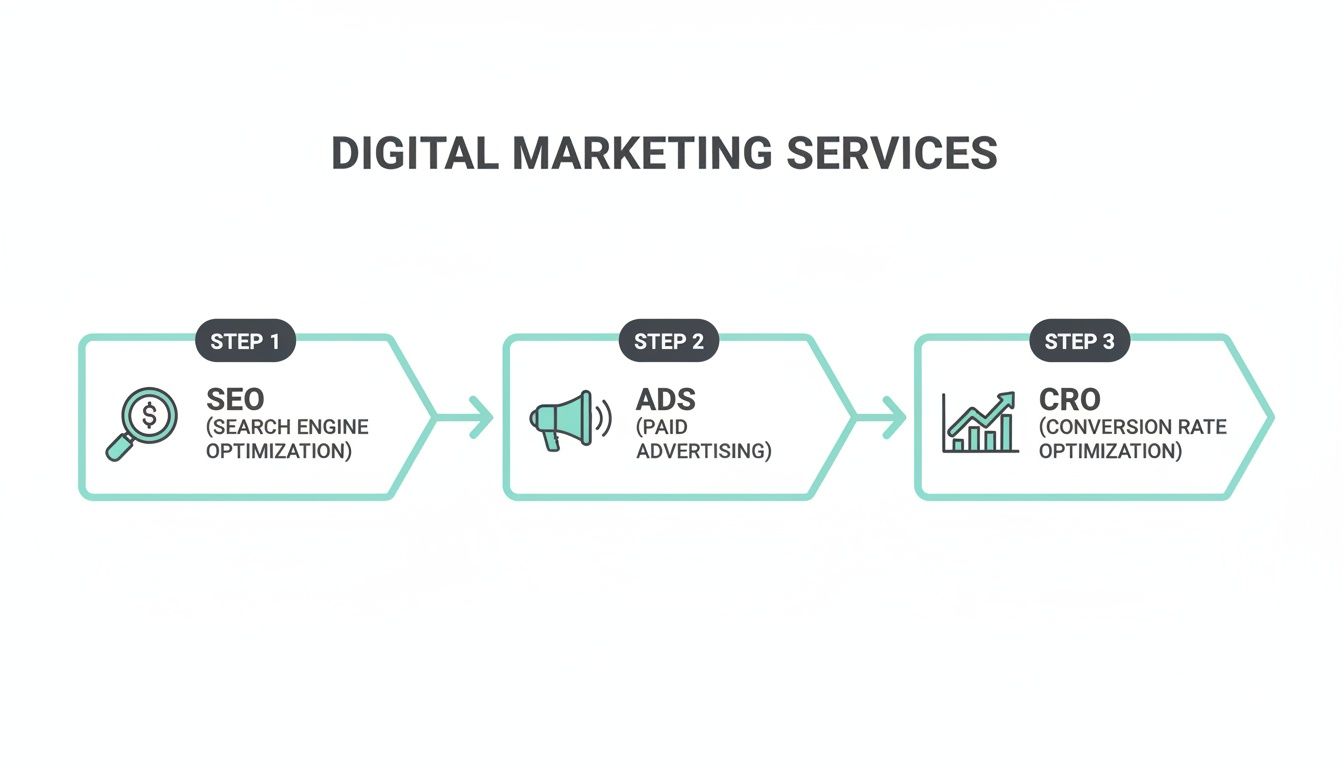
This shows how we use different services to first attract visitors to your site (SEO and Ads) and then turn those visitors into actual customers (CRO).
Stage 3: Implementation and Execution
This is where the plan springs to life. With the roadmap as our guide, the hands-on work begins. This could mean completely rebuilding your Google Ads campaigns from scratch, sorting out your website’s technical SEO issues, or A/B testing new landing page designs to see what resonates with your audience.
Throughout this phase, communication is everything. You should expect regular, clear updates on progress, key milestones we've hit, and any challenges we’ve run into along the way. No surprises.
Stage 4: Reporting and Optimisation
Digital marketing is never "set and forget." The final stage is really a continuous loop of measuring, reporting, and refining. Using analytics tools, your consultant tracks how every campaign is performing against the goals we set in the roadmap.
The goal of reporting isn't just to show you numbers on a page. It's to tell a story about what’s working, what isn't, and what adjustments we're making to drive even better results next month.
This data-first approach allows for constant fine-tuning. A campaign that’s performing well can be scaled up to capture more opportunity, while an underperformer can be tweaked or paused. It’s this iterative process that ensures your marketing budget is always working its hardest for you, maximising your return over time.
How to Measure Your Return on Investment
Putting money into digital marketing consulting without a way to measure its value is like flying a plane blind. Sure, you feel like you're moving, but are you actually heading in the right direction? To really know if your investment is paying off, you have to look past the superficial "vanity metrics" like website visitors or a few extra likes on a social media post.
The real story, the one that matters to your business, is always in the numbers that hit your bottom line. A good consultant is obsessed with the metrics that prove their work is actually making you money.
Key Metrics That Actually Matter
To get a true picture of the value your consultant is bringing, you’ll want to get familiar with a few core performance indicators. These are the numbers that draw a straight line from a marketing action to your bank account.
- Cost Per Acquisition (CPA): This is your all-in cost to land one new customer. Let’s say you spend $500 on a Google Ads campaign and it brings in five new clients. Your CPA is a neat $100. Simple as that.
- Return On Ad Spend (ROAS): This shows you exactly how much revenue you’re getting back for every dollar you put into advertising. A 4:1 ROAS means you made $4 for every $1 you spent.
- Lead-to-Customer Conversion Rate: This one tells you what percentage of your leads actually become paying customers. It's a fantastic indicator of how good your leads are and how well your sales process is working.
Getting a handle on these figures is everything. For example, an Adelaide plumber knows a new installation job is worth around $1,500. If their CPA to get that job is just $100, the investment is a no-brainer.
The single most important question a consultant should help you answer is this: "For every dollar we invest here, how many dollars are we getting back?" If they can't give you a clear answer, that's a huge red flag.
Common Pricing Models for Digital Marketing Consulting
How you pay for consulting services will also shape how you calculate your ROI. Consultants generally use one of three pricing structures, and each has its place.
- Monthly Retainer: You pay a fixed fee each month for ongoing work, like SEO or managing your ad campaigns. This is ideal for long-term strategies that need consistent attention to build momentum.
- Project-Based Fee: This is a one-off price for a specific task with a clear start and finish. Think a complete website redesign or a deep-dive SEO audit.
- Performance-Based: In this model, the consultant’s pay is directly linked to the results they deliver. This could be a percentage of your ad spend or a bonus for hitting certain lead targets.
The right model for you really depends on your goals and the job at hand. Knowing how to track the financial impact of your marketing is non-negotiable for success, and that includes measuring social media ROI effectively. It's also worth knowing that paid and organic strategies can be a powerful mix; we have a great guide on how SEO and PPC work together to boost results.
How Digital Consulting Works in the Real World
It's one thing to talk about strategies and another to see them make a real difference. Theory is great, but the proof is in the results. To show you what expert digital marketing consulting actually looks like, let's unpack a few real-world scenarios for different Australian businesses.
We'll move past the jargon and look at how a focused, well-executed strategy turns business problems into measurable growth.
These aren't just hypotheticals; they're the kind of transformations we see every day.
For the E-commerce Brand Drowning in Abandoned Carts
Imagine an online store selling beautiful boutique homewares. They had plenty of people visiting the site, but their sales figures just weren't matching up. The big problem? A sky-high cart abandonment rate. Shoppers were loading up their carts and then vanishing right before hitting "buy."
A consultant quickly spotted two culprits: a clunky, frustrating checkout process and Google Shopping ads that were attracting window shoppers, not serious buyers.
The game plan was twofold:
- Fix the Leaky Bucket (CRO): The multi-page checkout was streamlined into one simple, smooth process. We also made trust signals—like customer reviews and secure payment logos—front and centre to give shoppers more confidence.
- Sharpen the Ads: The Google Shopping campaigns were completely rebuilt. Instead of casting a wide, generic net, they were refocused on high-intent keywords and featured the store’s best-sellers with stunning images and crystal-clear pricing.
The Result: It was a game-changer. Within just three months, the cart abandonment rate plummeted by 35%. Even better, the Return On Ad Spend (ROAS) from Google Shopping shot up from a respectable 2:1 to an incredible 6:1. The store wasn't just getting more traffic; it was getting the right traffic and turning it into cash.
For the Local Tradie Invisible to Their Neighbours
We worked with a local electrician in Adelaide who was throwing money away on old-school directory listings that delivered next to nothing. Their website was gathering dust, and they were completely invisible on Google for crucial local searches like "electrician near me." Homeowners with an urgent problem simply couldn't find them.
The consultant’s strategy was all about dominating the local search results. It started with a ground-up rebuild of their local SEO and pairing it with a powerful 'click-to-call' Google Ads campaign. This is a crucial approach for any trades business that needs to be the first call a customer makes. For a deeper dive, you can check out our guide on marketing for tradies.
Here's what we did:
- Dominate Local SEO: We fully optimised their Google Business Profile, packing it with service details, high-quality photos, and a steady stream of five-star customer reviews.
- Instant-Call Ads: We ran highly targeted ads that only showed up for people within a 15km radius and included a button to call the business directly from the search results. No website visit needed.
The Result: The electrician went from getting maybe two or three weak online leads a week to an average of 15 qualified phone calls every single week. Their schedule was booked solid, giving them the freedom to choose the best jobs.
For the Professional Services Firm Losing Potential Clients
A conveyancing firm had a polished website that looked the part, but it wasn't doing its job. Visitors would land on a services page, have a quick look around, and then leave. Their bounce rate was high, and their pipeline of new clients was worryingly empty.
A digital consultant saw the problem right away: the website lacked clear direction and wasn't doing enough to build trust. The solution was to create high-value content on dedicated landing pages, supported by a simple email nurturing sequence. Instead of a generic "what we do" page, we built specific pages for "first home buyer conveyancing" and "property investment legal services." Each one offered tailored information and a straightforward form to book a consultation.
The Result: By sending ad traffic directly to these specialised landing pages, the firm’s lead conversion rate tripled. The automated email follow-ups then warmed up these new leads, which led to a 40% jump in booked appointments in the very first quarter.
How to Choose the Right Digital Marketing Consultant
Picking a digital marketing consultant is a big deal. It’s a decision that can either put your business on a fast track to growth or lead to a lot of wasted time and money. The right partner feels like a natural part of your team, whereas the wrong one just burns through your budget.
So, what should you look for? Simple: transparency, a focus on data, and a genuine interest in your specific business goals.
A great consultant's first questions won't be about your website traffic. Instead, they'll ask about your revenue targets, what a customer is worth to you over their lifetime, and what your profit margins look like. They build strategies from the ground up for your business, not just pull a generic package off the shelf. And you should absolutely expect clear, regular reporting that ties every action back to your bottom line. That part is non-negotiable.
Red Flags to Watch Out For
On the flip side, there are some serious warning signs that should have you heading for the door. Be very wary of anyone who makes grand, unrealistic promises or guarantees a #1 ranking on Google. In the ever-changing world of digital marketing, guarantees like that are impossible to make honestly.
Here are a few other red flags to keep an eye on:
- Confusing Jargon: If a consultant bombards you with technical terms they can't or won't explain, it's often a smokescreen for a weak strategy. A true expert can make complex ideas easy to understand.
- Vague Reporting: Reports filled with "vanity metrics" like clicks and impressions are meaningless without context. If they can’t connect those numbers to actual leads and sales, they aren’t focused on what really matters: your ROI.
- Lack of Industry Experience: This isn’t always a deal-breaker, but a consultant who already knows the ins and outs of your industry will be able to deliver results much faster.
The best consultants are also great teachers. They should be able to walk you through their strategy in plain English, explaining the why behind their actions and how it all connects back to your business goals.
Essential Questions to Ask
To separate the real experts from the sales-pitch artists, you need to go in armed with the right questions. Before you even think about signing a contract, get direct answers about their process for client communication, their track record with businesses like yours, and—most importantly—how they actually define and measure success.
Getting this clarity upfront ensures you’re both on the same page from day one.
Common Questions About Digital Marketing Consulting
Business owners are smart to ask tough questions before bringing a digital marketing consultant on board. Getting straight answers is the first step toward a partnership that actually works. Let’s tackle some of the most common questions we get from businesses ready to grow.
How Long Does It Take to See Results?
This is always top of the list, and for good reason. The honest answer? It really depends on the strategy we build together.
If we launch a well-targeted Google Ads campaign, for instance, you could start seeing new traffic and leads coming in within the first week. It's a fantastic way to get momentum quickly.
On the other hand, Search Engine Optimisation (SEO) is more of a long game. Think of it like building a valuable asset for your business. It usually takes a solid three to six months of consistent effort to see significant gains in your search rankings and organic traffic. We’re methodically building your website’s authority, and that doesn’t happen overnight.
Often, the smartest approach is a mix of both—quick wins from ads to fuel the business now, while we build a powerful, long-term foundation with SEO.
What Sort of Budget Do I Need?
There’s no one-size-fits-all answer here. A consultant’s fees can be structured in a few different ways: a monthly retainer for ongoing management, a fixed fee for a specific project, or sometimes even a performance-based model.
For a small or medium-sized Australian business, the key is investing enough to actually make a difference. Spreading a tiny budget too thin is a recipe for disappointment. A good consultant will work with you to figure out a realistic budget based on your revenue goals and how competitive your industry is, making sure every dollar is put to work to get you a solid return.
Should I Hire a Consultant or an In-house Marketer?
This is a classic crossroads for many businesses. Bringing someone in-house means you have a dedicated person on your team, but that comes with all the associated costs—salary, superannuation, training, and equipment. It's a big commitment.
Working with a consultant, however, gives you instant access to an entire team of specialists—experts in SEO, paid ads, conversion optimisation, and more—often for less than the cost of one senior-level employee. It offers far more flexibility and a much deeper well of expertise to draw from, which is perfect for businesses that want to scale up without the massive overhead.
Ready to get clear, data-driven answers for your business growth? Frank Digital Agency builds performance-focused strategies that turn clicks into customers. Find out how we can help at https://frankdigital.agency.