

Choosing the right website design company in Sydney is one of the most important investments you'll make in your business. It's not just a technical task; it's about finding a strategic partner who can genuinely drive your growth. The best firms don't just build pretty websites—they build assets that deliver real, measurable results like more sales and better leads.
Your Guide to Choosing a Sydney Web Design Partner
The Sydney market is flooded with web design agencies, and trying to find the right one can feel like a mammoth task. Hundreds of firms promise the world, but how do you sift through the noise to find a partner who truly understands business growth? How do you avoid ending up with a site that looks good but does nothing for your bottom line?
This guide will give you a clear, practical roadmap. The goal is to help you shift your thinking from "buying a website" to "investing in a strategic asset." After all, your website isn't just an online brochure. It should be your hardest-working salesperson, your number one lead generation tool, and the digital front door to your brand. Making the right choice here deserves serious thought.
Moving Beyond Aesthetics to Results
It's easy to get wowed by slick designs and cool animations. While a great-looking site is important, it’s only one part of the equation. A website that actually works for your business needs to be built on a solid foundation of strategy, user experience (UX), and technical know-how. It has to be fast, secure, simple for visitors to use, and built from day one to rank well on Google.
This means you need to find a website design company in Sydney that talks your language—the language of business outcomes.
- Conversion Rates: How good is the design at turning a casual visitor into a paying customer?
- Lead Generation: Is the website built to capture high-quality enquiries from potential clients?
- Search Engine Visibility: Can your ideal customers actually find you when they search on Google?
- Return on Investment (ROI): Can the agency show you how they've delivered real financial returns for other businesses like yours?
A great website is a blend of art and science. The art grabs attention, but it's the science that gets people to take action. Your ideal partner needs to be a master of both.
Understanding the Partnership Model
Think of this as hiring a key member of your team, not just paying a supplier. A top-tier agency will want to get under the hood of your business. They’ll take the time to understand your industry, your market, and your customers before they even think about design or code. They'll ask tough questions, challenge your assumptions, and act more like a strategic advisor.
As you talk to potential agencies, it’s also smart to understand the tools of their trade. Knowing they use the best WordPress plugins for agencies, for example, gives you a peek into how efficient and technically skilled they are. By looking for these deeper qualities, you’ll find a partner who won't just build you a website, but will build you a powerful engine for real, sustainable growth in the competitive Sydney market.
Understanding What Sydney Web Designers Actually Do
When you start searching for a website design company in Sydney, it's easy to fall into the trap of thinking you're just buying a pretty online brochure. The reality is, a top-tier agency offers so much more than just a good-looking layout. You're investing in a whole system designed to be a powerful engine for your business's growth.
Think of it like building a high-performance race car. You wouldn't just focus on the paint job, right? You'd be obsessed with the engine, the aerodynamics, the chassis, and the skill of the pit crew. In the same way, a website that truly performs relies on a bunch of core components all working together perfectly to win over customers and leave your competitors in the dust.
Core Design and Development: The Foundations
At the heart of every web project are the fundamental services that bring your digital presence to life. These are the absolute non-negotiables that form the structure and functionality of your site. They ensure it not only looks professional but feels effortless for every single visitor.
A proper agency package should always include:
- UI/UX Design: User Interface (UI) is what your website looks like—the colours, fonts, and layout. User Experience (UX) is how it feels to use it. A great Sydney web designer will be fixated on the UX, meticulously planning the journey from the moment someone lands on your homepage to the second they become a customer. It has to be intuitive.
- Custom Web Development: This is the actual technical build of the site. Sure, templates exist, but a custom-built website on a solid platform like WordPress gives you unparalleled flexibility, the ability to scale, and performance that's built specifically around your business goals.
- Responsive Design: With over 60% of all web traffic now coming from mobile phones, your site absolutely must look and work flawlessly on any screen. This isn't just a nice feature anymore; it's a fundamental requirement for being in business today.
Beyond the Build: Services That Drive Growth
This is what separates a good agency from a great one. A stunning website that nobody can find is like a billboard in the middle of the desert—pointless. To deliver a real return on your investment, the best firms bake in services that actively drive traffic and turn those visitors into paying customers.
These are the "growth services" that transform your website from a passive, static brochure into an active, lead-generating machine.
This flowchart shows how a true web partner thinks, moving from strategy through to design, development, and crucially, ongoing growth and support.
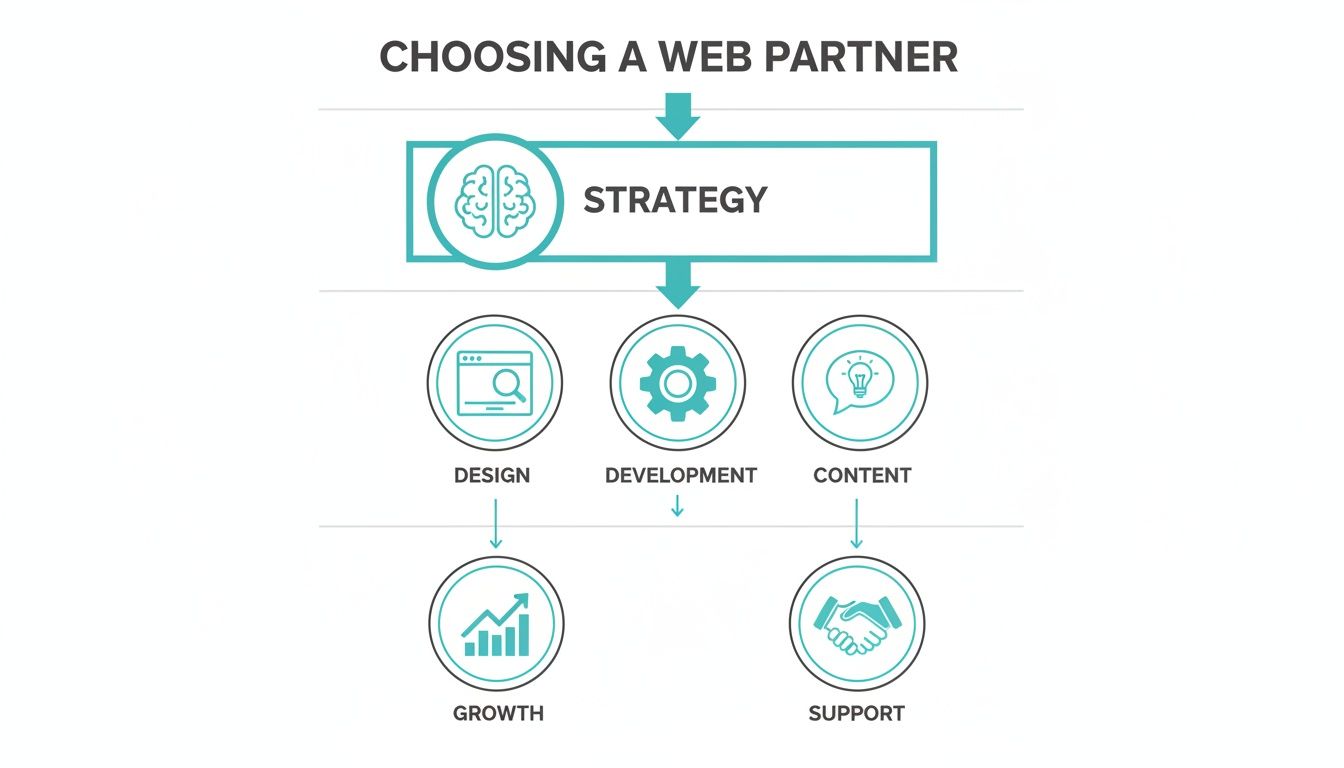
As you can see, a successful website isn’t a one-and-done project. It’s a continuous cycle where strategy shapes the design, which then fuels measurable growth.
Comparing Sydney Web Design Service Tiers
In Sydney, you'll find a whole spectrum of agencies, from solo freelancers to full-service firms. The services they offer—and the results they can deliver—often fall into a few distinct tiers. Understanding these tiers helps you match your budget and goals to the right kind of partner.
Here’s a general breakdown of what you can expect at different investment levels.
| Service Tier | Typical Services Included | Best For |
|---|---|---|
| Budget / Template-Based | Basic template customisation, limited pages, minimal strategy or copywriting. | Startups, sole traders, or businesses needing a very simple online presence quickly. |
| Mid-Range / Custom Design | Custom UI/UX design, responsive development, basic SEO setup, content management system (CMS) integration. | Established small-to-medium businesses (SMBs) needing a professional, unique site to compete effectively. |
| Premium / Growth Partnership | Full custom design & development, deep strategy, ongoing SEO, conversion rate optimisation (CRO), strategic copywriting, and post-launch support. | Ambitious businesses focused on growth, lead generation, and achieving a significant return on investment. |
Ultimately, choosing a tier isn't just about cost; it's about aligning the agency's capabilities with your business's ambitions. A premium partner costs more because they are accountable for delivering tangible results, not just a website.
To get those results, you need a partner who understands all the elements of effective website design and can weave them into a cohesive strategy.
Key growth services to look for include:
- Search Engine Optimisation (SEO): This is the art and science of getting your site to rank high on Google. An agency that builds SEO into the website from the ground up is giving you a massive head start on generating long-term, free traffic.
- Conversion Rate Optimisation (CRO): CRO is all about data. It involves analysing user behaviour and running tests to increase the percentage of visitors who take a specific action, like filling out a form or making a purchase. This service has a direct, measurable impact on your revenue.
- Strategic Copywriting: The words on your website are every bit as important as the design. Clear, persuasive, on-brand copy is what convinces a visitor to choose you over the competition. It's not just about filling space; it's about selling.
Why Your Website Is Invisible Without SEO

Imagine spending a fortune on a beautiful, state-of-the-art shopfront, only to build it in a forgotten alleyway no one ever walks down. That’s exactly what a new website without search engine optimisation (SEO) is like in Sydney's crowded digital marketplace. A stunning design is completely wasted if your customers can’t find you.
In a market as competitive as Sydney, just being online isn’t enough. You need to be visible. SEO is what gets your website to show up when people are on Google actively searching for the exact products or services you offer. It’s not an add-on or something you "bolt on" after the site is live; it needs to be baked into the very foundation of your website from day one.
A smart website design company in Sydney gets this. They don't just build pretty websites. They engineer them from the ground up to be understood, trusted, and ultimately rewarded by search engines like Google.
SEO Is More Than Just Keywords
While keywords are part of the puzzle, modern SEO is much more complex. It's deeply woven into the very structure of your site and how a visitor experiences it. A proper SEO-led design process focuses on the signals Google looks for to decide if a site is high-quality and relevant.
This all-in approach includes things like:
- Technical SEO: Making sure your site is built with clean code, loads lightning-fast, and is easy for Google’s bots to crawl and understand.
- Mobile-First Design: The majority of searches now happen on phones, so Google heavily favours sites that work perfectly on a smaller screen.
- Logical Site Architecture: Organising your content in a clear, sensible hierarchy. This makes it simple for both users and search engines to find what they need.
- High-Quality Content: Creating genuinely helpful content that answers the questions your potential customers are asking.
All these elements work together to build your website's authority over time. The end result? A steady stream of high-intent traffic—people who are already looking for a solution you provide.
The Real-World Business Impact of SEO
Thinking about SEO from the very beginning is a direct investment in the long-term health of your business. The numbers in the Sydney market tell a clear story: organic search is the single most powerful tool for finding new customers. In fact, local research shows that organic search drives over 60% of all website traffic, leaving paid ads and social media far behind.
SEO isn’t about tricking Google. It’s about working with Google to give users the best possible answers to their questions. When your website provides that value, Google rewards you with visibility.
What this really means is that a website built without a solid SEO foundation is effectively invisible to most of your potential customers. A strategic website design company in Sydney knows how to turn this from a problem into a major opportunity. They build sites that don't just attract this organic traffic but turn those visitors into leads and sales.
You can learn more about how design and SEO work hand-in-hand in our guide on building a website designed for SEO.
While your web design agency will handle your main site, remember that a strong online footprint often goes beyond just one website. For instance, optimising your video content is crucial for reaching a wider audience. Resources on topics like Youtube SEO tips can help you expand your reach. By choosing a partner who makes SEO a priority, you're not just buying a website; you're investing in a powerful, sustainable engine for generating leads for your Sydney business.
How to Evaluate an Agency's Portfolio and Case Studies
When you’re looking through an agency’s past work, it’s easy to get wowed by flashy designs and slick animations. But a truly great website design company in Sydney doesn’t just build pretty websites—they build websites that get results. Your mindset has to shift from asking, "Does this look good?" to "Did this actually work for their client?"
A solid portfolio is your first stop. You want to see a good mix of projects across different industries, proving the agency is versatile and can solve more than one type of business problem. Look for variety in function, too. Have they built e-commerce stores that actually sell, lead generation sites for tradies, and complex booking systems for professional services?
But the portfolio is just the preview. The real proof is in their case studies. This is where you separate the designers from the genuine growth partners. A proper case study should tell a story, and that story needs to be backed up by hard data.
Digging Deeper Than Design
Don't just scroll through the screenshots. Go to the live websites they’ve built. Try to use them. Is the navigation easy to figure out? Are the 'buy now' or 'contact us' buttons obvious and compelling? A site that looks amazing but is a nightmare to use is a failed investment.
A top-notch case study will always break the project down into three clear acts:
- The Problem: What specific challenge was the client actually facing? Vague statements like "they needed a new website" are a red flag. You want to see specifics, like "their bounce rate was over 80%" or "online sales had been stagnant for two years."
- The Solution: This part explains how the agency tackled the problem. It should detail their strategy, from user research and design choices to the tech they used and the SEO they implemented. It's a window into their thought process.
- The Results: This is the most important part. You’re looking for numbers, data, and key performance indicators (KPIs). The results should directly answer the problem laid out in the first step.
Quantifying Success with Real Metrics
The difference between an average portfolio and an impressive one is proof. Glowing testimonials are nice, but data is undeniable. As you review their work, you need to find evidence of real-world business impact.
A case study without data is just a story. A case study with data is proof of performance. It shows the agency gets that design is a tool to hit business goals, not just an art project.
Look for specific, measurable achievements like these:
- Lead Generation: Did they increase qualified leads by 300% for a local plumbing business?
- E-commerce Sales: Did they boost online revenue by 45% year-over-year for a retail client?
- Organic Traffic: Did their redesign and SEO work double a website’s organic traffic in six months?
- Conversion Rate: Did they lift the conversion rate from 1.2% to 3.5% with smart user experience changes?
This data-driven approach is non-negotiable in the competitive Sydney market. Local businesses consistently see the best returns when they partner with agencies that have a proven track record and high client ratings (think 4.8 stars or more). It’s all about performance. To learn more about what’s working right now, you can discover how top Sydney agencies deliver results on sitesbydesign.com.au.
At the end of the day, evaluating a portfolio means connecting the dots between design choices and business outcomes. When an agency can clearly show you how their work solved real problems and generated measurable growth, you know you’ve found a potential partner who will deliver real value.
Key Questions to Ask Before You Hire a Web Designer
That first meeting with a potential website design company in Sydney is make-or-break. It's your best shot at figuring out who’s genuinely good and who just talks a good game. If you walk in without a plan, you're setting yourself up for a very expensive lesson.
But when you show up with the right questions, the power dynamic shifts. You’re no longer just a potential client; you're a savvy business owner vetting a potential partner. The goal here isn't just to check boxes—it's to spark a real conversation that reveals how they operate, how they think, and whether they're truly invested in helping your business grow. Their answers will tell you everything.
Digging Into Their Process and Strategy
Before you even think about colours and fonts, you need to get inside their heads. A great agency doesn't just build pretty things; they build strategic tools. They should have a clear, collaborative process that’s all about getting to know your business inside and out.
Try these questions to see if they’re a strategist or just a supplier:
- How will you get to know our business, our customers, and our competition? A generic questionnaire is a lazy answer. What you want to hear about is a proper 'discovery' phase. Do they mention running workshops, mapping out customer profiles, or doing a deep dive into what your competitors are up to? That’s the sign of a team that does its homework.
- Can you walk me through your process, from our first chat to launch day? They should be able to outline a clear, step-by-step project plan without fumbling. This shows they’re organised, they know how to manage a project, and you’ll know exactly what to expect at every stage.
- How do you build SEO and conversion goals into the design from day one? This is a deal-breaker. If they say "we do SEO at the end," run. The right answer is that everything—from the site structure and user pathways to where the call-to-action buttons go—is planned with Google rankings and getting customers to act in mind.
- Who will I be dealing with day-to-day, and what's your communication rhythm? A project can fall apart without clear communication. Look for a dedicated project manager and a set schedule for updates, like a weekly check-in call. It proves they’re professional and won’t leave you in the dark.
Nailing Down the Technical Details and Ownership
The tech side can feel a bit overwhelming, but asking a few simple questions now can save you from a world of pain later. It’s absolutely essential to clarify who owns what and what happens after the site goes live.
Think of it this way: you’re not renting a website, you're building a permanent business asset. You need to be 100% certain that you will own the final website files, the code, and every bit of intellectual property once the final invoice is paid.
Make sure you get crystal-clear answers to these points:
- Once everything is paid for, who owns the website? The only acceptable answer is "you do." Any agency that tries to keep ownership or tether you to their exclusive system is a massive red flag.
- What platform will you be using to build the site? Most respected Sydney agencies use open-source platforms like WordPress. Why does this matter? It gives you the freedom to take your site to any developer in the future, so you're never held hostage.
- Do you design for mobile-first? With most of your customers finding you on their phones, this isn’t a nice-to-have; it's essential. A "mobile-first" approach means they design for the smallest screen first and then scale up. This guarantees a seamless experience for every single visitor, no matter their device.
- What's the plan for support and maintenance after we launch? A website is like a car; it needs regular servicing to stay secure and run smoothly. Ask if they offer maintenance plans and what's included—things like software updates, security scans, and backups are crucial. Knowing this upfront helps you budget properly for the site's ongoing costs.
Your Agency Vetting Checklist
To make this even easier, we've put together a checklist of questions to take into your next meeting. This is your tool to systematically evaluate any potential web design partner and ensure you're making an informed decision.
| Category | Question to Ask | Why It's Important |
|---|---|---|
| Experience & Portfolio | Can you show me 2-3 projects you've done for businesses similar to mine in Sydney? | This proves they understand your industry and local market, not just web design in general. |
| Strategy | How will this new website specifically help me achieve my business goals (e.g., more leads, online sales)? | This forces them to connect design to tangible business outcomes, moving beyond just aesthetics. |
| Process | What does your user testing and quality assurance (QA) process look like before launch? | A thorough QA process catches bugs and usability issues before your customers do. |
| Technical | Who is responsible for hosting, and do you offer performance optimisation (e.g., site speed)? | A slow website kills conversions. You need to know they prioritise speed and have a plan for reliable hosting. |
| Ownership | Will I receive training on how to use the content management system (CMS)? | You need to be able to make basic updates to your site without having to call (and pay) a developer every time. |
| Costs & Support | What is and isn't included in the quote? Are there any potential extra costs I should know about? | Transparency is key. A good partner will be upfront about all potential costs, preventing surprise bills. |
Having these questions ready will give you the confidence to lead the conversation and find a web design company in Sydney that’s a true partner, not just another expense.
Your Final Checklist Before Starting the Project
So, you’ve done the hard yards. You've sifted through portfolios, asked the tough questions, and you think you’ve found the right website design company in Sydney for you. Now it's time to get the ball rolling with total confidence.
This final stage is all about making sure every little detail is locked in before you sign anything. A strong start is the bedrock of a smooth, collaborative, and ultimately successful project. This checklist will walk you through those last crucial steps to make sure there are no nasty surprises down the track.
Taking a moment to confirm these key points isn't just about avoiding problems. It's about proactively building a partnership based on trust and clarity right from day one.
Review the Final Proposal and Contract
This document is so much more than a formality; it’s the blueprint for your entire project. Read it with a fine-tooth comb, and don't ever feel shy about asking for clarification on anything that seems a bit fuzzy. A good agency will respect your diligence.
Make sure these things are spelled out in plain English:
- A Complete List of Deliverables: The contract needs to list exactly what you’re getting. This means the number of pages, specific features like an e-commerce store or booking system, and any extras like copywriting or initial SEO work.
- Clear Timelines and Milestones: Look for a project schedule with key dates for each major phase—think design mockups, development, and the go-live date. This keeps everyone on the same page and accountable.
- Total Costs and Payment Schedule: The proposal must break down all the costs. Keep an eye out for any ongoing fees for things like hosting, maintenance, or software licences. To get a better feel for what goes into these numbers, you can learn more about the factors that determine website design cost in our detailed guide.
Establish Clear Communication Channels
Nine times out of ten, when a web design project goes off the rails, it’s down to miscommunication. To sidestep this, you have to lock in a clear and easy communication plan before a single line of code is written. This one simple step can save you countless headaches later on.
A project without a single point of contact on both sides is a project waiting for confusion. Designating one person from your team and one from the agency to be the primary communicators streamlines feedback and decision-making.
This way, vital instructions don't get lost in a long email chain, and feedback is always coming from a single, consistent source. Agree on a regular check-in, whether it's a quick weekly call or a fortnightly email update, just to keep the momentum going.
Define Your Success Metrics Upfront
How will you actually know if the new website is a success? This is a question that needs an answer before the project kicks off. Vague goals like "a better-looking site" just won't cut it. You need to agree on specific Key Performance Indicators (KPIs) that will be used to measure the project's return on investment.
These metrics should be tied directly to your business goals.
- For Lead Generation: Aim for something tangible, like "increase qualified leads through the contact form by 25% within three months of launch."
- For E-commerce: Set a clear sales target, such as "boost the online store's conversion rate from 1.5% to 2.5%."
- For Brand Awareness: Track metrics like "increase organic search traffic by 40% in the first six months."
Defining these KPIs from the get-go ensures your website design company in Sydney is focused on the same business outcomes you are. It turns the project from a simple creative exercise into a strategic investment designed for real, measurable growth. By ticking off these final items, you're not just buying a website; you're building a foundation for a great partnership.
Got Questions? We've Got Answers
When you're looking to hire a website design company in Sydney, a lot of questions pop up. It's totally normal. You're thinking about costs, how long it'll all take, and what the right technical approach is.
Let's walk through some of the most common questions we hear from Sydney businesses. Getting these sorted out upfront will help you set a realistic budget and find an agency that’s genuinely the right fit for you.
How Much Should a New Business Website Cost in Sydney?
This is the big one, isn't it? The truth is, website costs in Sydney can swing wildly depending on what you need and who you hire. Think of it like building a house – a project home is very different from an architecturally designed masterpiece.
For a sharp, professional website for a small local business, you're generally looking at a range of $5,000 to $15,000. If you're selling online and need a proper e-commerce setup with product catalogues and payment gateways, the investment typically falls between $10,000 and $40,000+. And for a completely bespoke platform with unique features, you should be prepared to invest $25,000 or more.
The key takeaway? Always ask for a detailed, itemised quote. You need to see exactly what you’re paying for to avoid any nasty surprises down the track.
What’s a Realistic Timeline for Building a Website?
The timeline is a direct reflection of the project's complexity. A straightforward, brochure-style site for a local service business can often be turned around pretty quickly, usually within 6 to 8 weeks from start to finish.
However, if you're building something more substantial, like an e-commerce store or a custom web app, it's a more involved process. These projects naturally take longer, typically somewhere between 3 and 6 months. It's also important to remember that the project's pace depends a lot on you, too – providing feedback, content, and approvals on time keeps everything moving. Any good website design company in Sydney will give you a clear project schedule with key milestones before a single line of code is written.
Should We Go for a Custom Website or Just Use a Template?
This is a classic fork in the road. A template-based website, built on platforms like Squarespace or using a pre-made theme on WordPress, is definitely the faster and cheaper option to get online. The trade-off, however, is that you're quite limited in what you can do with the design and functionality.
A custom website, on the other hand, is designed and built from scratch specifically for your business goals. It gives you total creative control, much better performance, and is built to scale as your business grows.
For any Sydney business serious about generating leads, making sales, and building a powerful brand, a custom website is almost always the smarter long-term investment.
Do We Really Need to Pay for Ongoing Website Maintenance?
Yes, 100%. One of the most common and costly mistakes is thinking of a website as a one-off project. It’s not. It's a living, breathing asset for your business, and it needs regular care to stay healthy, secure, and effective.
Ongoing maintenance is non-negotiable for a few critical reasons:
- Security: Regular software updates and security monitoring are your first line of defence against hackers and malware.
- Performance: Keeping everything updated ensures your site stays fast and responsive for your visitors. A slow site is a dead site.
- Functionality: Routine checks stop things from breaking, ensuring contact forms, payment gateways, and other features work flawlessly.
A reputable Sydney agency will offer a monthly maintenance plan to handle all this for you. It's about protecting your investment and making sure your website remains a reliable engine for your business, not a liability.
Ready to build a website that actually delivers? At Frank Digital Agency, we create high-performance websites and run Google Ads campaigns that turn clicks into customers. Get in touch today to discuss your project.