

User Experience (UX) design is all about making a product or service – like a website – genuinely easy and pleasant for people to use. Think of it as the invisible blueprint that shapes a visitor's journey, ensuring everything feels intuitive and satisfying. It’s like an architect focusing on a home's layout and flow long before deciding on the colour of the walls.
What Is User Experience Design In Simple Terms
Cast your mind back to the last time a website left you feeling completely stuck. Maybe the contact details were buried, or the checkout process was so clunky you just abandoned your cart. That feeling of frustration? That’s the direct result of a poor user experience.
On the flip side, great UX feels almost invisible. It anticipates what you need, guides you logically through each step, and makes you feel like the website just gets you. It’s not about how pretty a site looks; it’s about how it works and how it feels to use.
It’s More Than Just A Pretty Face
One of the biggest misconceptions is that UX design is just about making things look good. In truth, it's a deep, strategic discipline that focuses on the core structure and logic behind every click and scroll. For any business owner, whether you’re a local tradie or running a national e-commerce brand, this distinction is key. Good UX answers the fundamental questions that directly affect your revenue:
- Can customers easily find what they need? This could be a phone number for an emergency call-out or a specific product in your online store.
- Can they achieve their goal without hitting a roadblock? A smooth quote request form or a simple checkout process can make all the difference in securing a sale.
- Does the experience feel trustworthy? A website that is logical, professional, and works perfectly on any device builds confidence. You can learn more about this by exploring what responsive web design is and why it matters at https://frankdigital.agency/website-design/what-is-responsive-web-design/.
A Growing Business Necessity
Focusing on creating these effortless experiences is no longer just a "nice-to-have." Here in Australia, the demand for skilled UX designers has jumped by over 50% in the last five years alone. This tells you just how vital UX has become for businesses wanting to connect with Australian customers, who have come to expect fast, reliable, and mobile-friendly websites.
A great user experience doesn't just happen; it's designed. It’s the result of deeply understanding the user's needs, motivations, and pain points, then building a solution that solves their problem with elegance and efficiency.
At the end of the day, UX is a smart investment in the long-term success of your business. To continue building on this, the guide on What Is User Experience Design is a great resource that explores these core concepts further.
The Critical Difference: UX vs. UI Design
People often use the terms User Experience (UX) and User Interface (UI) interchangeably, but they represent two very different sides of the design coin. They’re deeply connected, for sure, but confusing them is a bit like confusing a building’s architectural blueprint with its final coat of paint and interior décor. Both are essential for a great result, but they are not the same job.
Simply put, UX design is all about the overall feel of the experience, while UI design is about how it looks and functions on a micro-level. UX tackles the big questions: "Does this flow make sense?" "Can people find what they need without getting frustrated?" On the other hand, UI is asking: "Is this button the right colour?" "Is this font easy to read?"
UX: The Strategic Foundation
Think of UX as the invisible architecture of your digital product. It's the deep, analytical thinking that happens long before anyone starts picking out colours. A UX designer is fundamentally a problem-solver, obsessed with the user's journey from start to finish. Their entire focus is on making that journey as logical, efficient, and painless as possible.
This isn’t just about guesswork; it’s a process rooted in research and strategy:
- User Research: This means getting out there and talking to real people. It involves interviews, surveys, and analysis to truly understand the audience’s goals, their biggest frustrations, and their existing habits.
- Information Architecture (IA): This is the art of organising content. A UX designer figures out the best way to structure your site or app so that users can navigate it intuitively, almost without thinking.
- Wireframing & Prototyping: These are the early sketches and interactive mock-ups. They’re not pretty, but they’re crucial for mapping out user flows and testing the core functionality before a single line of code is written.
A website with brilliant UX but poor UI is like a car with a perfectly engineered engine but an ugly, uncomfortable interior. It gets you where you need to go, but the ride is so unpleasant you'll never choose it again.
UI: The Visual Polish
Once the UX team has laid down that solid foundation, the UI designers step in to bring it all to life. If UX is the skeleton, UI is the skin—it's everything you can see, touch, and interact with. The goal of UI is to make the interface beautiful, engaging, and a pleasure to use.
A UI designer translates the UX blueprints and the company’s brand identity into a tangible, visual product. Their toolkit includes:
- Visual Design: Choosing the colour palettes, typography, and imagery that create a specific mood and reinforce the brand.
- Layout and Spacing: Carefully arranging every element on the screen to guide the user's eye and create a clean, balanced look.
- Interactive Elements: Designing the buttons, icons, sliders, and menus that look great and feel responsive when a user clicks or taps them.
To help clear things up, let's break it down side-by-side.
UX Design vs UI Design at a Glance
This table offers a quick snapshot of the distinct roles and responsibilities of User Experience (UX) and User Interface (UI) designers.
| Aspect | UX Design (The Blueprint) | UI Design (The Finishes) |
|---|---|---|
| Primary Focus | The user's overall journey and solving their problem. | The product's visual look, feel, and interactivity. |
| Main Goal | To make the experience logical, seamless, and useful. | To make the interface beautiful, engaging, and intuitive. |
| Key Questions | "How does the user move from A to B?" | "What does the button for B look like?" |
| Core Skills | Research, analysis, information architecture, strategy. | Graphic design, typography, colour theory, layout. |
| Typical Tools | Figma, Sketch, user interview software. | Adobe Illustrator, Figma, prototyping tools. |
| Deliverables | Personas, user journey maps, wireframes, prototypes. | Style guides, mock-ups, design systems, icon sets. |
Ultimately, a stunning website (great UI) that’s impossible to navigate (poor UX) is a failure. Users won’t stick around to admire the beautiful design if they can’t find what they’re looking for. True success comes when both disciplines work in harmony to create an experience that’s not just functional, but genuinely delightful to use.
Core Principles of High-Converting UX Design
Great UX design isn't some kind of mysterious magic. It's a practical science, really, built on a few core principles that have a direct impact on how people behave on your site. Once you get a handle on these concepts, you're well on your way to turning casual visitors into loyal customers. Think of them as your strategic checklist for building a website that actually works.
These aren't just about making things look pretty. They get to the heart of what your audience needs, ensuring every click and scroll feels logical, satisfying, and moves them closer to their goal—which, of course, helps you reach yours.
Clarity and Usability First
The absolute number one rule is clarity. If someone lands on your homepage and can't figure out what you do or where to go next in a few seconds, they're gone. It’s that simple. Clarity is all about using straightforward language, intuitive navigation, and a clean layout that naturally guides the user's eye.
Tied directly to this is usability. A usable website is one where people can achieve what they set out to do without getting frustrated. For an Adelaide plumber, that means a huge, tappable phone number right at the top of the mobile site for someone standing in a puddle. For an online store, it’s a checkout process so seamless it almost feels invisible. Strong usability is about getting rid of the roadblocks that kill conversions. You can dig deeper into the essential web design elements that improve conversion rates.
Building Trust Through Credibility and Accessibility
On the internet, credibility is everything. With every visit, people are subconsciously asking, "Can I trust this business?" A professional design, easy-to-find contact information, genuine customer reviews, and secure payment badges all send powerful signals that build confidence and make visitors feel safe.
Just as crucial is accessibility. Your website needs to be functional for everyone, including people with disabilities. This isn't just about doing the right thing; it's a massive business opportunity. A huge 53% of Australian consumers will walk away from a brand after a single poor digital experience. By designing for accessibility, you open your doors to a much wider audience, make the site better for all users, and build serious brand loyalty.
A truly high-converting website isn’t just easy to use for some people; it’s effortlessly functional for everyone. It anticipates needs, removes doubt, and makes the user feel understood and respected at every step.
At the end of the day, all these principles weave together to create a single, persuasive experience. Nailing this requires a deep understanding of your audience, which is why proper user experience testing methods are so vital for gathering real feedback. When you get these pillars right, you stop thinking of your site as just a website and start seeing it for what it is: a powerful, business-building asset.
How We Turn Clicks Into Customers
Great user experience doesn't just happen by magic. It’s a carefully planned process, a journey we take together to turn your business goals into a website that people genuinely enjoy using—and one that gets you results. It's about moving past guesswork and following a clear, proven path to build something that works.
This isn’t about just making things look pretty. It's a step-by-step framework that lines up what your business needs with what your customers actually want. The end result is a digital experience that’s built for performance from the very first click.
Step 1: Discovery and Research
Everything begins with listening and learning. Before a single design element is considered, we immerse ourselves in your world. We need to understand your business inside and out, get to know your ideal customers, and see who you're up against. We dig deep to uncover what motivates your audience, what their frustrations are, and how they behave online.
This first step is crucial. It gives us the strategic compass we need to build a website that not only connects with the right people but also carves out a unique space for you in the market.
Step 2: User Personas and Journey Mapping
Once we have that solid research, it’s time to bring your audience to life. We create detailed user personas, which are essentially character profiles of your ideal customers. These aren't just generic labels; they're rich descriptions with names, goals, needs, and pain points that help us see the world through their eyes.
Then, we map out their entire experience with your business. A customer journey map is a visual story, tracing every step a person takes, from the moment they realise they need you to the point where they become a loyal customer. This allows us to spot any roadblocks and find the perfect moments to create a smooth, intuitive experience.
Think of a well-defined user journey map as the architectural blueprint for your website. It makes sure every page and every button has a purpose, guiding users effortlessly towards their goal.
Step 3: Wireframing and Prototyping
This is where we start building the skeleton of your site. We begin with wireframes—simple, black-and-white layouts. By stripping away all the colour and imagery, we can focus entirely on structure, flow, and function. It’s all about getting the placement of key information and buttons right without any distractions.
From there, we move to interactive prototypes. These are clickable mock-ups that let you experience how the site will work before we write a single line of code. It feels like a real website, allowing us to test the navigation and user flow. Finding and fixing issues at this stage is a game-changer, saving a huge amount of time and money down the track.
Step 4: Visual Design and Development
With the blueprint locked in, our UI designers jump in to bring the site to life visually. This is where your brand’s personality—your logo, colours, and fonts—gets woven into the design to create a polished, cohesive look that builds immediate trust. Once you’ve given the design the green light, our developers get to work, turning the visuals into a fast, secure, and beautiful website that works flawlessly on any device.
Step 5: Continuous Testing and Optimisation
Launching your website isn't the finish line; it's the starting pistol. We keep a close eye on how the site is performing, using real-world data and user feedback to find opportunities for improvement. Through ongoing A/B testing and small, smart adjustments, we make sure your website keeps evolving and delivering results. This commitment to constant improvement is how we give users the best website experience for the long haul.
Practical UX Examples for Australian Businesses
Theory is great, but let's look at how this all works in the real world. Moving from abstract concepts to concrete examples really makes the value of UX design click. The core principles stay the same, but how you apply them completely depends on what your customer needs in that specific moment.
For a Local Service Business
Imagine you're a conveyancer in Adelaide. Your potential client is probably stressed, short on time, and looking for immediate, clear answers. For them, a good experience is all about simplicity and building trust, fast.
Here’s how that plays out on your website:
- Prominent Click-to-Call Buttons: When someone is on their mobile, they want to connect instantly. A big, unmissable call button right at the top of the screen removes all the friction. It turns an anxious visitor into a genuine lead in a single tap.
- Simple Quote Forms: Nothing kills a conversion faster than a long, complicated form. Smart UX design means only asking for the absolute essentials upfront. This makes the form feel quick and easy, encouraging people to actually complete it.
- Strategic Trust Signals: A glowing client testimonial or an industry award placed right next to your contact form can be the final nudge someone needs. It’s that little bit of reassurance that helps a hesitant person make an enquiry.
Getting these details right isn’t just guesswork. It's the result of a deliberate process: research, design, and then testing to see what works.
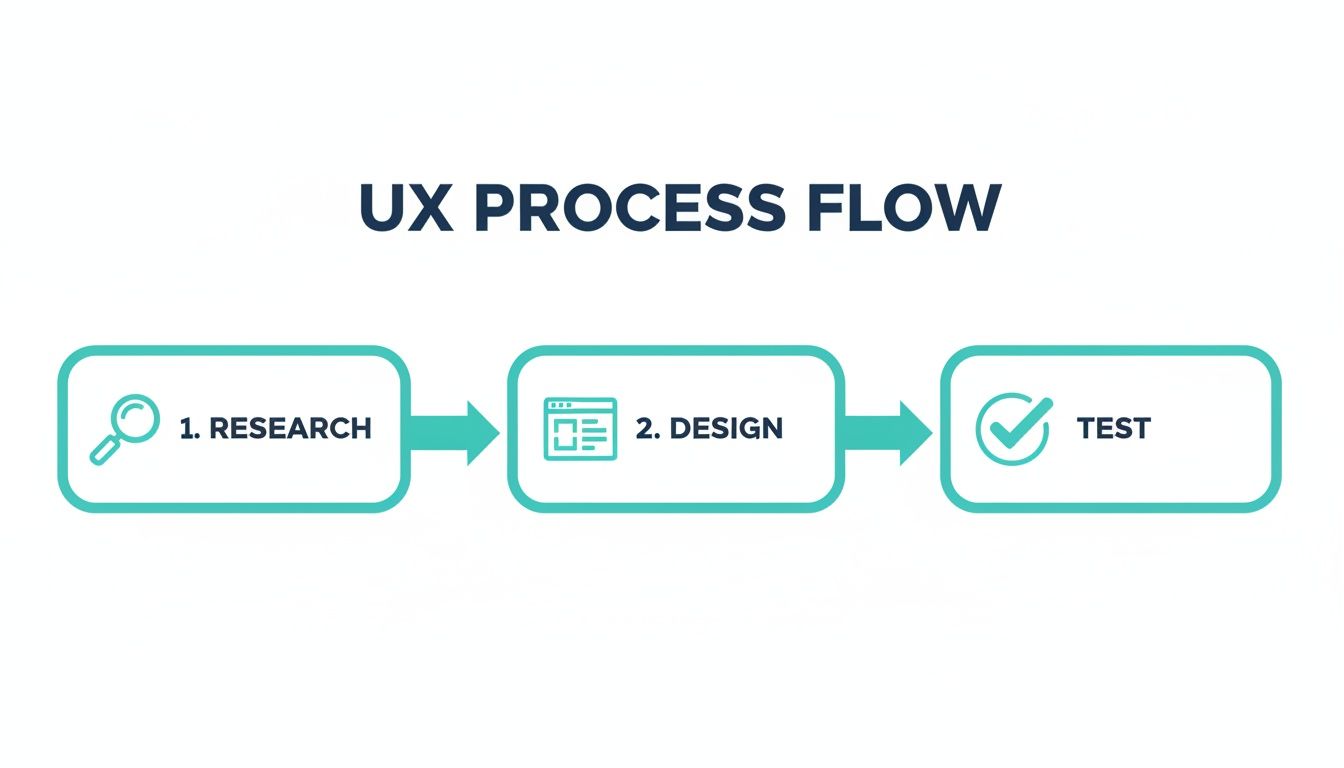
As you can see, great UX comes from a cycle of understanding users, creating solutions, and then checking back with them to make sure you got it right.
For E-commerce Success
Now, let's switch gears and think about an Australian e-commerce brand selling health products online. The customer’s goal here is totally different. They're browsing, comparing products, and trying to find the perfect item. In this scenario, UX is all about effortless discovery and a seamless path to purchase.
For an online store, every click is a potential point of frustration or a step closer to a sale. Effective UX design systematically removes the barriers that cause cart abandonment and builds the confidence needed to complete a purchase.
Key UX elements for any online store include:
- Intuitive Product Filters: When you have a large catalogue, you have to help customers narrow it down. Well-designed filters—letting people sort by price, ingredient, or health goal—are crucial for making product discovery feel effortless instead of overwhelming.
- A Seamless Checkout Process: A clunky, multi-page checkout is a notorious sales killer. Offering a one-page checkout with a guest option and multiple payment methods can dramatically reduce how many shoppers give up and abandon their carts.
- Clear Shipping Information: Nobody likes surprises when it comes to shipping costs. Displaying estimated delivery times and costs right from the start builds trust and manages expectations—both vital for keeping customers happy and encouraging them to come back.
This focus is more important than ever as Australia's e-commerce market continues to boom. The sector is projected to hit US$37.10 billion in 2024 and is on track to grow to US$58.03 billion by 2029. With nearly 85% of the population expected to be online shoppers, conversion-focused UX isn’t just a nice-to-have; it's essential for capturing your slice of this market. You can read more about Australia's e-commerce market trends to see the full picture.
Whether you're trying to generate local leads or drive national online sales, these examples show that understanding what is user experience design really just means understanding your customer's journey and doing everything you can to make it as smooth as possible.
When to Hire a Professional UX Design Agency
Do-it-yourself website builders and off-the-shelf templates are fantastic for getting a business online. But they have their limits. Sooner or later, a generic solution starts costing you more in lost sales and frustrated customers than you're saving on design costs. Knowing when you’ve hit that ceiling is the key to unlocking your real online potential.
So, how do you know when it’s time to call in the professionals? The data will usually tell the story for you. If your website analytics reveal stubbornly high bounce rates, dismal conversion numbers, or a mass exodus of users at the checkout page, you have a problem. These aren't just numbers; they're clear signals that your user experience is holding your business back.
Recognising the Warning Signs
Think of these metrics as symptoms of a much deeper issue. Your website isn't just a digital brochure; it's meant to be your hardest-working employee, generating leads and driving sales 24/7. When it’s failing at that core job, it's time for an expert diagnosis.
Some of the most common triggers we see include:
- Direct customer feedback that the site is confusing, clunky, or just plain hard to use.
- Poor engagement on critical pages. Are people visiting your service pages but never filling out the contact form?
- Your growth has flatlined even though your marketing is successfully driving traffic to the site.
A professional UX agency does more than just give your website a facelift. They dig into your data and user behaviour to solve these fundamental business problems, moving you from guesswork to a proven strategy that works.
Investing in expert UX is also a must-do before you pour money into a major marketing campaign or prepare to scale up your operations. Trying to build a bigger business on a shaky digital foundation is a recipe for wasted ad spend and missed opportunities.
At Frank Digital, this is what we do best. We turn underperforming websites into powerful, high-converting platforms. By focusing on what user experience design truly is—solving user problems to meet business goals—we create digital experiences that deliver measurable growth and a genuine return on your investment.
Got Questions About UX Design? Let's Talk specifics.
As a business owner, you're probably wondering what all this UX talk means for your bottom line. It's a fair question. Let's tackle a few of the most common queries we hear from clients to help you see how UX fits into your real-world growth strategy.
What's the Real Cost of Professional UX Design?
Look, there’s no one-size-fits-all price tag. A simple UX audit on your existing site could be a few thousand dollars, while building a complex e-commerce platform from the ground up is a much bigger undertaking.
But here’s a better way to think about it: UX design isn’t a cost; it’s an investment. A smart one. Getting your user experience right can boost conversion rates by an incredible 400%. So, that initial outlay often pays for itself many, many times over by turning more visitors into paying customers.
How Long Does This Whole UX Process Take?
For a typical website for a small or medium-sized business, you're generally looking at a 4 to 12-week process. That timeline covers the full journey—from digging into initial research and mapping out a strategy to wireframing, prototyping, final design, and testing.
It might sound like a long time, but this crucial upfront work is what saves you from expensive, frustrating redesigns down the road. It ensures your site is built to perform right out of the gate.
The most expensive website is the one that doesn't work. Investing time in a proper UX process ensures your digital asset is built on a solid, data-driven foundation, saving you money and frustration down the track.
Can't I Just Use a Website Template and Be Done With It?
Website templates can be a decent starting point, sure. They give you a visual shell. But a template has no idea who your customers are, what your business goals are, or what makes people trust your brand specifically.
Professional UX design goes much deeper. It builds a solution tailored to guide your ideal customer from the moment they land on your site to the moment they convert. This bespoke approach is what transforms a generic, off-the-shelf website into a genuine business-generating machine.
Ready to transform your website from a simple online brochure into your hardest-working sales tool? Frank Digital Agency builds high-performing websites with conversion-focused UX at their core. Let's create a digital experience that turns your clicks into customers. https://frankdigital.agency